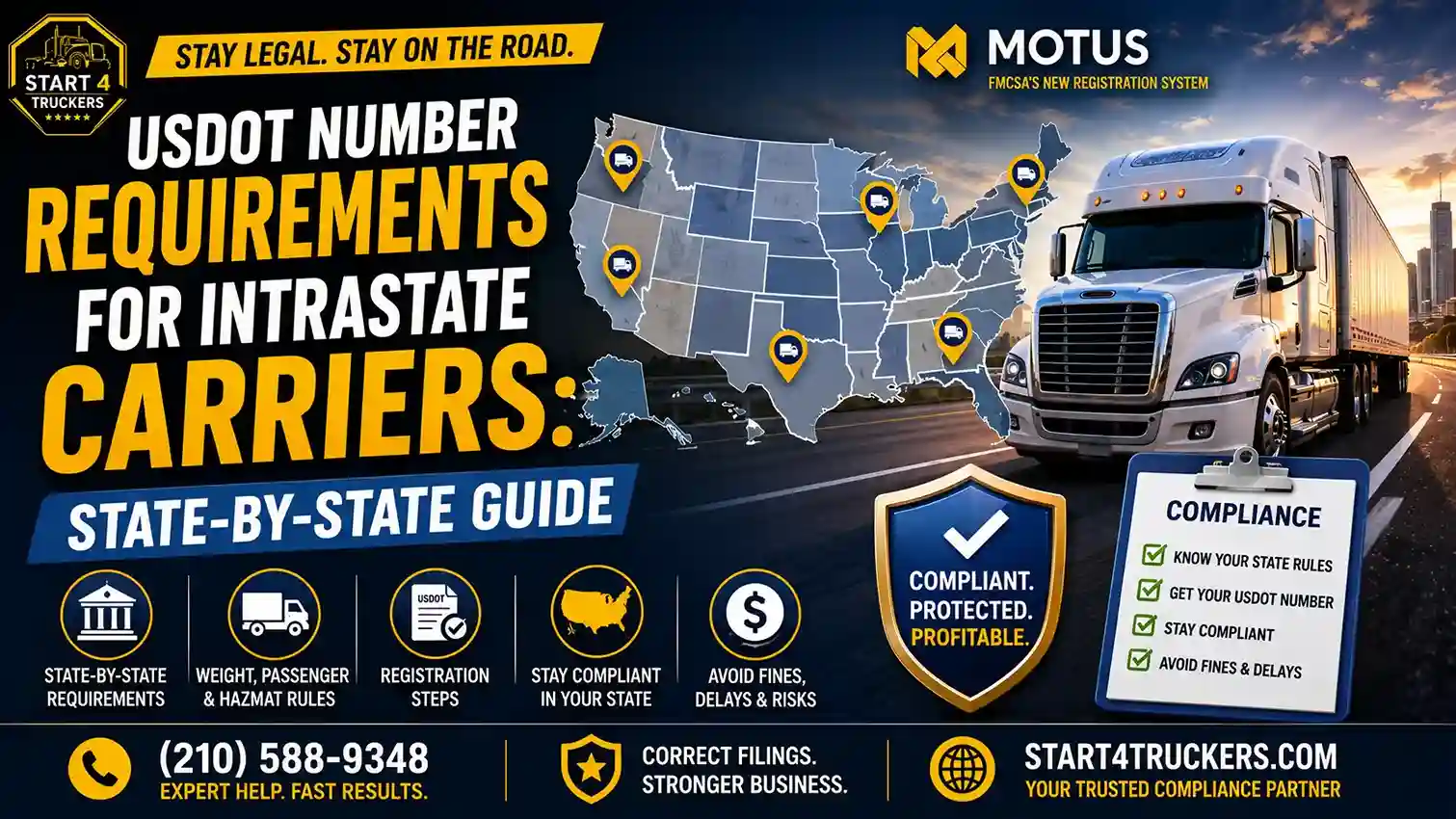
An intrastate carrier is a trucking business that only operates within one state’s borders. Not every intrastate carrier automatically needs a USDOT Number, because these rules come from your state, not just the federal government. Most states require a USDOT Number once your vehicle passes a certain weight, carries passengers, or hauls hazardous materials, but the exact triggers vary. The Federal Motor Carrier Safety Administration (FMCSA) sets the national framework, while each state’s own transportation or public safety agency decides how it applies at the intrastate level. This guide walks you through what to check, state by state, so you can register the first time correctly.
Last updated: July 2026. Trucking regulations can change, so always verify current requirements with your state’s transportation agency before you operate.
Getting your registration wrong isn’t just a paperwork headache. It can mean fines, a truck pulled out of service, or delays that cost you real freight. Let’s walk through exactly what intrastate carriers need to know.
What Are USDOT Number Requirements for Intrastate Carriers?
USDOT Number requirements for intrastate carriers are the rules that decide whether a trucking business operating only inside one state must register with a USDOT Number. These rules combine federal safety definitions with each state’s own transportation laws.
What Is a USDOT Number?
A USDOT Number is a unique ID issued by FMCSA that identifies a commercial vehicle operator. It helps track safety records, inspections, and compliance history for that carrier.
If you’re not sure how to check an existing number, our guide on how to look up a USDOT number walks through the process step by step.
What Is an Intrastate Carrier?
An intrastate carrier only hauls freight or passengers within the borders of one state. They never cross state lines while carrying cargo.
This is different from an interstate carrier, which regularly crosses state borders as part of normal business operations.
Intrastate vs Interstate Trucking
Interstate trucking almost always requires federal USDOT registration once a vehicle meets FMCSA’s weight or use thresholds. Intrastate trucking is regulated primarily at the state level, which is why requirements can look completely different depending on where you operate.
For a full breakdown of these two categories, see our guide on interstate vs intrastate trucking authority.
Why States Have Different USDOT Rules
Each state has its own transportation code, safety agency, and enforcement priorities. Some states adopt the federal thresholds directly for intrastate purposes, while others set their own weight limits or add extra permit requirements.
This is exactly why a “one-size-fits-all” answer doesn’t exist for intrastate USDOT registration.
Who Regulates Intrastate Carriers?
Intrastate carriers are typically regulated by a state Department of Transportation, Department of Public Safety, Highway Patrol, or Public Utilities Commission, depending on the state. FMCSA still plays a role by setting the national safety framework these agencies often build from.
Do Intrastate Carriers Need a USDOT Number?
Many intrastate carriers do need a USDOT Number, but it depends on your state and your vehicle. Most states require registration once a commercial vehicle crosses a certain weight threshold, hauls hazardous materials, or carries a certain number of passengers, even if the business never leaves the state.
If your vehicle qualifies as a commercial motor vehicle (CMV) under your state’s definition, you likely need a USDOT Number, even for local, in-state hauling.
When a USDOT Number Is Required
Generally, a USDOT Number becomes necessary when your vehicle:
- Meets or exceeds your state’s weight threshold for a CMV
- Transports hazardous materials requiring placarding
- Carries a certain number of passengers for compensation
- Is used to transport property or passengers as part of a business
When It May Not Be Required
Some smaller vehicles, personal-use vehicles, or specific exempt categories, like certain farm vehicles, may fall outside your state’s registration requirement. Exemptions vary widely, so this should always be confirmed directly with your state agency.
Federal vs State Requirements
Federal law sets clear rules for interstate commerce. For intrastate operations, states have the authority to set their own thresholds, which is why the same truck might need registration in one state and not in another.
Common Misconceptions About Intrastate Registration
A lot of new carriers assume that staying within one state means no registration is ever required. That assumption causes real compliance problems. Local-only operation does not automatically mean no rules apply.
Not sure where your business stands? Call Start4Truckers LLC at (210) 588-9348, and we’ll help you figure out exactly what your state requires.
How States Decide Whether You Need a USDOT Number
States generally look at your vehicle’s Gross Vehicle Weight Rating (GVWR), Gross Combination Weight Rating (GCWR), passenger capacity, and hazardous materials cargo to decide whether USDOT registration applies to your intrastate operation.
Gross Vehicle Weight Rating (GVWR)
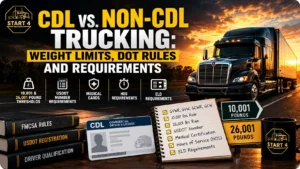
GVWR is the maximum operating weight of a single vehicle, as set by the manufacturer. Many states use a GVWR of 10,001 pounds or more as a starting point for defining a commercial motor vehicle, mirroring the federal definition used for interstate commerce.
Gross Combination Weight Rating (GCWR)
GCWR covers the combined weight of a power unit and any attached trailer. States often apply similar thresholds here as they do for GVWR when deciding if a combination vehicle counts as commercial.
Passenger Carrier Rules
States frequently apply lower vehicle thresholds for passenger transport. Vehicles designed to carry a certain number of passengers for compensation, such as shuttle vans or small buses, may need registration even if their weight is below typical freight thresholds.
Hazardous Materials (HazMat)
If a vehicle transports hazardous materials in a quantity requiring placarding, most states require USDOT registration regardless of the vehicle’s weight. HazMat rules tend to be some of the strictest across all states.
Commercial Motor Vehicle (CMV) Definitions
Each state legally defines what counts as a CMV. This definition is the backbone of whether your specific truck, van, or trailer needs a USDOT Number for intrastate use.
State-Specific Safety Regulations
Beyond weight and cargo type, some states layer on additional safety inspection rules, permit requirements, or local operating restrictions that go beyond the federal baseline.
State-by-State USDOT Number Requirements for Intrastate Carriers
Most states use a commercial motor vehicle definition close to the federal 10,001-pound GVWR/GCWR threshold as their starting point for intrastate USDOT registration, then layer on their own rules for passengers, hazardous materials, and specific vehicle categories. Because these details can change, always confirm current thresholds directly with your state’s regulating agency.
The table below is a general reference to help you understand which agency handles intrastate trucking in each state and what to check first. It is not a substitute for verifying exact, current thresholds with that agency.
| State | Typical Regulating Agency | What to Check First |
| Alabama | Alabama Department of Revenue / Public Service Commission | CMV weight threshold, motor carrier registration rules |
| Alaska | Alaska DOT & Public Facilities | Weight threshold, remote-operation permit rules |
| Arizona | Arizona Department of Transportation (ADOT) | GVWR threshold, intrastate permit requirements |
| Arkansas | Arkansas Highway Police / Arkansas DOT | CMV definition, HazMat rules |
| California | California Department of Motor Vehicles (DMV) / CHP | Weight threshold, CA-specific motor carrier permit (MCP) |
| Colorado | Colorado DOT / Colorado State Patrol | CMV weight threshold, safety compliance rules |
| Connecticut | Connecticut DOT | Weight threshold, intrastate registration process |
| Delaware | Delaware DOT / DMV | CMV definition, registration requirements |
| Florida | Florida DHSMV / FDOT | Weight threshold, Florida-specific trucking rules |
| Georgia | Georgia DOT / Department of Public Safety | CMV weight threshold, intrastate permit rules |
| Hawaii | Hawaii DOT | Weight threshold, island-specific operating rules |
| Idaho | Idaho Transportation Department | CMV definition, safety compliance |
| Illinois | Illinois DOT / Illinois State Police | Weight threshold, intrastate registration process |
| Indiana | Indiana DOT | CMV weight threshold, safety rules |
| Iowa | Iowa DOT | Weight threshold, motor carrier registration |
| Kansas | Kansas Corporation Commission | CMV definition, intrastate permit rules |
| Kentucky | Kentucky Transportation Cabinet | Weight threshold, safety compliance |
| Louisiana | Louisiana DOTD / Public Service Commission | CMV definition, HazMat rules |
| Maine | Maine DOT | Weight threshold, registration process |
| Maryland | Maryland DOT / MVA | CMV weight threshold, safety rules |
| Massachusetts | Massachusetts DOT (MassDOT) | Weight threshold, intrastate rules |
| Michigan | Michigan DOT / Michigan State Police | CMV definition, safety compliance |
| Minnesota | Minnesota DOT | * |
| Mississippi | Mississippi DOT / Public Service Commission | CMV definition, HazMat rules |
| Missouri | Missouri DOT / Missouri Highway Patrol | Weight threshold, safety compliance |
| Montana | Montana DOT | CMV definition, registration process |
| Nebraska | Nebraska DOT | Weight threshold, intrastate permit rules |
| Nevada | Nevada DOT / DMV | CMV weight threshold, safety rules |
| New Hampshire | New Hampshire DOT | Weight threshold, registration process |
| New Jersey | New Jersey MVC | CMV definition, safety compliance |
| New Mexico | New Mexico DOT | Weight threshold, intrastate permit rules |
| New York | New York State DOT / DMV | CMV weight threshold, state-specific rules |
| North Carolina | North Carolina DOT | Weight threshold, safety compliance |
| North Dakota | North Dakota DOT | CMV definition, registration process |
| Ohio | Ohio DOT / Public Utilities Commission of Ohio (PUCO) | Weight threshold, intrastate permit rules |
| Oklahoma | Oklahoma DOT / Corporation Commission | CMV weight threshold, safety rules |
| Oregon | Oregon DOT (ODOT) | Weight threshold, weight-mile tax rules |
| Pennsylvania | Pennsylvania DOT (PennDOT) | CMV definition, state-specific rules |
| Rhode Island | Rhode Island DOT | Weight threshold, registration process |
| South Carolina | South Carolina DOT / DMV | CMV weight threshold, safety compliance |
| South Dakota | South Dakota DOT | Weight threshold, registration process |
| Tennessee | Tennessee DOT / Highway Patrol | CMV definition, safety rules |
| Texas | Texas DMV / Texas DPS | Weight threshold, state-specific rules |
| Utah | Utah DOT | CMV weight threshold, safety compliance |
| Vermont | Vermont DMV | Weight threshold, registration process |
| Virginia | Virginia DMV | CMV definition, safety rules |
| Washington | Washington State DOT / Utilities and Transportation Commission | Weight threshold, intrastate permit rules |
| West Virginia | West Virginia DOT / DMV | CMV weight threshold, safety compliance |
| Wisconsin | Wisconsin DOT | Weight threshold, registration process |
| Wyoming | Wyoming DOT | CMV definition, safety rules |
Northeast States
States like New York, Pennsylvania, New Jersey, and Massachusetts tend to have dense trucking activity and correspondingly detailed registration processes. Expect stricter enforcement in high-traffic corridors.
Southeast States
Florida, Georgia, North Carolina, and South Carolina see high freight volume and generally align closely with federal thresholds, but each still runs its own registration and safety compliance programs.
Midwest States
Illinois, Ohio, Michigan, and Indiana carry heavy regional freight traffic. Many use standard CMV weight definitions but maintain active state-level enforcement.
Southwest States
Texas, Arizona, New Mexico, and Oklahoma cover large intrastate distances, so weight and safety rules matter even for local-only routes.
Western States
California, Oregon, Washington, and Nevada often have some of the more detailed intrastate permit systems in the country, particularly California’s separate motor carrier permit process.
States With the Strictest Intrastate USDOT Number Requirements
California, Texas, Florida, New York, and Illinois are generally considered to have more detailed intrastate compliance systems due to high freight volume, dense populations, and additional state-specific permits layered on top of federal rules.
California
California requires a separate Motor Carrier Permit (MCP) in addition to standard registration for many intrastate carriers, along with strict CHP inspection enforcement.
Texas
Texas has a large intrastate trucking industry and applies detailed registration and safety compliance rules through the Texas DMV and Texas DPS.
Florida
Florida sees heavy intrastate freight traffic and enforces its own registration and safety rules. Our guide on Florida trucking regulations breaks this down further, along with our post on how to get a DOT number in Florida.
New York
New York applies detailed CMV definitions and safety inspection rules, particularly in and around dense metro areas.
Illinois
Illinois maintains active enforcement through the Illinois DOT and Illinois State Police, especially along major interstate freight corridors that also carry heavy intrastate traffic.
States With Fewer Intrastate Registration Requirements
Some lower-population or lower freight-volume states apply lighter intrastate compliance layers, relying more closely on federal baseline definitions without as many extra state-specific permits. This does not mean no rules apply. It only means the compliance process may involve fewer additional steps.
Even in these states, weight thresholds, HazMat rules, and passenger carrier requirements can still apply. Always confirm directly with the state agency listed in the table above before assuming your vehicle is exempt.
Operating in a state you’re unsure about? Start4Truckers LLC can help confirm your requirements. Call (210) 588-9348 today.
Commercial Vehicles That Usually Need a USDOT Number
Heavy trucks, box trucks, dump trucks, passenger vehicles above a certain capacity, HazMat-carrying vehicles, and large pickup trucks used commercially usually require a USDOT Number once they meet their state’s weight or use thresholds.
Heavy Trucks
Tractor-trailers and other heavy-duty trucks almost always exceed standard weight thresholds and require registration.
Box Trucks
Box trucks used for commercial delivery frequently cross the GVWR threshold that triggers USDOT registration requirements.
Dump Trucks
Dump trucks used in construction or hauling materials commercially typically fall under CMV definitions due to their weight.
Passenger Vehicles
Vans or small buses transporting a set number of passengers for compensation often require registration, even at lower weights than freight vehicles.
HazMat Vehicles
Any vehicle transporting placarded hazardous materials generally needs a USDOT Number, regardless of weight.
Large Pickup Trucks
Heavy-duty pickup trucks pulling trailers for commercial use can cross the GCWR threshold, especially when hauling equipment or goods for a business.
Vehicles That May Be Exempt From USDOT Registration
Some vehicle categories, including certain farm vehicles, government vehicles, recreational vehicles, and emergency vehicles, may be exempt from USDOT registration requirements. Exemptions vary by state, so confirmation with your specific state agency is essential.
Farm Vehicles
Many states offer exemptions for vehicles used exclusively for farming operations, though rules on mileage radius and vehicle type can differ.
Government Vehicles
Vehicles owned and operated by government agencies are often exempt from standard commercial registration requirements.
Recreational Vehicles
Personal-use recreational vehicles are typically not considered commercial motor vehicles and fall outside registration requirements.
Emergency Vehicles
Fire trucks, ambulances, and similar emergency vehicles are generally exempt from standard USDOT registration rules.
Certain Local Operations
Some states offer narrow exemptions for very limited local operations, but these are usually specific and should never be assumed without direct confirmation.
Do Owner-Operators Need a USDOT Number for Intrastate Trucking?
Yes, in most cases. If an owner-operator’s vehicle meets their state’s commercial motor vehicle definition, they need a USDOT Number even if they only operate within their home state.
One-Truck Businesses
A single-truck intrastate business is treated the same as a larger fleet when it comes to meeting weight and safety thresholds. Business size does not exempt you from registration.
Independent Contractors
Independent contractors hauling freight commercially within one state generally follow the same registration rules as any other intrastate carrier.
Small Fleets
Small fleets with two or three trucks face the same state-by-state evaluation as single-truck operators, just multiplied across each vehicle.
Local Delivery Companies
Local delivery businesses using qualifying commercial vehicles are subject to the same intrastate rules, even if every delivery stays within city or county lines.
For a broader look at getting started the right way, see our guide on how to start a trucking company and our comparison of owner-operator vs company driver.
How to Get a USDOT Number for Intrastate Carriers
To get a USDOT Number for intrastate operations, confirm your state’s specific requirements, gather your business information, complete registration through FMCSA and your state if required, meet any additional state compliance steps, and keep your registration updated going forward.
Step 1: Confirm Your State’s Requirements
Start by checking your state’s regulating agency, listed earlier in this guide, to confirm whether your vehicle triggers a registration requirement.
Step 2 – Gather Business Information
You’ll need your legal business name, address, vehicle information, and Employer Identification Number (Tax id) before registering.
Step 3: Complete USDOT Registration
Registration is completed through FMCSA’s system. If you need a refresher on this process, our guide on how to apply for a new USDOT number covers it step by step.
Step 4: Meet State Compliance Requirements
Some states require additional permits or registrations beyond the federal USDOT Number, so check with your state agency to complete every required step.
Step 5: Keep Your Registration Updated
Your registration needs regular updates through the MCS-150 biennial update process to stay current and avoid deactivation.
Want help getting registered the first time correctly? Call Start4Truckers LLC at (210) 588-9348 or explore our USDOT registration service.
Does an Intrastate Carrier Also Need an MC Number?
Usually not. MC Authority is generally required for carriers that transport regulated freight across state lines for compensation. Most intrastate-only carriers do not need MC Authority, though some exceptions exist depending on cargo type and state rules.
Difference Between USDOT and MC Number
A USDOT Number identifies your business for safety tracking. An MC Number grants operating authority for interstate for-hire transportation. Our guide on DOT number vs MC number explains this difference in more detail.
When MC Authority Is Required
If your intrastate carrier ever expands into hauling freight across state lines for compensation, you’ll likely need to apply for MC Authority at that point.
Common Registration Mistakes
A common mistake is assuming a USDOT Number automatically grants operating authority for interstate hauls. These are two separate registrations serving two separate purposes.
Other Compliance Requirements for Intrastate Carriers
Beyond a USDOT Number, intrastate carriers may still need to handle MCS-150 updates, UCR registration, BOC-3 filings, drug and alcohol consortium enrollment, IRP/IFTA registration when applicable, and periodic safety audits.
MCS-150 Updates
All registered carriers must keep their MCS-150 information updated every two years, even if operations haven’t changed.
UCR Registration
Depending on your fleet size and operations, you may need Unified Carrier Registration (UCR), which applies to many interstate and some intrastate carriers depending on state participation rules.
BOC-3 Filing
Carriers operating under certain authority types may need a BOC-3 filing to designate process agents.
Drug & Alcohol Consortium
Carriers operating commercial motor vehicles requiring a CDL generally need to participate in a drug and alcohol consortium program.
IRP and IFTA (When Applicable)
If your intrastate operation later expands across state lines, you may need International Registration Plan (IRP) and International Fuel Tax Agreement (IFTA) registration, though these typically apply to interstate operations.
Safety Audits
New carriers, including intrastate carriers in some states, may be subject to a safety audit shortly after registering to confirm compliance with safety standards.
Common Mistakes Intrastate Carriers Make
The most common mistakes include assuming every state has the same rules, ignoring weight thresholds, registering late, operating without required registration, forgetting biennial MCS-150 updates, and missing state-specific permits.
Assuming Every State Has the Same Rules
This is the single biggest mistake. What applies in one state may not apply in another, even for the same truck.
Ignoring Weight Thresholds
Some carriers assume weight only matters for interstate trucking. Many states apply their own weight-based CMV definitions to intrastate operations too.
Registering Late
Waiting too long to register can delay your ability to legally operate and haul freight.
Operating Without Required Registration
Operating a qualifying vehicle without a required USDOT Number can lead to fines and vehicle out-of-service orders.
Forgetting Biennial MCS-150 Updates
Missing your update window can result in your USDOT Number being deactivated, even if your business is still active.
Missing State-Specific Permits
Some states require additional permits beyond the USDOT Number itself. Skipping these can create compliance gaps even if your federal registration is correct.
Penalties for Operating Without a Required USDOT Number
Operating without a required USDOT Number can result in fines, vehicle out-of-service orders, delayed operations, insurance complications, and broader compliance violations that follow your business record.
Fines
States can issue fines for operating a qualifying commercial vehicle without required registration.
Vehicle Out-of-Service Orders
Roadside inspections can result in a vehicle being placed out of service until proper registration is completed.
Delayed Operations
An out-of-service order means lost freight time, missed deliveries, and real revenue loss.
Insurance Issues
Operating without required registration can complicate insurance claims if an accident occurs during unregistered operation.
Compliance Violations
Violations can follow your business safety record, affecting future audits, insurance rates, and operating reputation.
State-by-State Compliance Checklist
Use this checklist as your starting point for intrastate compliance:
- Determine your operating state and its regulating agency
- Check your state’s weight thresholds for CMV status
- Determine if your vehicle qualifies as a CMV
- Review HazMat rules for your cargo type
- Review passenger carrier rules if applicable
- Register for a USDOT Number if required
- Complete any additional state-specific permits
- Update your MCS-150 on schedule
- Maintain accurate safety records
Decision Tree: Do You Need a USDOT Number?
Walk through these questions to get a general sense of where you stand:
- Do you operate only within one state? If yes, continue below. If no, you likely need interstate registration regardless of the following questions.
- Is your vehicle above your state’s applicable weight threshold? If yes, registration is likely required.
- Do you transport passengers for compensation? If yes, check your state’s passenger carrier threshold, which may be lower than freight thresholds.
- Do you haul hazardous materials requiring placarding? If yes, registration is almost always required regardless of weight.
- Does your state require intrastate registration for your vehicle type? Confirm directly with your state agency.
Result:
- Yes to any of the above → Register for a USDOT Number.
- Unsure or answered no to all → Verify your state’s specific exemptions before assuming registration isn’t required.
Still not sure where you land on this checklist? Start4Truckers LLC can walk through it with you. Call (210) 588-9348 now.
How Start4Truckers LLC Helps Intrastate Carriers Stay Compliant
Figuring out state-by-state intrastate rules on your own takes time you probably don’t have. Start4Truckers LLC helps trucking businesses of every size handle:
- USDOT Registration
- MC Authority Registration
- MCS-150 Filing
- UCR Registration
- BOC-3 Filing
- Ongoing FMCSA compliance support
- Full trucking company formation
Whether you’re a solo owner-operator or running a small fleet, our team helps you register correctly and stay compliant as your business grows. Explore our trucking company setup services or compare our plans and pricing to find the right fit.
Call Start4Truckers LLC today at (210) 588-9348 or reach out through our contact page to get your intrastate registration handled the right way.
Final Thoughts
Intrastate trucking rules are not the same from state to state, and assuming federal rules are the only thing that matters is one of the most common and costly mistakes new carriers make. Weight thresholds, passenger rules, HazMat requirements, and state-specific permits all shape whether you need a USDOT Number, even if you never leave your home state.
Verifying your state’s exact requirements before you operate protects your business from fines, out-of-service orders, and unnecessary delays. Staying compliant isn’t just a box to check. It keeps your freight moving and your business running.
If you want expert help getting registered correctly, no matter which state you operate in, Start4Truckers LLC is here to help. Call us at (210) 588-9348 or visit our contact page to get started today.
Frequently Asked Questions
1. Do intrastate carriers need a USDOT number?
Many do. If your commercial vehicle meets your state’s weight, passenger, or hazardous materials thresholds, you likely need a USDOT Number even if you only operate within your home state. Requirements vary by state, so always confirm directly with your state’s regulating agency.
2. Which states require a USDOT number for intrastate trucking?
Most states require registration for qualifying commercial vehicles, though the exact thresholds and additional permit requirements differ. States like California, Texas, Florida, New York, and Illinois tend to have more detailed intrastate compliance systems.
3. What is the difference between interstate and intrastate trucking?
Interstate trucking involves crossing state lines as part of regular operations and is primarily regulated by federal rules. Intrastate trucking stays within one state and is primarily regulated by that state’s own transportation laws, layered on top of federal safety definitions.
4. What vehicle weight requires a USDOT number?
Many states use a Gross Vehicle Weight Rating (GVWR) or Gross Combination Weight Rating (GCWR) of 10,001 pounds or more as a starting threshold, similar to the federal definition. Some states apply different thresholds, so confirm with your specific state agency.
5. Do pickup trucks need a USDOT number for commercial use?
It depends on weight and use. A heavy-duty pickup truck pulling a trailer for commercial purposes can cross the GCWR threshold that triggers registration, especially if it’s regularly used to haul equipment or goods for a business.
6. Do owner-operators need a USDOT number for intrastate trucking?
Yes, in most cases. Business size does not exempt an owner-operator from registration if their vehicle meets the state’s commercial motor vehicle definition, even for local-only routes.
7. Do intrastate carriers also need an MC Number?
Usually not. MC Authority generally applies to for-hire carriers transporting regulated freight across state lines. Most intrastate-only carriers do not need MC Authority unless their operations expand into interstate hauls.
8. How do I apply for a USDOT number for intrastate operations?
You confirm your state’s specific requirements, gather your business and vehicle information, complete registration through FMCSA, and meet any additional state-specific compliance steps required by your regulating agency.
9. Are farm vehicles exempt from USDOT registration?
Many states offer exemptions for vehicles used exclusively for farming operations, but the specific rules around mileage radius and vehicle type vary. Always verify farm vehicle exemptions directly with your state.
10. What happens if I operate without a required USDOT number?
You risk fines, vehicle out-of-service orders, delayed freight operations, complications with insurance claims, and compliance violations that can affect your business’s safety record long-term.
11. How often do I need to update my USDOT registration?
Most carriers must update their MCS-150 information every two years through the biennial update process, even if nothing about their operations has changed.
12. Which state agency regulates intrastate trucking in my state?
This varies by state and can include a Department of Transportation, Department of Public Safety, Highway Patrol, or Public Utilities Commission. Check the state-by-state table in this guide for a general starting point, then confirm directly with that agency.
13. Does hauling hazardous materials require a USDOT number?
In most cases, yes. Vehicles transporting hazardous materials that require placarding generally need a USDOT Number regardless of vehicle weight or whether operations stay within one state.
14. Can I use one USDOT number in multiple states?
Yes, your USDOT Number is a federal identifier that stays with your business across states. However, some states may still require additional intrastate permits on top of your USDOT Number.
15. How can I verify my state’s intrastate trucking requirements?
The most reliable way is to contact your state’s Department of Transportation, Department of Public Safety, or equivalent regulating agency directly, since these rules can change and vary by vehicle type and cargo.