If you are an interstate carrier, owner-operator, broker, or fleet operator, UCR Registration 2027 is not optional. It is a federal compliance requirement, and skipping it can get your truck placed out of service at the very next weigh station.
The Unified Carrier Registration Plan, overseen by the Federal Motor Carrier Safety Administration (FMCSA) and the U.S. Department of Transportation, requires all qualifying carriers to register and pay an annual fee. This fee funds state-level highway safety and enforcement programs.
For 2027, registration opened in late 2026. If you have not filed yet, you are already behind, and penalties can reach $5,000 or more. This guide covers everything: who must file, how much it costs, how to complete registration step by step, and how to avoid the most common mistakes truckers make every year.
What is UCR Registration 2027?
UCR Registration 2027 is the annual filing process under the Unified Carrier Registration system. It requires interstate motor carriers, brokers, freight forwarders, and leasing companies to register with a participating state and pay a fee based on fleet size.
The UCR system replaced the older Single State Registration System (SSRS). It applies across 41 participating U.S. states.
Not sure where to start? Explore Start4Truckers LLC’s compliance services and get your UCR filed correctly the first time.
Legal Background: The UCR Act of 2005
Congress established the UCR program through the Unified Carrier Registration Act of 2005. The law was designed to create a unified, simplified system for carrier registration across state lines, replacing a patchwork of individual state filings that carriers previously had to manage separately.
Since then, annual registration has been required every calendar year. The UCR Plan Board of Directors sets fee levels and manages the program with oversight from the U.S. DOT.
Why UCR Still Matters in 2027
UCR fees fund state commercial vehicle enforcement programs, including roadside inspections, weigh station operations, and safety audits. Every dollar collected goes back into keeping roads safer.
From a compliance perspective, UCR is one of the easiest filings to get wrong, either by missing the deadline, miscounting vehicles, or simply forgetting to renew. Yet violations carry real consequences at roadside checks.
Who Must File UCR Registration in 2027?
Interstate Motor Carriers
Any for-hire or private carrier that operates commercial vehicles crossing state lines must register. This includes full truckload (FTL), less-than-truckload (LTL), flatbed, tanker, and refrigerated carriers regardless of fleet size.
Owner-Operators (Even Single Truck Owners)
Yes, even if you operate a single truck, you are required to file UCR. The lowest fee bracket covers carriers with 0–2 vehicles. There is no exemption for one-truck operations. If you are still figuring out your business structure, see our guide on owner-operator vs. company driver to understand your compliance obligations before you hit the road.
New to trucking? Start4Truckers LLC helps new owner-operators get every registration done right from day one. Do not leave compliance to chance.
Brokers & Freight Forwarders
Motor carrier brokers and freight forwarders that arrange interstate transportation are also required to register under UCR even if they do not operate any vehicles themselves. The fee for brokers falls in the lowest bracket.
Leasing Companies & Fleet Operators
Companies that lease commercial vehicles to motor carriers must also file. Fleet operators are required to count all vehicles in their fleet, including leased units, when determining their fee bracket.
Carriers Exempt From UCR
The following are generally not required to file:
- Carriers operating only within a single state (intrastate only)
- Government-owned vehicles
- School buses
- Recreational vehicles
Carrier Type vs UCR Requirement
| Carrier Type | UCR Required? |
| Interstate motor carrier (for-hire) | Yes |
| Interstate private carrier | Yes |
| Owner-operator (1 truck, interstate) | Yes |
| Freight broker (no trucks) | Yes |
| Freight forwarder | Yes |
| Leasing company | Yes |
| Intrastate-only carrier | No |
| Government vehicle | No |
| Agricultural carrier (intrastate) | No |
Not sure if your operation qualifies? Contact Start4Truckers LLC for a free compliance check before you assume you are exempt.
Vehicles Covered Under UCR Registration 2027
The GVWR 10,001 lbs Rule Explained
A vehicle is subject to UCR if it has a Gross Vehicle Weight Rating (GVWR) of 10,001 lbs or more and is used in interstate commerce. This threshold captures most commercial trucks, including straight trucks and tractor-trailers.
Vehicles under 10,001 lbs GVWR are generally excluded unless they transport hazardous materials or passengers for compensation.
Passenger Vehicle Threshold
Vehicles designed or used to transport 10 or more passengers for compensation in interstate commerce are covered under UCR, regardless of GVWR.
Hazardous Materials Rule
Any vehicle transporting hazardous materials that requires placarding under federal law is covered by UCR, even if it falls below the standard 10,001 lbs threshold. This is a critical point that many small operators miss.
UCR Participating States 2027
41 Participating States
The UCR program currently has 41 participating states. When you register, you file with your base state, the state where your business is domiciled. Your fee covers operations in all participating states.
Participating states include: Alabama, Arkansas, Colorado, Connecticut, Delaware, Florida, Georgia, Idaho, Illinois, Indiana, Iowa, Kansas, Kentucky, Louisiana, Maine, Maryland, Michigan, Minnesota, Mississippi, Missouri, Montana, Nebraska, Nevada, New Hampshire, New Jersey, New Mexico, New York, North Carolina, North Dakota, Ohio, Oklahoma, Oregon, Pennsylvania, Rhode Island, South Carolina, South Dakota, Tennessee, Texas, Utah, Vermont, Virginia, Washington, West Virginia, Wisconsin, and Wyoming.
9 Non-Participating States
These states do not participate in the UCR program:
| Non-Participating States |
| Alaska |
| Arizona |
| California |
| District of Columbia |
| Florida |
| Hawaii |
| Maryland |
| Oregon |
| New Jersey (verify current status) |
Important: State participation can change year to year. Always verify the current list at the UCR Plan official website before filing.
What If Your State Is Not in the UCR Program?
If your base state does not participate in UCR, you must register through a designated alternative participating state. The UCR Plan website provides a tool to identify which state you should register in. You are still required to file, even though the non-participating status of your home state does not exempt you from UCR.
Unsure which state to file through? Reach out to Start4Truckers LLC, and their compliance team will point you in the right direction.
UCR Fees 2027 Breakdown
How UCR Fees Are Calculated
UCR fees are based entirely on fleet size, specifically, the number of commercial motor vehicles you operated in interstate commerce during the previous year. The more vehicles in your fleet, the higher your fee bracket.
Fees are set annually by the UCR Plan Board of Directors and must be approved by the U.S. Department of Transportation. For 2027, fee levels remain consistent with recent prior years.
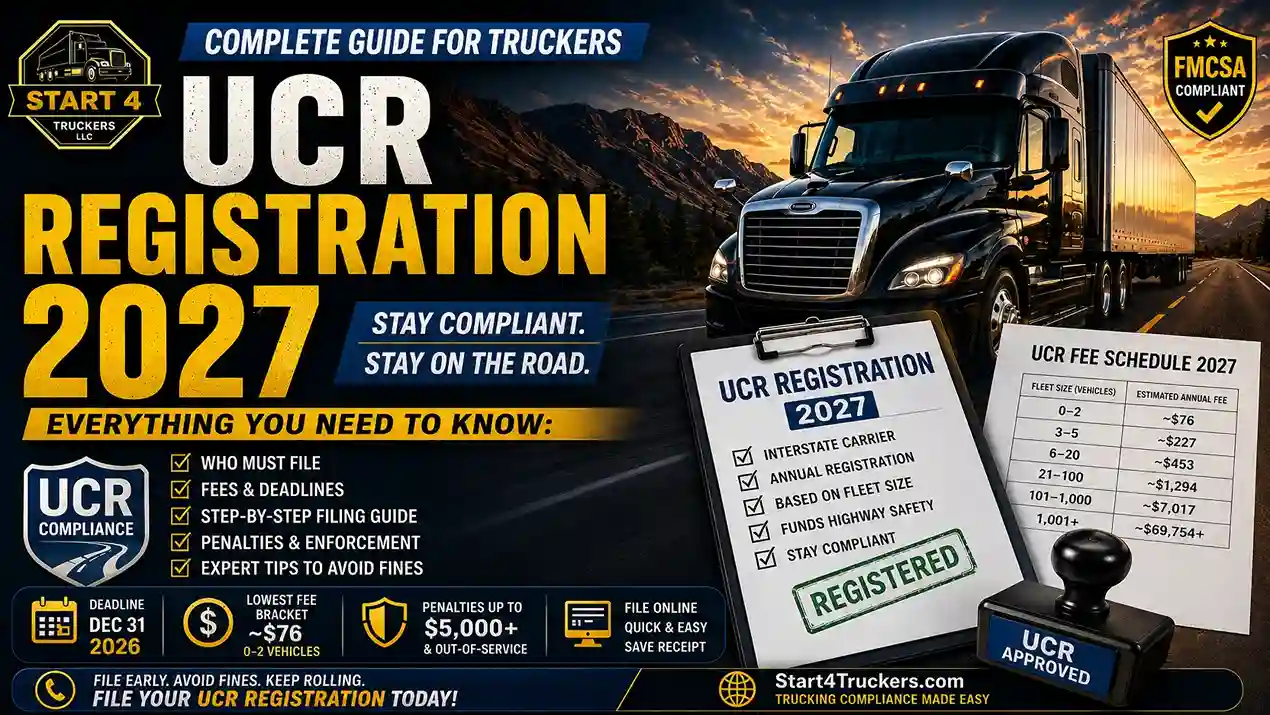
2027 UCR Fee Schedule by Fleet Size
| Fleet Size (Vehicles) | Estimated Annual Fee |
| 0–2 vehicles | ~$76 |
| 3–5 vehicles | ~$227 |
| 6–20 vehicles | ~$453 |
| 21–100 vehicles | ~$1,294 |
| 101–1,000 vehicles | ~$7,017 |
| 1,001+ vehicles | ~$69,754 |
Note: These figures reflect recent fee levels. Always verify the exact 2027 fee at the official UCR registration portal or FMCSA website before submitting payment.
Real-World Cost Examples
- Owner-operator with 1 truck: ~$76/year, the cost of a tank of fuel
- Small fleet with 10 trucks: ~$453/year
- Mid-size fleet with 50 trucks: ~$1,294/year
Brokers who operate no vehicles pay in the 0–2 vehicle bracket (~$76).
Want to handle UCR alongside your other annual filings? View Start4Truckers LLC plans and pricing, affordable compliance packages built for carriers of every size.
UCR Registration Deadline 2027
Key Dates to Know
| Event | Date |
| Registration opens | October 1, 2026 |
| Recommended filing window | October – December 2026 |
| Final deadline | December 31, 2026 |
| Enforcement begins | January 1, 2027 |
What Happens After the Deadline
Once January 1, 2027, arrives, enforcement is active. Officers at roadside inspections and weigh stations can check your UCR status in real time. If you are not registered, you can be placed out of service immediately.
The Grace Period Myth
There is no official grace period for UCR. Many carriers assume they have a few weeks into the new year to file. They do not. Enforcement starts on January 1, and officers enforce it. File before December 31 every year without exception.
Deadline approaching? Do not wait until the portal gets congested in December. File your UCR registration now with Start4Truckers LLC and check it off your list today.
How to File UCR Registration 2027 (Step-by-Step)
Step 1: Gather Required Information
Before logging on to the registration portal, have these ready:
- Your USDOT number (active and updated)
- Number of commercial vehicles operated in interstate commerce
- Business name, address, and contact details
- Payment method (credit card or ACH)
Use our US DOT number lookup tool if you need to verify or locate your USDOT number before filing.
Step 2: Verify Your USDOT Details
Log in to the UCR registration system at the official state portal or through the national UCR system. Your USDOT number will pull your carrier information automatically. Verify that your business name, address, and carrier type are correct before proceeding.
Step 3: Enter Your Fleet Size Correctly
This is where most mistakes happen. Count every vehicle you operated in interstate commerce during the previous year, including leased units and vehicles operated under your authority by owner-operators. Undercounting vehicles is the most common audit trigger.
Step 4: Review Calculated Fees
The system will automatically calculate your fee based on fleet size. Double-check the bracket before paying. If your fleet size changed significantly from last year, make sure the new count is reflected accurately.
Step 5: Submit Payment Online
Pay by credit card or ACH bank transfer through the portal. Keep your payment confirmation number. Most states process payments instantly and generate a receipt within minutes.
Step 6: Download Your Proof of Registration
Save and print your UCR registration receipt. Keep a copy in each truck. Officers at roadside inspections may ask for proof of current UCR registration, and having it ready prevents delays.
Warning: Avoid third-party websites that charge large “processing fees” for UCR registration. The official filing can be done directly through your base state’s UCR portal. Start4Truckers LLC can assist if you want expert help, but always verify any third-party service before paying.
What Happens If You Don’t File UCR Registration?
Roadside Inspection Failure
During any CVSA-level roadside inspection, the officer will check your UCR status against the national database. If your registration shows as expired or missing, you will fail the inspection on the spot.
Vehicle Out-of-Service Orders
A failed UCR check can result in an immediate out-of-service order. Your truck sits at the roadside until the issue is resolved. Lost hours, missed deliveries, and furious shippers all because of a $76 filing.
Fines ($100–$5,000+)
UCR penalties for late filing vary by state, but fines commonly range from $100 to $5,000 per violation. Some states also charge back fees for the unregistered period.
Criminal Penalties in Repeat Cases
In some states, repeated or willful violations of UCR requirements can escalate to misdemeanor charges. This is rare, but the risk is real for carriers with a history of non-compliance.
Violation Severity Scale
| Severity Level | Consequence |
| Low | Warning at inspection |
| Medium | Fine ($100–$500) |
| High | Fine ($500–$5,000) + out-of-service |
| Critical | Out-of-service + audit + possible criminal charge |
Already missed the deadline or unsure of your status? Do not guess. Contact Start4Truckers LLC now to resolve your compliance gap before your next roadside inspection.
UCR vs DOT Number vs IRP vs IFTA (Key Differences)
This is one of the most searched questions in trucking compliance, and most guides skip it. Here is a clear breakdown:
| Registration | What It Is | Who Needs It | Filing Frequency |
| UCR | Annual carrier registration fee | Interstate carriers, brokers, forwarders | Annually |
| DOT Number | Federal carrier identification number | Most commercial carriers | One-time (update every 2 years) |
| IRP | Apportioned license plates for multi-state travel | Carriers over 26,000 lbs GVWR crossing state lines | Annually |
| IFTA | Fuel tax reporting across jurisdictions | Qualified motor vehicles in multiple IFTA states | Quarterly |
When You Need All Four
If you are an interstate carrier with a truck over 26,000 lbs, you likely need all four:
- USDOT number to operate legally (get yours here)
- UCR annual carrier registration fee (view plans & pricing)
- IRP plates for multi-state travel (full IRP guide)
- IFTA account for quarterly fuel tax filing (IFTA explained)
Also, check your Florida trucking regulations 2026. If you operate in or through Florida, state-specific rules add another layer to your compliance checklist.
Managing all four at once? Start4Truckers LLC handles UCR, IRP, IFTA, and DOT registrations under one roof. Stop juggling multiple portals and let the experts handle it.
UCR Compliance Checklist 2027
Before Filing
- USDOT number is active and updated
- MCS-150 biennial update is current
- Fleet count verified (all interstate vehicles counted)
- Base state identified (or alternate state if home state does not participate)
- Payment method ready
During Filing
- Business info matches USDOT records exactly
- Correct fleet size bracket selected
- Fee amount reviewed before payment
- Payment confirmation saved
- Receipt downloaded immediately after payment
After Filing
- Copy of registration stored in each vehicle
- Digital copy saved in the company compliance folder
- Calendar reminder set for next year’s filing (October 1)
- UCR status verified in the national database 48–72 hours after filing
Want a compliance partner who tracks all of this for you? See how Start4Truckers LLC’s ongoing compliance support works so nothing slips through the cracks mid-year.
Expert Tips to Avoid UCR Penalties in 2027
Mistake #1: Miscounting Your Fleet
The most common audit trigger is fleet misclassification. Carriers often forget to count leased vehicles, owner-operators dispatched under their authority, or vehicles added mid-year. Count every vehicle that operated under your DOT authority during the previous year.
Mistake #2: Filing in the Wrong State
If your home state does not participate in UCR, you must file through a designated alternative state. Filing through the wrong state or not filing at all because you assumed your state handles it differently is a costly error.
Mistake #3: Waiting Until December
The registration portal can experience high traffic in late December. Technical issues or last-minute payment delays can push you past the deadline. File in October or November to avoid the rush.
File early, file right. Start your UCR registration through Start4Truckers LLC today and avoid the year-end scramble entirely.
Mistake #4: Using Unverified Third-Party Services
Many websites charge inflated fees to handle UCR filings. Some are outright scams. Only use services you can verify. If you want professional help, Start4Truckers LLC offers UCR registration assistance as part of their trucking compliance support packages.
Audit Risk Awareness
FMCSA and state enforcement agencies cross-reference UCR records with DOT registration data. Discrepancies like a carrier showing 20 active vehicles in FMCSA records but registering in the 0–2 bracket flag your account for audit. Keep your records consistent across all systems.
If you are still in the process of getting your trucking authority or setting up your carrier profile for the first time, get UCR on your compliance checklist from day one.
Conclusion
UCR registration is one of the simplest compliance filings in trucking but one of the most overlooked. The fee is small. The process takes minutes. But skipping it can cost you thousands in fines and a day or more sitting at a weigh station.
Here is what to do right now:
- Confirm your USDOT number is active
- Count your fleet size accurately
- Log in to your base state’s UCR portal
- Pay and download your receipt
- Store copies in every vehicle
If you want to make sure every compliance box is checked, UCR, IRP, IFTA, DOT authority, and more, Start4Truckers LLC is built for exactly that. Their team handles registrations, filings, and ongoing compliance so you can focus on running your business. Visit Start4Truckers.com to get started, or explore their trucking compliance services to find the right plan for your operation.
Do not wait until December. File today and stay on the road.
Frequently Asked Questions
1. What is UCR Registration 2027?
UCR Registration 2027 is the annual filing requirement under the Unified Carrier Registration program. Interstate carriers, brokers, freight forwarders, and leasing companies must register and pay a fee based on fleet size. It is administered by the UCR Plan under oversight from the U.S. Department of Transportation.
2. Who needs to file UCR registration?
Any motor carrier, broker, freight forwarder, or leasing company engaged in interstate commerce must file UCR. This includes owner-operators with a single truck, large fleets, and brokers who do not operate vehicles.
3. Is UCR mandatory for owner-operators?
Yes. Even a single-truck owner-operator operating across state lines must file UCR annually. The fee for the 0–2 vehicle bracket is approximately $76, the lowest tier available.
4. What is the UCR deadline for 2027?
The deadline to register for the 2027 operating year is December 31, 2025. Enforcement begins January 1, 2027. There is no grace period.
5. How much does UCR cost per truck?
UCR fees are based on total fleet size, not per individual truck. For 1–2 vehicles, the fee is approximately $76. For 3–5 vehicles, approximately $227. Fees increase with fleet size up to $69,754+ for fleets over 1,000 vehicles.
6. What happens if I don’t file UCR?
You risk roadside inspection failure, an out-of-service order, and fines ranging from $100 to $5,000 or more, depending on the state. Repeat violations can escalate to more serious enforcement action.
7. Is UCR required for intrastate trucking?
No. UCR applies only to interstate commerce carriers crossing state lines. If you operate exclusively within one state, you are generally not required to file UCR. Confirm with your state’s trucking authority to be certain.
8. Do I need UCR if I have a DOT number?
Having a DOT number does not replace UCR. They are separate requirements. A DOT number identifies your carrier profile. UCR is an annual registration fee. Most interstate carriers need both.
9. Can I file UCR registration myself online?
Yes. You can file directly through your base state’s UCR portal or through the national UCR system online. No broker or service provider is required, though compliance services like Start4Truckers LLC can handle it for you if preferred.
10. Which states do not participate in UCR?
States that do not participate in UCR include Alaska, Arizona, California, Hawaii, and a few others. If your home state does not participate, you must register through a designated alternative participating state. Always verify the current list at the official UCR Plan website.
11. What is the difference between UCR and IRP?
UCR is an annual carrier registration fee for interstate operators. IRP (International Registration Plan) provides apportioned license plates for vehicles traveling in multiple states. They are separate requirements, and most interstate carriers need both. See our full IRP registration guide for details.
12. Can brokers and freight forwarders file UCR?
Yes, and they must. Brokers and freight forwarders engaged in interstate transportation are required to file UCR regardless of whether they operate any vehicles. They register in the lowest fee bracket.
13. Is there a penalty for late UCR filing?
Yes. Late UCR filings result in fines that vary by state, typically ranging from $100 to $5,000. Some states also require back payment of fees for the unregistered period. There is no official grace period after January 1.
14. How do I check my UCR registration status?
You can verify your UCR status through the national UCR database or through your base state’s motor carrier portal. Status is typically updated within 24–48 hours of payment. Officers at roadside checks access the same database in real time.