You have a CDL. You drive someone else’s truck. The paycheck shows up on time. And somewhere on a long haul, you start asking yourself: would I make more money running my own truck?
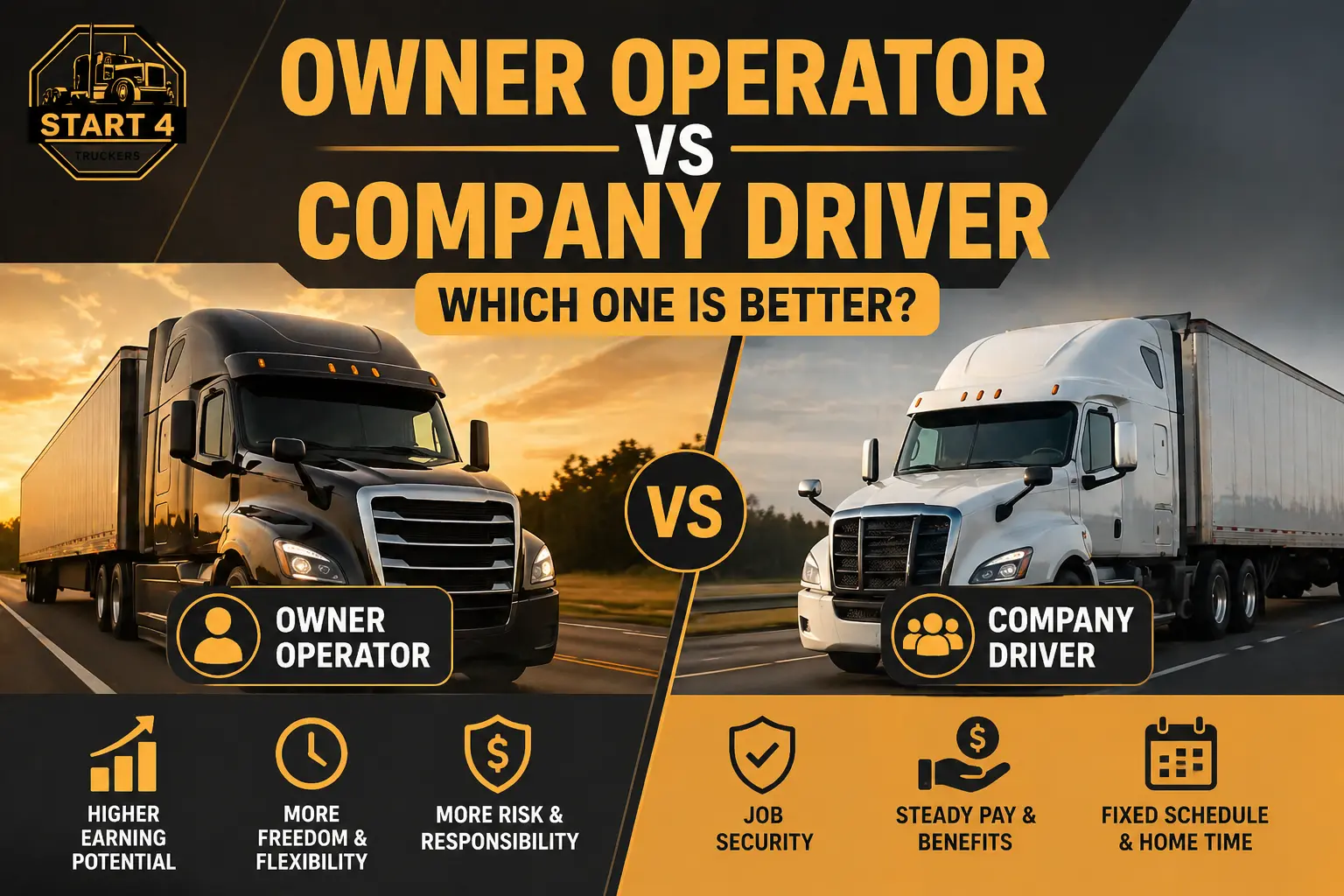
The honest answer is maybe. Owner-operators can earn more. They also carry costs, risks and paperwork that company drivers never see.
This guide puts both paths side by side, with the latest 2026 data from BLS, ATA, ATRI and ATBS. You will see what each path pays, what it costs, and what it asks of you. If you decide to go on your own, you will also see what it takes to get started.
Owner-Operator vs. Company Driver at a Quick Look
Comparison point | Company driver | Owner-operator |
Who owns the truck | The company | You (or you finance it) |
How you get paid | Wages from your employer: by the mile, the hour or a percentage | A share of what each load earns, or what you bill for the load |
Who pays for fuel, repairs and insurance | The company | You, in most cases |
Taxes | Employer withholds them (W-2) | You pay them yourself |
Benefits | Often health insurance, paid time off, retirement plan | You buy your own |
Annual pay / income | More predictable wages; ATA reports $73,639 median for dry van irregular-route drivers | Depends on gross revenue, expenses and net income |
Control over loads and schedule | Limited | More, depending on your setup |
Startup cost | Low | Truck, insurance, filings and cash reserve |
Business risk | Low | You carry it |
What Is a Company Driver?
A company driver is an employee of a trucking company. The company owns the truck and pays for fuel, repairs, tires, tolls and insurance. You show up, drive and get paid.
Pay is usually by the mile, by the hour or by a percentage of the load. Taxes come out of every check. Employers also add benefits such as health insurance or paid time off. The details change from one company to the next, so read the offer before you sign.
You do not need your own USDOT number or MC number. The company’s numbers cover the work.
What Is an Owner-Operator?
An owner-operator owns or finances a truck and runs it as a business. You are the driver and the boss. That means you also pay the bills and handle the paperwork.
There are two main ways to do it.
Leased on
You lease your truck to a motor carrier and haul under that carrier’s authority. The carrier finds the freight and bills the customer. You get a share. This is a common first step for drivers coming from a company job.
Own authority
You get your own USDOT number and MC authority. You find your own freight, through brokers or direct shippers. You keep more of each load, but you also take on more work and more risk.
Many drivers start leased on and move to their own authority later. Others go straight to their own authority. Both are valid. We cover the differences below.
How Much Do Company Drivers Make?
The U.S. Bureau of Labor Statistics (BLS) counts nearly 2.1 million heavy and tractor-trailer truck drivers. Their average pay was $59,710 a year as of May 2025. This is the mean, which means the average of all drivers’ pay.
Two things to know about that number:
- It covers employees. BLS does not count self-employed workers in this data.
- It is wages only. It does not show what benefits are worth.
Fleet surveys show that annual pay can be higher for some company driving jobs. According to the American Trucking Associations (ATA) 2026 Driver Compensation Study, which surveyed more than 130 fleets and over 140,000 employee drivers, annual driver earnings for 2025 varied by job type and region:
- Dry van drivers: For-hire truckload carriers paid irregular-route drivers a median annual pay of $73,639, up 8.3% from the 2023 study.
- Northeast dry van drivers: Earned just over $78,000 annually, the highest of any region. This figure excludes benefits.
- Linehaul LTL drivers: Earned a median annual pay of $85,000.
- Local LTL drivers: Earned a median annual pay of $72,942.
Most fleets in the study planned to increase driver pay again in 2026.
BLS and ATA count different groups of drivers, so their numbers do not match. Use both figures as general pay benchmarks, not as a guarantee of what you will earn.
Benefits are worth real money too. ATRI, the American Transportation Research Institute, tracks what carriers spend on drivers. In 2025, carriers averaged about 82 cents per mile on driver wages and about 21 cents per mile on benefits. That is roughly $1.03 per mile in total. Keep that number in mind when you compare pay.
How Much Do Owner-Operators Make?
There is no single answer, and anyone who gives you one is guessing. BLS does not publish a clean figure for owner-operators because they are self-employed. Pay also depends on freight type, lanes, fuel economy, empty miles and how well you run the business.
What matters most is the gap between gross revenue and net income.
- Gross revenue is the total money that comes in from loads.
- Net income is what is left after you pay every business expense.
A company driver sees one number: the paycheck. An owner-operator sees a big revenue number first and a much smaller number at the end. Many new owner-operators look at revenue per mile and forget the costs behind it.
How leased-on owner-operators get paid
Carriers pay leased-on owner-operators in a few ways like a flat rate, a rate per mile, or a percentage of the load. One large carrier, for example, offers a lease option that pays 65% of line-haul revenue and 100% of the fuel surcharge. Other carriers offer different splits.
Before you sign any lease, ask these questions:
- What percentage of line-haul revenue do I get?
- Do I get 100% of the fuel surcharge? (A fuel surcharge is extra pay that helps cover diesel costs.)
- Who pays for tolls, trailer rental, escrow and insurance?
- How and when can I end the lease?
Two offers can look the same per mile and still pay very differently once you count the extras. This matters more in 2026. ATBS says some brokers do not pass the full fuel surcharge on to the owner-operator.
How own-authority owner-operators get paid
With your own authority, the customer or broker pays you directly for each load. You keep the full revenue. You also pay every cost, including dispatch help, factoring fees and the time you spend finding loads.
What Does It Cost to Run a Truck?
This is where the owner-operator math gets real. ATRI’s 2026 report found that the average cost to run a truck in 2025 was $2.336 per mile. That is a record high. Without fuel, it was $1.854 per mile.
Those are fleet averages, so your numbers will differ. They still show where the money goes. Here are some of the main line items for 2025, per mile:
Expense | Average cost per mile |
Fuel | about $0.48 |
Truck and trailer payments | about $0.40 |
Repair and maintenance | about $0.22 |
Insurance | about $0.11 |
Tires | about $0.05 |
Tolls | about $0.04 |
Several of these rose faster than inflation in 2025, including tolls, repairs and tires. ATRI also found that profit margins for truckload carriers stayed under 1% that year. Trucking is a thin-margin business, and the cost side matters as much as the rate side.
2026 Update: Fuel and Freight Rates
The table above uses 2025 data. Fuel changed a lot in 2026.
- Diesel. The U.S. Energy Information Administration (EIA) reported a national average of $6.53 a gallon on September 21, 2026. It was the first time the average went above $6. At 6 to 6.5 miles per gallon, fuel can cost about $1 per mile or more. ATRI’s 2025 average was about $0.48 per mile. Prices move every week, so check the EIA weekly report.
- Freight rates. DAT data for the third week of September 2026 showed a dry van linehaul rate of $2.17 per mile, not counting fuel surcharge. That is up 31.5% from the same week in 2025. Refrigerated rates were $2.73 and flatbed rates were $2.60.
- Maintenance. ATBS clients now spend about 14 cents per mile on maintenance. That is an owner-operator figure, so it differs from ATRI’s fleet average in the table.
Higher rates help. But a fuel surcharge only helps if it covers the jump in diesel. Always check what share of the surcharge reaches you.
Per-mile costs are only part of the picture. Owner-operators with their own authority may also pay for:
- UCR registration (a yearly fee based on fleet size)
- IFTA and IRP, which cover fuel tax and apportioned plates for trucks that cross state lines
- Form 2290, the federal heavy highway vehicle use tax
- A drug and alcohol testing program
- An ELD (electronic logging device)
- Accounting, permits and factoring fees
Which ones apply to you depends on how and where you run. A call with a specialist can sort that out fast.
A Simple Example: Made-Up Numbers
The numbers below are for illustration only. They are not an average and not a promise.
Say you run 100,000 miles in a year and bill an average of $2.20 per mile on every mile. That is $220,000 in gross revenue.
Use ATRI’s fleet numbers as a rough guide for costs, leaving out driver pay: about $0.48 per mile for fuel and about $0.83 per mile for everything else. That adds up to about $1.31 per mile, or about $131,000.
That leaves about $89,000 before income tax, self-employment tax, health insurance and retirement savings. It also assumes the truck never sits. A truck that is down for two weeks still has a payment and an insurance bill.
Now change one number: fuel. Say diesel costs you about $1.00 per mile instead of $0.48, and your fuel surcharge covers none of the increase. Your costs rise to about $1.83 per mile, or about $183,000. That leaves about $37,000 before taxes, health insurance and retirement savings.
2025 fuel cost | 2026 fuel cost, no surcharge help | |
Revenue per mile | $2.20 | $2.20 |
Fuel per mile | $0.48 | $1.00 |
Other costs per mile | $0.83 | $0.83 |
Left per mile | $0.89 | $0.37 |
Left per year (100,000 miles) | about $89,000 | about $37,000 |
These are made-up numbers. They show why the fuel surcharge and your own cost per mile matter. Now compare the result to a company driver’s wages plus benefits. The owner-operator number can be higher. It can also be a lot lower. Build your own numbers with your own truck, lane and carrier.
Benefits: Company Benefits vs. Self-Funded Benefits
This part gets overlooked. Many company drivers get some mix of health insurance, paid time off, retirement plans and paid training. The employer pays part of the cost.
Owner-operators pay for all of it. That includes health insurance, retirement savings and any time off. There is no paid vacation when the truck is parked.
Taxes work differently too. Employees split Social Security and Medicare taxes with their employer. Self-employed people pay both halves, which is about 15.3% on net earnings. Business expenses can lower what you owe. Talk to a CPA before you make the jump, because this is not tax advice.
Freedom vs. Business Risk
Owner-operators often say they want freedom. That is a real benefit. You pick your lanes. You pick your home time. You choose which loads to take, especially under your own authority.
Freedom comes with risk. If a truck breaks down, you pay. If freight rates drop, your income drops. If diesel jumps, as it did in 2026, your costs rise before your rates catch up. If a customer pays late, you wait. If you get hurt and cannot drive, there is no paid leave unless you planned for it.
A company driver gives up some control and gets stability in return. Neither choice is wrong. The right one depends on your savings, your family, your tolerance for risk and how much you want to build something of your own.
Leased On vs. Your Own Authority
If you want to be an owner-operator, this is the next big question.
Can an owner-operator work under another company’s authority? Yes. That is exactly what a lease-on arrangement is. The carrier’s USDOT and MC numbers cover your work.
Comparison point | Leased on | Own authority |
Whose numbers are used | The carrier’s | Yours |
Finding freight | Carrier handles it | You handle it |
Share of each load | A percentage, set in the lease | Full revenue, minus your costs |
Insurance | Often partly through the carrier (you pay for it) | You buy and file your own |
Paperwork | Less | More |
Control | Set by the lease terms | Mostly yours |
Startup work | Lease signing, truck, insurance as required | Business setup and FMCSA filings |
Leased-on is simpler. Own authority gives you more control and a bigger upside. It also asks more of you.
Planning to go on your own? Take our free 1-minute check to see which filings you need, or call us at (210) 588-9348.
Pros and Cons
Company driver
Pros
- Steady paycheck
- No truck payment or repair bills
- Benefits may be included
- Low startup cost
- Easy to switch employers
Cons
- Limited control over loads and schedule
- Pay has a ceiling
- You build someone else’s business
Owner-operator
Pros
- Higher income potential
- More control over loads, lanes and home time
- You build your own business
- Business expenses may offer tax benefits
Cons
- You pay for fuel, repairs, insurance and benefits
- Income swings with the market and your truck’s uptime
- More paperwork
- Startup cost and cash reserve needed
What It Takes to Start Your Own Trucking Business
If you decide to operate under your own authority, you will need more than a truck. The exact filings depend on your business and the freight you plan to haul. For a fuller walkthrough, see our guide to starting a trucking company.
1. Set up the business
Some drivers form an LLC and obtain an EIN before applying for authority. An LLC is not required for every trucking business. Start4Truckers offers trucking LLC formation and EIN registration assistance.
2. Register with FMCSA
Apply for the appropriate USDOT registration and, when required, MC operating authority. FMCSA’s Motus system includes updated registration and identification procedures; our Motus registration guide explains those changes without turning this comparison into a technical filing tutorial.
3. Arrange process-agent filings and insurance
For authority that requires them, submit a BOC-3 filing and have the required insurance evidence filed with FMCSA. Coverage requirements depend on the operation and cargo.
4. Check the other registrations that apply
Depending on the truck and routes, you may need UCR registration, IFTA registration, IRP apportioned plates or Form 2290 filing. Drug and alcohol testing and Clearinghouse requirements may also apply. New carriers should prepare for the FMCSA New Entrant Safety Audit.
How long does it take?
Based on our registration experience, eligible applicants can often get a USDOT number and MC number in the same session, sometimes within minutes. The authority usually goes active about 10 days after registration. That assumes the protest period has passed and the BOC-3 and insurance filings are done. Cases that need manual review can take about 2 to 4 weeks. Timing is not guaranteed.
A number is not the same as active authority. You can have a USDOT number and still show “Not Authorized” on the MC side. In Motus, status reasons such as “Pending – Process Agent (Form BOC-3) Filings” or “Pending – Financial Responsibility Filings” tell you what is missing.
Is It Better to Be an Owner-Operator or a Company Driver?
Neither path is better for everyone. Here is a simple way to think about it.
Company driving may fit you if:
- You want a steady paycheck and benefits you do not have to buy
- You have little savings set aside
- You do not want to handle paperwork or business decisions
Owner-operating may fit you if:
- You have a cash reserve for slow weeks and repairs
- You are comfortable running numbers and tracking costs
- You want more control, and you accept the risk that comes with it
- You plan to build a business, not just drive a truck
If you are not sure, start with the numbers. Write down what you earn now, including benefits. Then estimate your costs per mile for your own truck. The gap tells you more than any average can.
Frequently Asked Questions
What is the difference between an owner-operator and a company driver?
A company driver is an employee. The company owns the truck and pays most costs. An owner-operator owns or finances the truck, runs it as a business and pays the costs. Owner-operators also pay their own taxes and benefits.
Do owner-operators make more than company drivers?
They can, but not always. According to ATA’s 2026 Driver Compensation Study, dry van irregular-route company drivers earned a median of $73,639 annually in 2025. Linehaul LTL drivers earned $85,000, while local LTL drivers earned $72,942. By comparison, ATBS clients averaged about $71,800 in 2025. However, owner-operators must pay for fuel, repairs, insurance, truck payments and benefits. What matters is net income, not gross revenue. Some owner-operators earn more than company drivers, while others earn less in a bad year.
How much does an owner-operator make after expenses?
It depends on freight type, lanes, miles, empty miles, fuel economy and repair costs. BLS does not publish owner-operator income because they are self-employed. ATBS clients averaged about $71,800 in 2025. ATRI’s data shows the average cost to run a truck was $2.336 per mile in 2025, and diesel rose sharply in 2026. Compare your revenue per mile against your own cost per mile to see what is left.
What is a company truck driver?
A company truck driver is an employee who drives a truck owned by the employer. The company pays for fuel, maintenance and insurance. The driver gets wages and may get benefits such as health insurance and paid time off.
Is it better to be an owner-operator or a company driver?
It depends on your goals, savings and comfort with risk. Company driving offers steadier pay and fewer responsibilities. Owner-operating offers more control and higher income potential, with more risk and more paperwork.
Can an owner-operator work under another trucking company’s authority?
Yes. This is called being leased on. You lease your truck to a motor carrier and haul under its USDOT number and MC authority. The carrier usually finds the freight, and you receive a share of each load. Read the lease terms carefully before you sign.
What are the biggest expenses of becoming an owner-operator?
The truck itself is usually the largest cost, followed by fuel, repairs and insurance. You also need money for business setup, FMCSA filings, UCR, and any fuel tax and plate registrations that apply to you. Keep a cash reserve for slow weeks and breakdowns.
Ready to Start Your Own Trucking Business?
Moving from a company job to your own business is a big step. You do not have to figure it out alone.
Start4Truckers.com helps drivers go from idea to open for business. We form your company, file with FMCSA, set up your tax and fuel accounts, and help you stay compliant after launch.
- Not sure what you need? Take the free 1-minute check
- Ready to see packages? View plans and pricing
- Want to talk it through? Call (210) 588-9348, Monday to Saturday, 7 AM to 7 PM ET