Getting your USDOT Number and operating authority is only the first step. Every new motor carrier still has to get through the FMCSA New Entrant Safety Audit, a compliance check that happens early in your first months of operation. Many carriers go in unprepared simply because they don’t know what an inspector is actually going to look at.
This guide walks through exactly what happens before, during, and after the audit, what documents inspectors check, the most common reasons carriers fail, and how to walk in prepared. If you’d rather not handle it alone, Start4Truckers LLC helps new carriers prepare for FMCSA compliance requirements, organize required documents, and avoid the mistakes that trip up first-time applicants.
What Is an FMCSA New Entrant Safety Audit?
An FMCSA New Entrant Safety Audit is a compliance review conducted for newly authorized motor carriers during their early period of operation. FMCSA inspectors evaluate whether carriers follow safety regulations, including driver qualification requirements, hours of service rules, vehicle maintenance standards, and drug and alcohol testing requirements.
What Is the FMCSA New Entrant Safety Audit Program?
The New Entrant Safety Assurance Program exists to confirm that a newly authorized carrier understands and follows federal safety regulations before they’ve had the chance to build up a long operating history. Since new carriers don’t yet have years of inspection data behind them, FMCSA uses this audit to get an early, direct look at how the business actually operates.
Why Does FMCSA Conduct New Entrant Safety Audits?
FMCSA runs these audits to confirm new carriers understand safety regulations, maintain proper records, operate their vehicles safely, and follow federal requirements from day one. Catching gaps early protects drivers, the public, and the carrier itself from bigger compliance problems down the road.
How Long After Getting Authority Does FMCSA Audit New Carriers?
New carriers are generally audited within their first several months of active operation, and FMCSA typically notifies carriers ahead of time about the audit rather than showing up unannounced. If you’re still working through your registration and haven’t reached this stage yet, our guide on how to get trucking authority covers what comes before this point.
Who Performs the FMCSA New Entrant Safety Audit?
FMCSA safety investigators, sometimes working alongside state enforcement partners, conduct these audits either in person or remotely, depending on the carrier’s location and circumstances.
What Happens During an FMCSA New Entrant Safety Audit?
Before the Audit
FMCSA sends notification of the upcoming audit, giving the carrier time to gather records and review its compliance systems. This is the window to get organized, not the time to start building files from scratch.
During the Audit
The investigator reviews your documentation, evaluates your safety management practices, and verifies that your operation matches what’s on file with FMCSA.
After the Audit
You’ll receive a result along with a safety rating. If problems were found, you may be asked to complete corrective actions within a set timeframe.
Not sure whether your records are audit-ready right now? A quick call to Start4Truckers LLC at (210) 588-9348 can help you find out before FMCSA does.
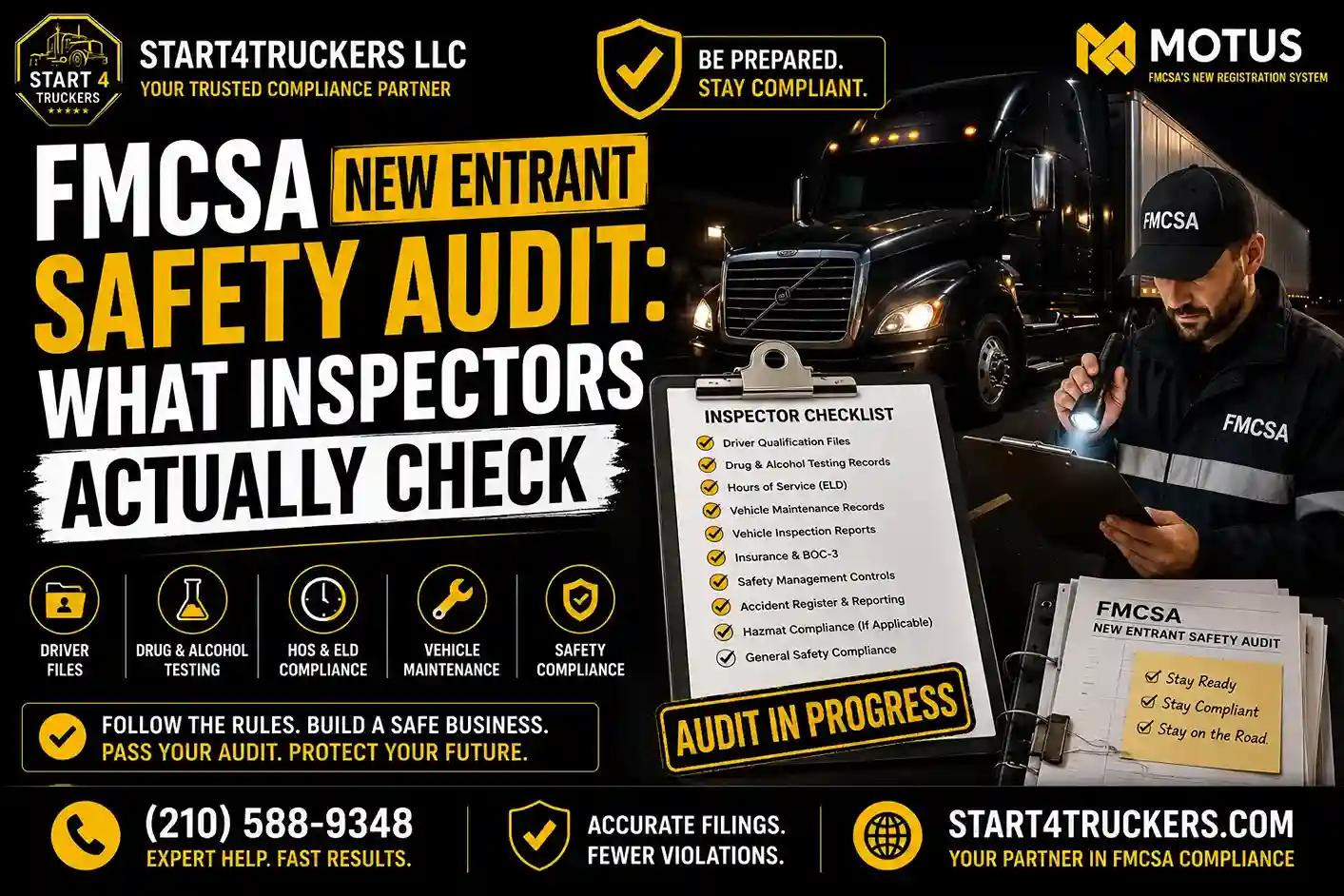
What Inspectors Actually Check During an FMCSA New Entrant Safety Audit
1. Driver Qualification Files
Inspectors review each driver’s application, employment history, CDL verification, medical examiner certificate, motor vehicle record, and safety performance history. Missing driver documents, expired medical cards, and incomplete files are among the most common issues found in this section.
2. Drug and Alcohol Testing Records
FMCSA checks whether you have a functioning drug and alcohol testing program in place, including pre-employment testing, random testing records, FMCSA Clearinghouse queries, and consortium enrollment. Every new carrier needs a compliant testing program running before drivers ever get behind the wheel. If you haven’t set this up yet, our DOT drug and alcohol consortium guide and FMCSA Clearinghouse registration service can help you get compliant quickly.
3. Hours of Service Compliance and ELD Records
Inspectors review your Electronic Logging Device records, driver logs, and any supporting documents tied to hours of service. Missing logs, false logs, and unassigned driving time are frequent problems found during this part of the review.
4. Vehicle Maintenance Records
Inspectors check maintenance schedules, repair records, annual inspections, vehicle inspection reports, and whether known defects were actually repaired. Missing maintenance files, incomplete inspection records, and uncorrected defects are common causes of violations here.
5. Accident Records and Safety Management Controls
FMCSA reviews your accident register, safety policies, training procedures, and general preventive safety measures to evaluate whether the carrier has proper safety management systems in place, not just paperwork after the fact.
6. Insurance and Operating Authority Records
Inspectors may verify your active insurance filing, your operating authority status, and your carrier registration information against FMCSA’s own records, including your BOC-3 filing and BMC-91 or BMC-91X. If your authority status looks off going into your audit, check our guide on operating authority status in MOTUS before your scheduled date.
If any of this feels like a lot to track down at once, that’s normal for a first time audit. Start4Truckers LLC can help you pull it all together before FMCSA arrives. Reach us at (210) 588-9348.
FMCSA New Entrant Safety Audit Checklist
Driver Documents
- Driver Qualification Files
- CDL copies
- Medical certificates
- MVR reports
Drug and Alcohol Documents
- Testing records
- Clearinghouse records
- Consortium information
Vehicle Documents
- Maintenance records
- Inspection reports
- Repair documents
Operations Documents
- ELD records
- HOS logs
- Accident records
- Insurance documents
Common FMCSA New Entrant Safety Audit Violations
Missing Driver Qualification Files
Incomplete driver files are one of the most frequent violations FMCSA finds, often because a document was collected but never filed correctly.
Hours of Service Violations
False logs, missing records, and unresolved ELD problems all count against a carrier during the audit.
Drug and Alcohol Compliance Failures
A missing testing program, no Clearinghouse checks, or poor recordkeeping in this area can create serious compliance issues fast.
Poor Vehicle Maintenance Records
Missing inspections, unsafe equipment still in service, and a lack of repair documentation are common findings.
No Safety Management System
FMCSA expects carriers to have actual safety procedures in place, not just documents. A carrier with no clear safety policy or training process stands out during review.
How to Prepare for an FMCSA New Entrant Safety Audit
Step 1: Organize All Required Documents
Build separate compliance folders for drivers, vehicles, maintenance, and testing records well before your scheduled date.
Step 2: Review Your FMCSA Compliance Status
Check the SAFER System, your carrier profile, and your authority status to confirm everything matches what you’ll present during the audit.
Step 3: Train Drivers Before the Audit
Make sure every driver understands hours of service rules, inspection procedures, and how to properly use their ELD.
Step 4: Fix Compliance Problems Before Inspection
Correct missing records, expired documents, and filing issues now rather than during the audit itself.
If you’d rather have a compliance specialist walk through this checklist with you, Start4Truckers LLC offers full audit preparation support. Call (210) 588-9348 to schedule a review before your notification date arrives.
What Happens If You Fail the FMCSA New Entrant Safety Audit?
A failed audit can lead to a conditional safety rating, required corrective actions, an unsatisfactory safety rating, or in serious cases, loss of operating authority.
Can a Carrier Continue Operating After Failing?
It depends on the audit result and the severity of what was found. A conditional rating usually allows continued operation while corrections are made, while an unsatisfactory rating carries more serious consequences.
How Can a Carrier Improve After Failure?
Carriers are typically required to complete a corrective action plan, fix the specific violations identified, and go through additional compliance review before the matter is closed out.
FMCSA New Entrant Safety Audit vs DOT Roadside Inspection
| FMCSA New Entrant Safety Audit | DOT Roadside Inspection |
| Reviews company compliance | Reviews vehicle and driver during operation |
| Document focused | Equipment focused |
| Usually scheduled | Happens roadside |
| Checks safety systems | Checks immediate violations |
How Start4Truckers LLC Helps Prepare Carriers for FMCSA Audits
Start4Truckers LLC helps carriers with FMCSA compliance support, ongoing DOT compliance management, drug and alcohol consortium setup, ELD compliance, registration assistance, and full safety audit preparation.
Preparing for your first FMCSA New Entrant Safety Audit? Start4Truckers LLC can help organize your compliance requirements and reduce the risk of violations before FMCSA ever looks at your files. Call (210) 588-9348, explore our ongoing DOT compliance service, or request a free consultation to get started today.
Conclusion
The FMCSA New Entrant Safety Audit is the first real test of whether your compliance systems can hold up under review, covering everything from driver files and drug testing to vehicle maintenance and safety management. Getting organized early, fixing gaps before the audit date, and understanding exactly what inspectors check gives you the best shot at a clean result.
If you’d rather not go through it alone, Start4Truckers LLC is ready to help you prepare. Call (210) 588-9348 or contact us to get your compliance files audit-ready.
Frequently Asked Questions
1. What is an FMCSA New Entrant Safety Audit?
It’s a compliance review conducted for newly authorized carriers to confirm they understand and follow federal safety regulations early in their operation.
2. What does FMCSA check during a safety audit?
Driver qualification files, drug and alcohol testing records, hours of service and ELD records, vehicle maintenance records, accident history, safety management controls, and insurance and authority records.
3. How long after getting authority does FMCSA audit a carrier?
Most new carriers are audited within their first several months of active operation, with notification typically sent ahead of the audit date.
4. How do I prepare for an FMCSA New Entrant Safety Audit?
Organize your driver, vehicle, and testing records ahead of time, review your FMCSA compliance status, train your drivers, and correct any known problems before your scheduled date.
5. What documents are required for a New Entrant Safety Audit?
Driver qualification files, CDL copies, medical certificates, MVR reports, drug and alcohol testing and Clearinghouse records, vehicle maintenance and inspection records, ELD and HOS logs, accident records, and insurance documents.
6. Does FMCSA check driver qualification files?
Yes. Driver qualification files are one of the primary areas reviewed during the audit.
7. Does FMCSA inspect ELD records during the audit?
Yes. Inspectors review ELD data and hours of service logs for accuracy and completeness.
8. Does FMCSA review drug and alcohol testing records?
Yes. This includes your testing program, Clearinghouse queries, and consortium enrollment records.
9. What are common FMCSA New Entrant Audit violations?
Missing driver files, hours of service violations, drug and alcohol compliance gaps, poor vehicle maintenance records, and a lack of a functioning safety management system.
10. What happens if I fail my New Entrant Safety Audit?
You may receive a conditional or unsatisfactory safety rating, be required to complete corrective actions, or in serious cases lose your operating authority.
11. How long does the New Entrant Safety Audit take?
The length varies depending on the size of the carrier and the scope of the review, but most audits are completed within a single scheduled session.
12. Can owner operators pass the FMCSA audit without help?
Yes, though many owner operators find it easier to prepare with guidance since the audit covers several compliance areas at once. Start4Truckers LLC can help fill in any gaps.
13. What safety rating does a new carrier receive?
Carriers typically receive a satisfactory, conditional, or unsatisfactory rating based on the audit findings.
14. How long does the FMCSA New Entrant Program last?
New carriers remain under the New Entrant monitoring period for a set window of time after receiving authority, during which their safety performance continues to be tracked.
15. Can Start4Truckers LLC help prepare for an FMCSA audit?
Yes. Start4Truckers LLC helps new carriers organize compliance documents, set up drug and alcohol testing programs, and prepare fully for their FMCSA New Entrant Safety Audit. Call (210) 588-9348 to get started.