Introduction
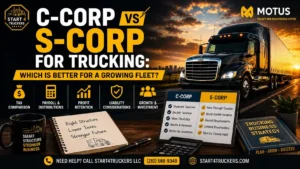
The main difference between a C-Corp and an S-Corp is related to taxation. A C-Corp (C Corporation) pays corporate income taxes, and it can be subject to double taxation on dividends; on the other hand, an S-Corp (S corporation) is a pass-through entity which pass profits to personal tax returns.
To understand which one is better for your trucking business, we bring this guide. In this guide, we will explain in detail how they both work, their key features, advantages, disadvantages, and which one is best for your trucking business.
A C-Corporation vs. S-Corporation
What Is a C-Corp?
A C-Corporation is a business structure that operates independently and is legally separate from its owner. It means the business can do all the legal work, such as own property, enter into contracts, pay taxes, and take on debts under the company name only.
The term S-Corporation is taken from Subchapter C of the Internal Revenue Code. This code explains how taxes are applied to C-Corps.
What Is an S-Corp?
An S-Corporation is a business structure in which all the finance-related issues, such as income, losses, deductions, and credits, are passed directly to the business owner or shareholders for tax purposes.
This means that all the financial and legal work will be conducted under the owner’s name.
Remember, your business is a C corporation by default unless you filed specific paperwork with the IRS to change your tax status to an S corporation.
C-Corp vs. S-Corp for Trucking: What’s the Difference?
How Does a C-Corp Work?
Here is how the C-Corporation business structure works. Suppose your trucking company earns a profit; the corporation will pay applicable corporate taxes on that profit, and whatever’s left over can either stay in the company or can be distributed to shareholders. If it’s distributed as a taxable dividend, the shareholder will owe tax on that income as well.
Key features
- Separate legal entity from its owners
- Owners have limited personal liability
- Can have unlimited shareholders
- Can issue different types of stock
- Pays corporate income tax on its profits
Advantages
- Shareholders, directors, and officers are not responsible for debts, lawsuits, or liabilities.
- The flexibility of multiple classes of stock and unlimited shareholders attracts venture capitalists, institutional investors, and encourages initial public offerings (IPO).
- No residency or citizenship restrictions on shareholders
- Federal corporate tax is taxed at a flat rate of 21%.
- C-corps can deduct health insurance and employee benefits as business expenses.
Disadvantages
- Profits can be taxed at both the corporate and personal levels.
- Business losses generally cannot reduce the owner’s personal taxable income.
- Requires regular meetings and detailed records.
- Has higher setup, accounting, and maintenance costs.
How Does an S-Corp Tax Work?
The S-Corp works independently of the distribution of profits among the shareholders. When your trucking company earns income, that income passes through to the shareholders, and each shareholder has to report their share on their personal tax return, whether or not the money was distributed to them.
Key features
- Income and losses pass directly to shareholders.
- Avoids federal corporate income tax.
- Owners have limited personal liability.
- Has restrictions on who can own shares.
- Must follow specific IRS rules and requirements.
S-Corp Advantages
- Profits and losses pass directly to personal tax returns
- Can reduce self-employment taxes through salary and distributions.
- Business losses can pass through to the owners’ personal tax returns.
- Protects owners’ personal assets from most business debts.
- Allows the business to continue even if an owner leaves.
Disadvantages
- Limited to 100 shareholders.
- Most shareholders must be U.S. citizens or residents.
- Allows only one class of stock.
- Working owners must receive a reasonable salary.
- Requires strict tax and reporting compliance.
After choosing a business structure, you are also required to complete your federal MC registration. MOTUS is the FMCSA’s USDOT Registration System, where you can complete the entire registration process.
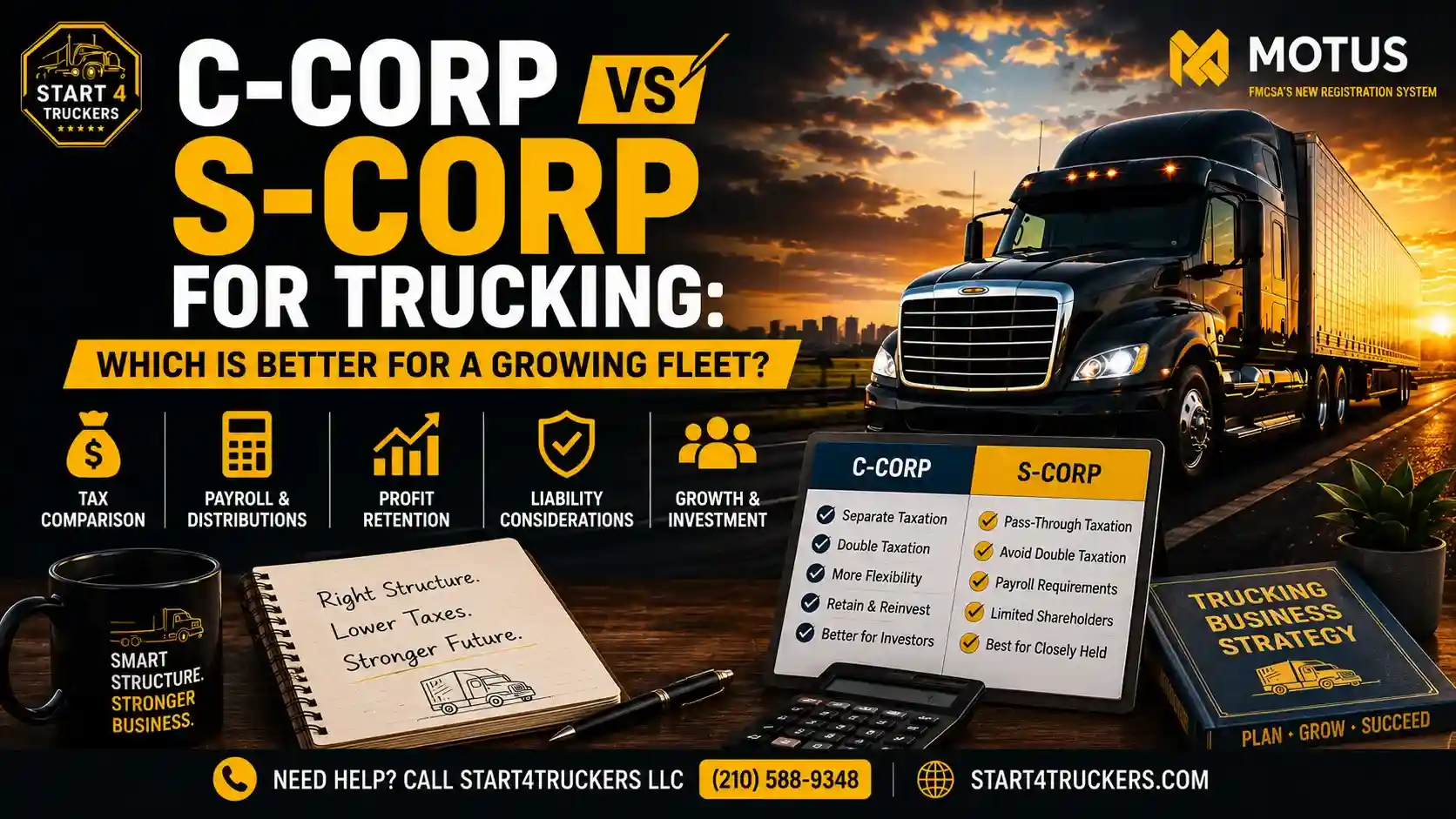
C-Corp vs S-Corp: What’s the Key Difference
| Factor | C-Corp | S-Corp |
| Federal tax treatment | Corporate taxation | Pass-through |
| Double taxation | Possible | Generally avoided at the federal level |
| Owner compensation | Salary and dividends | Salary and distributions |
| Profit retention | Flexible | Requires additional planning |
| Shareholders | Generally more flexible | Eligibility restrictions apply |
| Stock classes | More flexibility | Generally one class |
| Outside investment | Often more flexible | More restrictive |
| Tax return | Form 1120 | Form 1120-S |
| Best potential fit | Growth, reinvestment, and investment-oriented businesses | Qualifying, closely held businesses |
C-Corp vs S-Corp for Trucking: Which Is Better for You?
Choose an S-Corp when you expect to distribute most of the profit to yourself, want pass-through taxation, don’t need a complex investor structure, and ownership fits within S-Corp eligibility rules.
Consider a C-Corp When You expect to retain a substantial amount of profit and want more flexibility for outside investors, expect a more complex ownership structure, and plan to build toward long-term corporate growth.
Conclusion
Choosing the best business structure matters for your trucking business because it can affect your taxes, operations, and personal liability. Two of the ideal business structures are a C-Corporation and an S-Corporation. A C-Corp is good if you want to retain most of the profits to yourself, and an S-Corp is best when more flexibility for outside investors.
Make your decision on how your company earns, distributes, retains, and reinvests its profits, and where you actually want your fleet to be in the next several years.
Confused? Which Business Structure To Choose For Your Trucking Company
Visit Star4Truckers today and get a consultation!
We help you to select an ideal business structure based on your business goals.
FAQ
1- What is the key difference between a C-Corp and an S-Corp?
The main difference between a C-Corp and an S-Corp is that a C-Corp pays corporate income taxes and is subject to double taxation on dividends, while an S-Corp is a pass-through entity which pass profits to personal tax returns.
2- Do C-Corps pay double taxes?
yes. The corporation pays tax on its profit, and shareholders can owe additional tax if that profit is later distributed as a taxable dividend.
3- Does an S-Corp avoid double taxation?
Yes, because income passes through to shareholders once, rather than being taxed at both the corporate and personal level.
4- How do I know if my company is an S corp or C corp?
Your business is a C corporation by default unless you filed specific paperwork with the IRS to change your tax status to an S corporation.
5- Should my startup be an S corp or C corp?
It completely depends on your business goals. A C-Corp is good if you want to retain most of the profits to yourself, and an S-Corp is best when more flexibility for outside investors.