Two drivers pull 53-foot trailers down the same interstate. One hauls paper towels. The other hauls strawberries.
The second driver has an extra job: keep the refrigeration unit running and the box at the temperature on the paperwork. If the load warms up, the receiver can reject it, and the carrier is left dealing with a cargo claim.
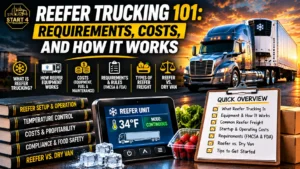
Reefer trucking can pay better than dry van work, but you’ll spend more to run the equipment and have more rules to follow. This guide explains what reefer trucking is, how the equipment works, what it costs, and what you need before picking up your first cold load.
Quick answer: Reefer trucking is hauling freight that must stay at a set temperature, using a refrigerated trailer or truck (a “reefer”). In early November 2026, DAT’s national spot averages, fuel included, were about $3.70 a mile for reefer and $3.11 for dry van. The extra pay comes with a pricier trailer, fuel for the cooling unit, and FDA food safety rules on top of the usual FMCSA setup.
What is reefer trucking?
Reefer trucking is the hauling of temperature-sensitive freight in refrigerated trailers or trucks. “Reefer” is trucking slang for refrigerated.
You will also hear it called refrigerated trucking, temperature-controlled freight or cold chain transport. Same work, different labels.
A reefer load is a shipment that needs temperature control. The person hauling it is a reefer driver, whose duties include looking after the refrigeration unit and the cargo throughout the trip.
How a reefer trailer and refrigeration unit work
You’ll hear people use “reefer truck” to describe different equipment. Here’s what each term means.
- Reefer trailer: An insulated semi-trailer with a refrigeration unit mounted on the front. The 53-foot trailer is the standard for full truckload cold freight.
- Reefer truck (straight truck): A box truck with its own refrigeration unit, common for local and regional delivery.
- Refrigeration unit: Carrier Transicold and Thermo King are the big names. Most trailer units run on their own diesel engine and fuel tank, some can plug into electric standby power, and many can heat as well as cool.
Reefer trailers have grooved or T-shaped floors that let cold air move under the pallets. Freight packed against the walls or across the air chute can block that flow. Parts of the load may then warm up even while the unit shows the right setpoint.
Check how the freight is loaded as well as the temperature display.
There are two operating modes to know:
- Continuous mode: The unit runs the whole time to hold temperature and keep air moving. Shippers often require it for fresh produce and flowers.
- Cycle-sentry (start-stop) mode: The unit shuts off and restarts to stay inside a temperature band. Thermo King calls it Cycle-Sentry, and Carrier has a similar start-stop setting. It saves fuel, but only use it when the shipper allows it.
The rate confirmation usually tells you which mode to run. Follow it.
Budget for the refrigeration unit’s diesel separately from tractor fuel. Newer units commonly burn between 0.4 and 1.1 gallons per hour. Hot weather and open doors can push that higher.
What freight moves in a reefer?
Anything that spoils, melts, wilts or loses strength outside a temperature range. Common reefer cargo includes:
- Fresh fruit and vegetables
- Meat, poultry and seafood
- Dairy and eggs
- Frozen foods and ice cream
- Beverages, flowers and plants
- Pharmaceuticals and some medical supplies
- Certain chemicals and cosmetics
The right temperature depends on the product. Some produce needs to stay above freezing; frozen goods need to remain frozen. Get the shipper’s written setpoint and mode before loading.
Reefer vs dry van: what actually changes
| Dry van | Reefer | |
| Cargo | General dry freight | Perishable and temperature-sensitive freight |
| Equipment cost | Lower | Higher (insulation plus refrigeration unit) |
| Fuel | Tractor only | Tractor plus the unit’s diesel |
| Maintenance | Trailer, tires, brakes | All of that plus unit servicing |
| Rates | Set by lane and market | Often higher, varies by lane and season |
| Cargo risk | Damage, shortage, contamination | Those plus spoilage and temperature claims |
| Extra rules | Standard trucking rules | Standard rules plus food safety and, in some states, TRU rules |
Here is the number that gets people interested. DAT reported national spot averages in early November 2026 of about $3.70 a mile for reefer and $3.11 for dry van, both including fuel surcharge. That gap is roughly 60 cents a mile, or about 19 percent.
These spot rates change weekly. Use them as a dated market snapshot when comparing loads.
A reefer can usually carry dry freight when cold loads are slow. A dry van can’t carry cold freight. Before switching back to food loads, check whether the trailer needs a washout. Food shippers and receivers expect a clean box with no odors.
What to check on a reefer load before you book
A reefer load comes with more instructions than a dry van load. On the rate confirmation, look for:
- Setpoint and mode: The exact temperature, and continuous or cycle-sentry.
- Pre-cool requirement: Follow the shipper’s instructions for pre-cooling before loading. The requirement can differ from one load to the next.
- Temperature records: Some shippers want logs, digital data or unit printouts. Ask what proof they need before you accept.
- Seal number: Don’t break a seal without authorization.
- Appointment time: Late arrival means warm product sitting on a dock.
- Detention terms: Waiting at a dock means the unit keeps burning fuel.
A good per-mile rate can leave less than you expected after hours of unit run time at a warehouse. Load boards like DAT show reefer rates by lane. Compare those rates with your own cost per mile before accepting the load.
If a receiver rejects a load over temperature, you’ll need records to support your case. Keep pre-trip photos, setpoint settings and temperature logs for every food load.
Reefer trailer cost and what it really costs to run
Moving from dry van to reefer adds expenses that many new owner-operators underestimate.
Buying a reefer trailer
Buying guides in 2026 put a new 53-foot reefer at roughly $60,000 to $90,000 or more, with the refrigeration unit making up a big share of that. Prices depend on the builder, the unit and the options.
Used prices are all over the map. In recent dealer listings, older trailers (around 2013 to 2016) sat at roughly $12,000 to $17,000. Models from 2019 and 2020 ran about $24,000 to $46,000. Trailers from 2022 to 2024 listed from about $63,000 to $89,000.
Check the unit hours along with the trailer’s age. A newer trailer with a worn-out unit can eat up what you saved on the purchase. Before buying, have a qualified technician inspect the unit and compare written quotes. A blog’s price range, including this one, is only a starting point.
Operating costs
The purchase price is only the start:
- Fuel for the tractor and for the refrigeration unit
- Unit maintenance, such as oil, filters, belts and software checks
- Repairs when a unit quits mid-trip
- Cargo insurance and reefer breakdown coverage. Standard cargo coverage doesn’t automatically cover a loss caused by refrigeration equipment failure, so read the policy.
- Extra washouts and cleaning on food loads
To see how fuel adds up, take this example using illustrative figures. The unit runs for 60 hours during a week of driving, loading and waiting. At 0.75 gallons an hour, it uses 45 gallons. With diesel at $5.00 a gallon, that’s $225, or about 9 cents a mile over 2,500 miles.
That nine cents uses only part of a 60-cent rate gap. Trailer payments, unit maintenance, higher insurance and washouts also come out of the difference. Work through your own costs before signing anything.
Leasing reduces the upfront bill, but you’ll have a monthly payment. Compare buying and leasing on paper before choosing.
Reefer trucking requirements
There is no special federal “reefer license.” Reefer carriers follow the same federal registration and safety rules as other for-hire motor carriers. Whether you need each item depends on your operation: for-hire or own goods, interstate or intrastate, and what you haul.
| Requirement | What it means for a reefer carrier |
| USDOT number | Your federal carrier ID. Not sure how it differs from MC? See DOT number vs MC number. |
| MC operating authority | Generally needed to haul regulated freight for hire across state lines. FMCSA’s filing fee is $300 per authority. |
| BOC-3 filing | Your process agent designation, required before authority is granted. |
| Insurance | At least $750,000 in liability for general freight, filed with FMCSA by your insurer (see FMCSA’s filing requirements). Cargo coverage isn’t a federal rule for most carriers, but many brokers and shippers require it. |
| UCR registration | Annual registration for interstate carriers. |
| IRP plates and IFTA license | For heavy vehicles running in more than one state. |
| Form 2290 | Heavy Vehicle Use Tax for vehicles at 55,000 pounds taxable gross weight or more. |
| Driver requirements | A Class A CDL for most tractor-trailers (CDL vs non-CDL), an ELD, and drug and alcohol testing. |
Some of these filings need a closer look.
Form 2290. The current tax period runs July 1, 2026 to June 30, 2027. According to the IRS, the due date depends on the month the vehicle is first used on a public highway, not your registration date. A tractor first used in November 2026 is due December 31, 2026. The tax runs from $100 at 55,000 pounds up to a $550 maximum. For a tractor-trailer, taxable weight counts the tractor, the trailer and the heaviest load you normally carry.
IFTA. A vehicle generally qualifies if it has two axles and weighs more than 26,000 pounds, has three or more axles, or runs in a combination over 26,000 pounds. If the reefer unit has its own fuel tank, ask your base jurisdiction how to handle that fuel on your return.
How long does authority take? FMCSA’s published guidance says new URS applications may take 20–25 business days. Based on Start4Truckers.com’s experience with Motus applications, operating authority can become active in around 10 business days when the application is complete and the required insurance and BOC-3 filings are in place. This is our experience, not an FMCSA processing guarantee. Additional review, missing information or delayed filings can extend the wait. Our guide to getting trucking authority walks through the steps.
The agricultural exemption
Some unprocessed agricultural products are exempt from federal economic regulation. That can mean an eligible carrier hauls them across state lines without MC authority.
You’ll still need to meet applicable USDOT registration, safety, insurance and state requirements. Check the exact commodity before hauling without MC authority, because the exemption doesn’t cover every agricultural load.
Food safety rules
The FDA’s Sanitary Transportation of Human and Animal Food rule covers shippers, loaders, carriers and receivers, with some exemptions. Shippers generally have to give carriers written temperature and sanitary requirements.
Read the written agreement before accepting responsibility for sanitary conditions in transit. If you take on that responsibility, you need trained personnel and records, which are generally kept for up to 12 months.
California and TRU rules
If your reefer unit will ever operate in California, check the California Air Resources Board’s TRU requirements first. They apply to out-of-state units too.
Owners report each unit to CARB, pay an operating fee and display compliance labels. The diesel TRU operating fee is $45 per unit, due every three years. Law firm Benesch notes that enforcement has increased, with penalties of up to $10,000 per day. Receivers in California may also refuse a load if the unit isn’t labeled. Check the CARB database before you accept a California load.
Business setup
You don’t need an LLC to get a USDOT number or MC authority. You can register as a sole proprietor or pick another structure. An LLC can help separate business and personal liability, but only if you set it up and maintain it properly. Our comparison of LLC vs sole proprietor for trucking breaks it down.
How to start a reefer trucking business
- Pick your model. Company driver, owner-operator or full motor carrier.
- Set up the business. Choose a structure and get your EIN.
- Get your USDOT number and MC authority, then file your BOC-3.
- Arrange insurance. Make sure your insurer files with FMCSA, and ask about reefer breakdown coverage.
- Buy or lease a reefer trailer. Check unit hours and have the unit inspected.
- Sort out the paperwork: UCR, IRP, IFTA, Form 2290, ELD and driver testing.
- Learn the food safety and TRU rules that apply to your lanes.
- Cost out your lanes, then find loads. Compare your cost per mile with real reefer rates.
Brand new carriers also go through FMCSA’s new entrant safety audit, so keep clean records from day one.
Is reefer trucking worth it?
Your lanes, equipment and cash reserve will determine whether the extra costs make sense.
What works in your favor:
- Food and other essentials keep moving, so cold freight tends to stay in demand
- Reefer rates are often higher than dry van, though the gap changes by lane and season
- A reefer can haul dry freight when cold loads are scarce
What can hurt:
- Higher equipment and maintenance costs
- Diesel burned by the unit, not just the tractor
- Claims for spoiled or rejected freight
- Long dock waits that eat into your hours of service
Add the trailer payment, unit service, extra fuel, insurance and washouts, then divide by the miles you expect to run. Compare the rate you need with what you can book on your lanes. If those loads won’t cover your costs, the trailer will cost you money. Slow-paying brokers can also leave you short of cash, which is why many new carriers consider freight factoring.
Reefer trucking FAQs
What does reefer mean in trucking?
“Reefer” is short for refrigerated. It can describe the trailer, the truck, the refrigeration unit or the load itself.
What is a reefer driver?
A reefer driver hauls temperature-controlled freight. They set the unit, monitor the temperature during the trip and keep the load within the shipper’s range.
What is the difference between a reefer and a dry van?
A dry van is an enclosed trailer without temperature control. A reefer adds insulation and a refrigeration unit for perishable freight. You’ll pay more to buy and run it, though you can usually carry dry freight in it too.
How much does a reefer trailer cost?
New 53-foot reefers generally run about $60,000 to $90,000 or more. Used trailers range from the teens into the $80,000s depending on age and unit hours. Get written quotes and have the unit inspected.
Do I need special authority for reefer trucking?
No separate federal authority exists for reefer. You generally need the same USDOT number, MC authority, BOC-3, UCR and insurance as other for-hire carriers. Food loads add FDA rules, and units in California must meet CARB requirements.
Is reefer trucking more profitable than dry van?
Often the rates are higher, but costs are too. DAT’s early November 2026 spot averages were about $3.70 a mile for reefer and $3.11 for van. Your profit depends on lanes, fuel use, unit condition and dock waiting time.
How long does it take to get MC authority for reefer trucking?
FMCSA’s published guidance gives 20–25 business days for new URS applications. Based on Start4Truckers.com’s experience with Motus applications, authority can become active in around 10 business days once the application is complete and the required insurance and BOC-3 filings are in place. That isn’t a guaranteed timeline. Missing information, delayed filings or additional FMCSA review can make it take longer.
Do I need an LLC to start a reefer trucking business?
No. You can get a USDOT number and MC authority as a sole proprietor or with another structure. An LLC may separate business and personal liability, but it doesn’t protect you in every situation.
How much fuel does a reefer unit use?
Newer units commonly use about 0.4 to 1.1 gallons of diesel per hour. Your fuel use will depend on the setpoint, weather, load type, door openings and operating mode.
Ready to get your authority set up?
Your USDOT number, MC authority, BOC-3 and other filings need attention alongside the trailer purchase. Errors in that paperwork can hold up a new carrier for weeks.
Start4Truckers.com helps trucking businesses handle those filings. Compare our packages or call (210) 588-9348 to talk through your setup with a specialist.