If you drive your own truck, you already run a business, whether or not you have filed anything to say so. The only question is what legal shape it takes. With no paperwork, you are a sole proprietor. With a state filing, you can be an LLC.
For most owner-operators, the LLC vs sole proprietor for trucking decision comes down to three things: how much personal exposure you can live with, how your income is taxed, and what the structure costs to set up and maintain. This guide walks through each one, then covers the federal registrations that apply either way, so you can decide whether an LLC for your trucking business is worth it.
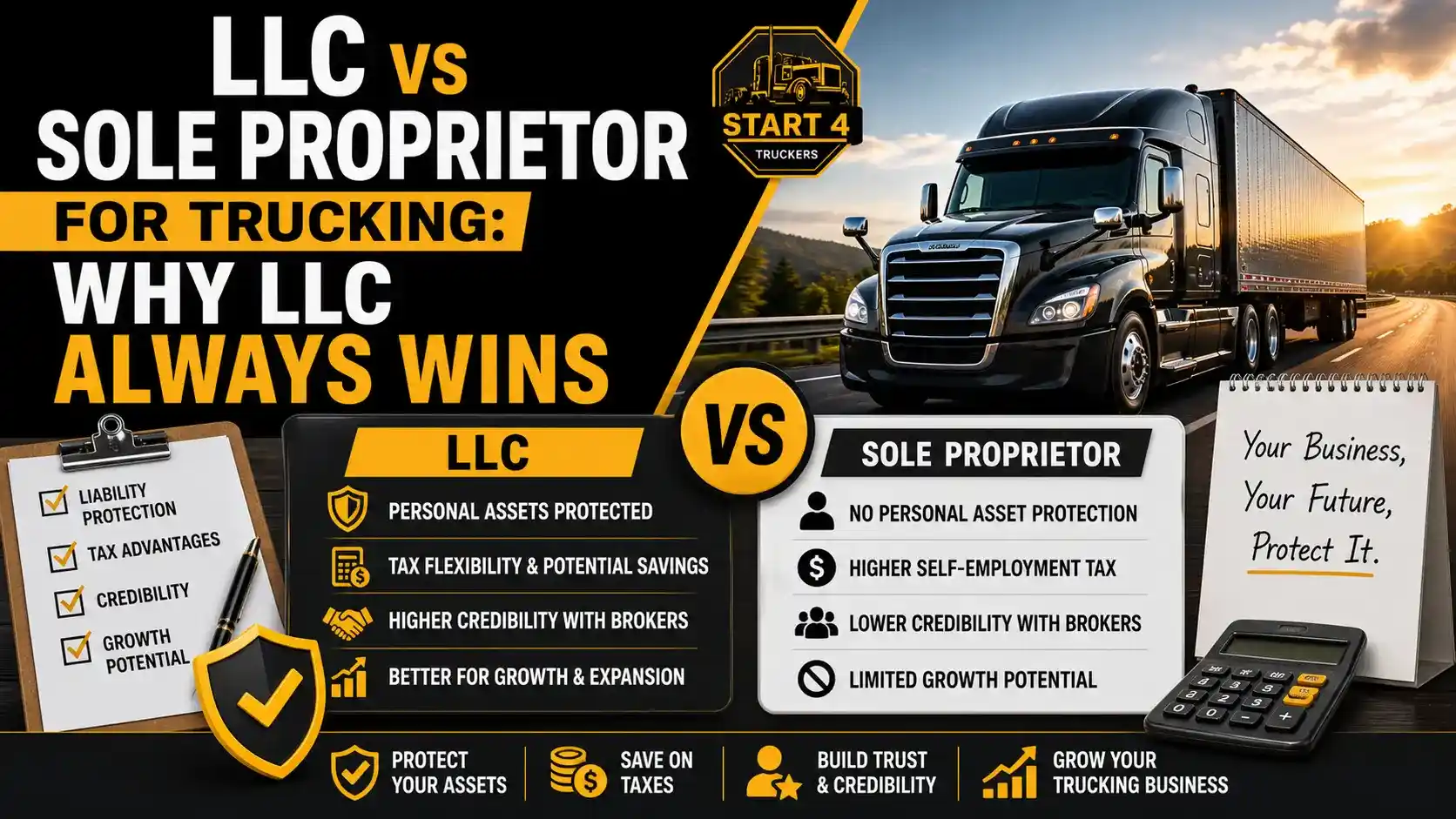
There is no single best business structure for trucking, but an LLC is usually the better fit once you own equipment, haul for brokers or shippers under your own authority, or plan to hire drivers. A sole proprietorship can work for a driver who is just starting out, leased on to a carrier, with one truck and little else at stake. Neither structure replaces insurance, and an LLC will not protect you from everything.
The rule of thumb: the more you have to lose, and the more parties you sign contracts with, the more an LLC earns its cost.
What a sole proprietorship means for a trucker
A sole proprietorship is the default. If you start hauling freight for pay and have not formed anything, you are one. There is no state formation filing and no separate business tax return. Income and expenses go on Schedule C of your personal Form 1040.
That simplicity is the appeal. You can open a bank account, buy a truck and start hauling with very little paperwork. If you want to operate under a business name, many states and counties require a “doing business as” (DBA) registration.
The trade-off is that the law sees one person. A business debt is your debt. A lawsuit against the business is a lawsuit against you, and your savings and other personal assets may be reachable to satisfy a judgment, depending on your state’s exemptions.
What an LLC does, and what it doesn’t
A limited liability company is a separate legal entity you create by filing articles of organization with a state. In general, the LLC owns the business assets and signs the business contracts, and your personal assets sit outside it. If the LLC cannot pay a supplier, that creditor usually cannot go after you personally.
Three limits matter for truckers:
- Your own negligence. If you cause a crash, you can be sued personally for what you did behind the wheel, LLC or not. Your liability policy does most of the work here.
- Personal guarantees. Lenders and equipment lessors often ask the owner to guarantee a loan personally. If you sign one, the LLC will not shield you from that debt.
- Sloppy separation. Mixing personal and business money, skipping annual filings or running the company with no capital can give a court reason to disregard the LLC, which lawyers call piercing the veil.
By default, a single-member LLC owned by an individual generally reports its business income on the owner’s federal tax return, much like a sole proprietorship. Different rules can apply to employment taxes, certain excise taxes and state-level obligations.
LLC vs sole proprietor for trucking: side by side
|
Factor |
Sole proprietorship |
LLC |
|
Liability for business debts |
Personal |
Generally limited to the business |
|
Liability for your own driving |
Personal |
Still personal |
|
Formation |
None; DBA if required |
State filing; operating agreement recommended |
|
Default federal tax |
Schedule C, self-employment tax generally applies |
Single-member: the same. S corporation election available |
|
Ongoing costs |
Minimal |
Annual report or fee in most states |
|
USDOT, MC, insurance, UCR |
Same requirements |
Same requirements |
|
Business and personal money |
Easy to blur |
Must be kept separate |
Where an LLC helps in practice
Consider three common situations.
- You hire a driver who causes a crash. The injured party can sue the LLC and, depending on the facts, you. A sole proprietor faces the same suit with no entity in between. The LLC adds a layer, and your insurance pays first.
- A fuel vendor or repair shop sues over an unpaid account. If the LLC signed the account agreement, the claim is generally against the LLC, not your personal bank account.
- A broker disputes a payment. Same logic: the contract is with the company.
How far the protection goes depends on the facts and your state’s law. Ask a business attorney before you rely on it.
How brokers, shippers and lenders see your structure
Structure can affect how you are treated in business dealings, though it guarantees nothing. Some brokers and lenders prefer to deal with a registered company rather than an individual, and an LLC name on your paperwork can look more established.
It will not offset weak credit, thin cash flow or a poor safety record, and it is not a requirement for operating authority or for financing. If you are buying or leasing a truck, ask the lender what they need in writing: entity documents, an EIN and, in many cases, a personal guarantee from you.
Keep your LLC’s liability protection intact
An LLC only helps if you run it like a separate business.
- Use a separate business bank account, and do not pay personal bills from it.
- Put the LLC’s exact name and EIN on contracts, insurance, bank accounts and your FMCSA registration.
- File your state’s annual report on time. In many states, missing it can lead to penalties or administrative dissolution.
- Keep a signed operating agreement, even as a single member.
- Carry insurance that matches your risk. The $750,000 federal minimum is a floor, and a serious crash can exceed it.
Taxes: Schedule C, self-employment tax and S corporations
As a sole proprietor, or as a single-member LLC with no election, you report profit on Schedule C and pay self-employment tax of 15.3% on 92.35% of your net profit. That covers Social Security and Medicare, and you pay both halves because you have no employer. You also owe regular income tax and, in most cases, quarterly estimated payments.So forming an LLC does not by itself lower your tax bill. Where an LLC can change your taxes is the S corporation election. An eligible LLC that files Form 2553 can be taxed as an S corporation. The owner then takes a reasonable salary, which carries payroll taxes, and takes the remaining profit as distributions, which generally are not subject to self-employment tax.
An S corporation is a tax election, not a separate type of business you form. A common path is to start with a default single-member LLC and revisit the election with a CPA once profit is steady. A C corporation is rarely a fit for a single truck, because its profit is taxed at the company level and taxed again when paid out as dividends.
The catch is real. You have to run payroll, file a separate business return (Form 1120-S) and pay yourself a salary the IRS considers reasonable for the work you do. For a driver with modest profit, the added accounting and payroll cost can eat the savings.
For a calendar-year business, the election is generally due by March 15 of the year it takes effect, or within two months and 15 days of forming a new entity. Talk to a CPA who works with truckers first, because fuel costs, depreciation and other deductions change the math. If you hire drivers, a single-member LLC is still treated as the employer for payroll tax purposes.
Federal registrations apply either way
Your entity type does not change what FMCSA and the IRS require. What changes is the name on every filing, so form the LLC before you register.
- USDOT number. Generally required for interstate commercial motor carriers operating vehicles with a GVWR, GCWR, gross vehicle weight or gross combination weight of 10,001 pounds or more, whichever is greater. Passenger and hazardous-material rules may also apply. Some states require USDOT numbers for intrastate operations.
- MC number (operating authority). Required if you haul regulated freight for hire across state lines. A USDOT number alone does not allow that. Carriers hauling only exempt commodities, or their own goods, may not need one.
- Insurance and BOC-3. For-hire carriers of non-hazardous general freight must carry at least $750,000 in public liability coverage, and the insurer files proof (BMC-91 or BMC-91X) with FMCSA. You also file a BOC-3 naming a process agent. Brokers and shippers often ask for more than the federal minimum, plus cargo coverage.
- UCR. Annual Unified Carrier Registration, priced by fleet size. For 0 to 2 vehicles, the fee is $46 for 2026 and $55 for 2027.
- Form 2290. Heavy Highway Vehicle Use Tax filing generally applies to highway vehicles with a taxable gross weight of 55,000 pounds or more. Full-year tax rates range from $100 to $550, although prorated taxes, suspended-tax treatment and exemptions may apply.
What it costs to form and maintain a trucking LLC
Cost depends on your state more than anything else. Filing fees for articles of organization run from under $100 to several hundred dollars, and many states add an annual report fee or franchise tax. California, for example, charges LLCs an $800 annual minimum franchise tax. Check your Secretary of State’s website for current figures.
Other items to plan for:
- A registered agent, if you do not want to serve as your own.
- An EIN, which the IRS issues for free.
- Local business licenses, depending on where you operate.
- Accounting help, especially if you elect S corporation treatment.
A sole proprietorship has almost none of these costs, which is its real advantage. Weigh the fees against how much you have to protect.
Best state to form a trucking LLC
In most cases, form the LLC in the state where you live and run the business. Forming in a cheaper or better-known state does not take you out of your home state’s rules. If you are based elsewhere, you generally have to register as a foreign LLC at home and pay those fees too, so you end up paying twice.
Which structure fits your operation
- One truck, leased on to a carrier, few assets. A sole proprietorship can be reasonable if you rely on the carrier’s authority and have little at risk. An LLC may still make sense as you grow.
- An owner-operator with your own authority. An LLC is usually the better fit. You sign contracts with brokers and shippers, carry your own insurance and own the compliance record.
- Hiring drivers or adding trucks. Form the LLC before you hire. More people on the road means more ways for a claim to start.
- Financing equipment. Read the loan or lease terms. Personal guarantees limit what the LLC can protect.
- Part-time hauling. Compare annual fees to your income. Insurance matters more than structure here.
Forming an LLC doesn’t complete your trucking registrations. If you’re starting under your own authority, Start4Truckers.com can help with company formation and the separate federal and state filings your operation requires.
Frequently asked questions
Do you need an LLC for a trucking company?
No. Federal rules do not require one. You can operate as a sole proprietor with a USDOT number and, if you haul for hire across state lines, MC authority. An LLC is a choice about liability and separation.
Can an owner-operator sole proprietor get a USDOT number and MC authority?
Yes. A sole proprietor can register with FMCSA in their own name. The registration, insurance and filing requirements are the same as for an LLC.
Does an LLC lower taxes for truck drivers?
Not by itself. A single-member LLC is taxed like a sole proprietorship unless it elects S corporation status. That election can reduce self-employment tax, but it adds payroll and a separate return.
Does an LLC protect me from a lawsuit after an accident?
Not from claims about your own driving. It can limit exposure to business debts and contract claims. Your insurance is the first line of defense after a crash.
How much does a trucking LLC cost?
State filing fees and annual fees vary widely. Add a registered agent if you use one, and any accounting costs. Check your state’s current fee schedule.
Can I switch from sole proprietor to LLC later?
Yes, you can form an LLC at any time. Then update your bank, insurance and FMCSA records, and confirm with FMCSA or a compliance specialist how your existing numbers are handled