Starting a trucking business in Florida is exciting, but before your wheels hit the road, you must get your USDOT number. Whether you’re operating within Florida or crossing state lines, this number is required to run legally. Without it, you risk fines, delays, or even shutdowns that can stop your business before it begins.
The Federal Motor Carrier Safety Administration (FMCSA) issues this number to track safety and compliance for commercial carriers. It’s a critical step every new trucker must complete to operate smoothly. Florida also has additional rules enforced by the Florida Department of Highway Safety and Motor Vehicles, even for intrastate carriers.
In this blog post, you will know everything about Florida DOT number requirements, from who needs one to how to apply, what it costs, and how to stay compliant. Let’s get into it.
What Is a DOT Number?
A DOT number, officially called a USDOT number, is a unique identification number issued by the FMCSA. Think of it like a Social Security number for your trucking business. It lets the government track your safety records, inspections, crash reports, and audit history.
Once you’re registered, your USDOT number stays connected to your company forever. Every time your truck gets inspected at a weigh station, or every time you’re part of an accident investigation, that number tells regulators who you are and how safely you’ve been operating.
Here’s what your DOT number is linked to:
- Safety audit history: Your roadside inspection results
- Compliance reviews: Whether your fleet meets federal safety standards
- Crash records: Reported accidents tied to your operation
- Insurance filings: Proof that you’re properly covered
For Florida carriers, this number is required for both interstate commerce (crossing state lines) and many types of intrastate operations (staying entirely within Florida).
Who Needs a DOT Number in Florida?
Not every truck on the road needs a DOT number, but more businesses qualify than you might think. Florida follows both FMCSA federal rules and its own state-level requirements. Here’s a breakdown:
Florida Intrastate DOT Number Requirements
Even if you never leave Florida, you may still need a Florida intrastate DOT number. Under Florida law, you’re required to register if your commercial operation fits any of these categories:
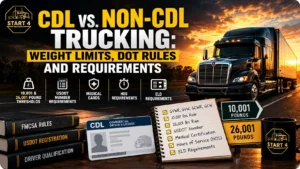
- Vehicles with a Gross Vehicle Weight Rating (GVWR) of 10,001 lbs or more
- Commercial vehicles transporting property for business purposes
- Passenger carriers with 8 or more passengers for compensation, or 15+ passengers without compensation
- Vehicles transporting hazardous materials that require placards under federal law
Real example: If you run a box truck inside Florida for a local delivery company and your vehicle weighs over 10,001 lbs, you need a DOT number even if you never cross the Florida state line.
Florida Interstate DOT Requirements
If your logistics operations cross state lines, say, hauling freight from Miami to Atlanta, you’re in interstate commerce territory. The FMCSA Unified Registration System (URS) requires all interstate motor carriers to have a USDOT number, no exceptions.
Real example: A flatbed company based in Tampa that picks up cargo in Orlando and delivers to Alabama must register under FMCSA’s interstate rules and obtain a USDOT number before their very first trip.
Do You Need an MC Number Too? (DOT vs MC Number Explained)
This is one of the most common questions from new Florida truckers. The short answer: a DOT number and an MC number are not the same thing, and some carriers need both.
| Feature | DOT Number | MC Number |
| Issued by | FMCSA | FMCSA |
| Purpose | Safety & identity tracking | Operating authority for hire |
| Who needs it | Most commercial carriers | For-hire interstate carriers |
| Cost | Free | ~$300 filing fee |
| Required for intrastate? | Often yes (FL-specific) | No |
| Required for interstate for-hire? | Yes | Yes |
If you’re hauling freight for other people across state lines and getting paid for it, you need a motor carrier authority, which is your MC number. If you’re an owner-operator running your own goods intrastate, you likely only need the DOT number.
Documents & Information You Need Before Applying
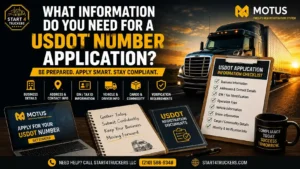
Before you sit down to fill out the online application, gather the following. Having everything ready saves time and reduces errors.
- Business legal name and contact information
- Tax id (Employer Identification Number) or SSN if you’re a sole proprietor
- Business structure: LLC, sole proprietor, corporation, etc.
- Vehicle details, including GVWR and the number of trucks
- Type of operation: interstate or intrastate
- Cargo type: general freight, hazardous materials, passengers, etc.
- Principal place of business address
- Insurance information (required for activation)
How to Get a DOT Number in Florida (Step-by-Step Process)
Here’s exactly how to get your USDOT number in Florida. Follow these steps to avoid delays or rejections.
Step 1: Determine Whether Your Business Qualifies
Ask yourself: Does my vehicle weigh over 10,001 lbs? Do I transport goods or people commercially? Do I cross state lines? If you answered yes to any of these, you very likely need a DOT number.
And yes, owner-operators need a DOT number in Florida if they operate a qualifying vehicle. You can also apply even if you don’t own a truck yet. The DOT number is assigned to your business entity, not the vehicle itself.
Step 2: Register Online via the FMCSA URS Portal
Head to the FMCSA Unified Registration System portal at fmcsa.dot.gov. Create an account using your business email and name. You’ll select your entity type (LLC, corporation, sole proprietor) and enter your Tax id or SSN.
This is the official federal portal. Be careful of third-party sites that charge fees just to submit the application. The basic USDOT number Florida application is completely free.
Step 3: Complete the MCS-150 Form
The MCS-150 form filing is the Motor Carrier Identification Report. It collects key information about your operation:
- Operation classification: Are you an intrastate or interstate carrier?
- Cargo classification: What are you hauling?
- Hazardous materials section: Do you transport hazmat?
- Fleet size: number of power units and drivers
- Safety certification: confirming your vehicles meet federal safety standards
Take your time on this form. Incorrect classifications are one of the top reasons carriers face compliance violations and penalties down the road.
Step 4: File the BOC-3 (If Required)
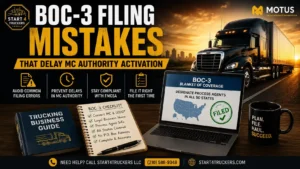
If you’re applying for interstate operating authority (MC number), you’ll also need to complete the BOC-3 filing process. This form designates process agents in each state where you’ll operate.
Florida-based interstate carriers must complete the BOC-3 before their authority becomes active. Process agent services typically charge $30–$75 to handle this filing on your behalf.
Step 5: Register for UCR (If Interstate)
If you operate across state lines, you also need to register under the Unified Carrier Registration (UCR) program. This annual registration fee is based on fleet size and is separate from your DOT application.
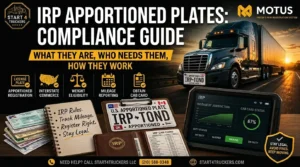
Interstate carriers should also be aware of the International Registration Plan (IRP) and the International Fuel Tax Agreement (IFTA) for apportioned license plates and fuel tax reporting when crossing into other states.
Step 6: Verify and Activate Your DOT Number
Once submitted, your DOT number is issued almost instantly online. However, it takes up to 20 days to become fully active in the FMCSA system, meaning your record is publicly visible, and your insurance filings are confirmed.
If you apply by mail instead of online, expect up to 6 weeks for processing. Always go online when possible.
How Much Does It Cost to Get a DOT Number in Florida?
The good news: getting a DOT number is completely free. The FMCSA does not charge a fee for the USDOT number itself. But that’s just the beginning. Here’s a realistic breakdown of what launching a compliant Florida trucking startup actually costs:
| Cost Item | Estimated Cost | Required? |
| USDOT Number Application | Free | Yes |
| MC Number (Operating Authority) | ~$300 | If interstate for-hire |
| BOC-3 Filing | $30–$75 | If interstate |
| UCR Registration (1 truck) | $76–$200/year | If interstate |
| LLC Formation (Florida) | ~$125 state fee | Recommended |
| Commercial Trucking Insurance | $5,000–$15,000+/year | Yes (for activation) |
| IRP Apportioned Plates | Varies by state/mileage | If interstate |
Want a full breakdown of everything you’ll need? See our Plans and Pricing to understand exactly what to budget from day one.
How Long Does It Take to Get a DOT Number in Florida?
Speed matters when you’re ready to start hauling. Here’s what to expect:
- Online application: USDOT number issued almost immediately after submission
- Full system activation: 20 days for your record to appear fully active in FMCSA’s database
- Mail application: Up to 6 weeks is not recommended
- Operating authority (MC number): After filing, there’s a 10-day protest period before authority is officially granted
Apply online on a Monday, and you could have your DOT number the same day. Full activation takes about three weeks.
How to Check Your DOT Number Status
Once you’ve applied, you can verify your registration using the FMCSA SAFER system. Enter your DOT number or company name to pull up your record.
Your status will show one of three states:
Active: You’re registered and compliant
Inactive: Your number exists but hasn’t been fully activated (check your insurance filings)
Out of Service: There’s a compliance or safety issue that needs immediate attention
If your status shows inactive after the 20-day window, double-check that your insurance carrier has filed the correct forms with FMCSA.
Can You Get a DOT Number in Florida Without a Truck?
Yes absolutely. The DOT number is issued to your business entity, not to a specific vehicle. Many startup trucking companies register before purchasing their first truck, and that’s perfectly legal.
This makes sense for entrepreneurs who want to get their legal setup done early, line up loads or contracts, and then bring on equipment. Just remember: you’ll need a truck on record before your operating authority is activated and before you can officially haul freight commercially.
Florida DOT Number Compliance Requirements
Getting your DOT number is just the beginning. Staying compliant is an ongoing responsibility. Here’s what Florida carriers need to keep up with:
Insurance Requirements
Your commercial vehicle registration isn’t complete without proper insurance on file. FMCSA minimums are:
- $750,000 liability coverage for general freight
- $1,000,000+ for most hazardous materials transport
- $5,000,000 for certain high-risk hazmat operations
Your insurance provider must file directly with FMCSA using Form MCS-90. Your authority stays active only as long as your coverage stays current.
Annual MCS-150 Updates
Every two years or within 90 days of a significant operational change, you must update your MCS-150 form. Failure to do so can result in your DOT number being flagged as inactive, which can disrupt your ability to operate.
Safety Audits
New entrant carriers are subject to a safety audit within the first 12 months of operation. This review checks your driver qualification files, vehicle maintenance records, and hours-of-service logs. Pass it, and you stay in business. Fail it, and your authority can be revoked.
Florida Intrastate Renewals
Florida intrastate carriers must also comply with Florida Department of Highway Safety and Motor Vehicles requirements, which may include separate state-level renewals and DOT compliance Florida inspections at port-of-entry checkpoints throughout the state.
Common Mistakes Florida Truckers Make (and How to Avoid Them)
These errors can cost you money, time, and your motor carrier authority:
- Wrong operation classification: Marking yourself as intrastate when you haul interstate triggers audits and fines
- Forgetting UCR registration: Required annually for interstate carriers; missing it is a compliance violation
- Skipping the BOC-3: Without it, your MC authority will never activate
- Incorrect GVWR: Always use the actual rated weight, not the loaded weight
- Not updating MCS-150: Even if nothing changed, the biennial update is mandatory
- Confusing intrastate vs interstate: One crossing of a state line changes your entire compliance picture
Need help staying on the right side of the regulations? Our Trucking compliance services provide ongoing support so nothing slips through the cracks.
Checklist: What You Need to Register for a DOT Number in Florida
Use this before you start your application to make sure you’re fully ready:
- Legal business name confirmed (LLC, sole proprietor, etc.)
- Tax id obtained from the IRS (or SSN for sole proprietors)
- Business address verified
- Vehicle GVWR calculated for all trucks
- Operation type determined: intrastate or interstate
- Cargo type identified (general freight, hazmat, passengers)
- Insurance coverage arranged and ready to file
- BOC-3 process agent identified (if applying for MC number)
- UCR registration fees budgeted (if interstate)
- FMCSA URS account created
Conclusion:
Getting your DOT number in Florida is simple once you understand the steps, but staying compliant is where most truckers struggle. From MCS-150 updates to UCR fees, ongoing requirements can quickly become overwhelming. That’s where Start4Truckers LLC comes in, helping you handle DOT registration, LLC setup, and compliance the right way from day one so you can stay focused on the road.
Ready to launch your trucking company the right way? Explore our Full Trucking Company Setup Packages and let Start4Truckers LLC handle the paperwork while you focus on the road ahead.
FAQs
1. How much does it cost to get a DOT number in Florida?
The DOT number itself is free. If you also need an MC number, that costs $300. Additional costs include BOC-3 filing, UCR registration, insurance, and LLC formation if applicable.
2. Can I get a DOT number online?
Yes. The FMCSA Unified Registration System (URS) lets you apply entirely online. It’s fast, free, and the recommended method.
3. Does a DOT number expire?
Your DOT number doesn’t expire, but it can become inactive if you fail to update your MCS-150 biannually or if your insurance lapses.
4. How long is a DOT number valid?
It’s valid indefinitely as long as you maintain compliance especially by keeping your MCS-150 updated and your insurance active with FMCSA.
5. Do I need insurance before getting a DOT number?
You can apply for the DOT number without insurance, but your authority won’t be fully activated until your insurance carrier files the required forms with FMCSA.
6. Can I operate without a DOT number in Florida?
No. If you operate a qualifying vehicle (GVWR 10,001 lbs or more) commercially in Florida, you are legally required to have a USDOT number. Operating without one can result in fines, out-of-service orders, and loss of operating rights.
7. What disqualifies me from getting a DOT number?
Serious safety violations, outstanding compliance orders, or operating under a revoked authority can lead to denial. The FMCSA may also deny registration if you have a history of using multiple DOT numbers to avoid safety rules.
8. How do I update my DOT number information?
Log in to your FMCSA URS account and submit an updated MCS-150 form. You’re required to do this at least every two years or within 90 days of any major change.
9. Do owner-operators need a DOT number in Florida?
Yes. If you’re an owner-operator with a qualifying commercial vehicle (10,001 lbs GVWR or more), you must register and have your own USDOT number.
10. Is a DOT number required for intrastate trucking in Florida?
Yes, in many cases. Florida requires intrastate carriers to register if their vehicles exceed 10,001 lbs GVWR, carry hazardous materials, or transport passengers for compensation.
11. What is the difference between a DOT and an MC number?
A DOT number is used for identification and safety tracking. An MC number provides operating authority for for-hire carriers transporting goods or passengers across state lines.
12. How do I check my DOT number status?
Use the FMCSA SAFER system at safer.fmcsa.dot.gov. Enter your company name or USDOT number to view your current registration status.