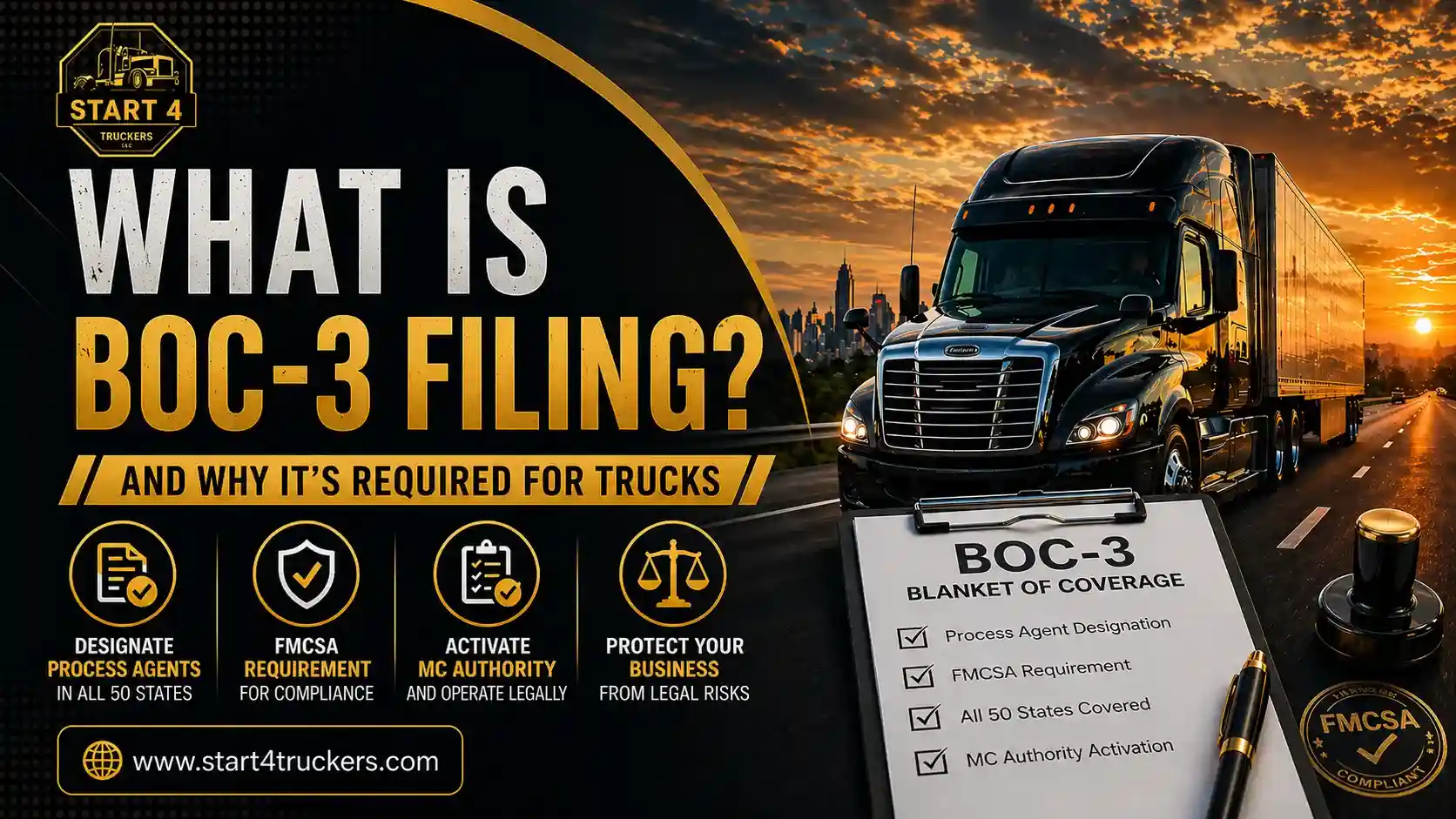
Starting a trucking business comes with a lot of paperwork. One of the most important forms you’ll hear about is the BOC-3 filing. But what is BOC-3 filing, exactly? And why does the FMCSA require it?
Simply put, a BOC-3 is a federal form that assigns a process agent to represent your trucking company in every U.S. state. Without it, your MC authority will never activate and you can’t legally haul freight across state lines.
Whether you’re a new carrier, a freight broker, or an owner-operator, this guide will walk you through everything you need to know. At Start4Truckers LLC, we help trucking businesses file their BOC-3 fast and get their authority activated without the confusion.
Let’s break it all down.
What Is BOC-3 Filing?
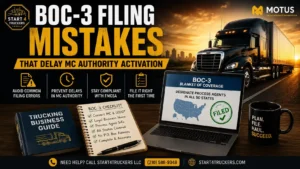
BOC-3 stands for Blanket of Coverage. It’s an official FMCSA form used to designate process agents across all 50 states.
A process agent is a person or company authorized to receive legal documents on your behalf in each state. This includes court papers, lawsuits, and official government notices.
The designation of process agents is a legal requirement under federal transportation regulations. The FMCSA wants every carrier to have a local point of contact in every state so that if something legal happens, there’s always someone who can be reached.
Think of it this way: if your trucking company is registered in Texas but you haul freight to New York, the FMCSA needs to know who receives legal papers in New York on your behalf. That’s what your process agent does.
What Does a BOC-3 Form Include?
The form includes:
- Your company’s legal name and address
- Your USDOT number and MC number
- A complete list of all 50 states
- The name and contact of your designated process agent in each state
- Certification by an authorized blanket agent
Most trucking companies use a blanket agent — one company that covers all states under a single filing. This is faster, cheaper, and easier than hiring individual agents for each state.
Why BOC-3 Filing Is Required for Trucks
The FMCSA requires this filing because interstate trucking operations cross multiple state lines. Each state has its own legal system. If a lawsuit is filed against your company in a state where you don’t have a local representative, the legal process breaks down.
That’s why FMCSA compliance requirements include having a process agent in every state you operate in or may operate in.
Here’s the key point: you cannot activate your MC authority without a BOC-3 on file. It’s one of the final steps in the MC authority registration process.
This requirement applies nationwide. It doesn’t matter if you’re in Florida, California, or anywhere in between — all motor carriers operating in interstate commerce must file a BOC-3.
Who Needs to File a BOC-3?
Motor Carriers
If you’re applying for operating authority for trucking, you need a BOC-3. This includes:
- New carriers applying for an MC number
- Interstate carriers hauling goods across state lines
- Anyone going through trucking company setup
If you’re just getting started, check out this full guide on how to start a trucking company before diving into filings.
Freight Brokers and Freight Forwarders
Freight brokers and freight forwarders also need a BOC-3. However, unlike carriers, they are allowed to file the form themselves without using a blanket agent — as long as they have someone who qualifies in each state.
That said, most brokers still prefer using a professional service to avoid errors.
Owner-Operators
If you’re an independent owner-operator with your own MC authority, you must file a BOC-3. If you’re leased to a carrier and operating under their authority, you typically don’t need one.
Not sure which setup is right for you? Read our comparison on owner-operator vs company driver and how to become an owner-operator truck driver.
What Does a BOC-3 Process Agent Do?
A BOC-3 process agent plays a quiet but critical role in your trucking business. Here’s what they do:
- Receive legal notices sent to your company in their state
- Accept court documents if your company is involved in a lawsuit
- Handle FMCSA correspondence when needed
- Protect your business during any legal action by ensuring proper service of process
You don’t interact with your process agent day-to-day. But if something legal happens, they step in immediately.
This is why service of process is so important under federal transportation regulations. Without a valid agent on file, a court could claim your company was never properly served — creating major legal problems.
BOC-3 Filing Requirements
Here are the core FMCSA compliance requirements for the BOC-3:
| Requirement | Details |
| Who must file | Motor carriers, brokers, freight forwarders |
| Who can file | Authorized blanket agents only (for carriers) |
| When to file | Before MC authority activates |
| Coverage | All 50 U.S. states |
| Filing frequency | One-time (not annual) |
| Must be kept at | Principal place of business |
The form must be submitted by an authorized blanket agent for motor carriers. This is a company or individual approved by the FMCSA to handle these filings on your behalf.
You can learn more about your DOT number vs MC number requirements to understand how BOC-3 fits into the bigger picture.
How To File BOC-3: Step-by-Step Guide
Filing a BOC-3 is straightforward when you follow the right steps.
Step 1: Choose an FMCSA-Authorized Process Agent
Look for a company with a nationwide network of process agents in all 50 states. Make sure they are authorized to file with the FMCSA through the Unified Registration System.
Ready to skip the search? File your BOC-3 with a trusted authorized agent and get your coverage set up fast — all 50 states, no hassle.
Step 2: Provide Your Company Information
You’ll need to share:
- Legal business name
- Principal business address
- USDOT number
- MC number (if already issued)
- Type of operation (carrier, broker, forwarder)
If you don’t have a DOT number yet, here’s how to get a DOT number in Florida as an example. You can also use our USDOT number lookup guide to verify your current registration status.
Step 3: Agent Files BOC-3 With FMCSA
Your chosen process agent submits the form electronically through the FMCSA. This includes a list of all state agents and certifies that your company is covered.
Step 4: Confirmation + Authority Activation
Once the BOC-3 is processed, your MC authority moves closer to activation. You’ll receive a confirmation, and your authority status on the FMCSA portal will update.
Step 5: Maintain a Copy at Your Business Address
FMCSA requires you to keep a copy of the BOC-3 at your principal place of business. This is an easy step that many new carriers forget.
Can You File Your Own BOC-3?
Motor Carriers: No
Motor carriers cannot file their own BOC-3. The FMCSA requires the form to be filed by an authorized blanket agent. You must hire a third-party service.
Freight Brokers and Freight Forwarders: Yes
Freight brokers and forwarders can file their own BOC-3, but only if they have qualified individuals in each state who meet FMCSA standards. Most still prefer professional services to avoid errors and delays.
How Much Does BOC-3 Filing Cost?
BOC-3 filing is one of the most affordable compliance steps in trucking.
| Service Type | Estimated Cost |
| Basic BOC-3 filing | $20 – $40 |
| BOC-3 with MC authority setup | $40 – $60+ |
| Annual process agent service | Varies by provider |
Note: The FMCSA does not charge a fee for the BOC-3 itself. The cost goes to the authorized agent handling the filing.
Some companies charge a yearly maintenance fee to keep your process agent coverage active. This is not an FMCSA requirement — it’s a business decision by the service provider.
At Start4Truckers LLC, we offer fast BOC-3 filing at a competitive price with no hidden fees.
What Happens If You Don’t File a BOC-3?
Skipping the BOC-3 has serious consequences:
- Your MC authority will never activate
- You cannot legally haul interstate freight
- Your USDOT file stays incomplete
- FMCSA may dismiss your authority application
- You risk fines and out-of-service orders
This is one step you simply cannot skip. It’s a mandatory federal filing — not optional.
Is BOC-3 a One-Time Filing or Annual Requirement?
Here’s the good news: BOC-3 is a one-time filing.
Once it’s submitted and processed by the FMCSA, it stays on file permanently unless you change your process agent. You don’t need to renew it every year.
However, some process agent companies charge an annual fee to maintain your coverage listing. That’s a separate business arrangement and is not required by the FMCSA. Always read the fine print before signing up with a service provider.
Do You Need a Process Agent in Every State?
Yes. The FMCSA requires coverage in all 50 states, even if you only plan to operate in a few.
There are two types of agents:
- Individual agents: One person per state. Expensive and time-consuming.
- Blanket agents: One company that covers all 50 states. Preferred by most carriers.
Blanket agents are almost always the better choice. They file a single BOC-3 that covers your entire operation nationwide. It’s faster, cheaper, and simpler than managing 50 separate agents.
How To Check If Your BOC-3 Is Filed With FMCSA
You can verify your BOC-3 status directly on the FMCSA portal.
Here’s how:
- Go to the FMCSA website
- Click on “Licensing & Insurance”
- Enter your MC number or USDOT number
- Check the “BOC-3” section for active status
Your authority status will show as:
- Authority Active: BOC-3 is on file and everything is in order
- Authority Pending: Filing is still being processed
- Authority Not Issued: BOC-3 or other documents may be missing
If something looks wrong, read our USDOT number lookup guide or contact your filing service for help.
BOC-3 Filing vs MC Authority — What’s the Difference?
These two are related but different.
| Feature | BOC-3 Filing | MC Authority |
| What it is | Legal agent designation | Federal operating license |
| Who issues it | Process agent/blanket agent | FMCSA |
| Purpose | Assigns legal representative | Grants right to operate |
| Required for | All interstate carriers | All interstate carriers |
| Filing cost | $20–$60 | $300 (FMCSA fee) |
| One-time or recurring | One-time | One-time (annual update required) |
| Dependency | Must be filed to activate MC | Cannot activate without BOC-3 |
In short: BOC-3 is a required step to activate your MC authority. You can have an MC number, but without the BOC-3, your authority won’t go live.
If you’re still figuring out your full business structure, it’s also worth reading about LLC vs sole proprietor for trucking before you register.
Why Choose Start4Truckers LLC for BOC-3 Filing?
Filing a BOC-3 doesn’t have to be stressful. At Start4Truckers LLC, we handle the entire process for you.
Here’s what you get:
- Fast filing — usually processed within 1 business day
- Nationwide coverage through authorized process agents
- Help with MC authority activation after filing
- Transparent pricing with no surprise fees
- Expert compliance support from real trucking specialists
We work with new carriers, owner-operators, and freight brokers every day. Whether you’re just getting started in trucking or need to clean up a compliance issue, we’re here to help.
You can also explore our full range of trucking compliance services or check our plans and pricing to find the right package for your needs.
Conclusion
BOC-3 filing is not optional. It’s a federal compliance requirement that every motor carrier, freight broker, and freight forwarder must complete before operating legally across state lines.
It assigns a process agent in all 50 states, protects your business from legal exposure, and most importantly unlocks your MC authority so you can start hauling freight. The good news? It’s simple, affordable, and fast when done right.
Don’t let paperwork slow down your trucking business. Get your BOC-3 filed today with Start4Truckers LLC and get your authority activated without the headaches. You can also request a free consultation if you have questions about your specific situation.
Your trucking career is waiting — let’s get you legal and on the road.