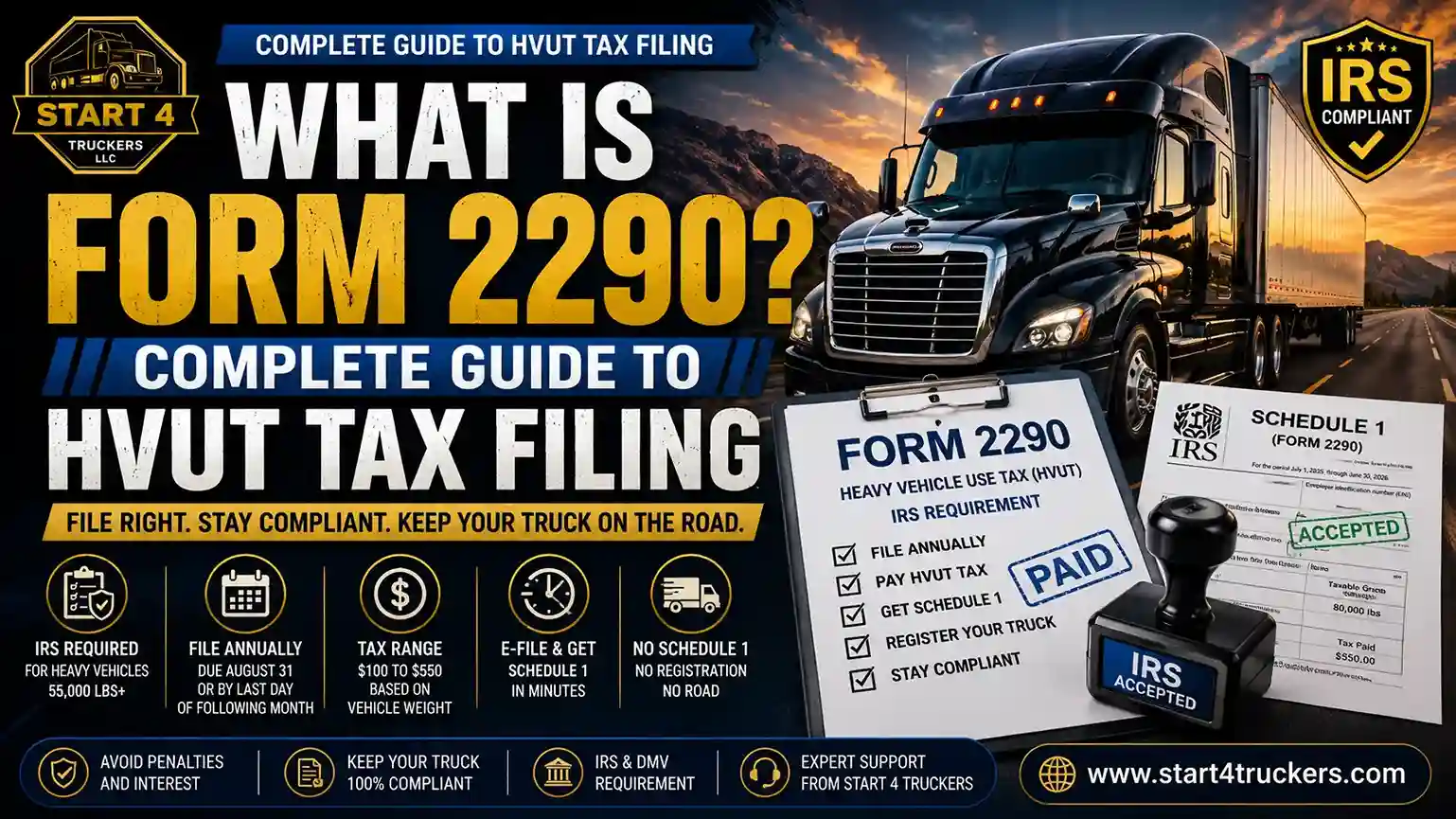
If you own or operate a heavy commercial truck in the United States, there is one IRS requirement you cannot ignore: Form 2290. Miss it, and your truck cannot legally hit the road. Your registration gets blocked. The IRS charges penalties. And your whole operation comes to a halt.
This guide breaks down everything you need to know about IRS Form 2290, what it is, who files it, how much it costs, and how to stay fully compliant. Whether you are a first-time owner-operator or managing a full fleet, this is the only Form 2290 guide you need.
What Is Form 2290?
Form 2290 is an IRS tax return used to report and pay the Heavy Vehicle Use Tax (HVUT), a federal tax on heavy highway motor vehicles with a gross weight of 55,000 pounds or more that operate on public roads in the United States.
Filed annually with the Internal Revenue Service, Form 2290 applies to trucks, tractor-trailers, and other heavy highway vehicles. Once you file and pay, the IRS stamps your Schedule 1 (Form 2290) with your official proof of payment. Without that stamped Schedule 1, you cannot register your truck or renew your plates.
In simple terms: No Form 2290 = No legal trucking.
Why This Matters for Every Truck Owner
- The IRS can assess penalties of 4.5% of the total tax per month for late filing
- Your state DMV will block vehicle registration without a stamped Schedule 1
- DOT roadside inspections can flag non-compliant trucks
- Fleet operators risk multiple trucks going out of service simultaneously
Who This Guide Is For
This guide is built for owner-operators filing for the first time, trucking companies managing fleet compliance, new trucking businesses setting up operations, and lease operators figuring out who is responsible for filing. It has been prepared by Start4Truckers LLC to give every trucker clear, no-fluff compliance guidance.
What Is Form 2290 Used For? (IRS and Compliance Context)
IRS Purpose of Form 2290
The Heavy Vehicle Use Tax exists to fund highway maintenance across the United States. Heavy trucks cause significantly more wear on public roads than passenger vehicles. The federal government collects HVUT through Form 2290 and routes that money into the Highway Trust Fund, which pays for road repairs, bridge maintenance, and infrastructure projects nationwide.
Why Truckers Must File It
For truck owners, Form 2290 is not optional. It is a federal legal requirement tied directly to your vehicle registration and operating authority. The Federal Motor Carrier Safety Administration (FMCSA) and state DMVs both use proof of HVUT payment as part of the registration process.
If you are getting your trucking authority or setting up a new carrier, Form 2290 is one of the first tax requirements you will face.
Who Needs to File Form 2290?
Owner-Operators
If you own and operate a single truck with a gross vehicle weight of 55,000 lbs or more and drive it on public highways, you are required to file Form 2290. There are no exceptions for small operators. One truck still means full compliance responsibility.
New to owner-operating? Read our complete owner-operator guide to understand every compliance requirement before you hit the road.
Trucking Companies and Fleets
Fleet owners must file Form 2290 for every qualifying vehicle. If your fleet has 25 or more vehicles, the IRS requires you to e-file. Larger fleets face a bigger risk; one missed filing can mean multiple trucks off the road at the same time.
Leased Truck Operators
For leased vehicles, the responsibility for filing Form 2290 typically falls on whoever is considered the registrant of the vehicle. In most cases, that is the owner of the truck, not the driver. Always check your lease agreement to confirm who is responsible before the filing deadline.
Exempt Vehicles
Not every heavy vehicle requires Form 2290. The following are generally exempt:
- Government-owned vehicles (federal, state, local)
- Qualified blood collector vehicles
- Mobile machinery not designed for highway transportation
- Vehicles used exclusively for farming may qualify for suspended status
Form 2290 Requirements (Eligibility Rules Explained)
Vehicle Weight Rule (55,000 lbs+)
The HVUT applies to any highway motor vehicle with a taxable gross weight of 55,000 pounds or more. Taxable gross weight includes the vehicle itself, any trailers, and the maximum load it carries.
Vehicles under 55,000 lbs are not subject to HVUT and do not need to file Form 2290.
Mileage Rule (5,000 / 7,500 Agricultural)
Even if your truck qualifies by weight, it may be eligible for suspended vehicle status if it is expected to travel 5,000 miles or less during the tax year (7,500 miles for agricultural vehicles). Suspended vehicles still need to file Form 2290, but no tax is owed. If the mileage threshold is later exceeded, you must amend your filing and pay the tax.
Tax id Requirement
You must have an Employer Identification Number (Tax id) to file Form 2290. Social Security Numbers are not accepted by the IRS for this filing. Even sole proprietors need an Tax id. If you do not have one yet, get your Tax id registration sorted before your filing deadline.
Vehicle Usage Conditions
The vehicle must be used on public highways in the United States. Trucks used exclusively on private property or off-road do not qualify as highway motor vehicles and are not subject to HVUT.
Form 2290 Filing Deadline and Tax Year Explained
HVUT Tax Period (July–June)
The HVUT tax year runs from July 1 to June 30. Most truckers file once a year. The standard filing deadline for trucks in use at the start of the tax year is August 31.
Monthly Filing Rule for New Vehicles
If you purchase or begin using a new truck mid-year, you must file Form 2290 by the last day of the month following the first month of use. For example, if you put a new truck on the road in October, your filing deadline is November 30.
Deadline Table
| First Used Month | Filing Deadline |
| July | August 31 |
| August | September 30 |
| September | October 31 |
| October | November 30 |
| November | December 31 |
| December | January 31 |
| January | February 28/29 |
| February | March 31 |
| March | April 30 |
| April | May 31 |
| May | June 30 |
| June | July 31 |
Why Late Filing Is Risky
Missing the deadline is not a minor inconvenience. The IRS charges a monthly penalty of 4.5% of the unpaid tax for up to five months, plus an additional 0.5% per month in interest. Beyond financial penalties, your DMV registration renewal will be blocked until your stamped Schedule 1 is on file. Every day you delay is a day your truck is at risk of being grounded.
How Much Does Form 2290 Cost?
Tax Rate Breakdown ($100–$550)
HVUT is calculated based on your vehicle’s taxable gross weight. The base rate structure is:
- $100 base tax for vehicles at 55,000 lbs
- +$22 per additional 1,000 lbs above 55,000 lbs
- Maximum tax: $550 for vehicles at 75,000 lbs or more
Weight-Based Examples
| Taxable Gross Weight | Annual HVUT |
| 55,000 lbs | $100 |
| 60,000 lbs | $210 |
| 65,000 lbs | $320 |
| 70,000 lbs | $430 |
| 75,000+ lbs | $550 (maximum) |
A standard 18-wheeler at 80,000 lbs gross weight pays the maximum of $550 per year in HVUT.
Suspended Vehicles Explanation
If your truck is expected to travel 5,000 miles or less (7,500 for agricultural), you still file Form 2290, but check the suspension box. No tax is due at filing. However, if you later exceed the mileage limit, you must file an amended return and pay the full tax for the year.
How to File Form 2290 Online Step-by-Step
Required Documents
Before you start, gather the following:
- Tax id (Employer Identification Number, not SSN)
- Vehicle Identification Number (VIN) for each truck
- Taxable gross weight of each vehicle
- First-use month for the tax year
- IRS payment method (EFTPS, credit/debit card, or check)
Not sure if you have everything in order? Book a free consultation with Start4Truckers LLC, and we will review your documents and make sure your Form 2290 filing goes in completely and on time.
Step-by-Step Filing Process
- Choose an IRS-authorized e-file provider, or let Start4Truckers LLC handle your Form 2290 filing so you skip the hassle entirely.
- Enter your business information, name, address, and Tax id
- Add each vehicle VIN, weight category, and first-use month
- Calculate your tax the system does this automatically based on weight
- Select your payment method and submit your return
- Receive your stamped Schedule 1 usually within minutes via e-file
Common Filing Mistakes
- Entering an incorrect VIN: The most common reason for IRS rejection
- Using the wrong weight category: Always verify against your vehicle title
- Filing without an Tax id: SSNs are not accepted; get your Tax id first
- Missing the first-use month: This determines your correct deadline
How to E-File Form 2290 Fast
Why E-Filing Is Recommended
E-filing is faster, safer, and more accurate than paper filing. You receive your stamped Schedule 1 within minutes of IRS acceptance, compared to weeks when filing by mail. Fewer data entry errors, instant confirmation, and no lost paperwork.
Paper vs E-File Comparison
| Factor | Paper Filing | E-Filing |
| Schedule 1 Turnaround | 4–6 weeks | Minutes |
| Error Rate | Higher | Lower |
| Confirmation | None immediate | Instant |
| Required for 25+ vehicles | No | Yes (IRS mandate) |
| Recommended | No | Yes |
IRS E-File Requirement Rule
The IRS requires e-filing for anyone filing Form 2290 for 25 or more vehicles. For fleets of any size, e-filing is the smarter choice. It eliminates mailing delays and ensures your Schedule 1 is in hand before any registration deadlines.
What Is Schedule 1 in Form 2290?
Why It Is Important
Schedule 1 (Form 2290) is the IRS-stamped document that proves you have paid your Heavy Vehicle Use Tax. It is not just a receipt; it is a legally required document for truck registration and operation.
Without a stamped Schedule 1, you cannot register your truck, renew your plates, or obtain IRP apportioned registration. Learn more about how Schedule 1 connects to the registration process in our IRP apportioned plates guide.
DMV and Registration Use
Every time you register or renew a heavy vehicle, your state DMV requires a copy of your IRS-stamped Schedule 1. This applies to:
- New truck registration
- Annual plate renewal
- IRP apportioned plate registration
- Adding a vehicle to an existing fleet account
Keep It in Your Truck
Your stamped Schedule 1 should always be kept inside the vehicle. DOT officers and weigh station inspectors may request it during roadside inspections. A missing Schedule 1 is a compliance violation, even if you have paid your tax.
What Happens If You Don’t File Form 2290?
IRS Penalties
The IRS does not overlook missed HVUT filings. The penalty structure is:
- 4.5% of total unpaid tax per month for up to 5 months
- 0.5% per month in interest on unpaid balances
- Fraud or intentional disregard carries even steeper penalties
On a $550 tax bill, five months of penalties alone can add over $123 in fees before interest.
Registration Blocking
Without a stamped Schedule 1, your state DMV will refuse to process your vehicle registration. Your truck sits. You lose revenue. And the longer you wait, the deeper the hole gets.
Fleet-Level Risk
For trucking companies, this risk multiplies. If an entire fleet’s Form 2290 filing is missed or rejected, every single vehicle faces registration problems simultaneously. One administrative mistake can take an entire operation off the road. This is why proactive trucking compliance support is critical for fleet operators.
Form 2290 Amendments and VIN Corrections
Why Amendments Are Needed
You may need to file an amended Form 2290 when:
- You entered an incorrect VIN on the original filing
- Your vehicle’s taxable gross weight increased during the year
- A suspended vehicle exceeded the 5,000-mile limit
- You need to add a vehicle that was missed in the original filing
How to Fix Errors
To correct a VIN error, check the VIN correction box on a new Form 2290 and resubmit. There is no additional tax for a VIN correction. For weight increases or mileage threshold violations, you file an amended return and pay the difference. The IRS processes amendments the same way as original filings e-filing is the fastest method.
Form 2290 Refunds (Sold or Retired Vehicles)
Eligibility Rules
You may be eligible for a partial HVUT refund if:
- You sold or transferred a truck during the tax year
- Your vehicle was destroyed, stolen, or retired from service
- A suspended vehicle was sold before exceeding the mileage limit
Refunds are prorated based on the number of months remaining in the tax year.
Form 8849 Mention
To claim your refund, file Form 8849 (Claim for Refund of Excise Taxes) with Schedule 6. This is a separate IRS form from Form 2290. Keep your original stamped Schedule 1 and bill of sale as supporting documentation.
Common Form 2290 Mistakes Truckers Make
These are the errors that cause IRS rejection, registration delays, and penalty notices:
VIN Errors: A single wrong digit in the Vehicle Identification Number triggers an immediate IRS rejection. Always cross-check the VIN against your vehicle title before filing.
Wrong Tax id: Using a Social Security Number instead of an Tax id will get your return rejected. If you do not have an Tax id, get one before your filing deadline. The IRS does not process 2290 filings without a valid Tax id.
Filing Late: Waiting until the last minute or past the deadline is the single most avoidable mistake. Late filing means penalties start accumulating immediately.
Wrong Weight Category: Filing under the wrong weight bracket results in underpayment, which triggers IRS notices and potential audits. Always verify GVWR from your vehicle title.
Missing Schedule 1: Forgetting to keep your stamped Schedule 1 accessible (or losing it) creates problems at the DMV and during roadside inspections. E-filing lets you reprint it anytime.
Understanding the difference between interstate and intrastate trucking authority also helps you determine which federal filings apply to your specific operation.
Compliance Importance for Trucking Businesses
IRS and DOT Compliance Connection
Form 2290 is not an isolated requirement; it connects directly to your broader trucking compliance ecosystem. Your stamped Schedule 1 is required for IRP registration. Your USDOT number is required for Form 2290 itself. Your USDOT registration, MC authority, IFTA license, and HVUT filing all work together as a compliance chain.
If one link breaks, the whole chain is at risk.
FMCSA Role in Trucking Compliance
The Federal Motor Carrier Safety Administration sets and enforces safety and compliance standards for interstate carriers. While FMCSA does not directly administer Form 2290, it works alongside the IRS and state DMVs to ensure carriers operating on public highways meet all federal requirements, including tax compliance.
Understand how the IFTA fuel tax filing fits into this picture by reading our IFTA fuel tax agreement guide.
Why Start4Truckers LLC Recommends Early Filing
Avoid Peak Season Delays
The IRS e-file system handles millions of returns every year. Filing early in July, as soon as the new tax year opens, means faster processing, fewer system slowdowns, and earlier receipt of your stamped Schedule 1.
Prevent Registration Issues
Your truck registration timeline depends on your Schedule 1. If your plates expire in September and you file Form 2290 in late August, even a small processing delay can leave your truck grounded during your busiest season.
Stay Fully Compliant Year-Round
Start4Truckers LLC helps truckers and fleet owners stay on top of every federal and state compliance requirement, not just Form 2290. From USDOT setup to MC authority to IFTA registration, we handle the paperwork so you can focus on the road. Explore our trucking company setup services to see everything we manage for carriers like you.
Conclusion: File Form 2290 on Time Every Time
Form 2290 is not complicated. But it is non-negotiable. One missed filing can block your registration, trigger IRS penalties, and take your truck out of service, costing you far more than the $550 maximum tax you were trying to avoid.
File early. File correctly. Keep your stamped Schedule 1 in the truck.
If you are just starting, getting your Form 2290 right is only one piece of the compliance puzzle. You also need your USDOT number, MC authority, IFTA license, BOC-3 filing, and more, all with the right paperwork and the right deadlines.
Start4Truckers LLC handles all of it for you. From HVUT filing to full trucking authority setup, we make sure every registration is done right the first time. Check our Plans & Pricing, and get your compliance locked in today before the August deadline hits and the penalties start.
Your truck should be on the road earning. Let us handle the paperwork.
Frequently Asked Questions
1. What is Form 2290 used for?
Form 2290 is used to report and pay the Heavy Vehicle Use Tax (HVUT) to the Internal Revenue Service (IRS). It applies to heavy trucks with a gross weight of 55,000 lbs or more that operate on public highways in the United States.
2. Who must file Form 2290?
Any owner or operator of a qualifying heavy highway vehicle, including owner-operators, trucking companies, and fleet owners, must file Form 2290 annually with the IRS.
3. When is Form 2290 due?
For vehicles in use at the start of the tax year (July 1), the deadline is August 31. For new vehicles placed in service mid-year, the filing is due by the last day of the following month.
4. What happens if I miss the deadline?
The IRS charges 4.5% of unpaid tax per month (up to 5 months) plus 0.5% monthly interest. Your DMV registration will also be blocked until your stamped Schedule 1 is filed.
5. Can I file Form 2290 without an Tax id?
No. The IRS does not accept Social Security Numbers for Form 2290. You must have a valid Employer Identification Number before filing.
6. How fast do I get Schedule 1?
With e-filing, most truckers receive their IRS-stamped Schedule 1 within minutes of submission. Paper filing takes 4 to 6 weeks.
7. Is Form 2290 required for leased trucks?
Yes, in most cases. The registrant of the vehicle, typically the owner, not the driver, is responsible for filing. Check your lease agreement to confirm.
8. Can I amend Form 2290 after filing?
Yes. File a new Form 2290 with the amendment box checked. VIN corrections, weight increases, and mileage threshold violations are all handled through amended filings.
9. What is HVUT tax in simple words?
HVUT stands for Heavy Vehicle Use Tax. It is a federal annual tax paid by owners of heavy trucks that use public highways. The money funds highway maintenance and infrastructure across the U.S.
10. How much is the Form 2290 tax?
Tax ranges from $100 (for 55,000 lb vehicles) to a maximum of $550 (for vehicles at 75,000 lbs or more). The rate increases by $22 for every additional 1,000 lbs above 55,000.
11. Do I need Form 2290 for a new truck?
Yes. You must file Form 2290 by the last day of the month following the first month you put the truck on the road.
12. What is a suspended vehicle in Form 2290?
A suspended vehicle is one expected to travel 5,000 miles or less (7,500 for agricultural vehicles) during the tax year. You still file Form 2290, but owe no tax. If the limit is exceeded, you must amend and pay.
13. What is the penalty for late Form 2290 filing?
The IRS charges 4.5% of the total unpaid tax per month for up to five months, plus 0.5% monthly interest on the unpaid balance.
14. Can I drive without Schedule 1?
Technically, your truck can move, but it cannot be legally registered without a stamped Schedule 1. DOT inspectors may also flag missing Schedule 1 documents during roadside checks.
15. What is the difference between HVUT and Form 2290?
HVUT is the tax itself the Heavy Vehicle Use Tax. Form 2290 is the IRS form used to report and pay that tax. They work together; you pay HVUT by filing Form 2290.