If you run a commercial truck across state lines, you need IRP Apportioned Plates. Without them, you risk heavy fines, roadside shutdowns, and serious compliance problems with the Federal Motor Carrier Safety Administration (FMCSA). The good news? Getting IRP Apportioned Plates is not as complicated as it looks.
In this guide, you will learn every single step from checking eligibility to holding your cab card in your hands. Whether you are an owner-operator just starting or a fleet manager handling dozens of trucks, this guide is built for you.
Let’s get into it.
What Are IRP Apportioned Plates?
IRP Apportioned Plates are special license plates issued to commercial trucks that travel in two or more states or Canadian provinces. “IRP” stands for the International Registration Plan, a cooperative agreement between U.S. states, Washington, D.C., and Canadian provinces.
How IRP Plates Work in Interstate Trucking
The IRP system works on a simple idea: you pay registration fees to each state based on how many miles you drive in that state. So instead of buying a separate license plate for every state you operate in, you get ONE apportioned plate that covers them all.
What “Apportioned” Really Means
“Apportioned” means divided. Your total registration fees are divided among the states based on your mileage. If you drive 40% of your miles in Texas and 60% in Oklahoma, your fees are split the same way 40% goes to Texas, 60% to Oklahoma.
This mileage-based tax system keeps things fair and legal for interstate carriers.
Who Issues IRP Apportioned Plates?
Your base jurisdiction (your home state’s DMV or IRP office) issues the plates. You register once with your base state, and that state handles the fee distribution to all other states you operate in.
Who Needs IRP Apportioned Plates?
Not every truck needs IRP plates. But if you match any of the criteria below, you are required by law.
Vehicles That Require IRP Plates
- Commercial Motor Vehicles (CMVs) with a Gross Vehicle Weight Rating (GVWR) over 26,000 lbs
- Vehicles with 3 or more axles, regardless of weight
- Combination vehicles (tractor-trailers) crossing state or provincial borders
- Buses designed to transport 15+ passengers for hire across state lines
Who Does NOT Need IRP Plates?
- Intrastate-only carriers (trucks that never leave their home state)
- Light commercial vehicles under 26,000 lbs GVWR
- Government-owned vehicles
- Emergency vehicles
Owner-Operator vs. Fleet Requirements
Owner-operators, even with just one truck, need IRP Apportioned Plates if they cross state lines with a qualifying vehicle. Fleet owners register all their qualifying trucks under a single IRP account, which makes managing multiple vehicles much easier.
IRP Eligibility Requirements
Before you apply, confirm your vehicle qualifies. Here is a quick eligibility checklist:
| Requirement | Details |
| GVWR | Over 26,000 lbs OR 3+ axles |
| Operation Type | Interstate (crosses state or provincial borders) |
| Vehicle Type | Tractor, straight truck, combination vehicle, or bus |
| Business Location | Must have a physical address in your base state |
| Registration | Must be registered with FMCSA and/or DOT (if applicable) |
If your vehicle meets these requirements, you are eligible for IRP apportioned registration.
IRP Base Jurisdiction Rules
This is the step most new carriers miss, and it causes major delays.
What Is a Base Jurisdiction?
Your base jurisdiction is the state where:
- Your business is physically located, AND
- Your trucks are based (where they return for dispatch, maintenance, or repairs)
You can only register under ONE base jurisdiction. That state becomes your point of contact for all IRP matters.
Proof of Business Location Requirements
Your base state will ask for documents that prove you actually do business there. You cannot just pick any state; you must prove your business presence.
Accepted Documents for Base Jurisdiction Proof
- Business lease or deed for your physical address
- State business registration or LLC formation documents
- Utility bills in your business name
- State income tax records
- Payroll records showing employees in that state
Common Mistake: Many new carriers try to register in a low-fee state without having an actual business address there. This can lead to rejection or future audits.
IRP Registration Requirements (Full Compliance Checklist)
Before you touch the IRP application, make sure you have these in place. Missing even one can freeze your entire application.
Mandatory Government Registrations
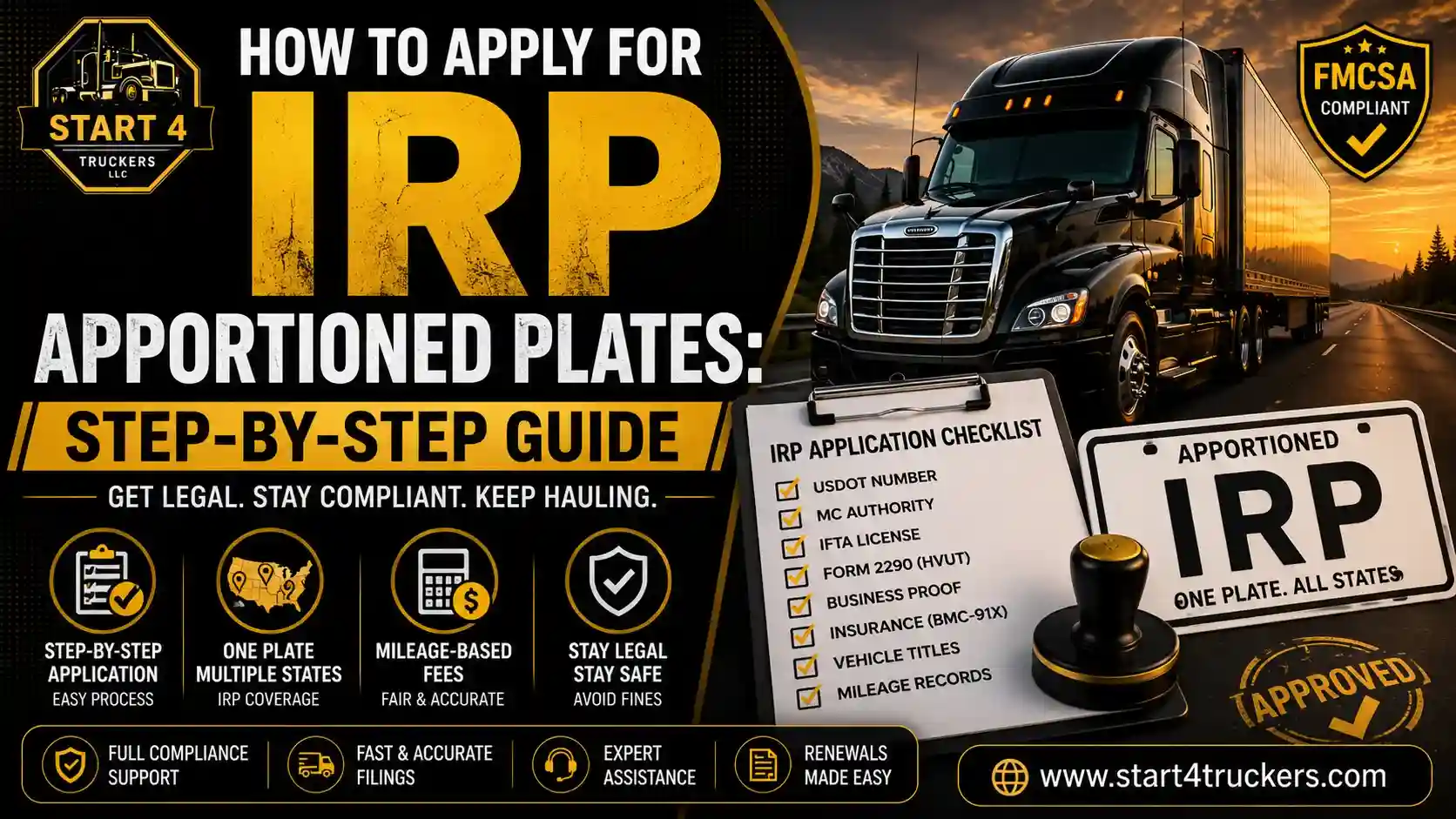
- USDOT Number Every commercial carrier must have a USDOT Number issued by the Department of Transportation. You can get this through our USDOT registration service. It is free and required before you can apply for IRP.
- MC Authority (Motor Carrier Authority) If you are a for-hire carrier (hauling loads for other people’s businesses), you need MC Authority from the FMCSA. Learn how to get it through our MC number registration page. Private carriers who only haul their own freight may not need this.
- IFTA License The International Fuel Tax Agreement (IFTA) license is a separate requirement for fuel tax reporting across states. IRP and IFTA work hand-in-hand. You cannot operate legally without both. See our IFTA registration guide to get started.
- HVUT — Form 2290 The Heavy Vehicle Use Tax (HVUT) is paid to the Internal Revenue Service (IRS) using Form 2290. If your truck weighs 55,000 lbs or more, this tax is required. You must show proof of payment (a stamped Schedule 1 from the IRS) when applying for IRP.
- Tax id (Employer Identification Number) Your business needs an Tax id issued by the IRS. Even sole proprietors often need one. Get yours through our Tax id registration page.
- BOC-3 Filing For for-hire interstate carriers, a BOC-3 filing (process agent designation) is also required by the FMCSA.
Additional Items You May Need:
- Business registration documents
- Vehicle title(s)
- Proof of insurance (BMC-91X for for-hire carriers)
- Odometer or mileage records (or “estimated miles” for new operations)
How to Apply for IRP Apportioned Plates (Step-by-Step)
Now you are ready to apply. Follow these steps carefully.
Step 1: Create Your IRP Account with Your Base State DMV
Visit your base state’s DMV or IRP office website. Most states have an IRP application online portal where you can create your account digitally.
You will enter your business name, Tax id, USDOT number, and physical business address. This becomes your IRP account; all your vehicles and renewals live here.
Don’t have your USDOT or Tax id yet? Set up your registrations now before you’re so that your IRP application does not get delayed.
Step 2: Gather Your Supporting Documents
Before submitting anything, get all of these together:
- USDOT Number confirmation
- MC Authority (if for-hire)
- IFTA account number
- Form 2290 stamped Schedule 1
- Vehicle title(s)
- Proof of insurance
- Proof of base state business address
- Vehicle VIN and specs (axles, GVWR)
Step 3: Submit Schedule A/E and Schedule B Forms
You will complete IRP forms as part of your application (explained in detail in the next section). Schedule A/E sets up your account. Schedule B captures your vehicle information.
Submit these through your state’s IRP portal or in person at the IRP office location nearest to you.
Step 4: Pay IRP Fees (Mileage-Based Calculation)
Your fees are calculated based on estimated mileage per state. First-time applicants with no mileage history typically use a standard mileage estimate set by each state.
Fees vary by state, vehicle weight, and distance. We break this down fully in the IRP Fees section below.
Step 5: Wait for Application Review and Approval
Once submitted, the IRP office reviews your application. This usually takes 15–25 business days, though some states process faster online.
You may be asked to provide additional documents during this time. Respond quickly to avoid delays.
Step 6: Receive Your Cab Card and Apportioned Plates
Once approved, you receive:
- Apportioned license plates (mounted on your truck)
- Cab Card a registration document that lists every state and jurisdiction you are authorized to operate in
Keep the cab card inside the vehicle at all times. It is proof of your legal registration during roadside inspections.
IRP Forms Explained
Understanding these forms makes the application much smoother.
Schedule A/E — New Account Setup: This is the main application form. It captures your business information, base jurisdiction, contact details, and fleet type. “A/E” refers to the combined form used in most states for both new accounts and renewals.
Schedule B — Vehicle Details: One Schedule B is submitted per vehicle. It includes: Vehicle Identification Number (VIN), year, make, and model, GVWR, number of axles, and estimated miles per state.
Schedule C — Changes and Updates: Use Schedule C when you need to make changes to an existing IRP account — adding vehicles, removing vehicles, or changing vehicle details.
Schedule F — Adding New States or Jurisdictions: If you start operating in a new state after your initial registration, Schedule F adds that jurisdiction to your cab card. You pay the proportional fee for the new state.
IRP Fees and Cost Breakdown
IRP fees are not flat fees they are calculated based on a formula. Here is how it works.
Mileage Ratio Formula
State Fee = (Miles in That State ÷ Total Miles in All States) × Total Registered Fee for That State
For example, if your total annual mileage is 100,000 miles and you drive 30,000 of them in Illinois, you pay 30% of Illinois’s registration fee.
State-by-State Cost Variations
Each state sets its own base registration fee schedule. Heavier trucks pay more. An 80,000 lb truck pays significantly more than a 30,000 lb truck.
Example IRP Cost Breakdown
| State | % of Miles | Estimated Fee |
| Texas | 35% | $420 |
| Oklahoma | 20% | $190 |
| Kansas | 25% | $240 |
| Missouri | 20% | $195 |
| Total | 100% | ~$1,045 |
Figures are illustrative. Actual fees vary by state and vehicle class.
Hidden Costs to Know About
- Plate fees (one-time, varies by state)
- County or city registration fees
- Title transfer fees (if title is new)
- Late filing penalties (if renewal is missed)
IRP Processing Time
How long will you wait? Here is a realistic timeline.
Average Approval Timeline
Most IRP applications are approved in 15 to 25 business days. Online applications in states with modern portals can be faster, sometimes as quick as 7–10 business days.
What Delays IRP Approval
| Delay Cause | How to Avoid It |
| Missing insurance filing | Submit BMC-91X before applying |
| Incorrect Form 2290 | Double-check IRS stamps and tax year |
| Wrong base jurisdiction docs | Use utility bills + business registration |
| Errors on Schedule B | Verify VIN and GVWR with the vehicle title |
| Incomplete mileage data | Use state estimates for new operations |
Approval Stages
- Application received
- Document review
- Fee calculation
- Payment confirmed
- Plates and a cab card were issued
Common IRP Mistakes That Cause Rejection
Avoid these errors and save yourself weeks of delays.
1. Wrong Vehicle Classification
Using the wrong GVWR or axle count leads to incorrect fees and possible rejection. Always verify specs from your vehicle title.
2. Missing USDOT or MC Number
Your application will be stopped immediately if these are not in place. Get them first.
3. Incorrect Mileage Reporting
Overstating or understating miles can trigger audits. Use actual records where possible, and use state-approved estimates for new operations.
4. No Proof of Insurance (BMC-91X)
For-hire carriers must have their insurance provider file a BMC-91X directly with the FMCSA before the IRP office will process registration.
5. Base Jurisdiction Errors
Claiming a base state you do not actually operate from is one of the most common and most serious mistakes. It can lead to registration rejection and future compliance issues.
IRP vs. IFTA: What Is the Difference?
Many new carriers confuse IRP and IFTA. They are related but separate programs.
| IRP | IFTA | |
| What It Covers | Registration/license plates | Fuel tax reporting |
| Issued By | State DMV / IRP office | State tax authority |
| Applies To | Trucks 26,001+ lbs, 3+ axles, interstate | Trucks 26,001+ lbs, 3+ axles, interstate |
| Renewal | Annual | Quarterly reporting, annual license |
| Purpose | Allows legal operation in multiple states | Reports and pays fuel taxes across states |
Why You Need Both
IRP gives you the legal right to operate in multiple states. IFTA handles how you report and pay fuel taxes across those states. They work together, and you need both to stay compliant.
For a step-by-step IFTA setup, visit our IFTA registration guide.
IRP Renewal Process
IRP registrations expire annually. Missing your renewal can suspend your operating authority.
When to Renew IRP Plates
Your renewal date is set when you first register. Most states mail a renewal notice 60–90 days before expiration. Do not wait for the notice mark your renewal date and start the process early.
Required Renewal Documents
- Updated mileage records (actual miles by state for the past 12 months)
- Updated vehicle list
- Proof of current insurance
- Updated Form 2290 (if tax year changed)
Late Renewal Penalties
- Operating with expired IRP plates is illegal
- Officers at weigh stations and DOT checkpoints will cite you
- Fees and reinstatement costs apply
How to Avoid Suspension
Set calendar reminders 90 days before expiration. Keep your mileage logs up to date throughout the year. Our DOT compliance services team can handle renewals automatically so you never miss a deadline.
State-by-State IRP Overview
IRP rules are mostly standardized across the 48 contiguous states, Washington, D.C., and participating Canadian provinces. However, some differences exist:
- Fee schedules vary significantly by state
- Online portal availability differs; some states still require in-person visits
- Documentation requirements may vary slightly
- Plate design and numbering vary by base state
States with easy online IRP portals include: Texas, Florida, Illinois, and California.
States that still prefer or require in-person visits: Some smaller or rural states. Check your base state’s DMV website for current options.
You can find your state’s IRP office through your state DMV website. Always apply through your base jurisdiction, not any other state, even if you drive more miles there.
IRP Compliance After Approval
Getting your plates is not the end; staying compliant is an ongoing responsibility.
Recordkeeping Requirements
The FMCSA and your base state require you to keep mileage records for a minimum of 3 years. These records must show:
- Date of each trip
- Origin and destination
- Miles driven per state
- Vehicle identification
Mileage Tracking System Requirements
Manual logs are acceptable but risky. Most carriers today use ELD (Electronic Logging Device) systems or GPS-based fleet software that automatically capture miles per state. This also helps with IFTA reporting.
Audit Preparation Tips
- Keep all IRP filings and receipts organized by year
- Match your mileage logs to your IFTA fuel tax reports
- Store Form 2290 stamped Schedule 1 copies for all vehicles
- Keep insurance certificates current
For a full compliance checklist, explore our DOT compliance services and MCS-150 filing service pages.
How Start4Truckers LLC Helps With IRP Registration
Applying for IRP Apportioned Plates involves a lot of moving parts USDOT, MC Authority, IFTA, Form 2290, IRP forms, base state rules, and more. One missing document can delay your entire operation.
Start4Truckers LLC takes care of all of it for you.
What Start4Truckers LLC Offers:
- Done-for-you IRP filing: We handle the full application from start to finish
- USDOT + MC + IRP bundle setup: Get all your registrations in one place
- Error-free application submission: We review every form before it goes in
- Faster approval assistance: We know what each state needs and submit accordingly
- Compliance support: We help you stay legal after approval, too
Whether you are setting up your first truck or expanding your fleet, Start4Truckers LLC’s trucking company setup services make the process simple, fast, and stress-free.
Conclusion
Getting your IRP Apportioned Plates is one of the first major steps in building a legally compliant trucking operation. The process has several layers: jurisdiction rules, government registrations, IRP forms, fee calculations, and ongoing compliance, but every step is manageable when you know exactly what to do.
Here is a quick recap of what you need to do:
- Confirm your vehicle qualifies (GVWR, axles, interstate use)
- Establish your base jurisdiction with proper proof
- Get your USDOT, MC Authority, IFTA, and Form 2290 in order
- Submit your IRP account setup and Schedule B forms
- Pay your apportioned fees and wait for approval
- Keep your cab card in your vehicle and stay current on renewals
Do not let paperwork delays keep your truck parked. Every day without proper registration is a day you cannot legally earn.
Start4Truckers LLC is here to handle the entire IRP registration process for you, from USDOT setup to IRP filing to IFTA compliance. We make sure everything is done right the first time so you can focus on the road.
Get started with our trucking company setup services today and let us get your authority and plates sorted fast.
Frequently Asked Questions
1. What are IRP Apportioned Plates used for?
IRP Apportioned Plates allow commercial trucks to legally operate in multiple U.S. states and Canadian provinces under a single registration. The plates show that your vehicle is registered under the International Registration Plan.
2. Who needs IRP plates?
Any commercial motor vehicle with a GVWR over 26,000 lbs, 3+ axles, or combination vehicles that cross state lines must have IRP Apportioned Plates.
3. How do I apply for IRP Apportioned Plates?
You apply through your base state’s DMV or IRP office. The process involves setting up an IRP account, submitting Schedule A/E and B forms, providing supporting documents, paying fees, and waiting for approval.
4. How long does IRP approval take?
Most IRP applications are approved within 15 to 25 business days. Online applications through state portals can sometimes be processed in 7 to 10 business days.
5. How much do IRP plates cost?
Costs vary by state and vehicle weight. A typical tractor-trailer operating in 4–6 states might pay between $1,000 and $3,000+ annually. Fees are calculated based on your mileage in each state.
6. What documents are required for IRP registration?
You need your USDOT number, MC Authority (if for-hire), IFTA account number, IRS Form 2290 stamped Schedule 1, vehicle title, proof of insurance, business registration documents, and proof of your base state address.
7. What is a cab card in IRP?
A cab card is a document issued with your IRP Apportioned Plates. It lists all the states and jurisdictions your vehicle is authorized to operate in. It must be kept inside the vehicle at all times.
8. What is the difference between IRP and IFTA?
IRP covers your vehicle registration across multiple states. IFTA (International Fuel Tax Agreement) covers fuel tax reporting across those same states. Both are required for interstate commercial trucking.
9. Do owner-operators need IRP plates?
Yes. If an owner-operator runs a qualifying commercial vehicle across state lines, they are required to have IRP Apportioned Plates even with just one truck.
10. What happens if I don’t renew my IRP registration?
Your plates become invalid. You can be cited at weigh stations or roadside inspections, face fines, and your operating authority can be suspended. Always renew on time.
11. Can I apply for IRP plates online?
Yes, most states offer an online IRP application portal. Some states still require in-person visits for first-time applicants. Check your base state’s DMV website for current options.
12. What is the base jurisdiction in IRP?
Your base jurisdiction is the state where your business is physically located and where your trucks are based. You register your IRP account there, and that state distributes fees to all other states on your behalf.
13. What causes IRP application rejection?
Common rejection causes include missing USDOT or MC numbers, incorrect mileage data, wrong base jurisdiction documentation, missing insurance filings (BMC-91X), and incomplete vehicle information.
14. Is IRP required for interstate trucking?
Yes. Any qualifying commercial vehicle operating across state lines must be registered under the International Registration Plan. Operating without IRP Apportioned Plates is a federal and state compliance violation.
15. How are IRP fees calculated?
IRP fees are calculated using a mileage ratio formula: the percentage of your total miles driven in each state determines what portion of that state’s registration fee you pay.