If you need to know how to lookup a USDOT number, you are in the right place. The process takes under two minutes, costs nothing, and requires no account.
But most people stop at finding the number. They do not know what the results actually mean, what red flags to watch for, or what to do when something looks wrong. This guide covers all of it — from running the free FMCSA search to reading every field in the results, spotting carrier fraud, and recovering a DOT number that has gone inactive.
What Is a USDOT Number?
A USDOT number is a unique identifier assigned by the Federal Motor Carrier Safety Administration (FMCSA) to commercial motor carriers operating in the United States. It is your company’s official fingerprint in the federal transportation system.
The FMCSA uses it to track everything connected to your operation: safety inspection results, roadside violation history, crash data, compliance review outcomes, insurance filings, and operating authority status. Every time your truck is inspected or your company is audited, that data is recorded against your USDOT number and becomes part of your permanent public record.
Who Needs a USDOT Number?
Federal law requires a USDOT number if you operate any of the following:
- Commercial vehicles with a GVWR or GCWR of 10,001 pounds or more in interstate commerce
- Vehicles transporting 8 or more passengers for compensation across state lines
- Vehicles transporting 15 or more passengers without compensation across state lines
- Vehicles hauling hazardous materials that require placarding under federal law
Beyond federal law, 38 states require USDOT numbers for intrastate commercial vehicle operations. Even if your trucks never cross a state line, you may still need one. States with notable intrastate requirements include California, Texas, Florida, New York, and Illinois.
Carriers operating for hire in interstate commerce also need an MC number in addition to the USDOT number. The MC number is what gives you legal authority to haul freight for compensation across state lines. If you are at that stage,
the Start 4 Truckers MC authority registration service handles the full filing for you, including BOC-3 and insurance verification.
If you need to know how to lookup a USDOT number, you are in the right place. The process takes under two minutes, costs nothing, and requires no account.
But most people stop at finding the number. They do not know what the results actually mean, what red flags to watch for, or what to do when something looks wrong. This guide covers all of it — from running the free FMCSA search to reading every field in the results, spotting carrier fraud, and recovering a DOT number that has gone inactive.
What Is a USDOT Number?
A USDOT number is a unique identifier assigned by the Federal Motor Carrier Safety Administration (FMCSA) to commercial motor carriers operating in the United States. It is your company’s official fingerprint in the federal transportation system.
The FMCSA uses it to track everything connected to your operation: safety inspection results, roadside violation history, crash data, compliance review outcomes, insurance filings, and operating authority status. Every time your truck is inspected or your company is audited, that data is recorded against your USDOT number and becomes part of your permanent public record.
Who Needs a USDOT Number?
Federal law requires a USDOT number if you operate any of the following:
- Commercial vehicles with a GVWR or GCWR of 10,001 pounds or more in interstate commerce
- Vehicles transporting 8 or more passengers for compensation across state lines
- Vehicles transporting 15 or more passengers without compensation across state lines
- Vehicles hauling hazardous materials that require placarding under federal law
Beyond federal law, 38 states require USDOT numbers for intrastate commercial vehicle operations. Even if your trucks never cross a state line, you may still need one. States with notable intrastate requirements include California, Texas, Florida, New York, and Illinois.
Carriers operating for hire in interstate commerce also need an MC number in addition to the USDOT number. The MC number is what gives you legal authority to haul freight for compensation across state lines. If you are at that stage,
the Start 4 Truckers MC authority registration service handles the full filing for you, including BOC-3 and insurance verification.
Why Would You Lookup a USDOT Number?
Three different groups use this tool for three different reasons.
Carriers and Owner-Operators Checking Their Own Status
Your DOT status directly affects your ability to legally run loads. Common reasons to look up your own number: confirming it is still active before a roadside inspection, verifying your safety rating after a compliance review, checking whether your biennial MCS-150 update was processed correctly, and confirming insurance filings are showing on your FMCSA record. A self-lookup takes 90 seconds and can catch problems before they turn into enforcement actions.
Freight Brokers and Shippers Vetting Carriers
Before dispatching a load with a new carrier, verifying their DOT number is the first step in responsible due diligence. It confirms they are legally authorized to operate, their insurance is current and meets minimum requirements, their safety rating is acceptable, and their crash history does not reveal patterns that should disqualify them.
Consumers Checking a Moving Company or Transport Provider
If you are hiring a moving company or vehicle transport service, a USDOT number lookup shows whether they are legitimately registered, properly insured, and in good standing with federal safety standards. Moving companies do not advertise their violation history on their own websites.
How to Lookup a USDOT Number: Step-by-Step
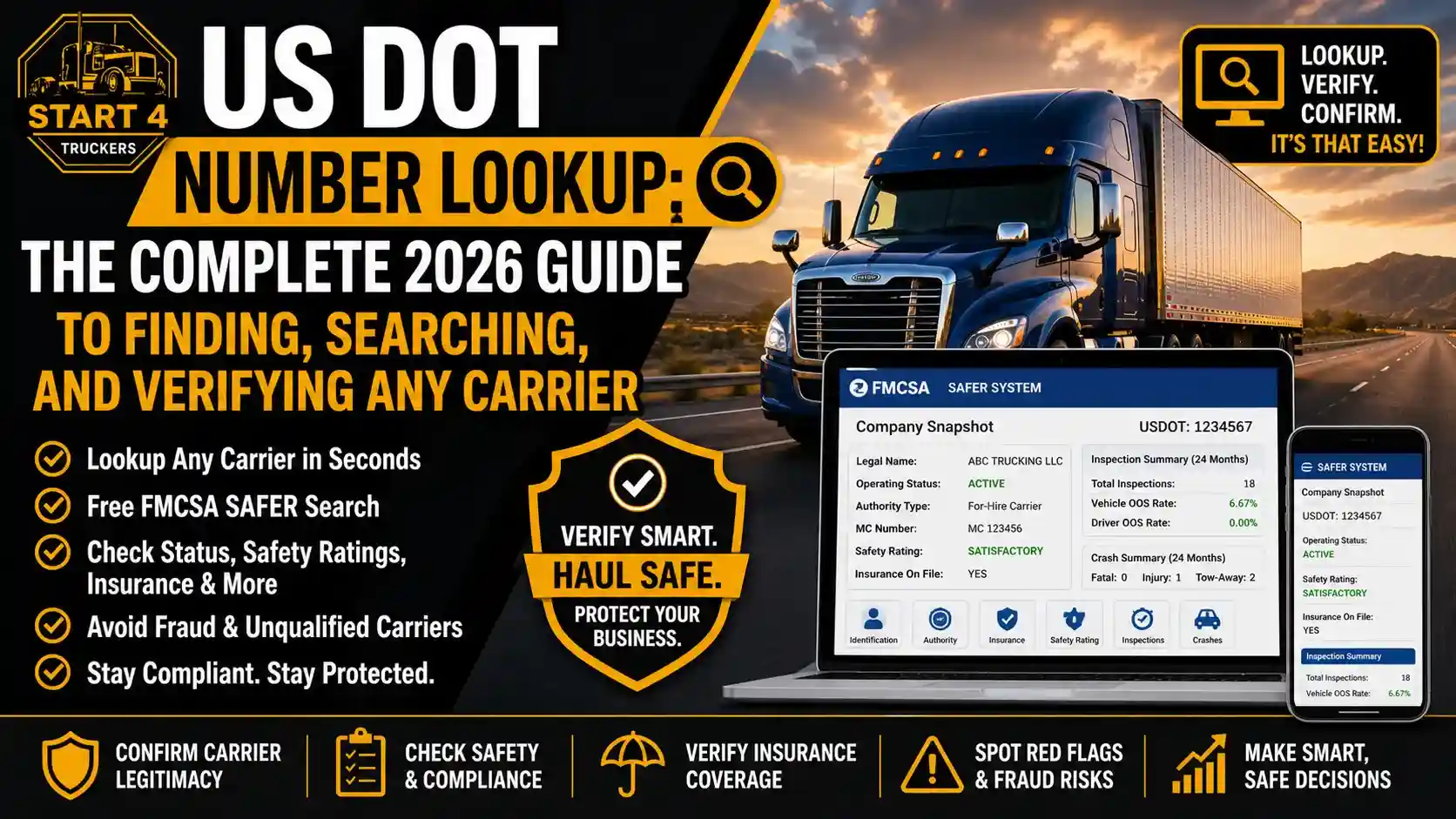
The official tool is the FMCSA SAFER System (Safety and Fitness Electronic Records System), available at safer.fmcsa.dot.gov. It is free, requires no login, and gives you access to the Company Snapshot for any registered carrier.
- Open safer.fmcsa.dot.gov in your browser. Bookmark it if you use it regularly.
- Click the Company Snapshot link in the FMCSA Searches section on the homepage.
- Choose your search method: USDOT Number (fastest if you have it), MC/MX Number, or Company Name.
- Enter your search term and click Search. Results load within seconds.
- Review the Company Snapshot. The next section explains every field.
On mobile: Go to safer.fmcsa.dot.gov on your phone and tap Company Snapshot. The same search options appear. Scroll down to see insurance and crash data, which load below the fold on smaller screens.
Not registered yet? Let us handle it for you.
Most carriers who look up a USDOT number for the first time realize they are either missing a filing or their record has an error. Getting registered correctly from the start saves you from compliance issues, delayed authority activation, and roadside surprises down the road.
Start 4 Truckers files your USDOT registration, MC authority, BOC-3, and everything in between all 50 states, processed in 24 to 48 hours.
Get Your USDOT Number Filed Today → 📞 Or call us directly: (210) 588-9348
What a USDOT Number Lookup Shows You
Company Identification
The carrier’s legal name, DBA name, physical address, mailing address, and phone number. Always cross-check this against what the carrier gave you. If any detail does not match, that is a serious red flag. Identity fraud often involves someone impersonating a legitimate carrier using a stolen USDOT number.
USDOT Number and Operating Authority Numbers
Confirms the USDOT number and lists any associated MC, MX, or FF numbers. A carrier can have a valid USDOT number but no MC number, meaning they are registered but not authorized to haul freight for hire across state lines. Always check for an active MC number when vetting a for-hire carrier.
Operating Status: The Field That Matters Most
This tells you whether the carrier is legally permitted to operate.
| Status | What It Means | What You Should Do |
| ACTIVE | Registered and authorized | Safe to proceed. Verify insurance separately. |
| INACTIVE | Registration has lapsed | Do not dispatch. Carrier is not authorized. |
| OUT-OF-SERVICE | Ordered to stop operations | Do not dispatch under any circumstances. |
| REVOKED | Authority formally revoked by FMCSA | Do not dispatch. Requires full reinstatement. |
Never dispatch a load with a carrier showing any status other than ACTIVE. Doing so exposes your business to uninsured liability, FMCSA penalties, and potential fraud.
Safety Rating
Satisfactory: Full compliance with DOT regulations. The best rating.
Conditional: One or more violations need correction. Operations can continue while fixes are made. Watch this carrier closely.
Unsatisfactory: Significant violations. This rating typically triggers an out-of-service order.
Not Rated: No formal compliance review conducted yet. Common for newer carriers. Not inherently negative.
Inspection and Out-of-Service Summary
Shows roadside inspection results for the past 24 months, total inspections, out-of-service violations, and comparison to national averages.
- Vehicle OOS rate above 20.72%: This is the national threshold that triggers FMCSA intervention.
- Driver OOS rate above 5.51%: Same threshold for driver violations.
A carrier consistently above these averages has a systemic problem, not an isolated incident.
Crash Data
Reported crashes for the past 24 months, broken into fatal, injury, and tow-away categories. These show involvement, not fault. A high crash count relative to fleet size is a meaningful risk signal worth investigating.
Insurance Information
Shows insurance type, coverage amounts, effective dates, and cancellation status on file with the FMCSA. Minimum required coverage: $300,000 for non-hazmat carriers under 10,001 lbs; $750,000 for general freight over 10,001 lbs; up to $5,000,000 for hazardous materials carriers. If a carrier shows no insurance on file or a cancellation, they cannot legally haul regardless of their other statuses.
8 Red Flags That Should Stop a Dispatch
- Status is anything other than ACTIVE.
- Company name in the FMCSA record does not match what the carrier told you. This is the top signal of carrier identity fraud.
- USDOT number contains letters or symbols. Legitimate USDOT numbers are numeric only, up to 8 digits.
- No insurance on file, pending insurance, or a recent cancellation.
- Vehicle or driver out-of-service rates significantly above national averages.
- Recently issued MC number combined with unusually high load volume. Legitimate new carriers build volume gradually.
- Address is a residential home or virtual office with no trucking infrastructure.
- Carrier cannot immediately produce their MC number certificate when you ask for it.
For extra protection: always call the carrier using the phone number from the FMCSA record, not the number they gave you. Request a copy of their operating authority certificate. If you dispatch regularly, use a carrier monitoring service that sends real-time alerts when status or insurance changes.
How to Dispute Incorrect Data in Your FMCSA Record
If a USDOT number lookup shows inaccurate data about your company such as a crash recorded incorrectly, a violation listed against the wrong carrier, or outdated status information you have the right to formally challenge it.
The FMCSA’s DataQs system (dataqs.fmcsa.dot.gov) handles these disputes. Submit a Request for Data Review (RDR), specify what you are disputing, and the system routes it to the appropriate FMCSA office or state agency. If your dispute is upheld, the data is corrected in the SAFER database. Inaccurate records directly affect your CSA scores and can trigger unnecessary audits, so challenge errors as soon as you spot them.
What to Do If Your USDOT Number Shows as Inactive
Finding your own DOT listed as inactive does not mean your business is over. It does mean you cannot legally operate until the issue is resolved.
Step 1: Find Out Why It Went Inactive
- Missed biennial MCS-150 update: The FMCSA requires every carrier to update their MCS-150 at least once every two years, even if nothing changed. Miss this deadline and your number goes inactive automatically.
- Lapsed insurance: Your insurer may have cancelled coverage without you realizing it.
- Failed New Entrant Safety Audit: New carriers must complete an audit within the first 12 to 18 months of registration.
Step 2: Fix the Root Cause First
If it is a missed MCS-150 update, gather your current company information before filing anything. If it is an insurance issue, contact your agent immediately and have them refile proof of coverage directly with the FMCSA. The compliance specialists at Start 4 Truckers can identify the exact issue and handle the correction without the back-and-forth of navigating FMCSA systems alone.
Step 3: Log Into the FMCSA Portal
Access your account at portal.fmcsa.dot.gov. If you do not have your login credentials, request a new PIN at safer.fmcsa.dot.gov and have it sent to the email address on file.
Step 4: File the MCS-150 Update
Complete and submit your biennial MCS-150 update through the portal. This filing is free. If you want help making sure it is submitted correctly with no errors, the Start 4 Truckers MCS-150 filing service handles the full submission for you.
Step 5: Refile Insurance and BOC-3 If Needed
Have your insurance provider submit updated proof of coverage directly to the FMCSA. Verify your BOC-3 process agent filing is still current. If you are reactivating MC operating authority specifically, an $80 reinstatement fee applies.
Step 6: Confirm Reactivation in SAFER
After filing, wait 24 to 48 hours and run a new USDOT number lookup to confirm your status shows ACTIVE. If it has not updated after 48 hours, call the FMCSA directly at 1-800-832-5660.
Do not operate any commercial vehicles while your DOT number shows as inactive. Fines for operating without an active USDOT number can reach thousands of dollars per violation.
Free vs. Paid USDOT Lookup Tools
| Tool | Cost | Best For | Limitation |
| FMCSA SAFER (Company Snapshot) | Free | Basic carrier verification, self-lookup | 24-month window, no real-time alerts |
| FMCSA L&I System | Free | Detailed insurance verification | Insurance data only |
| FMCSA Company Safety Profile | $20/report | Full compliance history, legal use | FOIA required for third parties |
| FMCSA SMS (BASIC Scores) | Free | CSA risk profiling | Data up to 30 days old |
| DAT CarrierWatch / RMIS | Subscription | Broker monitoring at scale | Cost; built for large brokerages |
For individual lookups the free FMCSA tools cover everything. If you manage hundreds of carrier relationships, a paid monitoring service that sends real-time alerts when status or insurance changes is worth the cost.
State-Specific USDOT Requirements
The FMCSA SAFER system covers federal USDOT numbers. Several states also require their own carrier registration for intrastate operations.
California: Requires a California Motor Carrier Permit in addition to the federal USDOT number. Also enforces CARB emissions requirements.
Texas: Requires a Texas DMV number for CDL trucking companies based in Texas, separate from the federal USDOT number.
New York: Has its own intrastate carrier registration requirements through the NYSDOT.
Florida and Illinois: Follow standard federal thresholds with their own state-level enforcement processes.
For carriers operating across multiple states the federal FMCSA SAFER lookup remains the primary verification tool.
What If You Do Not Have a USDOT Number Yet?
If you searched the FMCSA database and found no record for your company, you need to register before operating commercially. Apply through the FMCSA’s Unified Registration System at portal.fmcsa.dot.gov. The USDOT number itself is free and typically issued immediately after completing the online application.
Having a USDOT number alone does not mean you are fully authorized to operate. Depending on your business, you will likely also need:
- MC Number (Operating Authority): for for-hire carriers in interstate commerce. $300 FMCSA fee.
- BOC-3 Filing: required before MC authority activates.
- UCR Registration: annual Unified Carrier Registration based on fleet size.
- Drug and Alcohol Testing Program: mandatory for all CDL drivers.
- IFTA License: required if operating commercially across multiple states.
- IRP Apportioned Plates: required for interstate commercial operation.
Getting every filing right from day one prevents the compliance failures that cause DOT numbers to go inactive or trigger audits in the first 12 months. The team at Start 4 Truckers handles every step from USDOT registration through full compliance setup, all 50 states, with 24 to 48 hour processing.
Need Help With Your USDOT Number?
A USDOT number lookup takes two minutes and costs nothing. Use the free FMCSA SAFER system for any carrier verification. For carriers, checking your own record regularly is the simplest compliance habit you can build.
If your DOT number shows anything other than Active, or if you still need to register your operation, Start 4 Truckers handles USDOT registration, biennial MCS-150 updates, MC operating authority, BOC-3 filings, and inactive number reactivation for owner-operators and small fleets across all 50 states. Processing in 24 to 48 hours.
Call (210) 588-9348 or visit start4truckers.com to get started today.
Frequently Asked Questions
Is a USDOT number lookup free?
Yes. The FMCSA Company Snapshot at safer.fmcsa.dot.gov is completely free. No account, no login, and no fee required for standard carrier lookups.
Can I lookup a USDOT number by company name?
Yes. The Company Snapshot lets you search by company name, USDOT number, or MC/MX number. When searching by name, enter the legal business name and select a state if results are ambiguous.
What does ACTIVE status mean on a USDOT number lookup?
Active means the carrier’s USDOT registration is current and required filings are up to date. It confirms they are authorized to operate but does not automatically verify that their insurance is current. Always verify insurance separately through the FMCSA L&I system at li-public.fmcsa.dot.gov.
How often is the FMCSA SAFER database updated?
Registration and status data updates within 24 to 48 hours of a filing being processed. Inspection and crash data updates on a monthly basis. For time-sensitive carrier vetting, use a paid monitoring tool for real-time data.
What is the difference between inactive and out-of-service DOT status?
Inactive means the carrier’s registration has lapsed, typically because of a missed filing or administrative issue. Out-of-service means the carrier has been actively ordered to stop operations due to a safety or compliance violation. Out-of-service is the more serious status and requires formal resolution before the carrier can operate again.
How long does a new DOT number take to appear in SAFER?
New USDOT numbers issued through the online FMCSA portal typically appear in the SAFER database within 24 to 48 hours. Applications filed by mail can take 4 to 6 weeks.
Does a new carrier need to pass an audit before their DOT number becomes permanent?
Yes. New carriers enter an 18-month New Entrant Program. The FMCSA conducts a New Entrant Safety Audit within the first 12 months. Pass the audit and your registration becomes permanent. Fail it and your DOT registration can be revoked. Having your drug testing program, driver qualification files, vehicle inspection records, and HOS logs properly set up from day one is essential.
Carrier Verification Checklist
Run through this every time you verify a carrier before dispatching:
- Operating status shows ACTIVE
- Legal name matches what the carrier provided
- Address and phone number match carrier documentation
- Active MC number present if this is a for-hire interstate carrier
- Insurance is on file, current, and meets minimum coverage requirements for the load type
- Safety rating is Satisfactory or Not Rated
- Vehicle and driver OOS rates are below national averages
- No significant crash history relative to fleet size
- USDOT number is numeric only and returns valid results
- Phone verified using FMCSA record, not the number the carrier gave you