If you operate a commercial truck and hold a USDOT number, you have probably heard about Form MCS-150. But many carriers, especially new ones, are not sure what it is, when to file it, or what happens if they skip it. The MCS-150 is the official form used to register and update your carrier information with the Federal Motor Carrier Safety Administration (FMCSA). It captures key details about your business including your operation type, vehicle count, cargo, and driver information.
Every time something changes in your operation, or every two years at a minimum, this form needs to be updated. Skipping it or letting it go stale can put your USDOT number at risk of deactivation, which means you cannot legally operate until it is reinstated.
MCS-150 Meaning in Simple Terms
Form MCS-150 is the Motor Carrier Identification Report. It is the official form used to register a new USDOT number and to keep that number active over time.
Think of it like a driver’s license renewal. You do not just get one and forget about it. You have to update it regularly to prove your information is current and your business is still operating.
The Federal Motor Carrier Safety Administration (FMCSA) uses the data from your MCS-150 filing to maintain accurate records on every commercial carrier operating in the United States.
Why the FMCSA Requires Form MCS-150
The U.S. Department of Transportation requires all commercial motor carriers to keep their USDOT records up to date. When your information changes or every two years at a minimum, you must file a new FMCSA MCS-150 form to confirm your current operating details.
This is not just a formality. FMCSA uses this data to:
- Track your fleet size and operation type
- Monitor your safety performance record
- Verify your insurance and authority status
- Identify inactive or abandoned carrier accounts
Without accurate data, enforcement agencies cannot properly assess carrier risk on public roads.
How MCS-150 Connects to Your USDOT Number
Your USDOT number is your federal carrier identity. The MCS-150 form is what activates it, updates it, and keeps it from being deactivated.
If you are not sure whether your USDOT number is active or up to date, use our US DOT number lookup tool to check your current status before reading further.
Check your status now an inactive DOT number can shut your operation down at the next weigh station.
Who Needs to File Form MCS-150?
The short answer: if you have a USDOT number, you must file MCS-150.
That covers a wide range of carriers. Here is a breakdown:
Trucking Companies and Freight Carriers
Any for-hire or private motor carrier operating commercial vehicles in interstate commerce must file. This includes owner-operators, small fleets, and large trucking companies alike.
If you are still deciding how to structure your business, read our guide on LLC vs. sole proprietor for trucking your business structure affects your registration requirements.
Bus Operators and Passenger Carriers
Companies transporting passengers for compensation across state lines are also required to maintain an active MCS-150 filing. This includes charter bus companies, shuttle services, and other commercial passenger operations.
New FMCSA Registered Companies
When you first apply for a USDOT number, Form MCS-150 is part of the initial registration process. Without completing it, your USDOT number will not be issued.
If you are just starting a trucking company, MCS-150 is one of the very first forms you will fill out.
Starting from scratch? Get your USDOT number and MCS-150 filed correctly with Start4Truckers LLC’s setup service. No guesswork required.
Interstate vs. Intrastate Carriers
Both interstate and intrastate carriers may need to file MCS-150, depending on vehicle weight and cargo type. If your vehicle has a GVWR over 10,001 lbs or you transport hazardous materials, you likely need a USDOT number and therefore must keep your MCS-150 current.
Not sure which category you fall under? Read our full breakdown of interstate vs. intrastate trucking authority before you assume you are exempt.
When Do You Need to File MCS-150? (FMCSA Biennial Update Rule)
This is where many carriers get caught off guard. Two situations require you to file Form MCS-150, and both matter equally.
Every 24 Months (Mandatory Biennial Update)
The FMCSA biennial update requirement states that every carrier must update its MCS-150 filing at least once every 24 months. This is non-negotiable.
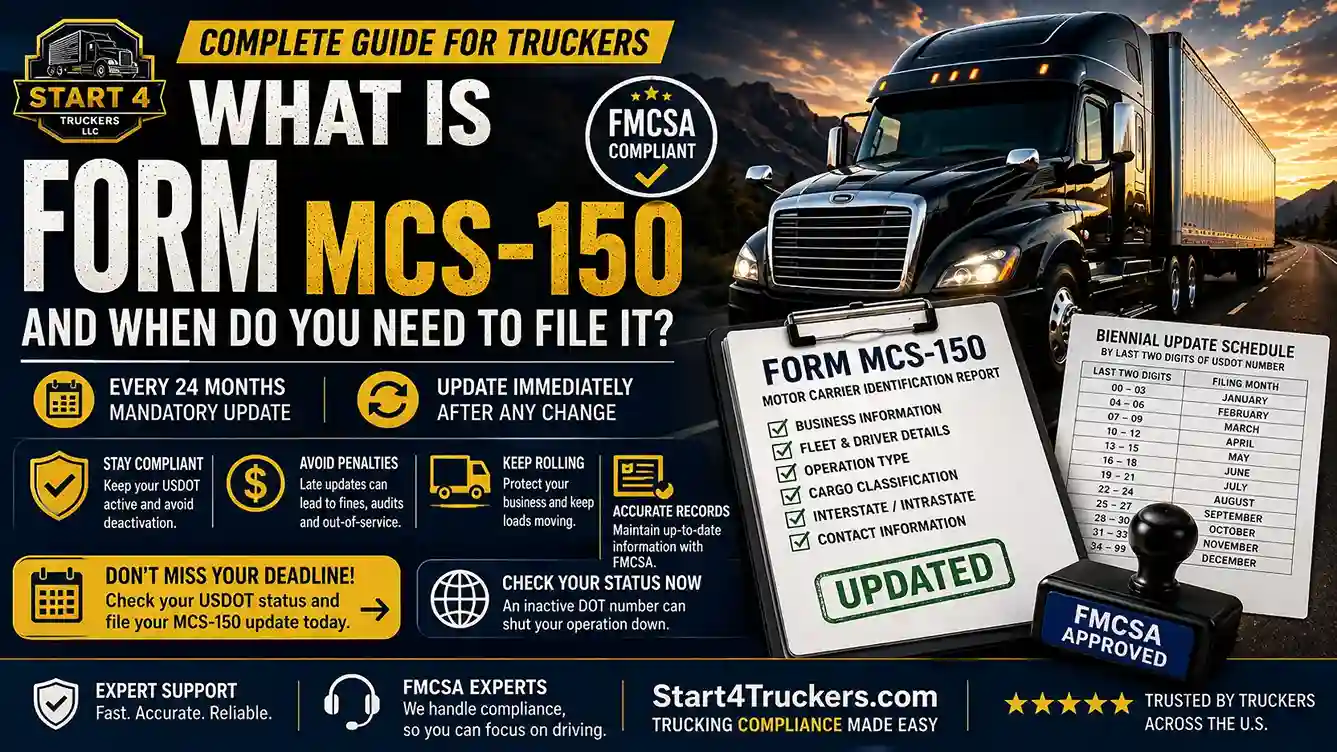
The filing window is based on the last two digits of your USDOT number:
| Last Two Digits of USDOT | Filing Month |
| 00–03 | January |
| 04–06 | February |
| 07–09 | March |
| 10–12 | April |
| 13–15 | May |
| 16–18 | June |
| 19–21 | July |
| 22–24 | August |
| 25–27 | September |
| 28–30 | October |
| 31–33 | November |
| 34–99 | December |
Check the FMCSA official website to confirm your specific biennial update month based on your USDOT number.
When You Must File Immediately (Trigger Events)
Beyond the biennial schedule, certain changes to your business require an immediate MCS-150 update. Do not wait for your scheduled window if any of these occur:
- Address change, new business location, or mailing address
- Fleet size change, adding or removing vehicles
- Ownership change: new owner, partner, or corporate structure
- Operation type change switching from intrastate to interstate, or vice versa
- Cargo classification change hauling different types of freight
- Company name change, legal or DBA name update
Failing to update after a trigger event is one of the most common compliance mistakes carriers make.
Changed your address or fleet size recently? File your MCS-150 update today before FMCSA flags your account for outdated information.
FMCSA Deadline Rules You Must Not Miss
FMCSA does not send reminders. It is entirely your responsibility to know when your update is due and file on time. If you miss your biennial window, your USDOT number can be deactivated, and an inactive DOT number means you cannot legally operate.
How to File Form MCS-150 Online (Step-by-Step Guide)
Filing Form MCS-150 online is straightforward once you know the steps. Here is exactly how to do it through the FMCSA registration portal.
Step 1: Access the FMCSA Registration Portal
Go to the FMCSA Licensing and Insurance (L&I) portal at the official FMCSA website. You can file as a new applicant (first-time USDOT registration) or as an existing carrier updating your information.
Step 2: Enter Your USDOT Number and PIN
Log in using your USDOT number and your assigned PIN. If you have lost your PIN, you can request a new one through the portal via mail or email verification. Do not skip this step the system requires authentication before allowing any updates.
Need help recovering your PIN or completing your USDOT login? Get expert assistance from Start4Truckers and avoid delays in your compliance process.
Step 3: Update Your Carrier Information
Review each section carefully. Update any information that has changed since your last filing:
- Legal business name and DBA name
- Principal business address
- Mailing address
- Phone and email contact details
- Company officer information
Step 4: Review Fleet and Operation Details
This section is critical. You must accurately report:
- Total number of power units (trucks, tractors, buses)
- Number of drivers employed or contracted
- Operation type: for-hire, private, exempt, or government
- Interstate vs. intrastate classification
- Cargo type the primary commodity you haul
Misreporting fleet size or operation type is a common audit trigger. Count every vehicle operating under your DOT authority, including leased units.
Step 5: Submit and Confirm Update
Review the completed form before submitting. Once submitted, FMCSA typically updates your carrier profile within 24–48 hours. You will receive a confirmation number. Save it.
Required Information for MCS-150 Filing (Quick Reference)
| Information Needed | Details |
| USDOT Number | Active number with a valid PIN |
| Carrier Name | Legal name + DBA if applicable |
| Business Address | Current physical and mailing address |
| Fleet Size | All power units under your authority |
| Driver Count | Employed + contracted drivers |
| Operation Type | For-hire / private/exempt |
| Cargo Classification | Primary freight type |
| Interstate/Intrastate | Correct jurisdiction type |
Need help gathering this information or filing without errors? Start4Truckers LLC’s MCS-150 filing service handles the entire process for you fast, accurately, and stress-free.
What Happens If You Don’t File Form MCS-150?
Skipping your USDOT biennial update is not a minor oversight. The consequences are immediate and serious.
USDOT Number Deactivation Risk
If you miss your biennial update window, FMCSA will deactivate your USDOT number. A deactivated DOT number means:
- You cannot legally operate your commercial vehicle
- You fail any roadside inspection instantly
- Your carrier profile shows “inactive” to shippers, brokers, and law enforcement
Reactivating a deactivated USDOT number requires filing a new MCS-150 and waiting for FMCSA to process it. That can mean days or weeks off the road.
Out-of-Service Orders
At any roadside inspection, officers check your USDOT status in real time. If your number is deactivated or your carrier profile is flagged as outdated, you can be placed out of service immediately.
An out-of-service order means your truck stops right there, right then until compliance is restored.
FMCSA Compliance Violations
Beyond deactivation, operating with outdated FMCSA records can lead to:
- Compliance review triggers
- Increased roadside inspection frequency
- Lower safety rating scores
- Audit exposure for your entire operation
If you are also operating under interstate authority, check our Florida trucking regulations 2026 guide to understand how state-level enforcement intersects with FMCSA compliance.
Business Disruption for Trucking Operations
Lost loads. Angry shippers. Missed contracts. A single missed MCS-150 update can cascade into real financial damage far more expensive than the few minutes it takes to file the form.
Is your USDOT number at risk of deactivation? Check your status and file your update now before it costs you a load or your operating authority.
MCS-150 vs MCS-150B: What Is the Difference?
Many carriers confuse these two forms. Here is a clear explanation:
Purpose of MCS-150 Form
Form MCS-150 is used by motor carriers, trucking companies, freight carriers, and bus operators to register for and maintain their USDOT number. This is the standard form used by the vast majority of commercial operators.
Purpose of MCS-150B Form
Form MCS-150B is used specifically by intermodal equipment providers (IEPs) companies that provide trailers and chassis to motor carriers without operating the vehicles themselves. It registers IEP operations under a separate USDOT number category.
Which One Applies to Your Career Type?
| Form | Who Uses It |
| MCS-150 | Motor carriers, freight companies, bus operators |
| MCS-150B | Intermodal equipment providers (IEPs) |
If you are a standard trucking company, freight carrier, or owner-operator, Form MCS-150 is your form. The MCS-150B only applies if you are solely providing trailers or chassis to other carriers without hauling freight yourself.
How to Check Your FMCSA MCS-150 Filing Status
You should verify your filing status at least once a year, even if your biennial window is not yet due.
Checking Your USDOT Registration Status Online
Go to the FMCSA SAFER system (Safety and Fitness Electronic Records) at the U.S. Department of Transportation portal. Enter your USDOT number to view:
- Current active/inactive status
- Last MCS-150 update date
- Next biennial update due date
- Carrier name, address, and fleet data on file
You can also use our US DOT number lookup tool for a quick status check.
Signs Your Filing is Outdated
Watch for these warning signs:
- Your carrier profile shows the wrong address or fleet size
- Your USDOT status shows “inactive” or “pending deactivation.”
- You receive a notice from FMCSA requesting a biennial update
- More than 18 months have passed since your last MCS-150 filing
How FMCSA Notifies Carriers
FMCSA may send a notice to the address on file when your biennial update is approaching. However, do not rely on receiving a notice. Many carriers miss updates simply because their addresses were already outdated in the system. It is your responsibility to track your own deadline.
Set a reminder right now. If your last update was over 18 months ago, file your MCS-150 update today before FMCSA deactivates your number.
Common Mistakes in MCS-150 Filing (Avoid These Errors)
These are the errors FMCSA sees most often and each one can trigger delays, audits, or deactivation.
Mistake #1: Incorrect USDOT Information
Submitting a form with the wrong USDOT number, incorrect business name, or outdated address creates a mismatch in the FMCSA database. This flags your carrier profile for review and can delay your update processing.
Mistake #2: Missing the Biennial Update Deadline
This is the most common mistake. Carriers forget to track their 24-month update window and suddenly find their DOT number deactivated mid-haul. Set a calendar reminder 60 days before your due month every year.
Mistake #3: Wrong Fleet Size Reporting
Underreporting fleet size is an audit trigger. Always count every vehicle operating under your authority, including leased trucks and owner-operators dispatched under your DOT number. Misreporting, even unintentionally can result in a compliance review.
Mistake #4: Not Updating After Ownership or Address Changes
If you moved your business, changed ownership, or restructured your company and never updated your MCS-150, your FMCSA profile is legally inaccurate. This creates problems at inspections, during audits, and when working with insurance providers.
Benefits of Keeping Your MCS-150 Updated
Filing on time is not just about avoiding penalties. It actively protects and strengthens your trucking operation.
Maintains an active USDOT Number
An active USDOT number means you can legally operate, pass inspections, and accept loads without interruption. It is the foundation of your entire career identity.
Improves Your FMCSA Compliance Score
FMCSA’s Safety Measurement System (SMS) tracks carrier compliance data. Carriers with accurate, up-to-date records maintain cleaner profiles — which translates to fewer roadside inspection triggers and better relationships with brokers and shippers.
Prevents Operational Shutdown
The cost of a deactivated DOT number lost loads, missed contracts, rand eactivation delays far outweighs the five minutes it takes to file an update. Prevention is always cheaper than recovery.
Keeps Carrier Records Accurate
Accurate FMCSA records protect you legally. If you are ever involved in an incident, audit, or dispute, having current and complete carrier records on file works in your favor.
How Start4Truckers LLC Helps With MCS-150 Filing
Managing FMCSA compliance on top of running a trucking business is a lot. Start4Truckers LLC exists to take that burden off your plate.
Why Choose Start4Truckers LLC?
- Compliance expertise, the team knows FMCSA rules inside and out
- Fast filing support updates are submitted accurately and promptly
- Error-free submissions, no mismatches, no audit triggers, no surprises
- Full-service compliance MCS-150 is just one of many filings they handle
How Start4Truckers LLC Helps Trucking Companies
Beyond MCS-150, they support carriers with:
- Getting trucking authority and FMCSA registration
- Renewing MC authority on time
- BOC-3 process agent filing
- IRP apportioned plates registration
- IFTA quarterly fuel tax filing
- DOT number vs. MC number guidance for new carriers
Whether you are a solo owner-operator or managing a growing fleet, explore their plans and pricing to find the right compliance package for your operation.
Ready to hand off your compliance filings? View all Start4Truckers LLC services and get expert support for every federal filing your business needs.
Final Thoughts: Stay FMCSA Compliant With Form MCS-150
Form MCS-150 is not a one-time task. It is an ongoing compliance requirement that every commercial carrier must take seriously.
Key Takeaways for Trucking Companies
- File MCS-150 when you first register for a USDOT number
- Update it every 24 months, no exceptions
- Update immediately whenever your business information changes
- Never assume FMCSA will remind you — track your own deadline
- An inactive USDOT number = your truck does not move
Keep Your USDOT Active and Compliant
Your USDOT number is the foundation of your trucking business. Without it active and current, you cannot legally haul freight, pass inspections, or maintain your operating authority. Keeping your FMCSA MCS-150 form updated is one of the simplest ways to protect everything you have built.
Also, make sure your other filings are current including your Form 2290 HVUT obligations and Form 2290 deadline so your entire compliance picture stays clean.
Work With Experts Who Know Trucking Compliance
Start4Truckers LLC handles MCS-150 filings, USDOT registrations, authority setup, and ongoing compliance support for carriers across the country. Their team knows exactly what FMCSA requires and makes sure you never miss a deadline.
Visit Start4Truckers today and let the experts keep your operation legal, active, and moving.
Frequently Asked Questions
1. What is Form MCS-150 used for?
Form MCS-150 is the Motor Carrier Identification Report used to register for a USDOT number and to keep carrier information current with the Federal Motor Carrier Safety Administration. It captures business details, fleet size, operation type, and cargo classification for every registered commercial carrier.
2. Who needs to file MCS-150?
Any commercial motor carrier, freight company, bus operator, or commercial vehicle operator that holds or is applying for a USDOT number must file Form MCS-150. This includes owner-operators, small fleets, and large trucking companies.
3. How often do I file MCS-150?
At a minimum, every 24 months this is the mandatory FMCSA biennial update requirement. You must also file immediately whenever your business information changes, such as a new address, fleet size update, or ownership change.
4. Is MCS-150 the same as a USDOT update?
Yes, filing a USDOT biennial update and filing Form MCS-150 refer to the same process. The MCS-150 is the specific form used to update and maintain your USDOT number registration.
5. What happens if I don’t file MCS-150?
Your USDOT number will be deactivated by FMCSA. This means you cannot legally operate, you will fail roadside inspections, and your carrier profile will show as inactive to shippers, brokers, and enforcement officers.
6. How do I update my FMCSA information?
Log in to the FMCSA L&I portal using your USDOT number and PIN. Complete the updated MCS-150 form with your current business details and submit it. Changes are typically reflected in the FMCSA database within 24–48 hours.
7. Can I file MCS-150 online?
Yes. MCS-150 online filing is available through the FMCSA registration portal at the FMCSA official website. You will need your USDOT number and PIN to access the system.
8. Is MCS-150 mandatory for all carriers?
Yes, for any carrier that holds a USDOT number. The biennial update is mandatory regardless of fleet size, carrier type, or whether you operated during the reporting period.
9. When is the MCS-150 due date?
Your due month is determined by the last two digits of your USDOT number and follows a rolling annual schedule. Check the FMCSA portal or use the table in this guide to find your specific filing month.
10. How long does an FMCSA update take?
After submitting Form MCS-150 online, FMCSA typically updates your carrier profile within 24 to 48 hours. During peak periods, it may take slightly longer. Always save your submission confirmation number.
11. What is the purpose of Form MCS-150?
The primary purpose is to maintain accurate carrier safety and identity records in the FMCSA database. This data is used by law enforcement, shippers, insurance companies, and federal safety programs to assess and monitor commercial carriers.
12. How do I check my FMCSA filing status?
Go to the FMCSA SAFER system online and enter your USDOT number. You will see your active/inactive status, last update date, and the next biennial filing due date. You can also use our DOT number lookup guide for step-by-step instructions.
13. What is the difference between MCS-150 and MCS-150B?
Form MCS-150 is for standard motor carriers, trucking companies, freight carriers, and bus operators. Form MCS-150B is specifically for intermodal equipment providers that supply trailers and chassis but do not haul freight themselves.
14. Why did FMCSA deactivate my USDOT number?
The most common reason is a missed biennial update. If you did not file your MCS-150 within the required 24-month window, FMCSA automatically deactivates your number. To reactivate it, you must file a new MCS-150 immediately.
15. Where can I file MCS-150 officially?
You can file directly at the FMCSA official website through the online L&I portal. You can also get professional filing assistance through Start4Truckers LLC’s MCS-150 service to ensure accuracy and avoid delays.