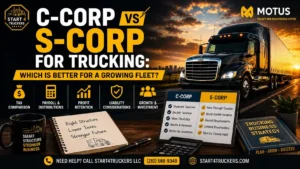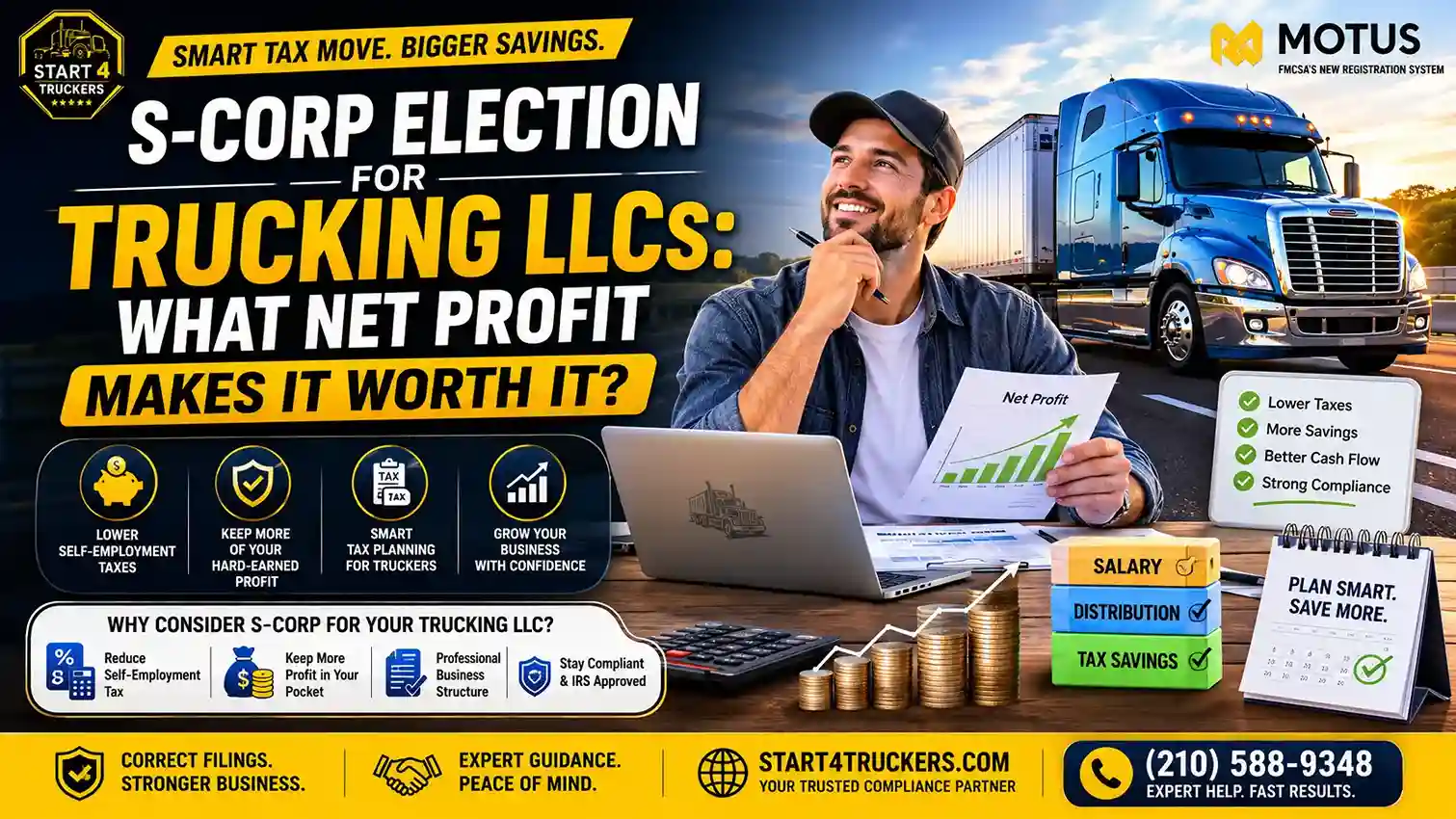
An S-Corp election for trucking LLCs is a tax choice you file with the IRS that changes how your business income is taxed. It does not change your LLC’s legal status or your FMCSA authority. Many trucking business owners start looking at this option once their trucking LLC earns steady net profit above roughly $50,000 to $80,000 a year, because that is often where potential self-employment tax savings start to outweigh payroll and accounting costs. The biggest benefit is lower self-employment tax on part of your profit. The biggest drawback is the extra paperwork, payroll setup, and yearly filing costs. Every trucking business is different, so talk to a qualified tax professional before you decide.
Trucking is hard work. You already deal with fuel costs, maintenance, permits, and long hours on the road. The last thing you need is a confusing tax decision that costs you money instead of saving it.
This guide breaks down the S-Corp election for trucking LLCs in plain English. We will cover what it is, who it helps, what net profit range makes it worth considering, and how to avoid the mistakes many new owner-operators make.
What Is an S-Corp Election for Trucking LLCs?
An S-Corp election for trucking LLCs is a request you file with the Internal Revenue Service (IRS) using Form 2553. It tells the IRS to tax your existing LLC like an S Corporation instead of a sole proprietorship or partnership. Your business stays an LLC in the eyes of your state and FMCSA. Only your federal tax treatment changes.
This trips up a lot of new trucking business owners. They hear “S-Corp” and think they need to form a whole new company. That is not true.
LLC vs S-Corporation Explained
An LLC, or Limited Liability Company, is a legal business structure. It protects your personal assets, like your home or savings, if your business runs into debt or legal trouble.
An S Corporation is not a legal business structure at all. It is a federal tax classification. You can have an LLC that is taxed as an S-Corp, and it is still legally an LLC everywhere else, including with your state and with FMCSA.
Why an LLC Can Elect S-Corp Tax Status
By default, the IRS taxes a single-member LLC like a sole proprietorship and a multi-member LLC like a partnership. Both of these are considered pass-through taxation, meaning profit passes through to your personal tax return.
An LLC can ask the IRS to instead tax it like an S-Corp. This changes how profit is split between salary and distributions, which is the main source of potential tax savings.
How IRS Form 2553 Changes Your Tax Classification
Form 2553 is the official document you file to request S-Corp tax treatment. Once approved, the IRS treats your trucking LLC as an S Corporation for tax purposes going forward.
This form does not create a new business. It simply changes the tax box your existing LLC checks each year.
Does Your Business Become a Corporation?
No. Your trucking LLC does not legally become a corporation. Your state records, your operating agreement, and your business name all stay the same.
The only thing that changes is how the IRS taxes your profit. Your liability protection as an LLC stays fully in place.
Who Can Elect S-Corp Status?
Most single-member and multi-member LLCs can elect S-Corp status if they meet a few basic IRS rules. Your business must:
- Be a domestic LLC or corporation
- Have no more than 100 shareholders or members
- Have only allowable shareholders, like individuals, certain trusts, or estates
- Have only one class of stock or membership interest
Most small trucking LLCs, including one-truck owner-operators, meet these requirements without any trouble.
Why Owner-Operators Consider an S-Corp Election
Owner-operators consider an S-Corp election mainly to reduce self-employment tax. Under standard LLC taxation, all business profit is subject to a 15.3% self-employment tax. Under S-Corp taxation, only your salary is subject to this tax. Profit distributions above your salary usually are not.
This single difference is why the S-Corp election for trucking LLCs gets so much attention in trucking business forums and Facebook groups.
Reducing Self-Employment Taxes
Self-employment tax covers Social Security tax and Medicare tax for business owners. It sits at 15.3% of your net business profit under standard LLC taxation.
With an S-Corp election, you only pay this tax on the salary portion of your income, not on distributions. This is where most of the potential savings comes from.
Separating Salary and Profit Distributions
Under S-Corp taxation, you pay yourself a W-2 salary through payroll. Any remaining profit can be paid out as a distribution.
This salary-versus-distribution split is the core mechanic behind S-Corp tax savings. It is also the part the IRS watches closely, which we cover later in this guide.
Keeping Liability Protection While Changing Tax Treatment
Some owner-operators worry that electing S-Corp status weakens their legal protection. It does not.
Your trucking LLC still shields your personal assets the same way it did before. The S-Corp election only touches your tax filing, not your legal liability structure.
Potential Tax Savings for Growing Trucking Businesses
As your trucking LLC grows and profit increases, the potential savings from an S-Corp election often grow too. This is because a bigger share of your profit can be paid as distributions instead of salary, within reasonable limits set by the IRS.
Growing fleets and multi-truck operations frequently review this option as their revenue increases.
Common Reasons Truck Drivers Switch from Standard LLC Taxation
Truck drivers often start exploring the S-Corp election for trucking LLCs because of:
- Rising annual net profit
- Advice from an accountant or tax professional
- A desire to lower their self-employment tax bill
- Plans to add trucks, trailers, or drivers
- Wanting a more formal payroll and salary structure
What Net Profit Makes an S-Corp Election Worth It?
There is no single profit number that works for every trucking LLC. Many trucking business owners begin seriously reviewing S-Corp election once their annual net profit reaches roughly $50,000 to $80,000, since that is often where potential self-employment tax savings start to outweigh added payroll and accounting costs. Below that range, the extra administrative burden usually costs more than it saves.
There Is No One-Size-Fits-All Profit Number
Every trucking business carries different expenses, salary needs, and state tax rules. A number that works well for one owner-operator may not work for another.
This is why a qualified tax professional should always review your specific numbers before you file Form 2553.
Factors That Affect the Break-Even Point
Several costs affect where your break-even point sits for an S-Corp election.
- Payroll costs: running payroll adds monthly fees and tax filings
- Accounting fees S-Corps usually need a more detailed tax return
- State taxes: some states add extra S-Corp fees or franchise taxes
- Business expenses higher expenses can lower your net profit and shrink potential savings
- Owner compensation your reasonable salary amount directly affects your tax outcome
Example Profit Scenarios
The table below shows general examples only. These are not guarantees and are not tax advice.
| Annual Net Profit | May Be Worth Considering? | Why |
| $30,000 | Usually No | Compliance costs often outweigh potential savings |
| $50,000 | Maybe | Depends heavily on salary level and expenses |
| $70,000 | Often Worth Reviewing | Payroll tax savings may start to appear |
| $90,000 | Frequently Considered | Savings may outweigh added compliance costs |
| $120,000+ | Strong Candidate | Larger distribution opportunities may apply |
Again, these figures are general starting points for discussion with your tax professional, not fixed rules.
How S-Corp Election for Trucking LLCs Saves Money
S-Corp election for trucking LLCs can lower your tax bill by reducing the amount of profit subject to self-employment tax. Instead of paying 15.3% self-employment tax on all business profit, you only pay payroll tax on your salary. Distributions above your salary usually avoid this extra tax layer.
Self-Employment Tax Explained Simply
Self-employment tax funds Social Security and Medicare for business owners who do not have an employer withholding these taxes for them. It sits at 15.3% and applies to your full net business profit under standard LLC taxation.
This is one of the largest tax burdens for owner-operators running a single-member or multi-member LLC.
Salary vs Owner Distributions
Under an S-Corp election, your income splits into two parts:
- W-2 salary – subject to payroll tax, including Social Security and Medicare tax
- Distributions – profit paid out beyond your salary, which usually is not subject to self-employment tax
The IRS requires this salary to be “reasonable” based on the work you actually do for the business.
How Payroll Taxes Work
Once you elect S-Corp status, your trucking LLC must run payroll for any owner who works in the business. This means withholding federal income tax, Social Security tax, and Medicare tax from your paycheck, just like a regular employer would.
Your business also matches a portion of these payroll taxes, similar to hiring a regular W-2 employee.
Example Tax Savings Calculation
Here is a simplified, general example. It does not reflect every owner’s actual tax situation.
Imagine a trucking LLC earns $90,000 in net profit for the year.
- Standard LLC taxation: Self-employment tax applies to the full $90,000 profit
- S-Corp taxation: The owner takes a $50,000 reasonable salary, subject to payroll tax; the remaining $40,000 is paid as a distribution, which is often not subject to self-employment tax
This structure is where the potential tax savings comes from, but the exact dollar amount depends on your salary level, deductions, and state rules. A tax professional can run precise numbers for your situation.
S-Corp vs LLC for Trucking: Which Is Better?
Quick Answer: A standard LLC is simpler and cheaper to run, which fits smaller or newer trucking businesses. An LLC taxed as an S-Corp can lower self-employment tax for businesses with higher, steady profit, but it requires payroll and more detailed IRS filings.
| Feature | Standard LLC | LLC Taxed as S-Corp |
| Self-employment tax | Applies to full profit | Lower on eligible distributions |
| Payroll required | No | Yes |
| IRS forms | Simple (Schedule C) | More complex (Form 1120-S, Schedule K-1) |
| Accounting costs | Lower | Higher |
| Best for | Lower or newer profit levels | Higher, steady profit levels |
There is no universal “better” option. The right choice depends on your net profit, your goals, and your comfort with added paperwork.
Pros and Cons of an S-Corp Election for Trucking LLCs
The biggest advantage of S-Corp election for trucking LLCs is potential self-employment tax savings on distributions. The biggest disadvantage is the added cost and responsibility of running payroll and filing a more complex tax return.
Advantages
- Potential tax savings through lower self-employment tax on distributions
- Possible eligibility for the Qualified Business Income (QBI) deduction
- Pass-through taxation is still maintained
- Added business credibility with formal payroll and salary structure
- Clear separation between owner salary and business profit
Disadvantages
- Payroll setup and ongoing payroll processing required
- Extra bookkeeping to track salary versus distributions
- Stricter IRS compliance, including reasonable salary rules
- Payroll tax filing deadlines throughout the year
- Higher accounting and tax preparation costs
How to Elect S-Corp Status for Your Trucking LLC
To elect S-Corp status, you first need an active trucking LLC and an Tax id. Then you file IRS Form 2553 within the required deadline, set up payroll for owner salaries, and maintain ongoing tax compliance each year.
Step 1: Form Your Trucking LLC
Before you can elect S-Corp status, you need a properly formed trucking LLC. This includes choosing a business name that does not conflict with an existing carrier and filing your state paperwork correctly. Our guide on how to name a trucking LLC without conflicts can help you avoid delays at this stage.
Step 2: Get Your Tax id
Your trucking LLC needs an Employer Identification Number (Tax id) before it can file Form 2553 or run payroll. This number acts like a Social Security number for your business.
Step 3: File IRS Form 2553
Form 2553 must generally be filed within two months and 15 days after the start of the tax year you want the election to apply to, or at any time during the prior tax year. Missing this window can push your S-Corp election back to the following year.
Step 4: Set Up Payroll
Once your election is approved, you must set up payroll for any owner working in the business. This includes withholding payroll taxes and filing regular payroll tax forms with the IRS.
Step 5: Maintain Annual Tax Compliance
Your trucking LLC will now file Form 1120-S each year instead of a standard Schedule C. Each owner also receives a Schedule K-1 showing their share of income to report on their personal tax return.
IRS Rules Every Trucking LLC Should Know Before Electing S-Corp Status
The IRS requires S-Corp owners who work in the business to pay themselves a reasonable salary before taking distributions. The business must also run payroll correctly, file Form 1120-S annually, issue Schedule K-1 to each owner, and pay quarterly estimated taxes when required.
Reasonable Salary Requirement
The IRS expects your salary to reflect what someone would normally be paid for similar work in the trucking industry. Paying yourself an unreasonably low salary just to avoid payroll tax is a common red flag during an audit.
Payroll Tax Responsibilities
Your trucking LLC must withhold federal income tax, Social Security tax, and Medicare tax from owner salaries. The business also matches part of these payroll taxes, the same as any employer would.
Filing Form 1120-S
Form 1120-S is the annual tax return for businesses taxed as an S-Corp. It reports total income, deductions, and each shareholder’s share of the profit.
Schedule K-1 Explained
Schedule K-1 shows each owner’s individual share of the business profit or loss. You use this form to report your share of income on your personal tax return.
Quarterly Estimated Taxes
Owners may still need to pay quarterly estimated taxes on distributions and other income not covered by payroll withholding. Missing these payments can lead to IRS penalties.
When an S-Corp Election Is NOT Worth It
An S-Corp election is often not worth it for trucking businesses with very low or inconsistent profit, part-time owner-operators, or anyone who does not want the added responsibility of running payroll.
Very Low Annual Profit
If your trucking LLC earns a small profit each year, the cost of payroll and extra tax filings can outweigh any potential savings.
Side-Hustle Trucking Businesses
If trucking is a side business alongside a full-time job, the added complexity of an S-Corp election rarely makes sense.
Part-Time Owner-Operators
Part-time drivers with inconsistent loads and unpredictable income may struggle to justify the fixed costs of payroll and formal tax filings.
Businesses Without Consistent Income
S-Corp election works best with steady, predictable profit. Highly seasonal or unpredictable trucking income can make salary planning difficult.
Companies That Don’t Want Payroll Administration
Running payroll takes time and attention. If you would rather keep things simple, standard LLC taxation may be the better fit for now.
Common Mistakes Trucking Business Owners Make
The most common mistakes include paying no salary at all, missing the Form 2553 deadline, electing S-Corp status too early, ignoring payroll tax rules, and mixing personal and business finances.
Paying Yourself No Salary
Some owners try to take all profit as distributions and skip salary entirely. This goes against IRS rules and can trigger penalties or a reclassification of your income.
Missing Form 2553 Deadlines
Filing Form 2553 late can delay your S-Corp election to the next tax year, meaning you lose out on any potential benefit for the current year.
Choosing S-Corp Too Early
Electing S-Corp status before your trucking LLC earns enough profit to cover payroll and accounting costs can actually increase your total costs instead of lowering them.
Ignoring Payroll Taxes
Skipping or delaying payroll tax deposits can lead to serious IRS penalties, since payroll taxes are considered a high-priority obligation.
Mixing Personal and Business Finances
Combining personal and business bank accounts makes it harder to track salary, distributions, and expenses correctly, which can create tax reporting problems.
Forgetting State Tax Rules
Some states apply their own S-Corp rules, fees, or franchise taxes. Always check your specific state requirements in addition to federal rules.
Does an S-Corp Election Affect FMCSA Registration or Your USDOT Number?
No. An S-Corp election is a federal tax classification only. It does not change your FMCSA operating authority, your USDOT Number, or your MC Authority. However, if your entity details change for other reasons, you may still need to update your FMCSA records separately.
USDOT Registration
Your USDOT Number stays tied to your legal business entity, which remains your LLC. Electing S-Corp tax status does not require a new USDOT Number.
MC Authority
Your MC Authority also stays unaffected by your tax classification. FMCSA cares about your business name, officers, and safety record, not your IRS tax election.
BOC-3 Filing
Your BOC-3 filing lists your process agents by state and does not change based on your tax classification.
UCR Registration
Your Unified Carrier Registration (UCR) is based on your fleet size and operating authority, not your tax status.
MCS-150 Updates
If your business address, officer information, or other entity details change for any reason, you may need to file an MCS-150 update, but this is separate from your S-Corp tax election itself.
FMCSA Compliance
Overall, staying FMCSA compliant depends on your safety record, registrations, and filings, none of which change because you elected S-Corp tax status.
Is an S-Corp Election Right for Single-Member and Multi-Member Trucking LLCs?
Both single-member and multi-member trucking LLCs can elect S-Corp status if they meet IRS requirements. The right choice depends more on your net profit and payroll readiness than on how many owners your LLC has.
Single-Member Trucking LLCs
A solo owner-operator running a single-member LLC can still elect S-Corp status. The owner simply becomes both the sole shareholder and the salaried employee of the business.
Multi-Member Trucking LLCs
A multi-member trucking LLC can also elect S-Corp status, as long as it meets shareholder and stock class requirements. Each active member typically needs a reasonable salary through payroll.
Owner-Operators
Owner-operators with steady, higher profit are often the ones who benefit most from reviewing this election with a tax professional.
Small Fleets
Small fleets with multiple trucks and growing profit may see larger potential savings, since more total profit can be split between salary and distributions.
S-Corp Election Checklist for Trucking LLCs
Use this checklist as a general starting point before speaking with your tax professional.
- Form your trucking LLC correctly
- Obtain your Tax id
- Estimate your expected annual net profit
- Consult a qualified tax professional
- File IRS Form 2553 before the deadline
- Set up payroll for owner salaries
- Track salary and distributions separately
- Maintain clean accounting records year-round
- File your annual Form 1120-S tax return
- Stay current on FMCSA compliance and filings
How Start4Truckers LLC Helps New Trucking Businesses
Getting your trucking business set up correctly from day one makes every later decision, including an S-Corp election, much easier. Start4Truckers LLC helps new and growing trucking companies handle the business formation side of things, including:
- Trucking LLC formation
- Tax id registration
- USDOT Number registration
- MC Authority registration
- BOC-3 filing
- UCR registration
- Ongoing FMCSA compliance support
While Start4Truckers LLC helps you build a solid business foundation, it does not provide tax, accounting, or legal advice. For decisions about S-Corp elections and tax planning, always consult a qualified tax professional who understands your full financial picture.
If you want help getting your trucking LLC formed and registered the right way, explore our trucking LLC formation services or compare our plans and pricing to find the right fit for your business.
Ready to talk it through? Call Start4Truckers LLC at (210) 588-9348 or reach out through our contact page.
Final Thoughts
An S-Corp election for trucking LLCs is not a one-size-fits-all decision. It can offer real tax savings for owner-operators and fleet owners with steady, higher net profit, but it adds payroll responsibilities and accounting costs that are not right for every business.
Owners with lower or inconsistent profit are often better off waiting and revisiting the decision as their trucking business grows. The key takeaway is simple: compare your expected tax savings against the real cost of payroll and compliance before you file anything with the IRS.
Before you make any tax election, focus first on building a strong, properly registered trucking business. Start4Truckers LLC can help with trucking company setup and FMCSA compliance, while a qualified tax professional can guide you through the S-Corp decision itself. Call (210) 588-9348 or visit our trucking company setup services page to get started today.
Frequently Asked Questions
1. What is an S-Corp election for a trucking LLC?
An S-Corp election is a federal tax choice filed with the IRS using Form 2553. It changes how your trucking LLC’s profit is taxed but does not change your legal business structure, your USDOT Number, or your FMCSA authority.
2. At what net profit does an S-Corp election usually become worthwhile?
Many trucking business owners begin reviewing this option once annual net profit reaches roughly $50,000 to $80,000. Below this range, payroll and accounting costs often outweigh any potential tax savings. Your exact number depends on your expenses and salary needs.
3. Can a single-member trucking LLC elect S-Corp status?
Yes. A single-member trucking LLC can elect S-Corp tax treatment as long as it meets IRS shareholder rules. The owner becomes both the sole shareholder and a salaried employee once payroll is set up.
4. Does an S-Corp election reduce self-employment taxes?
It can. Under standard LLC taxation, self-employment tax applies to your full net profit. Under S-Corp taxation, this tax generally applies only to your salary, not to distributions above that amount.
5. How do I file Form 2553 for my trucking LLC?
You complete Form 2553 with your business information and file it with the IRS within the required deadline, generally within two months and 15 days after the start of the tax year. A tax professional can help make sure it is filed correctly and on time.
6. What is a reasonable salary for an owner-operator with an S-Corp?
A reasonable salary reflects what someone would typically earn for similar work in the trucking industry. There is no fixed dollar amount; it depends on your role, your revenue, and industry norms, so a tax professional should help you set this figure.
7. Is an S-Corp better than a standard LLC for truck drivers?
Neither option is automatically better. A standard LLC is simpler and cheaper for lower profit levels, while an S-Corp election may offer tax savings for businesses with higher, steady profit that can absorb payroll costs.
8. Does an S-Corp election affect my USDOT Number or MC Authority?
No. Your USDOT Number and MC Authority are tied to your legal business entity, which remains your LLC. Your federal tax classification does not change your FMCSA registration.
9. Can I change my trucking LLC to an S-Corp later?
Yes. Many trucking businesses start with standard LLC taxation and elect S-Corp status later, once their profit grows enough to justify the added payroll and accounting costs.
10. What are the disadvantages of an S-Corp election?
The main disadvantages include mandatory payroll for owner salaries, more complex IRS filings like Form 1120-S, higher accounting costs, and stricter compliance rules around reasonable salary requirements.
11. Do I need payroll if my trucking LLC elects S-Corp status?
Yes. Any owner who actively works in the business must be paid a reasonable salary through payroll, which includes withholding and paying standard payroll taxes.
12. Can a multi-member trucking LLC elect S-Corp taxation?
Yes, as long as the LLC meets IRS requirements for shareholder type and stock class. Each actively working member generally needs a reasonable salary set up through payroll.
13. What happens if I miss the Form 2553 filing deadline?
If you miss the deadline, your S-Corp election may not take effect until the following tax year. In some cases, late election relief may be available, but this depends on your specific circumstances and should be reviewed with a tax professional.
14. Is an S-Corp worth it for a one-truck owner-operator?
It depends entirely on your net profit and expenses. A one-truck owner-operator with lower or inconsistent income may not see enough savings to offset payroll costs, while one with steady, higher profit might.
15. Should new trucking companies elect S-Corp status immediately?
Usually not. Most new trucking companies benefit from starting with standard LLC taxation, then reviewing an S-Corp election once their business shows consistent, higher profit and can support payroll costs.