The Unified Carrier Registration, or UCR, is an annual requirement most interstate trucking companies can’t skip, yet thousands of carriers unknowingly miss the renewal window every single year. Understanding UCR registration deadlines by year and what actually happens if you register late can save your business from fines, roadside headaches, and delays that hit right when you can least afford them.
Yes, you can still register for UCR after the deadline, but you’re considered non-compliant the moment the new year begins, which opens the door to state enforcement, citations, and possible vehicle detention at roadside inspections. There’s no separate “late fee” charged by the UCR Board itself, but individual states can issue penalties that often cost far more than the registration fee would have. Start4Truckers LLC helps carriers register on time every year and stay ahead of these deadlines.
What Is UCR Registration?
UCR Registration, short for Unified Carrier Registration, is an annual federal program that requires most interstate motor carriers, brokers, freight forwarders, and leasing companies to register and pay a fee based on fleet size.
What Does UCR Stand For?
UCR stands for Unified Carrier Registration, a program created to replace an older, more complicated system of individual state permits for interstate carriers.
Why Was the UCR Program Created?
UCR was created to simplify interstate carrier registration into one unified system, replacing a patchwork of state-by-state permits that used to make compliance far more complicated for trucking businesses operating across multiple states.
Who Administers the UCR Program?
The UCR Plan, made up of state, federal, and industry representatives, is responsible for developing, implementing, and administering the UCR Agreement nationwide.
Is UCR a Federal or State Requirement?
UCR is a federally mandated program, but registration and fee collection happen through each carrier’s base state, which then distributes funds according to the UCR Agreement.
What Is the Purpose of Annual UCR Registration?
Annual registration keeps carrier records current, funds state enforcement programs, and ensures every interstate carrier, broker, and forwarder contributes fairly to the system that oversees interstate commerce.
What Are UCR Registration Deadlines by Year?
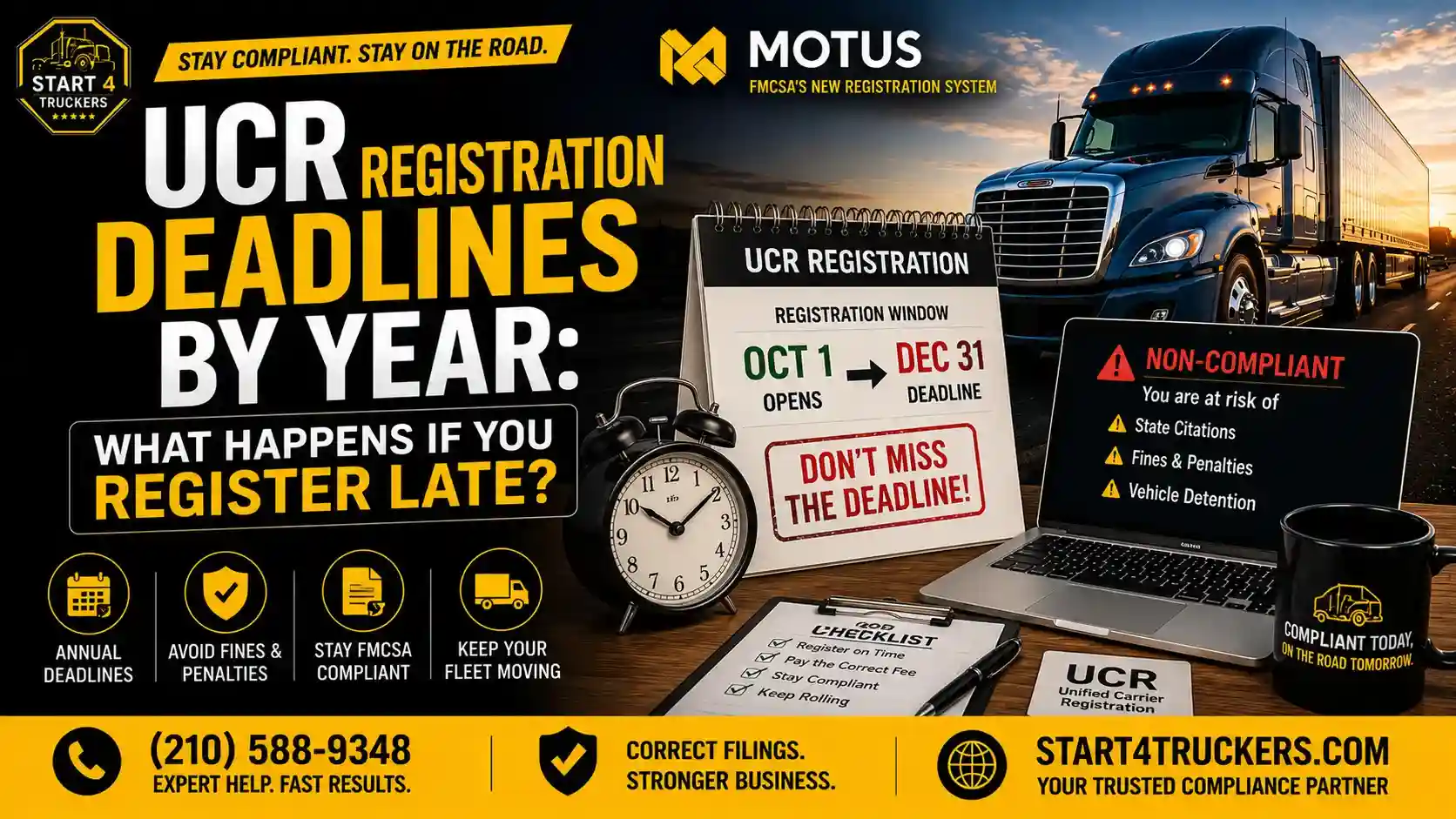
The UCR registration window generally opens October 1 each year and closes December 31, with your fee due before January 1 of the upcoming registration year to avoid state enforcement action.
When Does UCR Registration Usually Open?
According to the official UCR Plan website, the registration portal for a given year typically opens on October 1 of the prior year, giving carriers a three-month window to renew before the deadline.
Annual UCR Renewal Timeline
| Registration Year | Registration Opens | Deadline | Coverage Period |
| 2024 | October 2023 | Dec 31, 2023 | Calendar Year 2024 |
| 2025 | October 2024 | Dec 31, 2024 | Calendar Year 2025 |
| 2026 | October 1, 2025 | Dec 31, 2025 | Calendar Year 2026 |
| 2027 | October 1, 2026 (expected) | Dec 31, 2026 (expected) | Calendar Year 2027 |
Opening and closing dates may shift slightly based on UCR Board announcements, so always confirm the current year’s exact dates directly through the official UCR registration portal.
Why Does UCR Have an Annual Deadline?
UCR requires annual renewal because it’s designed as a yearly compliance program that funds state enforcement, keeps carrier records accurate, and ensures fees are collected fairly across every registration cycle.
Annual Compliance Requirement
Unlike some credentials that last multiple years, UCR applies strictly to one calendar year at a time. There’s no multi-year option, which means every carrier must renew annually without exception.
State Enforcement Funding
Fees collected through UCR help fund state-level enforcement programs, including roadside inspections and compliance reviews, which is part of why states take missed registrations seriously.
Keeping Carrier Records Current
Annual renewal gives the system a built-in checkpoint to catch changes in fleet size, business details, or operating status that might affect a carrier’s fee bracket.
Why Renewal Isn’t Automatic
UCR registration does not roll over automatically from year to year. Even if nothing about your business has changed, you still need to actively re-register and pay your fee each year.
What Happens If You Register Late?
Registering late doesn’t stop you from completing the process, but you remain non-compliant until you do, which puts you at risk of state citations, fines, and possible vehicle detention during roadside inspections.
Can You Still Register After the Deadline?
Yes. UCR registration remains open past the deadline, and carriers can and do register late. However, being registered late does not erase the compliance gap that existed between January 1 and the date you actually completed your filing.
Late Registration Rules
If you operated in interstate commerce before completing your registration, you’re still responsible for that period. Filing late means you complete your current registration, but the missed window still counts as a period of non-compliance.
State Enforcement Actions
Individual states enforce UCR compliance independently, which means citations, fines, and enforcement approaches can vary from one state to another.
Roadside Inspection Risks
Enforcement officers and roadside inspectors can check a carrier’s UCR status during routine stops. An expired or missing registration can trigger a citation on the spot.
Possible Civil Penalties
Civil penalties for non-compliance can be significant, particularly since some states enforce this per vehicle, meaning larger fleets can face steeper cumulative penalties.
Delays During Compliance Audits
A lapsed UCR registration can complicate FMCSA compliance audits or reviews, adding friction to a process that’s already stressful enough for most carriers.
Impact on Business Operations
Beyond fines, a citation or vehicle detention means lost time, missed deliveries, and potential damage to relationships with shippers or brokers who expect reliable, compliant service.
Behind on your UCR renewal? Call Start4Truckers LLC at (210) 588-9348 and let’s get you compliant quickly.
Is There a Late Fee for UCR Registration?
The UCR Board itself doesn’t charge a separate “late fee” on top of your standard registration cost. Instead, individual states enforce non-compliance through their own citations and fines, which can be considerably more expensive than the registration fee would have been.
Does the UCR Board Charge a Late Fee?
No dedicated late fee is tacked onto your UCR registration cost by the Board. Your fee stays based on your fleet size bracket, regardless of when during the year you file.
State Citation vs UCR Fee
The real cost of registering late usually comes from state enforcement, not the UCR fee itself. A citation at a weigh station or roadside inspection can far exceed what your annual registration would have cost.
Penalties Vary by State
Because enforcement is handled at the state level, the specific fine amounts and enforcement intensity can differ significantly depending on where you’re inspected.
Can You Receive Multiple Citations?
Yes. Depending on how your operations are structured and how many vehicles are affected, it’s possible to face more than one citation if multiple vehicles are inspected while your registration is lapsed.
Can You Operate Without an Active UCR Registration?
Technically, you can physically drive, but doing so without an active UCR registration puts your business out of compliance and exposes you to fines, citations, and potential vehicle detention.
Interstate Carrier Rules
Interstate carriers, brokers, and freight forwarders are expected to maintain active UCR registration for every calendar year they operate across state lines.
What Roadside Inspectors Check
During inspections, officers can check a carrier’s UCR status alongside other compliance records, such as USDOT registration and safety history.
How Missing UCR Can Affect Operations
An expired registration discovered during an inspection can lead to delays, citations, or even a vehicle being placed out of service until the situation is resolved.
Does It Affect Insurance?
While UCR itself isn’t insurance, a pattern of compliance violations, including lapsed UCR registration, can affect how insurers view your overall risk profile over time.
Which Carriers Must Meet UCR Registration Deadlines?
Interstate motor carriers, owner-operators, freight brokers, freight forwarders, and leasing companies operating in interstate commerce are generally required to register annually under UCR.
Interstate Motor Carriers
Companies hauling freight across state lines are the core group required to register under UCR each year.
Owner-Operators
Owner-operators running their own interstate authority are treated the same as larger carriers when it comes to UCR obligations.
Freight Brokers
Brokers arranging interstate freight movement must also register annually, typically falling into the lowest fee bracket regardless of transaction volume.
Freight Forwarders
Freight forwarders coordinating interstate shipments are subject to the same annual registration requirement as motor carriers.
Leasing Companies
Companies that lease commercial vehicles to interstate carriers may also have UCR obligations, depending on their role in the leasing arrangement.
Private Carriers
Private carriers, meaning businesses hauling their own goods rather than for-hire freight, are also generally subject to UCR if they operate in interstate commerce.
Companies That May Be Exempt
Some entities may be exempt depending on their specific operations, which is why confirming your status directly through the official UCR eligibility tool is always worth doing.
Who Does NOT Need UCR Registration?
Intrastate-only carriers, certain government vehicles, some agricultural operations, and specific passenger transportation exceptions may fall outside standard UCR registration requirements.
Intrastate-Only Carriers
Carriers that operate exclusively within one state generally fall outside UCR’s interstate-focused requirement, though state-specific rules can still apply. Our guide on USDOT Number Requirements for Intrastate Carriers covers this distinction in more detail.
Government Vehicles
Vehicles operated directly by government agencies are typically excluded from standard UCR registration requirements.
Certain Agricultural Exemptions
Some agricultural operations may qualify for exemptions depending on how their vehicles are used and classified.
Passenger Exceptions
Certain passenger transportation operations may fall under different rules, depending on vehicle capacity and how the service is structured.
How to Renew UCR Registration Before the Deadline
Quick Answer: To renew on time, verify your USDOT Number, confirm your current fleet size, calculate your fee bracket, complete registration online, save your confirmation, and verify your active status afterward.
Step 1: Verify Your USDOT Number
Make sure your USDOT Number is accurate and active before starting your UCR registration.
Step 2: Confirm Fleet Size
Your fleet size, based on your most recent MCS-150 filing, determines your fee bracket, so confirm this number is accurate before registering.
Step 3: Calculate Your Fee Bracket
Use the current year’s official fee schedule to determine exactly what you’ll owe based on your vehicle count.
Step 4: Complete Online Registration
Submit your registration through the National Registration System, entering your USDOT Number, business details, and fleet information.
Step 5: Save Your Confirmation
Download and store your UCR receipt. While no physical credential needs to be carried in the vehicle, proof of registration should stay easily accessible for audits or roadside questions.
Step 6: Verify Active Status
After completing payment, confirm your registration shows as active in the system rather than assuming the payment alone finished the process.
Want help getting your UCR renewed correctly and on time? Call Start4Truckers LLC at (210) 588-9348 today.
UCR Fee Brackets Explained
UCR fees are based entirely on fleet size, not mileage or revenue. Fees for the 2026 registration year remained unchanged from 2025, ranging from $46 for the smallest carriers to $44,836 for fleets of 1,001 or more vehicles.
| Fleet Size | 2026 Annual UCR Fee (Carrier/Forwarder) |
| 0–2 Vehicles | $46.00 |
| 3–5 Vehicles | $138.00 |
| 6–20 Vehicles | $276.00 |
| 21–100 Vehicles | $963.00 |
| 101–1,000 Vehicles | $4,592.00 |
| 1,001+ Vehicles | $44,836.00 |
Brokers and leasing companies are assessed a flat $46 fee regardless of fleet size, since they don’t operate their own vehicles the same way carriers and forwarders do. Always verify the current year’s exact fees through the official UCR fee bracket page, since amounts are set annually and can change based on program funding needs.
How to Check If Your UCR Registration Is Active
You can verify your UCR registration status online through the National Registration System using your USDOT Number, checking that your record shows as paid and active for the current registration year.
Online Verification
The UCR registration system allows carriers to check their current status directly by entering their USDOT Number.
Information You’ll Need
Have your USDOT Number and business name ready before checking your status online.
Common Status Messages
Your record may show as active, pending, or unregistered, depending on where you are in the renewal process.
What to Do If Your Registration Doesn’t Appear
If your registration doesn’t show as expected, double-check that you registered under the correct USDOT Number and that payment was fully processed before assuming there’s a system error.
Common Reasons Carriers Miss the UCR Deadline
Carriers most often miss the UCR deadline by simply forgetting the annual renewal, having outdated contact information, experiencing ownership or fleet changes, running into payment issues, or mistakenly assuming registration renews automatically.
Forgot Annual Renewal
With so many compliance dates to track, UCR renewal can slip through the cracks, especially for smaller operations without a dedicated compliance team.
Incorrect Email Address
If your contact information on file is outdated, you may miss renewal reminders entirely.
Fleet Ownership Changes
Adding or removing vehicles without updating your records can create confusion about which fee bracket applies.
Business Ownership Changes
Changes in business ownership or structure can sometimes get lost in the shuffle of a busy transition, leading to missed renewals.
Payment Problems
Expired cards or payment processing issues can quietly derail a renewal that was otherwise submitted on time.
Assuming Registration Automatically Renews
This is one of the most common and costly assumptions. UCR does not automatically renew, no matter how long you’ve been registered in previous years.
Common Mistakes After Missing the Deadline
After missing the deadline, carriers often make things worse by waiting too long to act, ignoring state notices, registering under the wrong USDOT Number, using unofficial payment websites, or failing to save confirmation records.
Waiting Too Long
The longer you wait to register after missing the deadline, the longer your compliance gap stays open, increasing your exposure to enforcement action.
Ignoring State Notices
State compliance notices shouldn’t be set aside. Addressing them promptly can help resolve issues before they escalate further.
Registering Under the Wrong USDOT Number
Double-check that your registration ties to the correct, active USDOT Number, especially if your business has multiple entities or has recently changed structure.
Paying Through Unofficial Websites
Stick to official registration channels or trusted compliance services to avoid confusion, delays, or payment issues from unofficial third-party sites.
Not Saving Confirmation Records
Always keep a copy of your registration confirmation. It’s your proof of compliance if questions come up later.
UCR Registration vs Other Annual FMCSA Requirements
Quick Answer: UCR is just one of several recurring FMCSA-related requirements. Unlike UCR’s annual cycle, MCS-150 updates happen every two years, IFTA filings are quarterly, and IRP and Form 2290 follow their own annual schedules.
| Requirement | Frequency | Required For |
| UCR Registration | Annual | Interstate carriers, brokers, forwarders |
| MCS-150 Update | Biennial | USDOT holders |
| BOC-3 Filing | As needed | Operating authority |
| IRP Registration | Annual | Apportioned vehicles |
| IFTA | Quarterly filing | Qualified vehicles |
| Form 2290 | Annual | Heavy vehicles |
Does Missing the UCR Deadline Affect Your USDOT or MC Number?
Missing your UCR deadline doesn’t directly deactivate your USDOT Number or MC Authority, but it does create a separate compliance issue that can complicate audits, roadside stops, and your overall safety record.
USDOT Number
Your USDOT Number itself typically remains active even if your UCR registration lapses, since these are technically separate systems.
MC Authority
Similarly, your MC Authority isn’t automatically revoked due to a missed UCR deadline, though ongoing non-compliance across multiple areas can draw more scrutiny over time.
Operating Authority Status
While the two systems are separate, a pattern of missed compliance requirements, including UCR, can factor into how FMCSA and state agencies view your overall operation.
FMCSA Safety Record
Citations related to UCR non-compliance can become part of your broader safety and compliance record, which matters for future audits and reviews.
State-by-State UCR Enforcement
UCR enforcement varies by state, with some states running more active roadside inspection and weigh station programs than others. Regardless of which state you’re inspected in, an expired UCR registration can trigger a citation.
Participating States
Most states across the country participate in the UCR program, collecting fees and enforcing compliance according to their own procedures.
States With Strong Enforcement
Some states are known for more consistent roadside checks and stricter enforcement of UCR compliance, particularly along high-traffic interstate corridors.
Roadside Inspection Programs
State roadside inspection programs are one of the most common ways UCR non-compliance gets caught, alongside general safety inspections.
Weigh Stations and UCR Checks
Weigh stations often double as compliance checkpoints, where officers can verify UCR status along with other required documentation.
UCR Registration Compliance Checklist
- Verify eligibility
- Confirm fleet size
- Update business information
- Register before Dec. 31
- Pay correct fee
- Save receipt
- Verify registration
- Keep proof in records
Annual UCR Renewal Calendar
The UCR renewal window typically follows a predictable pattern: registration opens in October, most carriers renew through November and December, and enforcement begins in January for anyone who hasn’t completed the process.
October: Registration Opens
The registration portal opens for the upcoming year, giving carriers a head start on renewing before the rush.
November: Renew Early
Renewing in November helps avoid the last-minute crunch that many carriers face closer to the deadline.
December: Final Renewal Month
December is the final month to register and pay before the new year begins, making it the busiest month for UCR filings.
January: Late Registration & Enforcement Begins
Once January starts, any carrier without an active registration for the new year is considered non-compliant, and state enforcement action becomes a real possibility.
How Start4Truckers LLC Makes UCR Renewal Easy
Staying on top of annual deadlines across USDOT, MC authority, BOC-3, MCS-150, and UCR can feel like a full-time job on its own. Start4Truckers LLC helps carriers handle:
- UCR Registration and renewal
- USDOT registration
- MC authority registration
- BOC-3 filing
- MCS-150 filing
- Ongoing FMCSA compliance support
- Full trucking company setup
Explore our UCR registration service directly, or compare our plans and pricing to find hassle-free, ongoing compliance support.
Call Start4Truckers LLC today at (210) 588-9348 or reach out through our contact page to get your UCR renewal handled before the next deadline.
Final Thoughts
UCR must be renewed every single year, with no automatic rollover and no grace period once January 1 arrives. Missing the deadline doesn’t stop you from registering, but it does open the door to state enforcement, citations, and operational delays that cost far more than the registration fee itself would have.
The smartest move is registering early, ideally as soon as the window opens in October, so you’re never scrambling in the final days of December. Start4Truckers LLC can take this off your plate entirely, handling your UCR registration and broader FMCSA compliance so you can stay focused on the road. Call us at (210) 588-9348 or visit our contact page to get started.
Frequently Asked Questions
1. What are the UCR registration deadlines by year?
The UCR registration window typically opens October 1 and closes December 31 each year, with your fee due before January 1 of the upcoming registration year to remain compliant.
2. What happens if I miss the UCR registration deadline?
You remain non-compliant until you complete your registration, which puts you at risk of state citations, fines, and possible vehicle detention during roadside inspections.
3. Can I register for UCR after December 31?
Yes, you can still register after the deadline, but you’re considered non-compliant for any period you operated without an active registration for the new year.
4. Is there a late fee for UCR registration?
The UCR Board doesn’t charge a separate late fee, but individual states can issue their own citations and fines for non-compliance, which often cost significantly more than the original fee.
5. Can I operate without an active UCR registration?
You can physically operate, but doing so without active registration puts your business out of compliance and exposes you to fines and possible vehicle detention.
6. Does UCR registration expire every year?
Yes. UCR is strictly an annual requirement with no automatic renewal, meaning you must actively re-register every calendar year regardless of past compliance history.
7. How do I renew my UCR registration?
You renew by verifying your USDOT Number, confirming your fleet size, calculating your fee bracket, and completing payment through the official National Registration System.
8. Do owner-operators need annual UCR renewal?
Yes. Owner-operators running interstate authority are subject to the same annual UCR registration requirement as larger carriers.
9. Does missing the UCR deadline affect my MC Number?
Not directly. Your MC Authority typically isn’t automatically affected by a missed UCR deadline, though ongoing compliance issues across multiple areas can draw additional scrutiny.
10. Does missing the UCR deadline affect my USDOT Number?
No, your USDOT Number generally remains active independently of your UCR registration status, since these are separate systems.
11. Which states enforce UCR registration?
Most states participating in the UCR program enforce compliance through roadside inspections and weigh stations, though enforcement intensity can vary from state to state.
12. How do I verify my UCR registration status?
You can check your status online through the National Registration System using your USDOT Number to confirm whether your registration is active for the current year.
13. What documents do I need for UCR renewal?
You’ll generally need your USDOT Number, business information, and current fleet size, based on your most recent MCS-150 filing.
14. How much does UCR registration cost each year?
Fees are based on fleet size and are set annually. For the 2026 registration year, fees ranged from $46 for the smallest carriers to $44,836 for fleets of 1,001 or more vehicles, unchanged from 2025.
15. Can Start4Truckers LLC handle my UCR registration and renewal?
Yes. Start4Truckers LLC helps carriers complete their UCR registration accurately and on time each year, alongside broader FMCSA compliance support like USDOT, MC authority, and BOC-3 filings.