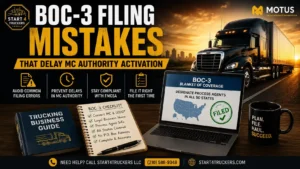
Getting your MC Number approved is exciting, but many new trucking companies hit a wall right after: the BOC-3 filing requirement. One of the most common questions at this stage is simple: “Can you file your own BOC-3, or do you need a process agent service?”
A BOC-3 is a mandatory filing for most interstate motor carriers and freight brokers before operating authority becomes active. Many business owners assume they can submit this form on their own, but FMCSA has specific rules about who is allowed to serve as your process agent. This guide breaks down those rules, clears up common misconceptions, and walks through how to complete the process correctly. Start4Truckers LLC is here as a trusted resource for FMCSA registration and compliance support along the way.
Can You File Your Own BOC-3?
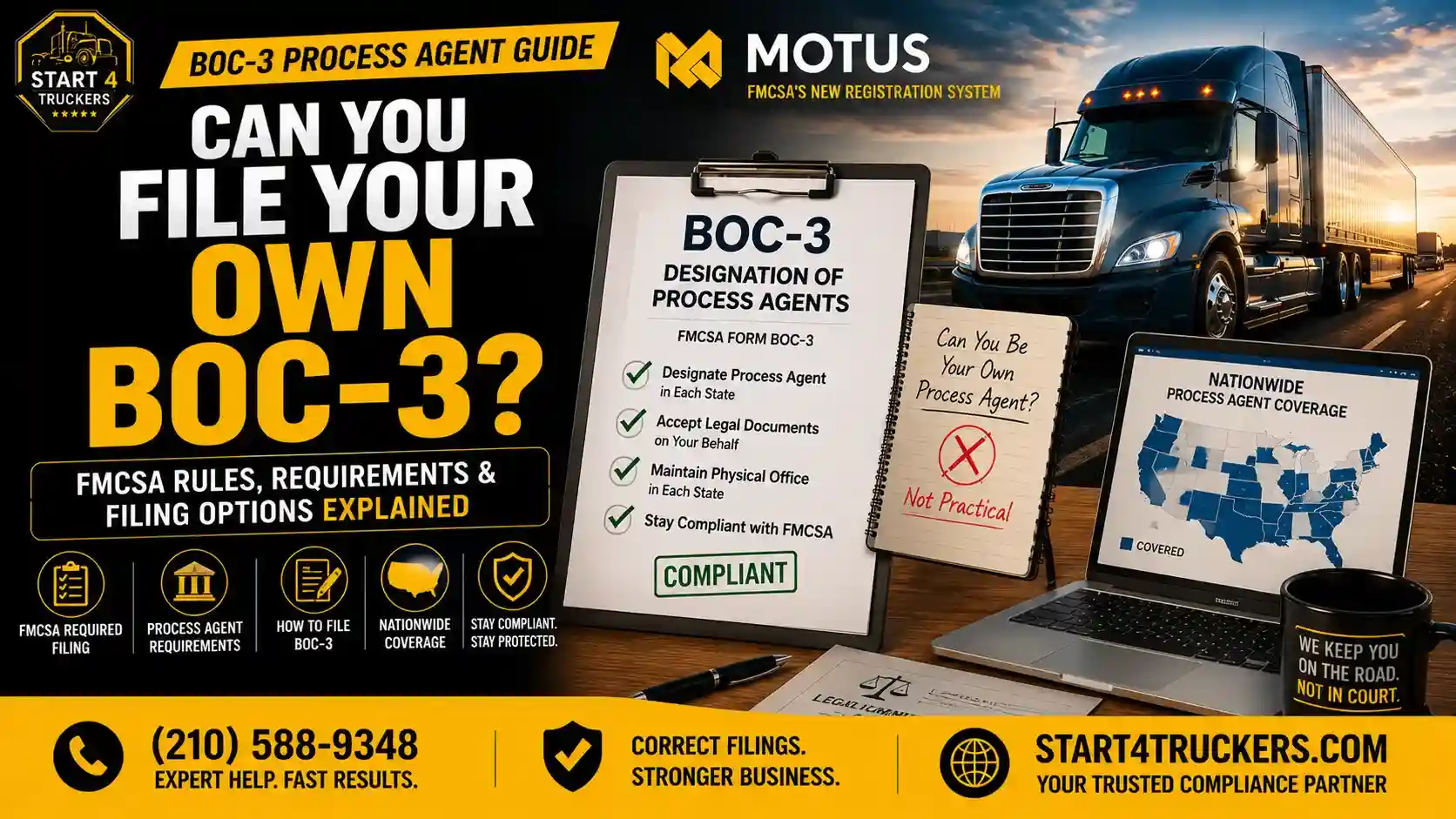
No, you generally cannot act as your own process agent for a BOC-3 filing. FMCSA requires a designated process agent in each state where you operate, and that agent must maintain a physical office or business address in that state to accept legal documents on your behalf. Because of this, most carriers use a blanket process agent service that already has coverage across all required states, rather than trying to handle it themselves.
Key Takeaway: You can technically attempt a self-filed BOC-3 if you personally meet the process agent requirements in every state where you operate, but this is impractical for almost every carrier. A blanket process agent service is the standard, efficient solution.
What Is a BOC-3 Filing?
A BOC-3 filing is FMCSA’s official “Designation of Process Agents” form. It names a person or company in each required state who is authorized to accept legal documents on behalf of a motor carrier, freight broker, or freight forwarder.
What Does BOC-3 Stand For?
BOC-3 doesn’t stand for a specific phrase; it’s simply FMCSA’s form number for this designation. Most people in the industry just call it “the BOC-3.”
Why the FMCSA Requires a BOC-3 Filing
FMCSA requires this filing so that legal notices, lawsuits, and court documents can reliably reach a carrier or broker, no matter which state the legal matter arises in. Without a designated process agent, there would be no consistent way to serve legal papers to an interstate carrier operating across many states.
Who Must File a BOC-3?
Generally, the following businesses must file a BOC-3:
- Motor carriers operating in interstate commerce
- Freight brokers
- Freight forwarders
- Businesses applying for new interstate transportation authority
Not sure if this applies to your specific setup? Our guide on BOC-3 filing requirements covers this in more detail.
What Is a Process Agent?
A process agent is a person or company designated to receive legal documents, such as lawsuits or court notices, on behalf of a motor carrier or broker in a specific state.
What Does a Process Agent Do?
A process agent’s core responsibilities include:
- Receiving legal notices addressed to the carrier
- Accepting court documents on the carrier’s behalf
- Handling service of process in the state where they’re designated
- Supporting the carrier’s ongoing regulatory compliance
What Is a Blanket Process Agent?
A blanket process agent is a company that already maintains process agent coverage in every state where designation is required. Instead of finding a separate individual agent in all 48 contiguous states, carriers can use one blanket process agent service to meet the entire requirement at once. This is why blanket process agents are the most common and practical solution in the industry.
Can You Be Your Own Process Agent?
Technically, yes, but only if you personally maintain a physical business address in every state where FMCSA requires a designated process agent. For almost every carrier, this isn’t realistic, which is why nearly all businesses use a professional process agent service instead.
Myth vs Fact
Myth: “I can just list myself as my own process agent on the BOC-3.”
Fact: FMCSA requires a process agent physically located in each state you operate in. Unless you have a real business address in every one of those states, you cannot legally serve as your own process agent everywhere your authority covers.
Myth: “The BOC-3 is basically the same as naming a registered agent for my LLC.”
Fact: A BOC-3 process agent and a state registered agent serve different legal purposes. We cover this difference in more detail later in this guide.
Myth: “I don’t need a BOC-3 if I already have MC authority.”
Fact: A BOC-3 filing is generally required before your MC authority can become active, not after. Skipping it delays your ability to legally operate.
Do You Need a Process Agent Service for a BOC-3?
Quick Answer: Yes, in almost every case. A process agent service provides nationwide coverage, handles the filing correctly, and helps avoid the delays that come with incomplete or incorrect submissions.
Benefits of Using a Process Agent Service
- Full compliance with FMCSA’s state-by-state coverage requirement
- Nationwide or blanket coverage in one simple package
- Less paperwork for you to manage
- Faster, more accurate filings
- Ongoing support if your business address or operations change
Risks of Incorrect or Incomplete BOC-3 Filings
Getting your BOC-3 wrong isn’t just a minor hiccup. It can lead to:
- Filing delays that push back your timeline
- Your MC authority activation getting held up
- Broader FMCSA compliance issues down the road
- Rejected filings due to incorrect business or agent information
Who Needs a BOC-3 Filing?
Interstate motor carriers, freight brokers, and freight forwarders are all generally required to file a BOC-3. Intrastate carriers may or may not need one, depending on their specific state and operating authority requirements.
| Business Type | BOC-3 Required? | Reason |
| Interstate Motor Carrier | Yes | Needed to activate operating authority |
| Freight Broker | Yes | Required for broker authority |
| Freight Forwarder | Yes | FMCSA requirement |
| Intrastate Carrier | Depends | Based on state and operating authority requirements |
If you’re not sure which category your business falls into, our guide on USDOT Number Requirements for Intrastate Carriers can help clarify.
When Should You File a BOC-3?
A BOC-3 should be filed after you’ve applied for your MC Number and secured your required insurance, but before FMCSA will activate your operating authority.
Before MC Authority Activation
Your BOC-3 is one of the final pieces FMCSA checks before flipping your operating authority to “active.” Without it, your authority stays pending, no matter how complete the rest of your application is.
During FMCSA Registration
Many carriers file their BOC-3 as part of the same overall registration push that includes their MC Number application and insurance filing, keeping the whole process moving together.
After Receiving Your MC Number
Some carriers wait until their MC Number is issued before filing their BOC-3. Either order can work, but the filing must be completed before authority becomes active.
General Timeline:
- Apply for your MC Number
- Obtain required insurance
- Submit your BOC-3
- FMCSA reviews all filings
- Operating authority becomes active
Trying to figure out where you are in this timeline? Call Start4Truckers LLC at (210) 588-9348, and we’ll help you sort it out.
BOC-3 Filing vs Registered Agent: What’s the Difference?
A BOC-3 process agent handles FMCSA compliance and transportation-specific legal notices, while a registered agent handles general state business compliance for your LLC or corporation. They serve different purposes and are not interchangeable.
| BOC-3 Process Agent | Registered Agent |
| FMCSA compliance | State business compliance |
| Transportation-specific | LLC/Corporation compliance |
| Receives legal process related to carrier operations | Receives general legal and business documents |
Many trucking companies need both: a registered agent for their LLC’s state compliance, and a BOC-3 process agent for their FMCSA operating authority.
Common Mistakes When Filing a BOC-3
The most common mistakes include assuming you can file it yourself, choosing an unreliable process agent, delaying the filing, submitting incorrect business information, and failing to coordinate the timing with your insurance filing.
Assuming You Can File It Yourself
This is the single biggest misconception covered in this guide. Without a real, physical presence in every required state, self-filing simply isn’t realistic for most carriers.
Choosing the Wrong Process Agent
Not all process agent services offer true nationwide, blanket coverage. Picking one that misses required states can create compliance gaps you may not notice until it’s too late.
Delaying the Filing
Waiting too long to submit your BOC-3 pushes back your MC authority activation, which means delayed freight contracts and lost revenue.
Incorrect Business Information
Mismatched business names, addresses, or MC Number details between your BOC-3 and your other FMCSA filings can trigger delays or rejections.
Not Coordinating Insurance and BOC-3
FMCSA typically needs both your insurance filing and your BOC-3 on file before activating your authority. Submitting one without the other just creates unnecessary back-and-forth.
How to Complete the BOC-3 Filing Process
To complete your BOC-3 filing, you apply for your MC Number, select a qualified process agent, submit the BOC-3, confirm FMCSA acceptance, and wait for your operating authority to activate.
Step 1: Apply for Your MC Number
Before your BOC-3 matters, you need an active MC Number application in progress. Our guide on applying for MC authority walks through this step.
Step 2: Select a Qualified Process Agent
Choose a process agent service that offers genuine blanket coverage across all states where FMCSA requires designation.
Step 3: Submit the BOC-3
Your process agent service typically handles the actual submission to FMCSA on your behalf once you’ve confirmed your business details.
Step 4: Confirm FMCSA Acceptance
Make sure your BOC-3 filing shows as accepted in FMCSA’s system before assuming your authority is close to active.
Step 5: Wait for Operating Authority Activation
Once your BOC-3, insurance filing, and MC Number application are all in order, FMCSA activates your operating authority, allowing you to legally begin interstate operations.
If you’re still early in the process, our guide on starting a trucking company and our overview of getting FMCSA operating authority can help you get the full picture before you begin.
Ready to get your BOC-3 filed correctly and quickly? Call Start4Truckers LLC at (210) 588-9348 today.
BOC-3 Filing Checklist
- MC Number application submitted
- USDOT Number obtained (if applicable)
- Insurance filing completed
- Qualified process agent selected
- BOC-3 submitted
- FMCSA confirmation received
How Start4Truckers LLC Can Help With BOC-3 Filing
Navigating BOC-3 requirements on your own can slow down your entire launch timeline. Start4Truckers LLC helps trucking companies and freight brokers complete BOC-3 filings accurately, avoid delays, and meet FMCSA requirements with confidence, alongside:
- MC Number registration
- USDOT registration
- FMCSA compliance support
- Ongoing FMCSA compliance support
Explore our BOC-3 filing service directly, or check our plans and pricing to see the full range of setup and compliance support available.
Final Thoughts
Understanding the BOC-3 requirement isn’t just a technicality. It’s one of the final steps standing between your MC Number application and legally hauling freight across state lines. Choosing the right process agent and getting the filing right the first time keeps your authority activation on schedule instead of stuck in limbo.
Start4Truckers LLC helps trucking companies and freight brokers handle their BOC-3 filing correctly alongside the rest of their FMCSA registration, so nothing falls through the cracks. Call us at (210) 588-9348 or visit our contact page to get your BOC-3 and operating authority moving today.
Frequently Asked Questions
1. Can you file your own BOC-3?
Technically yes, but only if you personally maintain a physical business address in every state where FMCSA requires a process agent. This isn’t realistic for most carriers, which is why nearly everyone uses a blanket process agent service instead.
2. What is a BOC-3 process agent?
A BOC-3 process agent is a person or company designated to receive legal documents, like lawsuits and court notices, on behalf of a motor carrier or broker in a specific state.
3. Do I need a process agent for FMCSA?
Yes. FMCSA requires interstate motor carriers, freight brokers, and freight forwarders to designate a process agent in each required state as part of the BOC-3 filing.
4. Can I be my own process agent for a BOC-3?
Only if you have a real, physical business presence in every state where designation is required. Most carriers don’t meet this requirement across all states, so they use a professional process agent service instead.
5. Is a BOC-3 required for MC authority?
Yes. A BOC-3 filing is generally required before FMCSA will activate your MC operating authority, along with your insurance filing and completed MC Number application.
6. How much does a BOC-3 filing cost?
Costs vary depending on the process agent service you choose. Many providers bundle BOC-3 filing with other compliance services, so it’s worth comparing what’s included before selecting one.
7. What happens if I don’t file a BOC-3?
Without a completed BOC-3, FMCSA will not activate your operating authority, which means you cannot legally begin interstate operations, even if your MC Number application is otherwise approved.
8. Can I change my BOC-3 process agent later?
Yes. If you switch process agent services or your business circumstances change, you can update your designation with FMCSA to reflect your new process agent.
9. How long does it take for a BOC-3 filing to be processed?
Processing times vary, but a properly completed filing through a reliable process agent service is generally faster than attempting to coordinate individual agents across multiple states yourself.
10. Does every trucking company need a BOC-3?
Most interstate motor carriers, freight brokers, and freight forwarders need one. Intrastate-only carriers may or may not, depending on their state and specific operating authority.
11. Do owner operators need a BOC-3?
If an owner-operator is operating under their own interstate MC authority, they generally need a BOC-3 filing just like any other motor carrier.
12. What documents are needed for a BOC-3 filing?
You’ll generally need your business name, MC Number, USDOT Number, and your selected process agent’s designation information to complete the filing.
13. Is a BOC-3 the same as a registered agent?
No. A BOC-3 process agent handles FMCSA-related legal notices tied to your transportation authority, while a registered agent handles general state business compliance for your LLC or corporation.
14. Can freight brokers file their own BOC-3?
Freight brokers face the same practical limitation as motor carriers: they can only serve as their own process agent if they have a physical business address in every required state, which is uncommon.
15. When should I submit a BOC-3 filing?
You should submit your BOC-3 after applying for your MC Number and securing your required insurance, but before you expect your operating authority to become active.