You submitted your application. You did everything right. And now you are sitting here wondering why FMCSA is taking so long to approve your MC or DOT application.
- You check your status every day. Still pending. Still no update. No clear explanation from anyone.
- Here is the truth: you are not alone, and in most cases, there is nothing wrong with your application.
What is happening right now is unprecedented. The FMCSA approval process has slowed significantly in 2026, not because of individual mistakes, but because of a perfect storm of factors that have overwhelmed the agency’s review capacity at every level.
This guide breaks down exactly why MC authority approval is taking so long, what the DOT application process looks like right now versus what it used to be, and what you should be doing while you wait.
FMCSA Taking So Long to Approve MC or DOT Application
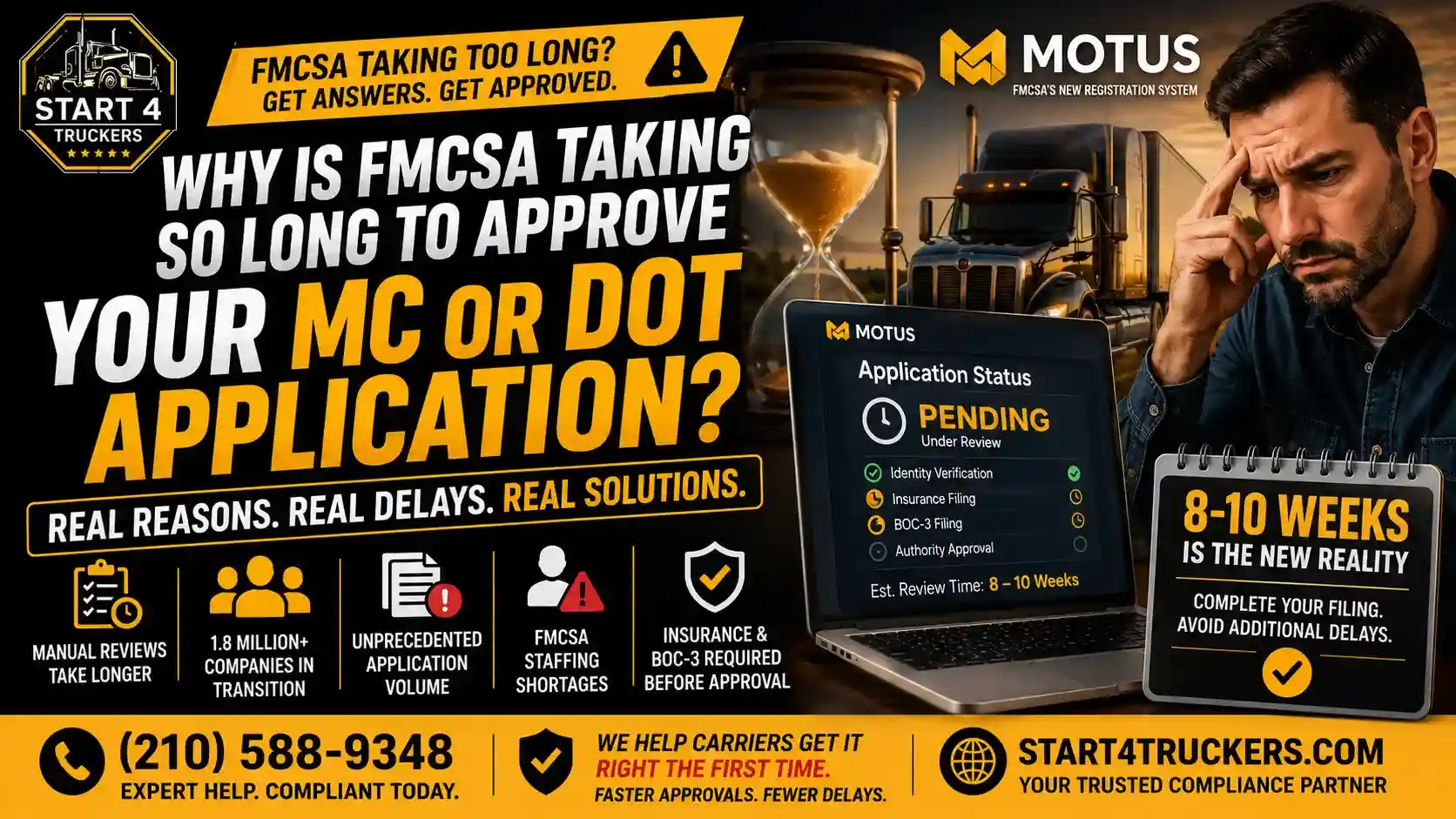
FMCSA approval delays in 2026 are being caused by five compounding factors working simultaneously:
- A shift from automated approvals to manual application review for most new registrations
- The MOTUS registration transition involves approximately 1.8 million trucking companies, which are processing system migrations simultaneously.
- Unprecedented carrier registration volume driven by that transition
- FMCSA staffing shortages that were already a problem before this spike hit
- Insurance and BOC-3 verification requirements that add processing steps before the authority can activate
The result is that what once took minutes or days now routinely takes 8 to 10 weeks. This is a systemic problem, not a problem with your specific application.
How the FMCSA Approval Process Worked Before MOTUS
Most MC Authority Applications Were Approved Automatically
Not long ago, applying for an MC authority or a USDOT number was remarkably fast. The FMCSA’s registration system relied heavily on automated processing, handling most applications without human intervention.
For many applicants, the whole thing felt almost instant. You submitted your information, the system verified the basic data fields, and your registration proceeded within seconds or minutes.
There was minimal friction. Automated checks ran in the background. If your information matched federal records, the system approved it and moved on.
Why USDOT Number Approval Was Often Completed Within Minutes
The old Unified Registration System (URS) was built around automated workflows. A new applicant could submit their business information, and the system would:
- Verify basic business data automatically
- Issue a USDOT number quickly
- Route the application forward without requiring a human reviewer
This made the process fast, sometimes almost too fast. The speed came at a cost: the old system had significant security gaps that allowed fraudulent registrations, chameleon carriers, and bad actors to slip through without detection.
To understand how the old system worked and what replaced it, read our complete guide on the Motus FMCSA registration system.
How Automated Reviews Helped Reduce FMCSA Processing Time
When automation handled 80 to 90 percent of the application review work, FMCSA staff could focus on exceptions and complex cases. Volume was manageable. Processing times were short. The system worked until the scale of the trucking industry outgrew it.
Why FMCSA Application Delays Are Much Longer in 2026
FMCSA Has Shifted Away From Automatic Approvals
The introduction of MOTUS, the FMCSA’s new digital registration and compliance platform, brought a fundamental change to how applications are processed.
MOTUS introduced mandatory identity verification, more rigorous data cross-referencing, and enhanced fraud detection. These improvements are valuable. But they also require more human review than the old automated system did.
Every Carrier Registration Receives Additional Review
Under the current process, most MC authority applications and USDOT number registrations now receive some level of human review before moving forward. A real person looks at your application. They verify your identity against MOTUS records. They check your insurance filings. They confirm your BOC-3 information.
That review adds significant time, especially when the volume of applications is at a historic high.
Why Manual Application Review Slows Down MC Authority Approval
Manual review is slower than automated review by definition. When a human being is checking each application, the throughput is limited by how many reviewers are available and how many hours they work.
During normal periods, manual review for flagged applications was manageable. Right now, manual review has become the standard rather than the exception, and FMCSA does not have the staffing to match.
How Identity Verification Requirements Added New Processing Steps
The MOTUS platform requires every applicant to complete identity verification through Login.gov before their registration can proceed. This is a new step that did not exist under URS.
When identity verification fails or triggers additional review, which happens frequently, the application stalls while the issue is resolved. Every stall adds to the overall backlog.
If you run into identity verification problems yourself, our detailed guide on MOTUS identity verification failures walks through every fix step by step.
What Is Causing the Current FMCSA Processing Backlog?
The Impact of the MOTUS Registration Transition
The single biggest driver of FMCSA application delays right now is the MOTUS migration itself.
Approximately 1.8 million trucking companies are currently going through MOTUS-related transitions simultaneously. That number is not a typo. Nearly every active motor carrier, broker, freight forwarder, and owner-operator in the United States is touching the FMCSA system at the same time, either migrating from URS, claiming USDOT numbers in MOTUS, updating records, or filing new applications.
The FMCSA has never processed this kind of volume in this compressed a timeframe.
For full context on what the URS to MOTUS transition involves, read our complete FMCSA compliance transition from URS to MOTUS guide.
Why Nearly 1.8 Million Trucking Companies Are Creating More Requests
Think about what 1.8 million companies doing simultaneous system migrations actually generates:
| Activity | Volume Impact |
| New MOTUS account creations | Millions of identity verifications |
| USDOT number claims in MOTUS | Millions of record matching requests |
| MCS-150 updates filed during transition | Millions of biennial filings |
| New MC authority applications | Additional review queue |
| Insurance re-filings through MOTUS | Millions of confirmation checks |
| BOC-3 re-submissions | Millions of process agent verifications |
| Support calls and tickets | Hundreds of thousands of inquiries |
Each one of these activities requires FMCSA staff time. The volume is simply beyond what the current team can absorb at normal speed.
Increased Demand for Carrier Registration and Authority Updates
On top of the migration workload, the trucking industry itself has been expanding. New carriers are entering the market. Existing carriers are applying for additional authority types. Brokers are registering through MOTUS for the first time.
All of this legitimate growth is happening at the worst possible time, right in the middle of the largest system migration in FMCSA history.
More Compliance Reviews Than Ever Before
MOTUS also generates more compliance review activity than URS did. The new system cross-references applications against enforcement histories, flags potential chameleon carrier activity, and triggers additional review when data mismatches are detected.
Each flag means a human reviewer must look at the application. Each review takes time. Multiply that across millions of applications, and you get the backlog carriers are experiencing today.
FMCSA Does Not Have Enough Staff to Handle the Current Volume
Existing Backlogs Before the MOTUS Transition
This is important context: the FMCSA was already dealing with a significant workload before the MOTUS migration accelerated everything.
The agency processes hundreds of thousands of carrier registrations, authority applications, insurance filings, compliance reviews, and enforcement actions every year. Their support ticket volume was already high. Their review queues were already stretched.
The MOTUS transition did not create a staffing problem from scratch. It turned a manageable workload into an unmanageable one.
Why Support Tickets Continue to Increase
Every carrier that cannot get through the MOTUS transition on its own generates a support ticket. Every application that stalls generates a follow-up inquiry. Every confused applicant who calls FMCSA adds to the phone queue.
Those support interactions take staff time away from processing applications, which slows approvals, further generating more support requests from frustrated applicants. It is a compounding loop.
The Growing Number of New Carrier Applications
New carrier applications have increased significantly as entrepreneurs enter the trucking industry. Every new carrier needs a USDOT number, an MC authority, a BOC-3 filing, and insurance verification. Each of those steps requires FMCSA processing.
If you are just starting and wondering how all these pieces connect, our Motus for new carriers guide explains the full registration sequence from beginning to end.
How Staffing Shortages Affect FMCSA Application Review
The FMCSA, like many federal agencies, operates with fixed staffing levels that cannot be rapidly scaled to meet sudden demand spikes. Hiring and training new reviewers takes months. Budget constraints limit how quickly staff can be added.
The result is a growing gap between application volume and processing capacity, and carriers waiting in that gap are the ones experiencing 8 to 10-week approval timelines.
Application pending, and you need it moved faster? Call Start4Truckers LLC at (210) 588-9348. We review your filing for errors, confirm your insurance and BOC-3 are correctly in place, and help you avoid the common mistakes that add weeks to approval timelines.
Current FMCSA Approval Times for MC Authority and USDOT Applications
How Long Does FMCSA Take to Approve a DOT Application?
Under the old system, USDOT number issuance was often near-instant for straightforward applications. Today, depending on when you applied and the current review queue, basic USDOT registration can take anywhere from a few days to several weeks.
How Long Does MC Number Approval Take in 2026?
MC authority approval is taking significantly longer than USDOT number issuance. Many carriers are currently reporting waits of 8 to 10 weeks from application submission to active authority status.
| Application Type | Previous Timeline | Current Timeline (2026) |
| USDOT Number | Minutes to hours | Days to weeks |
| MC Authority Application | Days to 1–2 weeks | 8–10 weeks or more |
| BOC-3 Processing | 1–3 business days | Several business days |
| Insurance Filing Confirmation | 24–48 hours | Several business days |
| Authority Activation | Shortly after approval | After all filings are confirmed |
Why Some Applicants Are Waiting 8 to 10 Weeks
The 8 to 10 week wait is not random. It reflects the combination of manual review time, backlogged processing queues, insurance and BOC-3 verification requirements, and the sheer volume of applications ahead of yours in the queue.
Some applicants wait longer if their application has any data issue, even a minor one, that triggers additional review.
What Happens During the FMCSA Review Period?
While your application is pending, the FMCSA is:
- Verifying your identity through MOTUS records
- Reviewing your business registration information
- Confirming your insurance filing is on file and active
- Verifying your BOC-3 process agent designation
- Cross-referencing your application against enforcement databases
- Confirming your authority type matches your stated operations
Every one of these checks takes time, and none of them can proceed until the one before it is cleared.
Why Is My MC Authority Still Pending?
Insurance Filing Requirements That Can Delay Approval
Your MC authority cannot activate until the FMCSA receives and confirms your insurance filing. Your insurer submits this electronically. If they have not yet filed, or if the filing contains errors, your authority stays pending regardless of how long you wait.
Contact your insurance provider and confirm they have filed your coverage with the FMCSA and that the filing appears in the system. Do not assume it was submitted automatically.
Missing or Incorrect BOC-3 Filing Information
A BOC-3 filing is required before your authority can activate. If your BOC-3 has not been submitted, contains errors, or is not properly linked to your carrier profile in MOTUS, your application will remain pending indefinitely.
Read our complete BOC-3 filing guide to understand exactly what this filing covers and confirm it has been done correctly. You can also use our BOC-3 filing service to get it handled immediately.
Identity Verification Issues and MOTUS Verification Delays
If your MOTUS identity verification was not completed successfully, your application cannot move forward. Even if you received a confirmation that your application was submitted, the verification status is checked as part of the review process.
Confirm your Login.gov identity verification is fully complete before assuming your application is in the normal processing queue.
Application Verification Errors
Incorrect business information, wrong Tax id, mismatched legal name, and wrong operation type can flag an application for additional review without generating a clear error message to the applicant. If your application has been pending for an unusually long time, review every piece of information you submitted for accuracy.
Incorrect Business Information Submitted During Registration
The legal name on your application must match your business formation documents, your Tax id records, and your FMCSA profile exactly. Any mismatch triggers manual review. This is one of the most common hidden causes of extended FMCSA application delays.
Before submitting any new application, confirm your business is properly structured. Our guide on how to get an LLC for a trucking business covers the formation steps that ensure your records are consistent from the start.
Why Has My USDOT Number Been Issued, but My Authority Is Not Active?
This is one of the most confusing situations new carriers face. You have a USDOT number. Everything looks official. But your operating authority shows as inactive or pending.
Understanding the Difference Between a USDOT Number and Operating Authority
A USDOT number and an MC authority are two separate things. Getting one does not automatically give you the other.
Your USDOT number is your federal carrier identification. It is used to track your safety record, compliance history, and registration data.
Your MC number and operating authority are what legally authorize you to haul regulated freight for hire in interstate commerce.
You need both. And they are processed separately. For a clear breakdown of exactly how they differ, read our DOT number vs MC number guide.
Why a DOT Number Does Not Automatically Activate MC Authority
Receiving your USDOT number simply means phase one of your registration is complete. MC authority requires a separate application, a separate review process, and additional filing requirements before it activates.
Insurance and BOC-3 Requirements Before Activation
Even after your MC authority application is approved, activation requires:
- Active insurance filing on file with FMCSA
- Confirmed BOC-3 process agent designation
- Payment of the required authority fees
- Completion of any pending review steps
Only after all of these are confirmed does your operating authority status change to active.
Evidence of the High FMCSA Workload Right Now
Why Caller Queues Often Exceed 300 People
When carriers call the FMCSA contact center to check on their pending applications, they are frequently told there are 300 or more callers ahead of them in the queue. This is not an exaggeration; it is a real reflection of how overwhelmed the system currently is.
Peak Periods With More Than 350 Waiting Calls
During peak processing periods, the FMCSA phone queue has exceeded 350 simultaneous callers. That means 350 carriers, brokers, and applicants all waiting, all concerned about pending applications, all needing staff time to resolve their specific issues.
What These Numbers Reveal About Current Demand
A queue of 300 to 350 callers represents only the people who decided to call at that particular moment. Behind them are thousands more who checked the queue, gave up, and went back to waiting. The actual demand for FMCSA support right now is far higher than even the call queue numbers suggest.
How Support Delays Reflect Application Review Delays
When support staff are handling hundreds of calls per day, they have less time for application review. When application review slows down, more applicants call to check their status. It is the same compounding loop, and the only way out is for the underlying transition workload to decrease.
How to Check Your FMCSA Application Status
Checking Your MC Authority Status
You can check your MC authority status through the FMCSA’s Licensing and Insurance portal. Your authority will show as pending, active, or inactive. If it has been pending for more than a few weeks, confirm that all supporting filings are complete before assuming the delay is purely a processing backlog.
Monitoring Your USDOT Number Approval
Use the FMCSA’s carrier lookup tools to check your USDOT number status. Our guide on how to look up a USDOT number through Motus walks you through the lookup process step by step.
Reviewing Insurance Filing Status
Log in to your MOTUS account and check whether your insurance filing appears in your carrier profile. If it does not, contact your insurer immediately. The filing must appear in the FMCSA system; your policy being active with your insurer is not sufficient on its own.
Confirming BOC-3 Submission
Your BOC-3 must be submitted by a registered process agent and must appear in your MOTUS carrier profile. Contact your process agent and ask for written confirmation that the filing was submitted and accepted. Do not assume it was completed because you paid for the service.
Tracking Carrier Registration Progress Through MOTUS
Log in to your MOTUS dashboard regularly. The platform surfaces application status updates, FMCSA review requests, and filing confirmations in real time. Missing a notice or request from FMCSA inside MOTUS can add significant additional delay to your pending application.
How to Avoid Common FMCSA Approval Delays
The backlog is real and mostly outside your control. But there are things you can do to make sure your application is not held up for avoidable reasons.
Submit Accurate Carrier Registration Information
Double-check every field before submitting. Your legal business name, Tax id, address, operation type, and officer information must all be accurate and consistent with your business formation documents. Errors trigger manual review. Manual review adds weeks.
Complete Insurance Filings Promptly
Work with your insurance provider before you submit your authority application. Confirm they are set up to file electronically with FMCSA through the MOTUS system. Have them file your coverage immediately after your MC number is issued, not after you remind them twice.
File Your BOC-3 Without Delay
Submit your BOC-3 the same day your MC number is issued. Every day you delay is a day your authority activation is pushed back. Use our BOC-3 filing service to get this handled immediately without delays.
Complete MOTUS Identity Verification Correctly
Make sure your identity verification is fully complete before submitting your application. A partially completed or failed verification is one of the most common hidden causes of application stalls.
If you experienced verification issues, our MOTUS identity verification failure guide covers every fix in detail.
Monitor FMCSA Requests for Additional Information
Check your MOTUS dashboard and the email address associated with your FMCSA account every day during the review period. The FMCSA may send requests for additional information. Missing or delaying your response to these requests can add weeks to your wait.
What Happens After FMCSA Approves Your Application?
Receiving Your Operating Authority
When your MC authority is approved, and all required filings are confirmed, your operating authority status changes to active in the FMCSA system. Your MC number becomes fully functional, and you are legally authorized to operate.
Completing Required Payments and Compliance Steps
Some authority types require payment of fees before final activation. Confirm what payments are required for your specific authority type and have them ready so you can move immediately when your application is approved.
Preparing for Active Carrier Operations
While you are waiting for approval, use the time productively. Get your UCR registration handled through our UCR registration guide. Set up your IFTA account by reviewing our IFTA fuel tax guide. Get your IRP plates in order using our IRP apportioned plates guide.
These steps do not require an active MC authority to begin. Having them ready means you can start hauling the moment your authority activates.
Next Steps for New Entrant Carriers
Once your authority is active, you automatically enter the New Entrant Safety Assurance Program, an 18-month monitoring period during which the FMCSA closely tracks your compliance performance.
Prepare for this by having your driver qualification files, drug and alcohol testing program, and vehicle maintenance records in order before your first day of operations.
Application pending for weeks with no update? Visit our USDOT and MC authority registration services page or call Start4Truckers LLC at (210) 588-9348. We review your filing status, identify any missing pieces, and help you avoid the mistakes that keep applications stuck.
Will FMCSA Approval Times Improve Soon?
Why the Current Situation Is Temporary
The delays carriers are experiencing right now are directly tied to the MOTUS migration workload. Once the bulk of the approximately 1.8 million trucking companies complete their transitions, the extraordinary volume of simultaneous applications, support requests, and compliance reviews will begin to decrease.
This is not a permanent new normal. It is a transition period.
What Happens After Most Companies Complete Their MOTUS Transition
As the migration backlog clears, FMCSA reviewers will have fewer migration-related requests competing with new authority applications for their time. The processing capacity that is currently absorbed by migration support will become available for new registrations again.
How Backlog Reduction Could Speed Up Future Approvals
Once the MOTUS migration stabilizes, the FMCSA’s workload should return to levels that are more manageable with existing staff. Automated checks within MOTUS, once the system is fully operational at scale, may also reduce the manual review burden for straightforward applications.
Expected FMCSA Processing Improvements Over the Next Few Months
Most industry observers and compliance professionals expect processing times to improve gradually over the coming months as the transition workload winds down. The improvement will not be instant; backlogs take time to clear, but the trajectory should be toward shorter approval timelines.
The best thing you can do right now is submit a complete, accurate application with all supporting filings in place, and then wait patiently while monitoring your status regularly.
How Start4Truckers LLC Helps Carriers Avoid Registration Delays
The FMCSA approval backlog is a system-level problem you cannot fully control. But you can control whether your application is complete, accurate, and fully supported from the moment you submit it.
Start4Truckers LLC helps motor carriers, owner-operators, and freight brokers across the United States get their FMCSA applications right the first time, reducing the chance of additional review delays caused by avoidable errors.
Here is how we help:
- MC authority applications filed correctly through our MC number registration service
- USDOT number registration is handled through our USDOT registration service
- BOC-3 filing submitted immediately after MC number issuance through our BOC-3 filing service
- MCS-150 management filed accurately through our MCS-150 filing service
- MOTUS registration supports full guidance through identity verification, USDOT claiming, and profile setup
- Ongoing compliance monitoring through our ongoing DOT compliance program, so nothing is missed after approval
We serve carriers in Texas, Florida, California, Georgia, Ohio, Illinois, Pennsylvania, Tennessee, Virginia, North Carolina, and every other state in the country.
Check our plans and pricing or explore our full trucking company setup services to find the right support level for your situation.
Key Takeaways About FMCSA Approval Delays
| Key Point | What It Means for You |
| Manual reviews are now standard | Every application takes longer than before |
| 1.8 million companies in transition | Unprecedented volume is the root cause |
| 8–10 week wait times are common | This is systemic, not a sign your application has problems |
| Staffing cannot scale instantly | FMCSA cannot hire fast enough to clear the backlog quickly |
| Insurance and BOC-3 must be complete | These filings are prerequisites not optional steps |
| Most delays are not your fault | The backlog affects everyone equally |
| Improvement is coming | As the transition winds down, timelines should shorten |
Conclusion
If your MC or DOT application has been pending for weeks with no update, the most likely explanation is the one that affects tens of thousands of carriers right now: the FMCSA is processing an unprecedented volume of applications, reviews, and support requests simultaneously, and the system is stretched beyond its normal capacity.
The FMCSA approval delays in 2026 are not primarily caused by mistakes in individual applications. They are caused by approximately 1.8 million trucking companies moving through MOTUS-related transitions at the same time, combined with a shift to manual review processes and staffing levels that cannot instantly scale to meet this historic demand.
- The good news is that this is temporary. As the MOTUS migration winds down and the transition backlog clears, FMCSA processing times are expected to gradually improve over the coming months.
- While you wait, make sure every piece of your application is complete. Confirm your insurance filing appears in your FMCSA records. Verify your BOC-3 is submitted and linked. Check your MOTUS dashboard regularly. And respond immediately to any FMCSA requests for additional information.
- If you are unsure whether your application is complete, if your authority has been pending for an unusually long time, or if you need help navigating the MC authority or USDOT registration process, Start4Truckers LLC is ready to help.
Application still pending? Don’t wait in the dark. Contact Start4Truckers LLC today for expert help with MC authority filing, USDOT registration, BOC-3 submissions, insurance compliance, and MOTUS registration support. Request your free consultation or call (210) 588-9348 right now. We help carriers get their applications right and their authority active as fast as the system allows.
Frequently Asked Questions
1. Why is FMCSA taking so long to approve my MC number?
FMCSA is taking longer to approve MC numbers in 2026 because most applications now receive manual review rather than automated processing. The MOTUS migration has created approximately 1.8 million simultaneous transitions, generating an unprecedented workload for FMCSA staff. Combined with staffing shortages, the result is MC authority approval timelines of 8 to 10 weeks for many applicants. This is a system-wide issue, not a problem specific to your application.
2. How long does FMCSA take to approve a DOT application?
Under the old system, basic USDOT number approval often happened within minutes. In 2026, the same process can take several days to several weeks, depending on the review queue and whether any additional verification steps are triggered. MC authority applications that require separate processing are currently taking 8 to 10 weeks or more due to the combination of manual reviews, increased volume, and MOTUS-related workload.
3. Why is my MC authority still pending?
Your MC authority remains pending either because it is in the FMCSA review queue waiting for a human reviewer or because a required filing is missing. Before assuming it is purely a backlog issue, confirm that your insurance filing appears in your FMCSA records, your BOC-3 has been submitted and linked to your carrier profile, and your MOTUS identity verification is fully complete. A missing filing will keep your authority pending indefinitely, regardless of how long you wait.
4. Can I operate while waiting for FMCSA approval?
No. You cannot legally haul regulated freight for hire in interstate commerce until your MC authority is active and confirmed. Operating without active authority is a federal violation that can result in civil penalties, out-of-service orders, and complications for your insurance coverage. Use the waiting period to complete other setup tasks UCR registration, IFTA setup, IRP plates so you are ready to operate the moment your authority activates.
5. What delays MC authority approval?
The primary causes of MC authority delays in 2026 are the MOTUS migration backlog, manual review requirements, FMCSA staffing shortages, and increased application volume. Application-specific causes include missing or incorrect insurance filings, unsubmitted BOC-3 process agent designations, identity verification issues, business information errors, and name mismatches between your application and your FMCSA carrier profile.
6. Does insurance affect FMCSA approval time?
Yes. Your MC authority cannot activate until the FMCSA receives and confirms your insurance filing from your insurer. If your insurer is slow to file, if the filing contains errors, or if the filing does not appear in your FMCSA carrier profile, your authority will remain inactive regardless of how long everything else has been pending. Contact your insurer proactively to confirm the filing was submitted and appears in the system.
7. How long does it take for BOC-3 to be processed?
Under normal conditions, a BOC-3 filing submitted by a registered process agent is typically processed within a few business days. During the current high-volume period, processing may take longer. To minimize delay, file your BOC-3 the same day your MC number is issued not after you receive approval so the filing has maximum time to process while the rest of your application is under review.
8. How do I check my FMCSA application status?
You can check your MC authority status through the FMCSA’s Licensing and Insurance portal. Your USDOT number status can be verified through carrier lookup tools on the FMCSA website. Log into your MOTUS account to see real-time updates on your application progress, insurance filing status, and BOC-3 confirmation. Check daily and respond immediately to any FMCSA notices or information requests that appear in your dashboard.
9. Why has my DOT number been issued but my authority is not active?
A USDOT number and MC operating authority are two separate things processed by separate workflows. Receiving your USDOT number means phase one of your registration is complete. MC authority requires a separate application, separate review, active insurance filings, a confirmed BOC-3 designation, and payment of required fees before it activates. Having a USDOT number does not mean your authority is active or that you are authorized to haul freight for hire.
10. What happens if FMCSA rejects my application?
If your application is rejected, the FMCSA will notify you with a reason for the rejection. Common rejection causes include incorrect business information, failed identity verification, missing or inadequate insurance, and incomplete supporting filings. You can correct the identified issues and resubmit. Rejection does not permanently bar you from obtaining authority it simply means your current application cannot be approved as submitted.
11. How long does it take to activate trucking authority?
After your MC authority application is approved by the FMCSA, activation requires your insurance filing to be confirmed and your BOC-3 to be verified. Once both are in place, authority typically activates within a few business days of approval. The longer part of the current timeline is the approval itself which is currently taking 8 to 10 weeks due to the review backlog.
12. Can identity verification delay FMCSA approval?
Yes. MOTUS requires identity verification through Login.gov before your registration can proceed. If your verification failed, was only partially completed, or triggered a flag for additional review, your application cannot move forward. This is one of the most common hidden causes of application delays that carriers do not realize is affecting them. Confirm your Login.gov verification is fully complete and linked to your MOTUS account.
13. Does MOTUS affect authority approval times?
Yes, significantly. The MOTUS migration is the primary driver of the current FMCSA approval delays. The transition of approximately 1.8 million trucking companies into the new system simultaneously has created an unprecedented spike in application volume and review demand that has stretched FMCSA processing capacity well beyond normal levels. MOTUS itself is a better system but the migration period is creating the current bottleneck.
14. Why is my insurance filing not showing in FMCSA records?
If your insurance filing is not appearing in your FMCSA carrier profile, the most likely causes are that your insurer has not yet submitted the filing, the filing contains errors that prevented processing, or the filing was submitted to the old system and needs to be re-filed through MOTUS. Contact your insurance provider immediately, ask for confirmation of submission, and ask them to verify the filing appears in the FMCSA system. Do not assume it was submitted because your policy is active.
15. What should I do if my application is pending for more than 30 days?
First, verify that all your supporting filings, insurance, and BOC-3 are complete and confirmed in your FMCSA records. Check your MOTUS dashboard for any outstanding notices or requests from FMCSA. If everything is in order and your application has been pending for more than 30 days with no update, contact the FMCSA directly to inquire about your specific application status. Be prepared for long wait times when calling. Consider working with a compliance service like Start4Truckers LLC to review your filing and identify any issues that may be causing the delay.