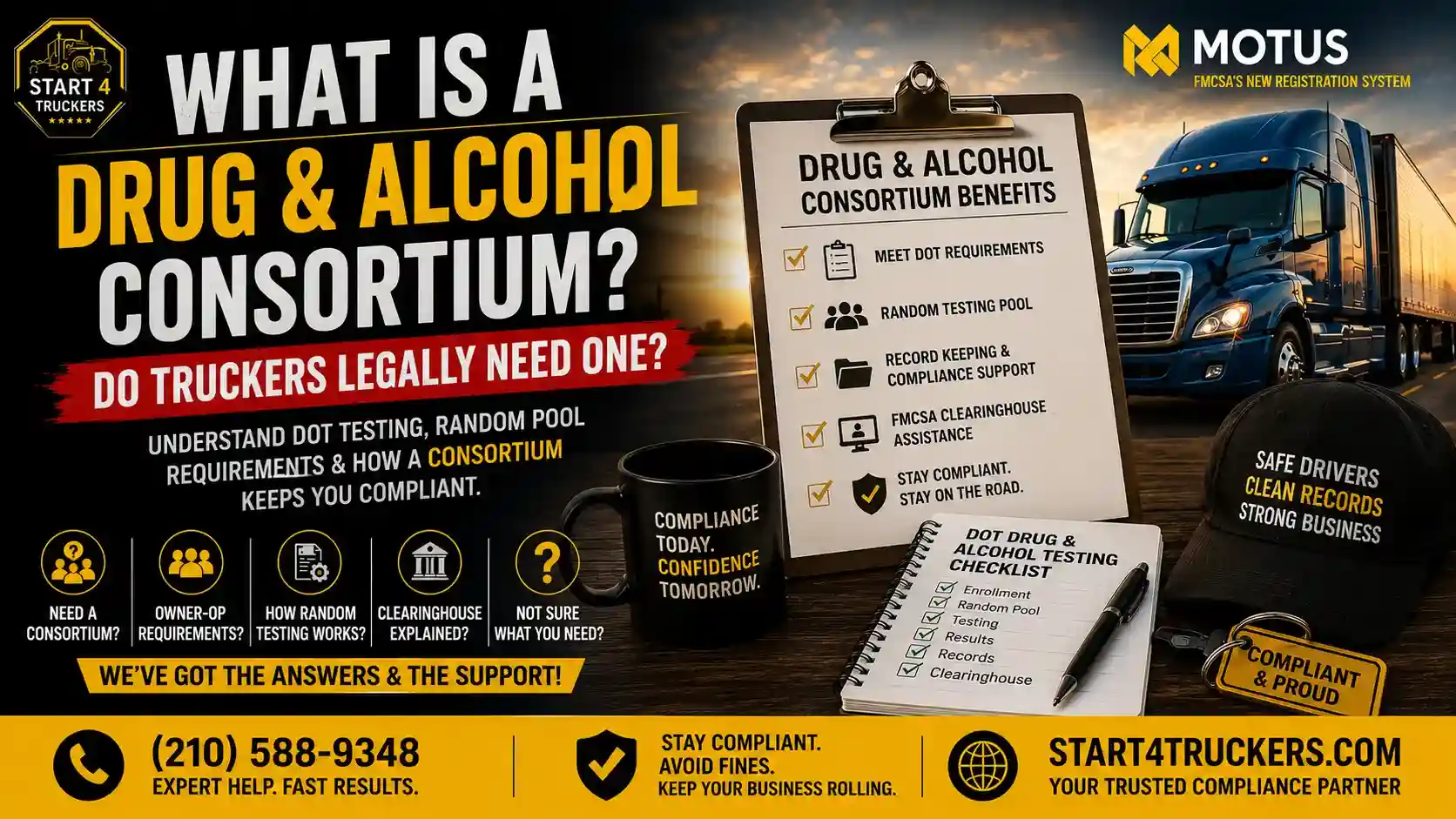
A Drug and Alcohol Consortium helps DOT-regulated truckers manage required drug and alcohol testing, including participation in a random testing pool. A C/TPA can also help manage testing and certain FMCSA Clearinghouse requirements. If you’re an owner-operator, you may wonder whether you legally need a consortium or can manage testing yourself.
This guide explains DOT drug and alcohol testing, random testing, C/TPA services, and how the FMCSA Clearinghouse fits into the process. Start4Truckers LLC can help you manage these compliance requirements.
What Is a Drug & Alcohol Consortium?
A Drug and Alcohol Consortium is a program that helps DOT-regulated employers manage their required drug and alcohol testing program, including placing eligible drivers into a random testing pool and helping coordinate the administration of that testing.
Drug and Alcohol Consortium Definition
In plain terms, a consortium is how many trucking companies, especially smaller ones and owner-operators, meet their DOT drug and alcohol testing obligations without building an entire in-house testing program from scratch. Rather than managing random selection, testing coordination, and recordkeeping alone, a company enrolls in a consortium that handles these pieces of the DOT drug and alcohol testing program.
What Does a Drug and Alcohol Consortium Do?
A consortium typically:
- Places eligible drivers into a random testing pool
- Coordinates random testing selections
- Helps administer the employer’s broader testing program
- Maintains or coordinates required testing records
- Supports general compliance administration
- May provide FMCSA Clearinghouse-related services, depending on the specific C/TPA arrangement
Is a Consortium the Same as a C/TPA?
Not exactly, and this distinction is worth understanding clearly. A consortium generally refers to the testing pool and program structure itself, while a C/TPA, or Consortium/Third-Party Administrator, is the entity that manages all or part of an employer’s DOT drug and alcohol testing program. In practice, many providers offer both functions together, which is part of why the terms get used somewhat interchangeably in casual conversation, even though they technically describe different pieces of the system.
Do Truckers Legally Need a Drug & Alcohol Consortium?
The legal requirement isn’t about the word “consortium” specifically. It’s tied to whether a driver or employer is subject to DOT and FMCSA drug and alcohol testing regulations in the first place. Once that requirement applies, a consortium or C/TPA is commonly, though not universally, how employers choose to administer it.
Is a DOT Drug & Alcohol Consortium Required by Law?
It isn’t accurate to simply say “every truck driver needs a consortium.” What the regulations actually require is that DOT-covered drivers operating CDL-required commercial motor vehicles participate in a drug and alcohol testing program, including random testing. Whether that program is administered through a consortium, a C/TPA, or handled another compliant way depends on the employer’s specific situation. For most owner-operators and small carriers, a consortium/C/TPA arrangement is the practical way to meet this requirement.
Do Owner-Operators Need a Drug & Alcohol Consortium?
Generally, an owner-operator who operates a CDL-required commercial motor vehicle in either interstate or intrastate commerce is subject to the DOT drug and alcohol testing program. This includes CDL holders, drivers performing safety-sensitive functions, and single-driver companies just as much as larger fleets. Because a single-driver operation can’t realistically administer its own random selection process, most owner-operators join a consortium or C/TPA specifically to meet the random testing requirement.
Our guide on how to become an owner-operator truck driver touches on the broader compliance picture new owner-operators need to plan for.
Do Leased Owner-Operators Need a Consortium?
This depends on the driver’s and employer’s DOT-covered status and the specific testing arrangement in place. In some leasing arrangements, the leasing company’s testing program may cover the driver. In others, the owner-operator remains responsible for their own program. This is worth confirming directly rather than assuming either way.
Does Every Trucking Company Need a Drug Testing Consortium?
Every DOT-covered employer needs a compliant drug and alcohol testing program, but not every company necessarily uses the word “consortium” to describe how they meet it. Small carriers and one-driver companies commonly use a consortium/C/TPA because it’s the most practical way to administer random testing. Larger carriers with many CDL drivers may also use a consortium, or may administer parts of the program with more internal resources, while still often relying on a C/TPA for certain functions.
Not sure whether your operation is DOT-covered or what your testing obligations actually are? Call Start4Truckers LLC at (210) 588-9348, and we’ll help you figure it out.
Who Needs to Join a DOT Drug Testing Consortium?
Owner-operators, small trucking companies, and employers with multiple CDL drivers performing safety-sensitive functions commonly need to join a DOT drug testing consortium to meet their random testing obligations.
Owner-Operators
CDL owner-operators operating a DOT-covered commercial motor vehicle, including single-driver companies, generally need to participate in random testing through a consortium or C/TPA.
Small Trucking Companies
Small carriers commonly use a C/TPA/consortium arrangement because building and administering an in-house random selection process for just a handful of drivers isn’t practical.
Employers With Multiple CDL Drivers
A testing pool works by combining eligible drivers, whether from one company or several pooled together through a consortium, so that random selections can be made from a larger group throughout the year.
DOT-Covered Employees
A “covered employee” generally refers to a driver performing safety-sensitive functions requiring a CDL, which is the population subject to DOT drug and alcohol testing requirements in the first place.
Who May Not Be Subject to These Requirements?
Applicability depends on whether the specific driver and operation fall under the applicable DOT and FMCSA rules. Rather than assuming your situation is exempt, it’s worth confirming your DOT-covered status directly, since the details can vary based on vehicle type, operation, and role.
How Does a Drug & Alcohol Consortium Work?
A consortium works by enrolling an employer or owner-operator in a DOT testing program, placing eligible drivers into a random testing pool, conducting unannounced random selections throughout the year, and coordinating the testing, results, and recordkeeping process.
Step 1: Enroll in a DOT Testing Program
The employer or owner-operator enrolls with a consortium/C/TPA to begin meeting their DOT drug and alcohol testing program requirements.
Step 2: Join a Random Testing Pool
Eligible drivers are added to a random testing pool, often combined with other drivers from different companies within the same consortium.
Step 3: Drivers Are Randomly Selected
Selections are made throughout the calendar year and must be reasonably spread out, rather than concentrated at just one point in the year.
Step 4: Driver Receives Testing Instructions
Random testing is unannounced. A selected driver receives instructions to report for testing without advance notice.
Step 5: Driver Completes the Required Test
The driver completes the required specimen collection or testing process at an appropriate collection site.
Step 6: Results Are Reviewed and Recorded
Drug test results are reviewed by a Medical Review Officer (MRO), and results, along with alcohol test outcomes where applicable, are recorded as part of the testing program.
Step 7: Applicable Results Are Handled for Compliance
Depending on the result, this step can connect to FMCSA Clearinghouse reporting, violation handling, and, where applicable, the return-to-duty process.
How Does a DOT Random Testing Pool Work?
A DOT random testing pool is a group of eligible drivers from which drivers are selected for unannounced testing throughout the year, with selections reasonably spread out rather than clustered at any single point.
What Is a DOT Random Testing Pool?
It’s the pool of eligible, DOT-covered drivers that a consortium or employer draws from when conducting random selections.
How Are Drivers Selected for Random Testing?
Selection is meant to be random and unpredictable. There’s no way for a driver to anticipate exactly when they’ll be selected, which is precisely the point of the requirement.
How Often Are Truck Drivers Randomly Drug Tested?
Random selections happen throughout the calendar year and are meant to be reasonably distributed across that period, rather than all occurring at once.
Can a Driver Refuse a Random DOT Drug Test?
Refusing a required test carries serious compliance consequences and is generally treated the same as a positive result under DOT rules, which can affect a driver’s ability to perform safety-sensitive functions.
What Happens After a Random Test?
The general flow moves through selection, notification, specimen collection, laboratory and MRO review, the final result, and then appropriate record and compliance handling based on that outcome.
What Does a C/TPA Do for Truck Drivers?
A C/TPA is a Consortium/Third-Party Administrator that manages all or part of an employer’s DOT drug and alcohol testing program, including random testing pool administration and, in many cases, certain FMCSA Clearinghouse-related functions.
What Is a C/TPA?
A C/TPA is the organization behind the consortium that actually administers the testing program on the employer’s behalf.
What Services Can a C/TPA Provide?
- Random testing administration
- Testing coordination
- Testing pool management
- Recordkeeping
- Compliance administration
- Clearinghouse services, where applicable to the specific arrangement
Does a C/TPA Handle the FMCSA Clearinghouse?
C/TPAs can perform certain Clearinghouse functions on an employer’s behalf, such as conducting queries and, in some arrangements, reporting violations, depending on what the specific service agreement covers.
Does an Owner-Operator Need to Designate a C/TPA?
FMCSA specifically notes that an owner-operator must designate a C/TPA in the Clearinghouse. This designation allows the C/TPA to carry out certain required Clearinghouse functions on the owner-operator’s behalf.
Our guide on registering your company in the FMCSA Clearinghouse covers this registration process in more depth.
Consortium vs. C/TPA: What’s the Difference?
| Feature | Consortium | C/TPA |
| Random testing pool | Yes | Administers/coordinates |
| Testing administration | Program function | May manage |
| Driver selection | Pool-based | May coordinate |
| Records | Maintained/managed | May administer |
| Clearinghouse support | Depends on arrangement | Can perform certain functions |
How Does a Drug & Alcohol Consortium Work With the FMCSA Clearinghouse?
A Drug and Alcohol Consortium and the FMCSA Clearinghouse are related but separate things. The consortium/C/TPA helps administer parts of the testing program, while the Clearinghouse is FMCSA’s centralized database for drug and alcohol program violations and related employer queries.
What Is the FMCSA Drug & Alcohol Clearinghouse?
The Clearinghouse is FMCSA’s database containing information on CDL driver drug and alcohol program violations, used by employers to run required queries and by C/TPAs to fulfill certain reporting responsibilities.
Does the Clearinghouse Replace a Drug Testing Consortium?
No. This is an important distinction to keep clear. The consortium/C/TPA helps administer the actual testing program, including random selection and coordination, while the Clearinghouse is FMCSA’s centralized database for applicable drug and alcohol program information. One doesn’t substitute for the other; a compliant employer typically needs both a testing program and Clearinghouse compliance.
What Does a C/TPA Do in the Clearinghouse?
A C/TPA can be designated to handle certain Clearinghouse responsibilities on an employer’s behalf, including conducting queries and, depending on the arrangement, reporting violations.
Does a Drug and Alcohol Consortium Report to the Clearinghouse?
This depends on the specific C/TPA arrangement rather than being automatic for every consortium. Reporting responsibilities should be clearly understood as part of choosing a provider, rather than assumed.
What Is a Clearinghouse Query?
Employers are generally required to run Clearinghouse queries on drivers, which can include a limited query for a quick status check or a full query for more detailed violation information, depending on the situation.
What DOT Drug and Alcohol Tests Are Required?
DOT-covered drivers are subject to several types of testing depending on the circumstances, including pre-employment, random, post-accident, reasonable suspicion, return-to-duty, and follow-up testing.
Pre-Employment Drug Testing
Required before a driver begins performing safety-sensitive functions for a new DOT-covered employer.
DOT Random Drug Testing
Conducted through unannounced selections spread throughout the calendar year, as covered earlier in this guide.
Post-Accident Testing
Required following certain qualifying accidents, based on specific DOT criteria.
Reasonable Suspicion Testing
Conducted when a trained supervisor observes specific behavior or signs that create reasonable suspicion of drug or alcohol use.
Return-to-Duty Testing
Required before a driver who has violated DOT drug and alcohol regulations can return to performing safety-sensitive functions.
Follow-Up Testing
Additional required testing that follows a return-to-duty process, typically as part of a Substance Abuse Professional’s (SAP) follow-up plan.
What Is Included in a DOT Drug & Alcohol Testing Program?
A complete DOT drug and alcohol testing program includes drug testing, alcohol testing, random testing administration, required recordkeeping, and the return-to-duty and follow-up process managed alongside an MRO and SAP where applicable.
Drug Testing
Covers controlled substances testing through specimen collection, laboratory analysis, and Medical Review Officer (MRO) review of results.
Alcohol Testing
Involves alcohol testing conducted by a Breath Alcohol Technician (BAT) or Screening Test Technician (STT), depending on the specific testing circumstance.
Random Testing
The ongoing, unannounced testing selections described earlier in this guide, spread throughout the year.
Testing Records
Employers are responsible for maintaining required testing records as part of overall program compliance.
Compliance Documentation
Beyond testing itself, employers need documentation supporting their compliance with the broader DOT drug and alcohol testing program.
Return-to-Duty and Follow-Up Process
This process involves the Medical Review Officer (MRO) and Substance Abuse Professional (SAP), who play distinct roles in evaluating results and supporting a driver’s return to safety-sensitive functions after a violation.
What Happens If You Don’t Have a Required DOT Testing Program?
Missing required random testing, failing to meet DOT drug and alcohol testing requirements, and falling behind on Clearinghouse compliance can affect a driver’s ability to perform safety-sensitive functions and create broader DOT compliance problems for the employer.
Missing Required Random Testing
Failing to participate in required random testing is a compliance gap that can affect both the driver and the employer’s standing.
Failing to Meet DOT Drug and Alcohol Testing Requirements
Beyond random testing specifically, gaps in any part of the required testing program create compliance exposure.
Clearinghouse Compliance Problems
Failing to meet required Clearinghouse query or reporting responsibilities creates a separate but related compliance issue.
Potential Impact on a Driver’s Ability to Perform Safety-Sensitive Functions
Compliance gaps in testing can directly affect whether a driver is permitted to continue performing safety-sensitive functions.
Why Small Carriers Should Not Ignore Testing Administration
It’s tempting for a one-truck operation to assume testing administration isn’t worth the effort, but the requirement applies regardless of company size, which is exactly why so many owner-operators turn to a consortium/C/TPA to handle it correctly.
Can an Owner-Operator Manage DOT Drug Testing Without a Consortium?
Technically, an owner-operator could attempt to administer their own DOT random testing program, but in practice this is difficult for a single-driver operation, which is why most owner-operators use a C/TPA to handle random selection, coordination, and records instead.
Can a One-Truck Owner-Operator Handle Their Own Testing?
In theory, yes, but building a compliant random selection process for a single driver is far more complicated in practice than joining an existing pool through a consortium.
Can an Owner-Operator Manage Their Own Random Testing?
This is technically possible but uncommon, largely because a proper random selection process is much easier to administer across a larger combined pool than for just one driver.
Why Do Many Owner-Operators Use a C/TPA?
A C/TPA offers easier random selection administration, testing coordination, recordkeeping, general compliance administration, and Clearinghouse assistance where applicable, without the owner-operator needing to build any of that infrastructure themselves.
Consortium vs. DIY DOT Testing
| Option | Consortium/C/TPA | DIY |
| Random selection | Managed | Employer responsibility |
| Testing coordination | Assisted | Employer responsibility |
| Records | Assisted | Employer responsibility |
| Clearinghouse support | Available depending on provider | Employer responsibility |
| Convenience | Higher | Lower |
| Compliance administration | Outsourced | Self-managed |
How to Choose a DOT Drug & Alcohol Consortium
Choose a consortium that clearly supports DOT/FMCSA requirements, properly administers a random testing pool, offers Clearinghouse support, handles testing records responsibly, and has experience working with owner-operators specifically.
Make Sure It Supports DOT/FMCSA Requirements
Confirm the provider’s program is structured to meet actual DOT and FMCSA regulations, not just a generic drug testing service.
Check Random Testing Pool Administration
Understand exactly how the provider manages random selection and how frequently selections occur.
Ask About Clearinghouse Support
Clarify what Clearinghouse-related functions, if any, the C/TPA handles as part of your service.
Ask How Testing Records Are Handled
Confirm how records are maintained and how you can access them when needed.
Confirm What Is Included in the Service
Understand exactly which testing types and administrative functions are covered under your enrollment.
Understand Pricing and Renewal Fees
Ask about enrollment costs, renewal fees, and any additional charges tied to specific testing events.
Choose a Provider Familiar With Owner-Operators
Owner-operators have different practical needs than large fleets, so a provider experienced with single-driver enrollments can make the process smoother.
Ready to enroll in a consortium built for owner-operators and small carriers? Call Start4Truckers LLC at (210) 588-9348 today.
How Much Does a Drug & Alcohol Consortium Cost?
Consortium costs vary based on factors like the number of drivers enrolled, which testing services are included, random pool administration, Clearinghouse services, and any additional administrative functions offered.
What Determines Consortium Cost?
Pricing depends on variables such as driver count, included testing services, random pool administration, Clearinghouse support, additional testing requirements, and general administrative services bundled into the program.
Is a Cheap Consortium Always the Best Option?
Not necessarily. The most important factor is whether the provider genuinely covers your full compliance needs, not just the lowest sticker price. A cheaper option that leaves gaps in random testing administration or Clearinghouse support can end up costing far more in compliance risk than it saves upfront.
Drug & Alcohol Consortium vs. Other DOT Compliance Requirements
A consortium is specifically about administering drug and alcohol testing, which is distinct from the Clearinghouse database, your DOT physical, and general CDL drug testing rules, even though all of these pieces work together as part of overall compliance.
Consortium vs. FMCSA Clearinghouse
The consortium administers testing; the Clearinghouse is the database that tracks violation-related information separately.
Consortium vs. DOT Physical
A DOT physical evaluates a driver’s medical fitness to operate a commercial motor vehicle and is a completely separate requirement from drug and alcohol testing administration.
Consortium vs. CDL Drug Testing
“CDL drug testing” broadly refers to the testing requirement itself, while a consortium is one common way that requirement gets administered in practice.
Consortium vs. DOT Compliance Program
A consortium covers one specific piece, drug and alcohol testing, within a much broader DOT compliance program that includes many other requirements, like MCS-150 filings and safety audits.
Drug & Alcohol Consortium Checklist for Owner-Operators
Before Starting Operations
- Determine whether you are subject to DOT drug and alcohol testing
- Establish the required testing program
- Enroll in an appropriate consortium/C/TPA arrangement if applicable
- Address Clearinghouse requirements
- Complete required pre-employment testing where applicable
During Operations
- Stay enrolled in the applicable testing program
- Participate in random testing
- Complete required testing
- Maintain records
- Handle Clearinghouse obligations
- Complete follow-up/return-to-duty requirements when applicable
Start Your DOT Drug & Alcohol Compliance With Start4Truckers LLC
Managing DOT drug and alcohol requirements can be genuinely difficult for a new owner-operator trying to sort out random testing pools, C/TPA designations, and Clearinghouse responsibilities all at once. Start4Truckers LLC can help truckers understand and manage the compliance steps involved in getting their trucking business set up properly, including our DOT drug and alcohol consortium service and FMCSA Clearinghouse registration support.
Need help with your DOT drug and alcohol compliance? Contact Start4Truckers LLC to learn about available DOT compliance services and trucking company setup support.
Call Start4Truckers LLC at (210) 588-9348 or visit our contact page to get started.
Final Takeaway: Do You Need a Drug & Alcohol Consortium?
A Drug and Alcohol Consortium helps DOT-regulated employers and owner-operators administer required drug and alcohol testing, particularly random testing, without having to build that infrastructure themselves.
Whether you legally need one comes down to whether you’re a DOT-covered driver operating a CDL-required commercial motor vehicle. If that applies to you, and it applies to the vast majority of owner-operators and CDL-required carriers, participating in a compliant testing program is required, and a consortium/C/TPA is the practical way most single-driver and small operations meet that obligation.
It’s also worth remembering that a consortium and the FMCSA Clearinghouse are related but separate systems. The consortium/C/TPA administers your actual testing program, while the Clearinghouse is FMCSA’s centralized database for violation-related information. Meeting one requirement doesn’t automatically satisfy the other.
If you’re setting up your trucking business and aren’t sure where drug and alcohol testing compliance fits into the picture, Start4Truckers LLC can walk you through it. Call (210) 588-9348 or reach out through our contact page to get your compliance program set up correctly.
Frequently Asked Questions
1. What is a Drug and Alcohol Consortium?
A Drug and Alcohol Consortium is a program that helps DOT-regulated employers manage required drug and alcohol testing, including placing eligible drivers into a random testing pool and coordinating that testing on the employer’s behalf.
2. Do truck drivers legally need a Drug and Alcohol Consortium?
The legal requirement is tied to whether the driver is DOT-covered and operating a CDL-required commercial motor vehicle. Once that applies, a consortium or C/TPA is a common, practical way employers meet the required testing obligations.
3. Do owner-operators need a Drug and Alcohol Consortium?
Generally, an owner-operator operating a CDL-required CMV and subject to the DOT drug and alcohol testing program must participate in required testing, and most use a consortium/C/TPA to administer random testing and related compliance tasks.
4. Is a DOT consortium required for owner-operators?
A DOT drug and alcohol testing program is required for DOT-covered owner-operators. A consortium/C/TPA is the practical, common way single-driver operations meet the random testing portion of that requirement.
5. Does a single-truck owner-operator need a random testing pool?
Yes, generally. Since a single driver can’t reasonably form a random pool on their own, owner-operators typically join a combined pool through a consortium to meet this requirement.
6. Can an owner-operator manage their own DOT random drug testing?
Technically possible, but uncommon in practice, since properly administering random selection for just one driver is far more complicated than joining an established consortium pool.
7. What does a C/TPA do for truck drivers?
A C/TPA, or Consortium/Third-Party Administrator, manages all or part of an employer’s DOT drug and alcohol testing program, including random testing administration and certain FMCSA Clearinghouse functions.
8. What is the difference between a consortium and a C/TPA?
A consortium generally refers to the testing pool and program structure, while a C/TPA is the entity that administers all or part of that program on the employer’s behalf.
9. How does DOT random drug testing work?
Eligible drivers are placed in a random testing pool, unannounced selections occur throughout the calendar year, and selected drivers report for testing, with results reviewed by a Medical Review Officer.
10. How often are truck drivers randomly drug tested?
Random selections happen throughout the year and must be reasonably spread out, rather than occurring all at once, though there’s no way to predict exactly when any individual driver will be selected.
11. Does a drug and alcohol consortium report to the FMCSA Clearinghouse?
This depends on the specific C/TPA arrangement. Some C/TPAs handle certain Clearinghouse reporting functions on the employer’s behalf, but this isn’t automatic for every consortium.
12. Does the FMCSA Clearinghouse replace a drug testing consortium?
No. The Clearinghouse is FMCSA’s centralized database for drug and alcohol program violation information, while the consortium/C/TPA administers the actual testing program. Both typically work together, not as substitutes for one another.
13. What drug and alcohol tests are required by DOT?
DOT-covered drivers may be subject to pre-employment, random, post-accident, reasonable suspicion, return-to-duty, and follow-up testing, depending on the specific circumstances.
14. What happens if a truck driver does not participate in required DOT testing?
Failing to participate in required testing creates serious compliance issues and can affect a driver’s ability to continue performing safety-sensitive functions.
15. How do I join a DOT Drug and Alcohol Consortium?
You enroll with a consortium/C/TPA provider, confirm your DOT-covered status, and complete required registration steps, including designating your C/TPA in the FMCSA Clearinghouse if you’re an owner-operator.