You want to run loads across state lines, but your regular truck registration only covers your home state. So how do you legally operate in Texas, Oklahoma, and Arkansas without registering your truck three separate times?
This is exactly what IRP apportioned plates are built for.
Getting this piece of your compliance right matters just as much as getting your trucking authority or setting up your business the right way. That’s actually where Start4Truckers LLC comes in. We’re a third-party agency that helps owner-operators and small fleets across the country handle registration and compliance work like IRP, so carriers can spend less time on paperwork and more time on the road. If you need help at any point in this guide, call us directly at (210) 588-9348.
Now let’s break down what IRP apportioned plates actually are, who needs them, and how the whole system works.
What Are IRP Apportioned Plates?
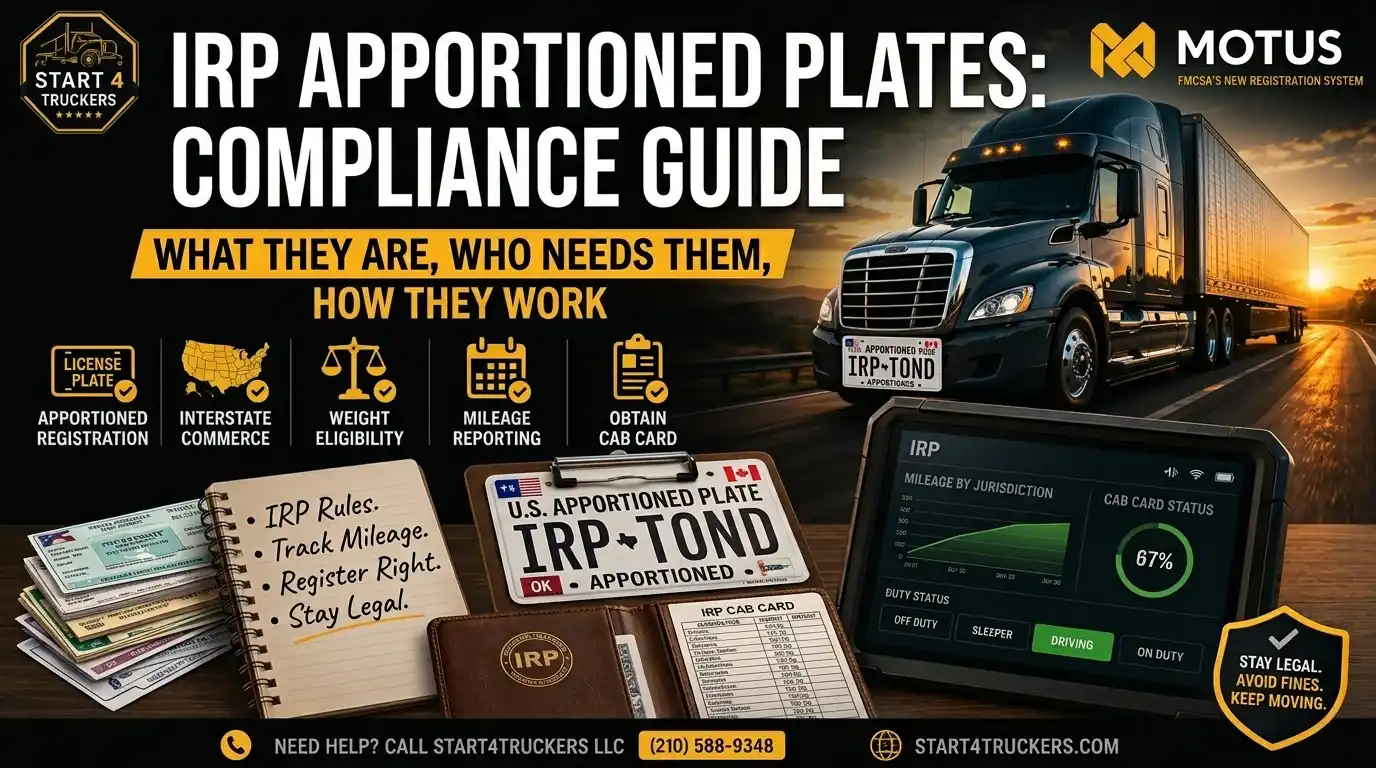
IRP apportioned plates are commercial vehicle registration credentials for carriers that operate qualifying vehicles across multiple IRP member jurisdictions. Instead of buying full registration separately in every state you drive through, you register once through your base jurisdiction, and your registration fees are apportioned, or split, based on things like the miles you travel in each jurisdiction and your vehicle’s registered weight.
Who generally needs them? Qualifying commercial vehicles operating in two or more jurisdictions in interstate commerce, subject to each jurisdiction’s specific eligibility rules.
What Is IRP in Trucking?
What Does IRP Stand For?
IRP stands for International Registration Plan. It’s an agreement between participating U.S. states and Canadian provinces that lets carriers register a commercial vehicle once and legally operate it across all the jurisdictions covered by that registration.
What Is IRP Registration?
Instead of registering your truck separately in every state you plan to drive through, IRP lets you register through one base jurisdiction. Your registration fees are then apportioned, meaning divided up, among the jurisdictions you actually operate in, based on your reported mileage and other factors.
What Are IRP Apportioned Plates, Exactly?
IRP apportioned plates are the physical license plate issued under this system. Along with the plate, you’ll also get an IRP cab card, which is a separate document that lists the jurisdictions and details tied to your registration. One important thing to understand early: IRP registration is not the same thing as your operating authority. Your USDOT number and MC number, covered in our guide on DOT number vs. MC number, are separate requirements.
Who Needs IRP Apportioned Plates?
What Is an Apportionable Vehicle?
An apportionable vehicle is generally a commercial vehicle used for transporting people or property that operates in two or more IRP jurisdictions and meets applicable weight or axle requirements set by those jurisdictions.
Do Owner-Operators Need IRP Plates?
It depends on the operation, not just the fact that you’re your own boss. If you’re running qualifying interstate loads across multiple jurisdictions, you likely need IRP registration, whether you’re leased onto a carrier or running under your own authority.
Do Trucking Companies and Small Fleets Need IRP?
Yes, generally, if the fleet’s vehicles are apportionable and operating across jurisdictions. The good news is that IRP allows you to register multiple vehicles under one account, which makes managing a small fleet more straightforward once it’s set up correctly.
Do Semi Trucks Need IRP Plates?
Most tractor-trailer combinations running interstate freight fall under IRP requirements, assuming they meet the applicable weight and jurisdictional criteria.
Do Hotshot Trucks Need IRP Plates?
It depends on the vehicle and how it’s used. Not every hotshot operation automatically needs IRP. It comes down to the vehicle’s weight, configuration, and whether it’s operating across multiple jurisdictions as a commercial vehicle.
Do Box Trucks Need IRP Plates?
Same answer: it depends. Vehicle type alone doesn’t decide this. Weight, interstate operation, and jurisdictional requirements are what actually determine whether a box truck needs IRP registration.
Who Does Not Need IRP Apportioned Plates?
When IRP Registration May Not Apply
Vehicles that don’t meet the applicable weight, axle, or interstate operation requirements generally don’t need IRP registration.
Intrastate-Only Trucking
If your operation stays entirely within one state and never crosses into another jurisdiction, you’re generally working under intrastate rules, which are different from IRP. If you’re not sure which category your operation falls into, our guide on interstate vs. intrastate trucking authority is a good place to start.
Vehicles That Qualify for an Exemption
Some vehicles may qualify for exemptions depending on the jurisdiction. These rules vary, so it’s worth verifying your specific situation rather than assuming.
Why You Shouldn’t Assume Your Truck Is Exempt
Don’t guess based on vehicle type alone. Weight, axle count, operation type, jurisdiction, and mileage all play a role. If you’re unsure, it’s faster to call and confirm than to risk operating without the right registration. Reach our team at (210) 588-9348 if you want a direct answer for your specific truck.
How Do IRP Apportioned Plates Work?
Here’s the general process, step by step.
Step 1: Choose Your Base Jurisdiction
Your base jurisdiction is generally the state or province where you have an established place of business or residency, and it’s where your IRP account and records are maintained. You can’t simply pick a jurisdiction for convenience; there are specific requirements you need to meet.
Step 2: Register Your Vehicle Under IRP
You’ll set up an IRP account and submit your carrier and vehicle information as part of the application.
Step 3: Report Mileage and Other Required Information
You’ll report your jurisdictional mileage (the miles driven in each jurisdiction), along with your vehicle’s declared or registered weight.
Step 4: Pay Apportioned Registration Fees
Your registration fees are distributed among the jurisdictions you operate in, based on the applicable apportionment formula for each one.
Step 5: Receive Your IRP Plate and Cab Card
Once everything is processed, you’ll receive your apportioned plate along with your cab card, which should stay with the vehicle at all times.
Step 6: Operate Across Participating Jurisdictions
With your credentials in place, you can generally operate across the jurisdictions covered by your registration. Keep in mind that other requirements, like IFTA and your operating authority, still apply separately.
How Are IRP Registration Fees Calculated?
What Factors Affect IRP Fees?
- Jurisdictions you travel through
- Jurisdictional mileage
- Mileage percentage across jurisdictions
- Declared or registered weight
- Vehicle classification
- Fees specific to each jurisdiction
What Is Jurisdictional Mileage?
This is the distance your vehicle travels within each specific jurisdiction. Accurate mileage reporting matters, since it directly affects how your registration fees are split.
What Is Declared Weight?
This is the weight you register your vehicle at for IRP purposes. A higher declared weight generally increases your registration cost.
Are IRP Fees the Same in Every State?
No. Fees and specific requirements vary by jurisdiction, so there’s no single flat price that applies everywhere.
How Much Do IRP Apportioned Plates Cost?
There’s no single nationwide price for IRP apportioned plates. Your actual cost depends on your vehicle, declared weight, the jurisdictions you operate in, and your reported mileage in each one. Getting an accurate quote for your specific setup is always better than relying on a generic number you found online.
What Is an IRP Cab Card?
What Information Is on an IRP Cab Card?
Your cab card generally lists your carrier information, vehicle details, the jurisdictions your registration covers, weight information, and your registration credentials.
Do You Need to Keep the Cab Card in the Truck?
Yes. It should be kept with the vehicle at all times, since it’s one of the first things checked during a roadside inspection.
IRP Plate vs. IRP Cab Card
| Feature | IRP Plate | IRP Cab Card |
| Purpose | Vehicle registration credential | Detailed registration credential |
| Where it’s kept | Affixed to the vehicle | Kept inside the vehicle |
| What it shows | Apportioned registration | Vehicle and jurisdiction details |
How to Get IRP Apportioned Plates
Step 1: Confirm Your Truck Requires IRP
Check whether your vehicle qualifies as apportionable and whether your operation is genuinely interstate.
Step 2: Determine Your Base Jurisdiction
Confirm which state or province qualifies as your base jurisdiction based on where your business is established.
Step 3: Gather Your IRP Documents
You’ll typically need business information, vehicle title or registration details, your VIN, proof of your established place of business or residency, and mileage information.
Step 4: Complete the IRP Application
Forms and exact procedures vary by jurisdiction, so it helps to confirm the requirements for your specific base jurisdiction before submitting.
Step 5: Pay the Registration Fees
Your fees are calculated based on the factors covered above.
Step 6: Receive Your IRP Credentials
You’ll get your plate, your cab card, and any other required documentation.
Step 7: Keep Your Records Updated
Keep your mileage records, vehicle information, weight details, and business address current, since all of this can affect your registration going forward.
If this whole process sounds like more paperwork than you want to deal with on your own, that’s exactly the kind of thing our IRP apportioned plates service is built to handle. We also have a dedicated walkthrough on how to apply for IRP apportioned plates if you want to go deeper into the application steps.
What Documents Do You Need for IRP Registration?
Business Documents
- Basic business information
- Proof of established place of business
- Applicable carrier information
Vehicle Documents
- VIN
- Title or ownership information
- Vehicle description
- Weight information
- Lease documents, if applicable
Mileage and Operational Records
- Jurisdictional mileage
- Supporting mileage records
- Any additional documents required by your base jurisdiction
Requirements vary by jurisdiction, so it’s worth confirming the current document list with your specific IRP office before applying.
How Often Do You Renew IRP Apportioned Plates?
IRP Renewal Period
IRP registration is renewed on a cycle set by your base jurisdiction, so the exact timing depends on where you’re registered.
What Happens During Renewal?
You’ll typically update your vehicle information, report your required mileage, confirm your weight, pay the applicable fees, and receive updated credentials.
What Happens If Your IRP Registration Expires?
Operating with expired IRP credentials can create real compliance problems, including issues during roadside inspections. It’s worth renewing on time rather than waiting until you’re stopped to find out your registration lapsed.
IRP Apportioned Plates vs. Trip Permits
| Feature | IRP Apportioned Plates | Trip Permit |
| Purpose | Ongoing apportioned registration | Temporary authorization |
| Best used for | Regular interstate operations | Specific trips or temporary situations |
| Duration | Full registration period | Limited period |
| Best for | Frequent interstate carriers | Occasional or temporary travel |
Do You Need a Trip Permit If You Have IRP Plates?
Generally, no, for jurisdictions already covered by your IRP registration. But this can depend on the jurisdiction and the specific permit type, so it’s not a blanket rule.
When Might a Trip Permit Make More Sense?
If you only travel through a jurisdiction occasionally, or you’re running a temporary operation, a trip permit may be simpler than adding that jurisdiction to your full IRP registration.
IRP vs. IFTA: What Is the Difference?
This is one of the most common points of confusion for new carriers.
| Feature | IRP | IFTA |
| Main purpose | Vehicle registration | Fuel tax reporting |
| Applies to | Qualifying interstate vehicles | Qualifying interstate motor vehicles |
| Main credential | IRP plate and cab card | IFTA license and decals |
| Based on | Registration and apportionment | Fuel use and jurisdictional miles |
| What it covers | Registration | Fuel tax |
Does IRP Replace IFTA?
No. IRP and IFTA cover two completely different requirements, and most interstate carriers need both. If you haven’t looked into it yet, our guide on what the IFTA fuel tax agreement is explains how that piece works separately from IRP.
IRP vs. Regular Truck Registration
Regular Registration
This is standard, single-state vehicle registration, generally meant for vehicles that operate within one jurisdiction.
Apportioned Registration
IRP registration is built specifically for commercial vehicles operating across multiple jurisdictions, splitting your fees based on where you actually drive.
Which Registration Does Your Truck Need?
This comes down to your vehicle and how it’s actually used, not simply the fact that it’s a truck. A local delivery truck and a long-haul interstate tractor can need very different registration setups.
Common IRP Apportioned Plate Mistakes to Avoid
- Assuming every truck needs IRP. Eligibility depends on the vehicle and the operation, not vehicle type alone.
- Assuming every interstate truck needs identical registration. Requirements can vary based on weight and configuration.
- Reporting incorrect mileage. This directly affects your fees and can create compliance issues later.
- Choosing the wrong base jurisdiction. This can create registration headaches down the road.
- Forgetting to renew. Expired credentials can lead to real problems during inspections.
- Confusing IRP with IFTA. One is registration, the other is fuel tax. They’re not interchangeable.
- Confusing IRP with DOT or MC authority. IRP does not give you operating authority. Those are separate requirements covered in our guide on how to start a trucking company.
- Failing to keep supporting records. Mileage and operational records matter more than most new carriers expect.
IRP Compliance Tips for Owner-Operators
- Keep your cab card in the truck at all times.
- Track your jurisdictional mileage accurately.
- Keep your registration current and renew on time.
- Review your declared weight before each renewal.
- Keep your vehicle information updated.
- Maintain supporting mileage records in case of an audit.
- Check requirements before entering a new jurisdiction for the first time.
- Don’t confuse IRP with IFTA, UCR, or your operating authority.
Final Verdict: Do You Need IRP Apportioned Plates?
IRP is primarily about apportioned commercial vehicle registration for carriers operating across state lines. If you’re running qualifying interstate loads in two or more jurisdictions, you likely need it. Eligibility comes down to your specific vehicle and operation, not assumptions based on truck type. And remember, IRP is separate from IFTA, UCR, and your operating authority. Keeping accurate mileage and registration records will save you real headaches down the road.
If you’re still not sure whether your truck needs IRP registration, or you’re in the process of setting up your trucking business from the ground up, Start4Truckers LLC can walk you through the registration and compliance steps so you don’t have to figure it out alone. We also help carriers with UCR registration, Form 2290 and HVUT filing, and ongoing FMCSA compliance.
Call (210) 588-9348 today to talk through your trucking setup, or compare our plans and pricing to see which package covers what you need.
Frequently Asked Questions
1. What Are IRP Apportioned Plates?
They’re commercial vehicle registration credentials for carriers operating across multiple IRP jurisdictions, with fees apportioned based on mileage and other factors instead of paying full registration in every state.
2. Who Needs IRP Apportioned Plates?
Generally, qualifying commercial vehicles operating in two or more jurisdictions in interstate commerce, based on weight, axle count, and each jurisdiction’s specific rules.
3. How Do IRP Apportioned Plates Work?
You register through a base jurisdiction, report your mileage and vehicle weight, pay apportioned fees split across the jurisdictions you operate in, and receive a plate and cab card covering those jurisdictions.
4. Do Owner-Operators Need IRP Plates?
Often, yes, if they’re running qualifying interstate operations across multiple jurisdictions, regardless of whether they lease on or run under their own authority.
5. What Vehicles Require IRP Registration?
Generally, apportionable commercial vehicles that meet weight and axle requirements and operate across two or more jurisdictions.
6. How Much Do IRP Apportioned Plates Cost?
There’s no flat nationwide cost. It depends on your declared weight, the jurisdictions you operate in, and your reported mileage in each one.
7. What Is an IRP Cab Card?
It’s a document that lists your carrier and vehicle information along with the jurisdictions covered by your IRP registration. It should stay with the vehicle at all times.
8. How Do I Get IRP Apportioned Plates?
You confirm your vehicle needs IRP, determine your base jurisdiction, gather your documents, complete the application, pay the fees, and receive your plate and cab card.
9. What Documents Are Needed for IRP Registration?
Typically, business information, proof of established place of business, vehicle title and VIN details, weight information, and mileage records.
10. Do I Need IRP Plates in Every State I Travel Through?
No. IRP registration covers the jurisdictions included in your registration, so you don’t need to register separately in each one.
11. What Is the Difference Between IRP Plates and a Trip Permit?
IRP plates are ongoing apportioned registration for regular interstate operations. Trip permits are temporary authorizations, usually better suited to occasional travel.
12. Does IRP Replace IFTA?
No. IRP covers vehicle registration, while IFTA covers fuel tax reporting. Most interstate carriers need both.
13. Do Hotshot Trucks Need IRP Plates?
It depends on the vehicle’s weight, configuration, and whether it operates as a commercial vehicle across multiple jurisdictions. Not every hotshot operation automatically qualifies.
14. Do Box Trucks Need IRP Plates?
It depends on weight and interstate operation, not the vehicle type alone.
15. How Often Do IRP Plates Need to Be Renewed?
Renewal happens on a cycle set by your base jurisdiction, so the exact timing depends on where your registration is based.