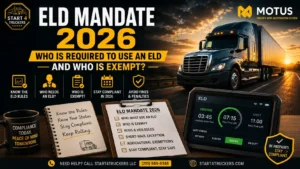
Do you really need an ELD, or does your trucking operation qualify for an exemption?
That’s the question most drivers actually want answered. Not every truck driver is treated the same way under the FMCSA ELD rule. The real issue usually comes down to one thing: are you required to keep records of duty status, also called RODS, under the hours of service rules that apply to your operation?
This post explains the ELD Mandate 2026 rules in plain language, so you can figure out where your operation stands.
Who Needs an ELD?
The ELD Mandate generally applies to motor carriers and drivers who are required to keep records of duty status. But FMCSA also allows a handful of exceptions, including qualifying short-haul operations, drivers who keep RODS no more than 8 days in any 30 days, qualifying drive-away-tow-away operations, vehicles built before model year 2000, and certain agricultural operations.
If you’re just starting out and still working through how to get your trucking authority, this is a good rule to understand early, before you ever get pulled over for a roadside inspection.
Key Takeaways
- Most drivers required to keep RODS must use an ELD.
- Qualifying short-haul drivers may use the short-haul exception instead.
- Drivers who keep RODS 8 days or fewer in any 30 days may qualify for paper logs on those days.
- Vehicles built before model year 2000 are generally exempt.
- Qualifying drive-away-tow-away operations can be exempt.
- Certain agricultural operations have their own set of rules.
- Being ELD exempt does not always mean you’re exempt from keeping records at all.
- Always check your specific operation against the current FMCSA rules. Exemptions are based on your actual operation, not just your job title.
What Is the ELD Mandate?
What Does ELD Stand For?
ELD stands for Electronic Logging Device.
What Does an ELD Actually Do?
An ELD is a piece of equipment that connects to your truck’s engine and automatically records your driving time and duty status. It replaced a lot of the old paper logbooks that drivers used to fill out by hand.
How the ELD Rule Connects to Hours of Service
Here’s the simple chain: the hours of service rules decide how long you’re allowed to drive and work. Those rules create the requirement to keep RODS. And once you’re required to keep RODS, you’re generally required to use an ELD to record them, unless an exemption applies.
Is ELD the Same Thing as HOS?
No, and this trips a lot of new drivers up.
- HOS (hours of service) is the set of rules about how long you can drive and work.
- RODS (records of duty status) are the actual records that document your duty status.
- ELD is simply the electronic tool used to keep those records.
Who Is Required to Use an ELD in 2026?
Drivers Required to Keep RODS
If your operation requires you to keep records of duty status, you generally need an ELD unless you qualify for one of the exceptions covered later in this guide.
Motor Carriers Subject to the ELD Rule
If your company runs drivers who are required to keep RODS, your business is generally subject to the ELD rule too. This is one more reason it pays to get your compliance basics right early, and it’s a big part of what our FMCSA compliance services are built to help with.
Do Owner-Operators Need an ELD?
Usually, yes, if you’re running interstate loads and keeping RODS. Simply being your own boss, or having recently completed the process to start your own trucking company, doesn’t change this requirement on its own.
Commercial Drivers Subject to HOS Rules
Just holding a CDL doesn’t automatically mean you need an ELD, and not holding one doesn’t automatically mean you’re exempt either. What matters is whether your specific operation requires you to keep RODS.
Trucks and Buses Covered by the Rule
Generally, commercial motor vehicles used in interstate commerce that require a driver to keep RODS fall under the ELD rule, unless a specific exception applies.
Who Is Exempt From the ELD Mandate in 2026?
Here’s a quick way to see the main exceptions at a glance.
| Situation | ELD Required? | Key Condition |
| Qualifying short-haul operation | Generally no | Must meet all short-haul conditions |
| RODS kept 8 days or fewer in any 30 days | No | Paper logs allowed on those days |
| Qualifying drive-away-tow-away operation | No | The vehicle itself is the commodity |
| Vehicle built before model year 2000 | No | Based on engine model year, not vehicle age |
| Certain agricultural operations | May be no | Depends on season and radius |
Short-Haul ELD Exemption
What Is the Short-Haul Exception?
This exception is for drivers who work close to home and return to their starting location each day. Qualifying drivers can use time records, sometimes called a timecard, instead of full RODS.
When Can a Short-Haul Driver Skip the ELD?
Generally, drivers need to stay within a 150 air-mile radius of their normal work reporting location, return to that location within 14 hours, and get the required off-duty time between shifts. Every part of the rule matters here, not just the radius.
Do Short-Haul Drivers Still Need Records?
If a driver meets the short-haul conditions on a given day, RODS usually aren’t required for that day. But the moment a driver goes outside the qualifying radius or hours, RODS may be required for that day, and an ELD may then apply.
This is one of the most common compliance mistakes small fleets make: assuming every local driver is automatically covered, without tracking the days they go outside the radius.
The 8 Days in 30 Days ELD Exemption
What Does “8 Days in 30 Days” Mean?
If a driver is only required to keep RODS on 8 or fewer days within any 30 days, that driver can use paper logs instead of an ELD on those days.
Is This Any Calendar Month?
No. The 30 days are not tied to a calendar month. It’s a rolling 30-day window, so it moves with you day by day.
Can You Use Paper Logs Under This Exception?
Yes. Drivers who qualify under this exception can use paper RODS on the days they’re required to keep records.
What Happens After the 8th Day?
Once a driver goes past 8 days of required RODS within any rolling 30-day period, they generally become subject to the ELD requirement going forward, unless another exception applies.
A Simple Example
Say a driver mostly runs short local routes but occasionally picks up a longer regional load that requires RODS. As long as those RODS days stay at 8 or fewer within any 30-day window, paper logs may be enough. Once that ninth day happens, the driver is generally expected to be using an ELD.
Pre-2000 Truck ELD Exemption
What Year Truck Is Exempt From ELD?
Vehicles with an engine built before model year 2000 generally fall under this exception. Older engines usually don’t have the electronic control module needed to connect to an ELD in the first place.
How Do You Prove a Truck Is Pre-2000?
Carriers should keep documentation on hand, such as the vehicle registration, VIN, and engine information, showing the model year of the engine.
What If the Engine Was Replaced?
This is where a lot of carriers get it wrong. The exemption generally follows the engine, not the truck’s body or frame. If a pre-2000 engine is placed into a newer chassis or glider kit, the exemption can still apply, but you need to keep clear documentation proving the engine’s original model year. Don’t assume “old-looking truck” automatically means exempt.
Drive-Away-Tow-Away ELD Exemption
What Is a Drive-Away-Tow-Away Operation?
This exemption applies when the vehicle being driven is itself the commodity being delivered, not a truck hauling freight in a trailer.
When Does the Exemption Apply?
This generally covers situations like moving a truck from a manufacturer to a dealer, where the vehicle itself is the product, not a load it’s carrying.
Examples
Delivering a new commercial truck by driving it, rather than hauling it, is a common example. A regular freight run where the truck is simply pulling a loaded trailer does not qualify under this exception.
Agricultural ELD Exemptions
Are Agricultural Drivers Automatically Exempt?
No, and this is a common misunderstanding. Some agricultural operations qualify for exceptions, but not every agricultural driver is automatically covered.
The 150 Air-Mile Agricultural Exception
Certain agricultural operations may qualify for an hours-of-service exemption within a 150 air-mile radius from the source of the agricultural commodity, generally during planting and harvesting periods.
Covered Farm Vehicles
Some covered farm vehicles have their own set of rules separate from standard commercial trucking regulations. If this applies to your operation, it’s worth double-checking the specifics for your state and vehicle type.
When Does an Agricultural Operation Need an ELD?
Once an operation moves outside the qualifying radius, season, or vehicle type, the standard ELD requirement can apply again. Agricultural exemptions are seasonal and situational, not a year-round pass.
Do Owner-Operators Need an ELD?
When an Owner-Operator Needs One
If you keep RODS and don’t qualify for an exception, you need an ELD, whether you’re leased to a carrier or running under your own authority.
When an Owner-Operator May Be Exempt
If your operation genuinely fits one of the exceptions above (short-haul, the 8-day rule, pre-2000 engine, drive-away-tow-away, or a qualifying agricultural exception), you may not need one.
Does Having Your Own Authority Change Anything?
Not by itself. Whether you run under your own MC number and USDOT number or lease onto another carrier, the ELD requirement is based on your operation, not your authority status.
New Owner-Operators and ELD Compliance
If you recently made the jump from company driver to owner-operator, this is one of the easiest things to overlook. Check your operation against the exceptions above before you assume you’re covered either way.
Do Leased or Rented Trucks Need an ELD?
Does Leasing Automatically Make You Exempt?
No. Leasing a truck doesn’t change whether you’re required to keep RODS.
What About Short-Term Rentals?
There is a specific exception for certain property-carrying trucks rented for 8 days or less, but it comes with documentation requirements, including proof of the rental period and the applicable FMCSA exemption paperwork.
What Documents Should You Keep?
Keep your rental agreement, any required exemption documentation, and your RODS for the current day plus the prior 7 days if RODS are required.
Do Hotshot Drivers Need an ELD?
When a Hotshot Operation Needs One
Many hotshot operations run heavier trucks that require keeping RODS, which generally means an ELD is required.
When a Hotshot Driver May Qualify for an Exception
If the operation genuinely fits the short-haul exception or another qualifying exemption, an ELD may not be required. This depends on the vehicle, the route, and the hours, not simply the term “hotshot.”
Do Box Truck Drivers Need an ELD?
Does Every Box Truck Need One?
Not automatically. It depends on the vehicle’s weight rating and whether the operation requires RODS.
Why Vehicle Weight Matters
Heavier box trucks that meet the commercial motor vehicle definition and require RODS generally need an ELD. Lighter operations that don’t trigger RODS requirements may not.
Can You Use Paper Logs Instead of an ELD?
Paper logs are not a general substitute for an ELD. They’re only allowed when a specific exception applies, such as:
- The 8 days in 30 days exception
- Pre-2000 engine vehicles
- Qualifying drive-away-tow-away operations
- Qualifying short-haul days where RODS aren’t required at all
Outside of these situations, paper logs generally aren’t a legal substitute for a required ELD.
What Happens If You Need an ELD but Don’t Use One?
ELD Violations
Operating without a required ELD is treated as a hours-of-service recordkeeping violation and can result in citations during a roadside inspection.
Roadside Inspection Issues
If a safety official asks for your ELD data and you can’t produce it, this can lead to a citation and, in some cases, being placed out of service until the issue is resolved.
Using a Device That’s No Longer Registered
This is a real 2026 issue worth knowing about. FMCSA continues to remove non-compliant devices from its list of registered ELDs. If your device gets pulled from that list, you’re expected to replace it, even if it worked fine before.
How to Check Whether Your ELD Is FMCSA-Registered
Why Registration Matters
Only devices on FMCSA’s registered ELD list count as compliant. Using an unregistered or revoked device can put you in the same position as not having an ELD at all.
How to Check
FMCSA maintains an official list of registered devices on its ELD website, which it updates as devices are added or removed.
What Happens When a Device Gets Removed?
If your specific device is removed from the list, you generally need to switch to a compliant, registered device. This is one area where it genuinely pays to check in periodically instead of assuming your device is still good. If you need help getting set up correctly the first time, our ELD device setup service can walk you through it.
ELD Malfunction: What Should a Driver Do?
What Counts as a Malfunction?
Generally, this means your ELD stops recording or transmitting data properly.
What to Do When It Happens
Notify your motor carrier as soon as possible and follow the required steps for keeping manual records of your duty status until the device is repaired or replaced.
Paper Records During a Malfunction
Drivers are generally expected to reconstruct their records of duty status on paper for the current 24-hour period and the previous 7 days, if requested.
ELD Requirements During a Roadside Inspection
What Can Be Checked?
A safety official can generally ask to see your ELD data and any required supporting documents.
What Should You Keep in the Truck?
Keep your current ELD data readily available, along with any supporting documents required for your specific exemption, such as rental agreements or engine documentation.
ELD Mandate 2026 Compliance Checklist
- Determine whether you’re required to keep RODS.
- Check whether an ELD exception applies to your operation.
- Check your vehicle’s engine model year.
- Check whether your operation qualifies for the short-haul exception.
- Review whether the 8-in-30-day exception applies to you.
- Check whether an agricultural exception applies.
- Check drive-away-tow-away eligibility if it applies to your work.
- Use an FMCSA-registered ELD if one is required.
- Keep all required documents and records in the truck.
- Train every driver on proper ELD use.
- Monitor for ELD malfunctions and fix them quickly.
Common ELD Exemption Mistakes to Avoid
- Assuming every local driver is automatically exempt. Short-haul status depends on meeting every condition, every day.
- Confusing an HOS exception with a full ELD exemption. They’re related, but not always the same thing.
- Misunderstanding the 8-in-30-day rule. It’s a rolling window, not a calendar month.
- Assuming every pre-2000 situation is identical. Engine swaps and glider kits need documentation.
- Assuming a leased truck is automatically exempt. Leasing doesn’t change your RODS requirement.
- Using paper logs without a qualifying exception. This is a common and avoidable violation.
- Using an ELD that’s no longer registered. Check the FMCSA list periodically.
- Not keeping supporting documentation. An exemption is only as strong as the paperwork behind it.
How to Know If You Need an ELD: Simple Decision Guide
Ask yourself these questions in order:
- Do you have to keep RODS?
- No: you likely don’t need an ELD.
- Yes: continue to question 2.
- Do you qualify for an ELD exception?
- Yes: follow the specific requirements of that exception.
- No: you generally need an ELD.
- Do you keep RODS more than 8 days in any rolling 30-day period?
- Yes: the 8-day exception no longer applies to you.
- No: you may qualify for the 8-day exception on those days.
This is a general guide to help you think it through, not a replacement for checking your specific operation against current FMCSA rules.
Start4Truckers LLC Can Help With Your Trucking Compliance
Figuring out whether you need an ELD is only one part of staying compliant. Start4Truckers LLC is a third-party agency that helps owner-operators and small fleets across the country handle the setup and paperwork side of running a trucking business, so you can spend more time on the road and less time buried in regulations.
Whether you’re just working through USDOT and MC number registration, need help with BOC-3 filing, UCR registration, or IFTA reporting, our team can help you get it right the first time. We also offer ongoing DOT compliance support and back-office support for carriers who want a partner keeping an eye on their compliance year-round, not just at setup.
Have questions about your ELD requirements or anything else related to compliance? Call Start4Truckers LLC at (210) 588-9348, or compare our plans and pricing to see which package fits your business best.
Final Thoughts on the ELD Mandate 2026
The real question isn’t simply “do truck drivers need ELDs?” It’s whether your specific operation is required to keep records of duty status, and whether a specific exception applies to you.
To recap:
- Most drivers required to keep RODS need an ELD.
- Short-haul operations may qualify for an exception.
- The 8-days-in-30-days rule matters for mixed operations.
- Pre-2000 engine vehicles have a documented exception.
- Qualifying drive-away-tow-away operations can be exempt.
- Certain agricultural operations have their own seasonal rules.
- Every exception depends on your actual operation, not assumptions.
If you’re still not sure where your operation stands, don’t guess. Call (210) 588-9348 and talk it through with our team, or check FMCSA’s official ELD resources directly for the most current details.
Frequently Asked Questions
1. Who Is Required to Use an ELD in 2026?
Most drivers and motor carriers required to keep records of duty status (RODS) must use an ELD, unless a specific FMCSA exception applies to their operation.
2. Who Is Exempt From the ELD Mandate?
Drivers who qualify for the short-haul exception, 8-days-in-30 rule, pre-2000 engine exemption, drive-away-tow-away exemption, or certain agricultural exemptions may not need an ELD.
3. Do Owner-Operators Need an ELD?
Usually yes, if they are required to keep RODS and do not qualify for a specific exception. Owning your own trucking authority does not automatically make you exempt.
4. What Trucks Are Exempt From ELD?
Trucks with an engine built before model year 2000 are generally exempt, based on the engine’s model year rather than the truck’s outward appearance.
5. What Is the 8 Days in 30 Days ELD Exemption?
Drivers who are required to keep RODS on 8 or fewer days within any rolling 30-day period can generally use paper logs instead of an ELD on those days.
6. Are Short-Haul Drivers Exempt From the ELD Mandate?
Qualifying short-haul drivers who stay within the required radius, return within the allowed hours, and meet required rest conditions can generally use time records instead of RODS.
7. Are Trucks Made Before 2000 Exempt From ELD?
Generally yes, based on the engine’s model year, although documentation may be needed to prove the exemption, especially with engine swaps or glider kits.
8. Are Agricultural Drivers Exempt From ELD?
Some qualifying agricultural operations may be exempt within a specific radius and during applicable periods, but not every agricultural driver automatically qualifies.
9. Do Leased or Rented Trucks Need an ELD?
Generally yes, unless the operation qualifies for a specific exception, such as an applicable short-term rental exemption with the required documentation.
10. Can You Use Paper Logs Instead of an ELD?
Only if you qualify for a specific exception, such as the 8-day rule, pre-2000 engine exemption, or drive-away-tow-away exemption. Paper logs are not a general substitute for a required ELD.
11. Does a Hotshot Driver Need an ELD?
Often yes, depending on the vehicle’s weight and whether the operation requires RODS, unless the operation genuinely qualifies for an exception such as the short-haul exception.
12. Does a Box Truck Require an ELD?
It depends on the vehicle’s weight and whether the operation requires RODS. Not every box truck automatically needs an ELD.
13. What Happens If You Don’t Use an ELD When Required?
Failing to use an ELD when required can result in a citation during a roadside inspection and, in some cases, an out-of-service order until the issue is corrected.
14. How Do I Know If My Trucking Business Needs an ELD?
Start by checking whether your drivers are required to maintain records of duty status (RODS). Then determine whether a specific FMCSA exception applies to your operation.
15. Does Every CDL Driver Need an ELD?
No. Holding a CDL alone does not determine ELD status. What matters is whether the driver’s specific operation requires RODS under the applicable FMCSA hours-of-service rules.