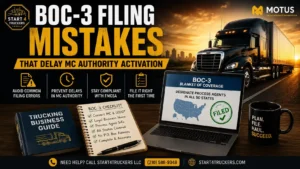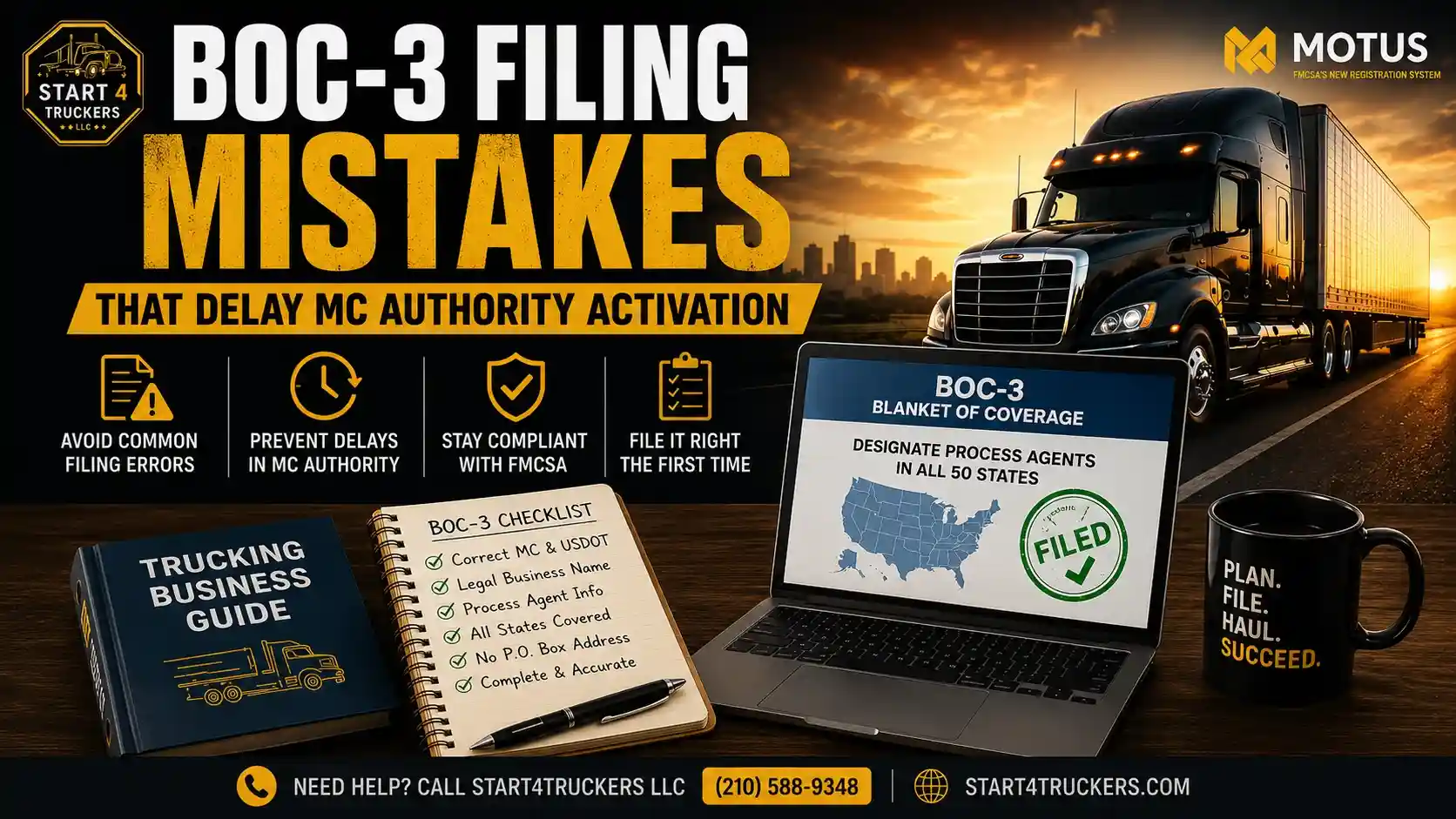
A BOC-3 is a filing that designates process agents who can receive legal documents on behalf of your trucking business. Incorrect carrier information, an incomplete designation, or a problem with the process agent handling your filing can all create real issues. A BOC-3 is an important requirement for operating authority, but filing it correctly doesn’t by itself guarantee your MC authority goes active. Insurance and a few other requirements matter just as much.
This blog post will tell you the most common BOC-3 filing mistakes, how to tell if one is actually holding up your authority, and how to fix it.
What Is a BOC-3 and Why Does It Matter for MC Authority?
What Does BOC-3 Stand For?
BOC-3 stands for Blanket of Coverage. It’s the FMCSA form used to designate process agents nationwide for a motor carrier, broker, or freight forwarder.
What Does a BOC-3 Do for a Trucking Company?
A BOC-3 designates process agents, meaning representatives who can accept legal documents, court papers, and other official notices on your company’s behalf in every state where you operate. If your company gets named in a lawsuit somewhere you don’t have a physical office, your process agent is who receives that paperwork and forwards it to you.
Is BOC-3 Required for MC Authority?
Yes, generally. For for-hire interstate motor carriers, a valid BOC-3 designation is one of the requirements FMCSA checks before granting operating authority. That said, it’s not the only requirement. Insurance and financial responsibility filings also have to be satisfied before authority actually activates.
Want this filed correctly the first time instead of troubleshooting it later? Our BOC-3 filing service handles the process agent designation for you, or call Start4Truckers LLC at (210) 588-9348.
12 Common BOC-3 Filing Mistakes That Can Cause Problems
1. Entering the Wrong MC Number
A typo, a transposed digit, or accidentally using the wrong MC number entirely can create a mismatch between your BOC-3 and your actual carrier record. Double-check this before submitting.
2. Using the Wrong Legal Business Name
Your BOC-3 needs to match the exact legal business name on file with FMCSA and, if you’re a corporation or LLC, the name filed with your Secretary of State. A DBA or trade name in place of your legal name is a common source of confusion here.
3. Entering Incorrect USDOT Information
Mixing up your USDOT number with your MC number, or simply mistyping either one, can create a similar mismatch problem to entering the wrong MC number.
4. Using Incorrect or Incomplete Process Agent Information
Your process agent’s name, address, and contact information all need to be accurate. One important detail a lot of carriers miss: a P.O. Box is not acceptable as a process agent’s address. It has to be a physical location.
5. Missing Required State Designations
Your BOC-3 needs to include a designated agent for every state where you operate, not just your home state. Missing a required state is one of the more common gaps in an otherwise correct filing.
6. Filing Through an Improper or Unreliable Process Agent
Only a process agent can generally file the BOC-3 on your behalf, a carrier typically can’t submit it directly. Make sure whoever is filing for you is a legitimate, properly registered process agent rather than an unverified third party.
7. Filing an Incomplete BOC-3
Missing information, incomplete state coverage, or an incorrectly filled-out agent section can all leave your filing sitting incomplete rather than fully processed.
8. Filing a Duplicate BOC-3 Without Checking the Existing Filing
Only one completed BOC-3 can generally be on file for your business at a time. Before filing again because something looks off, check your existing filing first. In many cases, what you actually need is a correction or an updated designation, not a brand new filing on top of an old one.
9. Assuming BOC-3 Filing Automatically Activates Your MC Authority
BOC-3 filing does not equal automatic MC authority activation. This is one of the biggest misunderstandings new carriers have. Your BOC-3 is one piece of the puzzle. Your insurance filing, your application status, and FMCSA’s own processing all factor into when your authority actually goes active.
10. Waiting Too Long to File Your BOC-3
Since BOC-3 is required before authority can be granted, waiting until the last minute to file it can create an avoidable timing bottleneck. File it early rather than treating it as an afterthought.
11. Not Checking Whether Your BOC-3 Was Successfully Recorded
Submitting a filing isn’t the same as having it accepted and recorded. Don’t assume it went through correctly just because you submitted it, actually verify it shows up correctly on your FMCSA record.
12. Not Updating the BOC-3 After a Relevant Business Change
If your business name, address, or process agent changes, you generally need to file a new BOC-3 to reflect that change. An outdated designation tied to old business information can create real problems down the road.
Not sure which of these applies to your situation? Call Start4Truckers LLC at (210) 588-9348, and we can help you figure out what’s actually going on.
BOC-3 Filing Mistakes vs. Problems That Are Not Actually BOC-3 Errors
A lot of generic articles lump every MC authority delay into “BOC-3 mistakes.” That’s not accurate. Here’s a clearer breakdown:
| Problem | Is It a BOC-3 Mistake? | Can It Affect Authority? |
| Wrong MC number on the filing | Yes | Potentially |
| Wrong legal business name | Yes | Potentially |
| Missing required state designation | Yes | Potentially |
| BOC-3 not filed at all | Yes | Yes |
| Insurance not filed | No | Yes |
| USDOT number inactive | No | Potentially |
| General FMCSA application issue | No | Yes |
| Protest or authority review issue | No | Yes |
Understanding this distinction matters, since it means fixing your BOC-3 alone won’t necessarily solve every authority delay you’re seeing.
Why Is My BOC-3 Not Showing on FMCSA?
The BOC-3 Was Never Actually Submitted
Sometimes what feels like a processing delay is actually a filing that never made it through in the first place.
The Information Was Incorrect
A mismatch in your business name, MC number, or USDOT number can prevent your filing from properly linking to your carrier profile.
The Filing Is Still Being Processed
Give it a reasonable amount of time before assuming something’s wrong, especially if you just submitted it.
An Existing BOC-3 Is Already on File
If your business already has a BOC-3 on record, a new attempt might not show up the way you expect, since only one completed filing is generally allowed at a time.
What to Check Before Filing Again
Compare your BOC-3 information against your actual FMCSA carrier record: business name, MC number, USDOT number, and process agent details, before assuming you need to start over.
Does BOC-3 Filing Activate Your MC Authority?
No. A BOC-3 is an important operating authority requirement, but submitting it alone does not automatically make your MC authority active.
Authority activation generally depends on your BOC-3, your insurance and financial responsibility filing, and FMCSA finishing its processing on your application, all together, not any single piece on its own. If your BOC-3 is confirmed correct and your authority is still pending, the holdup is likely somewhere else. Our guide on how long the 21-day protest period actually takes covers the rest of that activation timeline in detail.
How to Fix BOC-3 Filing Mistakes
Step 1: Identify the Exact BOC-3 Error
Pin down specifically what’s wrong before trying to fix anything, whether that’s a name mismatch, a missing state, or bad agent information.
Step 2: Compare Your BOC-3 With Your FMCSA Information
Check your legal name, MC number, USDOT number, address, and process agent details side by side against your official FMCSA record.
Step 3: Contact Your Process Agent
Reach out to whoever filed your BOC-3 and give them the specific correction that’s needed.
Step 4: Determine Whether a New BOC-3 Is Required
Since changes to your designation are generally made by filing a new BOC-3, confirm with your process agent whether that’s the right move for your specific correction.
Step 5: Verify the Updated Filing
After the correction goes in, check that it’s actually showing correctly on your FMCSA record, don’t just assume it worked.
Step 6: Check the Rest of Your MC Authority Requirements
Don’t stop at the BOC-3. Confirm your insurance filing is also in order, since that’s just as often the real reason authority is still pending.
How to Check If Your BOC-3 Was Filed Correctly
- Check your MC number matches exactly
- Check your USDOT number matches exactly
- Verify your legal business name
- Verify your process agent’s information
- Confirm your required state designations are all included
- Confirm your BOC-3 is actually on file
- Check your overall MC authority status
How Long Does a BOC-3 Filing Take?
What Determines BOC-3 Processing Time?
This depends on your process agent and how quickly they submit and confirm the filing. Many electronic BOC-3 filings process relatively quickly once submitted, but exact timing can vary by provider.
Can a BOC-3 Delay MC Authority Activation?
Yes, if it’s missing, incorrect, or incomplete. A properly filed BOC-3 shouldn’t be the bottleneck on its own.
What Should You Do If the BOC-3 Is Not Showing?
Verify your information against your FMCSA record and follow up with your process agent directly rather than guessing.
When Should You Follow Up?
If a reasonable amount of time has passed and your filing still isn’t reflected on your record, it’s worth following up rather than continuing to wait.
BOC-3 vs. Insurance: What’s the Difference?
| BOC-3 | Insurance |
| Designates process agents | Demonstrates required financial responsibility |
| Related to service of legal process | Related to financial responsibility |
| Filed through your process agent | Filed directly by your insurance provider |
| Does not replace insurance | Does not replace BOC-3 |
Both are separate requirements for authority activation. Neither one substitutes for the other.
BOC-3 vs. MC Number vs. USDOT Number
What Is a BOC-3?
A filing that designates your process agents in every state you operate in.
What Is an MC Number?
Your operating authority identifier, issued by FMCSA for certain for-hire interstate carriers.
What Is a USDOT Number?
Your carrier identification number, tied to FMCSA safety monitoring and registration. Our guide on DOT number vs. MC number explains the difference in more detail if you’re still sorting these out.
How Do They Work Together?
Your USDOT number identifies your business as a carrier. Your MC number relates to your operating authority. Your BOC-3 is a requirement tied to getting that authority activated. All three are connected, but they’re not interchangeable.
What Happens If Your BOC-3 Is Incorrect?
Your Filing May Need Correction
Most incorrect BOC-3 filings are fixable once you identify the specific error.
Your Authority Process May Remain Incomplete
Until it’s corrected, your operating authority application generally can’t move forward past that requirement.
Your Filing May Need to Be Replaced or Updated
Depending on the specific issue, your process agent may need to submit an entirely new filing rather than a minor correction.
An Invalid Process Agent Designation Can Create More Serious Problems
If left uncorrected, an invalid designation can lead to bigger issues with your operating authority registration, not just a delay.
BOC-3 Filing Checklist for New Trucking Companies
Before Filing
- Confirm your legal business name
- Confirm your USDOT number
- Confirm your MC number
- Verify your carrier information
- Choose and verify your process agent
- Confirm your required state designations
- Check whether a BOC-3 already exists for your business
After Filing
- Keep your filing confirmation
- Verify your BOC-3 appears correctly on your FMCSA record
- Check your overall MC authority status
- Confirm your insurance filing is also complete
- Don’t assume BOC-3 alone activates your authority
If you’d rather have this handled the first time correctly, our BOC-3 filing service covers every step above for you.
7 Ways to Avoid BOC-3 Filing Mistakes
- Double-check your MC number before submitting.
- Use your correct, exact legal business name.
- Verify your USDOT information matches your FMCSA record.
- Use a legitimate, properly registered process agent.
- Confirm you have complete state coverage, not just your home state.
- Check whether a BOC-3 is already on file before submitting another.
- Verify your filing actually shows up correctly after submission.
When Should You Contact a BOC-3 Filing Service?
You’re Unsure Which Process Agent to Use
Not every process agent service is equally reliable, and choosing the wrong one can create the exact problems this article covers.
Your BOC-3 Contains Incorrect Information
If you’ve already identified an error, getting it corrected quickly matters.
Your BOC-3 Is Not Showing
If you’ve checked everything and it’s still not reflecting correctly, it may be time for a second set of eyes.
Your MC Authority Is Still Pending
If your BOC-3 checks out but your authority is still stuck, something else in the process needs attention.
You Don’t Want to Risk Filing Errors
Some carriers would simply rather have this handled correctly the first time than troubleshoot it after the fact.
How Start4Truckers LLC Can Help With Your BOC-3 Filing
Start4Truckers LLC is a third-party agency, not FMCSA or a government office, that helps trucking businesses across the country get their BOC-3 filed correctly the first time. We review your carrier information before filing, help prevent the common errors covered in this article, coordinate the process agent filing itself, and help you understand where your authority actually stands in the bigger activation process.
We can’t guarantee a specific activation date, since that ultimately depends on FMCSA, but we can make sure your BOC-3 isn’t the thing holding you up. Our BOC-3 filing service handles this directly, and if you need your MC number registration or USDOT registration set up alongside it, we can help with that too.
Need help with your BOC-3 filing? Call Start4Truckers LLC at (210) 588-9348 to discuss your trucking authority setup.
Final Takeaway
BOC-3 filing mistakes, like an incorrect MC number, the wrong legal name, missing state designations, or bad process agent information, can genuinely delay your MC authority. But BOC-3 alone isn’t always the culprit either. Insurance filing and FMCSA’s own processing matter just as much. If your authority is stuck, check your BOC-3 first, but don’t stop there if it checks out clean.
If you’d rather have your BOC-3 filed the first time correctly, Start4Truckers LLC can help you avoid the mistakes covered in this article. Call (210) 588-9348 to get started.
Frequently Asked Questions
1. What are the most common BOC-3 filing mistakes?
Generally an incorrect MC or USDOT number, the wrong legal business name, incomplete state designations, bad process agent information, or assuming the filing alone activates authority.
2. Can a BOC-3 mistake delay MC authority?
Yes. If your required BOC-3 is missing, incorrect, incomplete, or not properly recorded, it can prevent your operating authority application from completing its requirements.
3. Why is my BOC-3 not showing on FMCSA?
Common reasons include the filing never being submitted, incorrect information preventing it from linking to your carrier profile, normal processing time, or an existing BOC-3 already on file.
4. How long does a BOC-3 filing take to process?
It depends on your process agent, but many electronic filings process relatively quickly once correctly submitted. Verify it’s showing on your FMCSA record rather than assuming based on time alone.
5. What happens if my BOC-3 is rejected?
You’ll generally need to identify the specific issue, work with your process agent to correct it, and confirm the corrected filing shows up properly afterward.
6. How do I fix a BOC-3 filing error?
Identify the exact error, compare it against your official FMCSA information, contact your process agent, determine whether a new filing is needed, and verify the correction afterward.
7. Does filing a BOC-3 activate my MC authority?
No. It’s one requirement among several, including insurance and FMCSA’s own processing, that together determine when your authority actually activates.
8. Why is my MC authority still inactive after filing BOC-3?
Your BOC-3 may be correct, but your insurance filing, application processing, or another requirement could still be outstanding.
9. What information is required for a BOC-3 filing?
Generally your legal business name, MC number, USDOT number, and accurate process agent information covering every state you operate in.
10. What is a BOC-3 process agent?
A representative designated to receive legal documents on your company’s behalf in a specific state.
11. Does a BOC-3 process agent need to be located in every state?
Generally, yes, you need a designated agent for each state where you operate, not just your home state.
12. Can I change my BOC-3 process agent?
Yes. Changes to your designation are generally made by filing a new BOC-3 rather than editing the old one.
13. How can I check my BOC-3 filing status?
Compare your submitted information against your official FMCSA carrier record, and follow up with your process agent if anything looks off.
14. Can I file another BOC-3 if there is a mistake?
Generally you should first check your existing filing, since only one completed BOC-3 is typically allowed on file at a time. A correction or updated designation is often what’s actually needed.
15. What should I do if my BOC-3 information is incorrect?
Identify the specific error, contact your process agent, get it corrected, and verify the update shows correctly before assuming it’s resolved.