You have heard about MOTUS. Maybe you got an email from the FMCSA. Maybe a fellow carrier mentioned it. And maybe, like a lot of truckers, you have been putting it off.
You are not breaking down your truck on the side of the road, so it feels like it can wait.
It cannot.
What happens if you don’t migrate to MOTUS is one of the most important questions a motor carrier, owner-operator, or freight broker can ask right now. The consequences are not theoretical. They are real, they are already affecting carriers across the country, and they get worse the longer you wait.
This guide lays out exactly what happens when you do not complete your MOTUS migration, how those consequences escalate over time, and what you need to do right now to protect your USDOT number and operating authority before it is too late.
What Happens If You Don’t Migrate to MOTUS
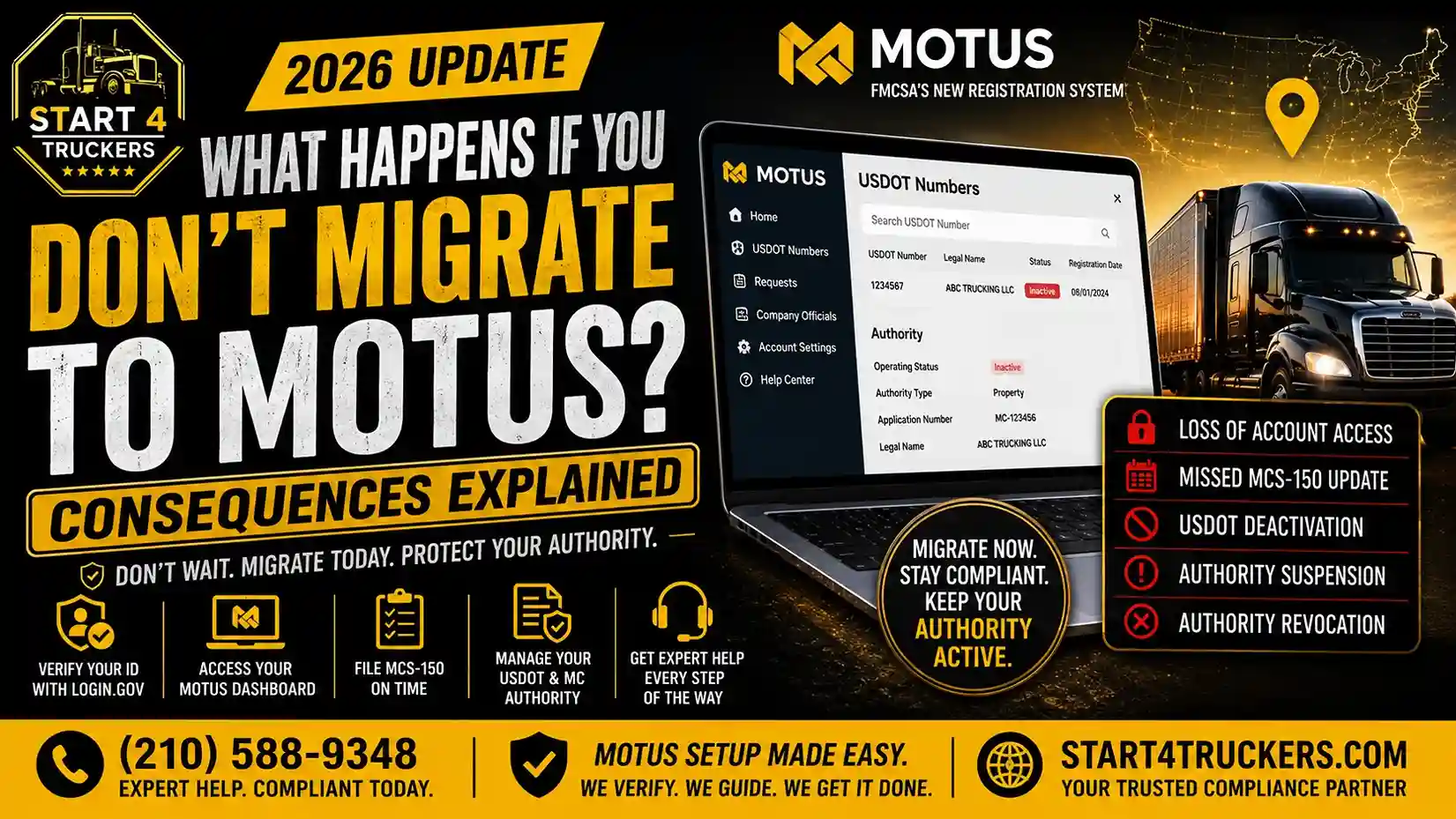
If you do not migrate to MOTUS, you progressively lose the ability to manage your FMCSA registration. This starts with restricted access to the old URS system, then moves to an inability to file your MCS-150 biennial update, which leads to USDOT deactivation. A deactivated USDOT number suspends your operating authority, meaning you can no longer legally haul freight or broker loads. Left unresolved, this can escalate to authority revocation, requiring a full reapplication process. The fix is simple: complete your MOTUS migration before these consequences compound.
Why MOTUS Migration Matters for Every Carrier
MOTUS Is Not Optional
MOTUS is the FMCSA’s new digital registration and compliance platform. It is replacing the old Unified Registration System (URS) as the only place carriers, brokers, and freight forwarders can manage their FMCSA accounts.
This is not an upgrade you can choose to skip. It is the system. If you have an active USDOT number or MC authority, you are required to transition into it.
For a full background on what MOTUS is and why FMCSA built it, read our complete guide on the Motus FMCSA registration system.
Who Is Affected by Not Migrating
Every type of FMCSA-regulated entity faces consequences for failing to migrate:
- Motor carriers with active USDOT numbers and MC authority
- Owner-operators with their own operating authority
- Freight brokers with MC numbers and surety bonds on file
- Freight forwarders registered with the FMCSA
- Process agents who file BOC-3 designations
If any of these describe your business, the consequences below apply to you directly.
The Escalating Consequences of Not Migrating to MOTUS
The damage from skipping your MOTUS migration does not happen all at once. It builds in stages, and each stage is more serious than the last.
Stage 1: Restricted Access to Your FMCSA Account
The first consequence is the simplest and the easiest to fix: you lose the ability to log in and manage your account through the old URS system. You can no longer update your information, view your filings, or respond to FMCSA notices through the legacy portal.
At this stage, your USDOT number and authority are usually still active. But you are flying blind, unable to monitor or manage your own compliance status.
Stage 2: Inability to File Your MCS-150 Update
This is where things get serious. Every carrier must file an MCS-150 biennial update every two years. If you cannot access your account because you have not migrated to MOTUS, you cannot file this update.
A missed MCS-150 filing is a direct trigger for USDOT deactivation. Learn exactly what this form requires in our guide on what Form MCS-150 is and when to file it.
Stage 3: USDOT Number Deactivation
Once your MCS-150 becomes overdue, the FMCSA deactivates your USDOT number. This is not a warning it is an active change in your registration status.
A deactivated USDOT number means:
- Your record shows as inactive to anyone who looks it up
- Brokers and shippers will see your inactive status before booking loads
- Your insurance filings may be affected
- Your business can no longer legally operate under that number
Stage 4: Operating Authority Suspension
A deactivated USDOT number directly affects your operating authority. Your MC number’s authority status becomes suspended, meaning you are no longer legally permitted to haul freight for hire or broker loads.
Operating during this period is a federal violation, regardless of whether you knew your authority had been suspended.
Stage 5: Authority Revocation
If the situation is left unresolved for an extended period, suspension can escalate to full authority revocation. This is far more serious than suspension. Revocation typically requires a brand-new application process, not a simple reactivation.
If you are at this stage, our guide on how to renew your MC authority covers what reinstatement requires.
Comparison: Migrated vs Not Migrated
| Factor | Carrier Who Migrated | Carrier Who Did Not Migrate |
| Account access | Full access through the MOTUS dashboard | Restricted or no access |
| MCS-150 filing | Filed on time | Cannot file becomes overdue |
| USDOT status | Active | Eventually deactivated |
| Operating authority | Active and manageable | Suspended or at risk |
| Insurance filing visibility | Clear, integrated tracking | Disconnected, unclear status |
| BOC-3 management | Linked and confirmed | May become unlinked or outdated |
| Compliance risk | Low | High and increasing |
| Business continuity | Uninterrupted | At risk of operational shutdown |
Why So Many Carriers Are Putting Off the Migration
Understanding why carriers delay helps explain why this problem is so widespread.
| Reason for Delay | Why It Happens |
| “I haven’t had time” | Daily operations take priority over admin tasks |
| “I didn’t get a notice” | FMCSA emails went to an outdated or unmonitored address |
| Confusion about the process | Login.gov and identity verification feel unfamiliar |
| Assumed someone else handled it | Office staff or dispatchers assumed the owner did it |
| Fear of doing it wrong | Past registration errors make carriers hesitant to act |
| Did not realize they were affected | Brokers and owner-operators sometimes assume this only applies to large fleets |
None of these reasons makes the consequences any less real. The FMCSA system does not waive penalties because you were busy.
Still haven’t migrated to MOTUS? Call Start4Truckers LLC at (210) 588-9348. We get your account set up correctly today, before deactivation or suspension puts your business at risk.
What Operating Without Active Authority Actually Costs You
Federal Penalties and Enforcement Risk
Operating a commercial motor vehicle under a deactivated USDOT number or suspended authority is a federal violation. This exposes you to:
- Civil penalties assessed per violation
- Roadside inspection flags that follow your carrier record
- Potential out-of-service orders during inspections
- Increased scrutiny in future FMCSA interactions
Lost Freight and Business Relationships
Brokers and shippers routinely check carrier status before tendering loads. A suspended or deactivated status shows up immediately in lookup tools. This means:
- Brokers will not book loads with you
- Shippers may flag your company for vetting issues
- Your reputation in load boards and freight networks takes a hit
Insurance Complications
Operating with a non-compliant FMCSA status can create real problems with your insurance coverage. If a claim arises while your authority is suspended or your USDOT number is deactivated, your insurer may dispute coverage based on your non-compliant operating status at the time of the incident.
Cash Flow Disruption
Every day your authority is suspended is a day you cannot legally generate revenue from hauling freight. For owner-operators and small fleets, this kind of disruption can be financially devastating, especially if it stretches into weeks while you work through the recovery process.
How to Avoid These Consequences: Complete Your MOTUS Migration Now
The good news is that every consequence described above is preventable and most are reversible if caught early enough.
Step 1: Create Your Login.gov Account
Login.gov is the federal identity verification system required to access MOTUS. Visit login.gov and create an account using a personal email address you check regularly.
For a complete walkthrough of this process, including common errors and how to fix them, read our detailed guide on Login.gov and MOTUS: complete account setup guide for truckers.
Step 2: Complete Identity Verification
You will need a valid government-issued photo ID, your Social Security Number, and a smartphone or webcam to complete identity proofing. Your legal name must match exactly across your ID, your Login.gov account, and your FMCSA records.
If your verification fails, do not panic; most failures are fixable. Our complete guide on MOTUS identity verification failed: how to fix it step by step walks through every common error and its solution.
Step 3: Claim Your Existing USDOT Number in MOTUS
Once your identity is verified, log in to the MOTUS portal and claim your existing USDOT number. Your number does not change; you are simply linking your verified identity to your existing carrier records.
If you are unsure of your current USDOT status before starting, use our guide on how to look up a USDOT number through MOTUS to confirm where you stand.
Step 4: Review and Update Your Carrier Profile
Carefully review your business name, address, contact information, and operation details inside your new MOTUS profile. Correct anything outdated. Inaccurate information at this stage can trigger compliance flags down the line.
Step 5: File Any Overdue MCS-150 Update
If your MCS-150 has already become overdue, file the updated form immediately through MOTUS. This is the step that reactivates a deactivated USDOT number.
Use our MCS-150 filing service to get this handled correctly and quickly.
Step 6: Verify Insurance and BOC-3 Filings
Confirm that your active insurance filings and BOC-3 process agent designation appear correctly in your MOTUS profile. If either is missing, contact your insurer or process agent immediately to have them re-filed through the new system.
Learn more about this requirement in our BOC-3 filing guide, or use our BOC-3 filing service for fast resubmission.
Step 7: Confirm Your Operating Authority Status
Check your MC number and authority status inside MOTUS to confirm everything shows as active. If your authority has already been suspended or revoked, you will need to follow the FMCSA’s reinstatement process.
What If You Already Missed the Deadline?
If you are reading this because your USDOT number is already deactivated or your authority is already suspended, the path forward is the same, just more urgent.
Complete the migration steps above immediately, prioritizing the MCS-150 filing since that directly reactivates your USDOT number. For a full breakdown of recovery steps specific to carriers who are already past the migration window.
Do not operate any vehicles or broker any freight until your status is confirmed as active again.
Special Considerations by Carrier Type
Owner-Operators
If you hold your own authority, you are solely responsible for your migration. There is no compliance department to catch this for you. Review our owner-operator vs company driver comparison if you are reassessing whether independent authority remains the right fit for your operation.
Freight Brokers
Brokers face an added risk: a lapsed surety bond combined with a missed migration can suspend your authority even faster. Full details on broker-specific requirements are covered in our Motus for freight brokers guide.
New Carriers
If you are just starting out and have not yet registered, you do not need to worry about migration; you will register directly through MOTUS from day one. Our Motus for new carriers guide explains the full process.
Existing Carriers From URS
If you have an existing registration under the old system, read our complete FMCSA compliance transition from URS to MOTUS guide for full context on what the transition involves.
How Start4Truckers LLC Helps Carriers Avoid MOTUS Migration Consequences
Waiting to migrate to MOTUS is one of the costliest mistakes a trucking company or brokerage can make right now. The consequences compound quickly, and recovery takes far longer than the migration itself would have.
Start4Truckers LLC helps motor carriers, owner-operators, and freight brokers across the United States complete their MOTUS migration correctly and avoid the deactivation and suspension risks described in this guide.
Here is how we help:
- Login.gov and MOTUS account setup guided identity verification and account creation
- USDOT number claiming through our USDOT registration service
- MCS-150 filing handled through our MCS-150 filing service to prevent or reverse deactivation
- BOC-3 re-filing through our BOC-3 filing service
- MC authority restoration through our MC number registration service
- Ongoing compliance monitoring through our ongoing DOT compliance program, so this never happens again
We serve carriers in Texas, Florida, California, Georgia, Ohio, and every other state nationwide.
Check our plans and pricing or explore our full trucking compliance services to find the right support for your business.
Don’t risk deactivation. Visit our trucking company setup services page or call Start4Truckers LLC at (210) 588-9348. Let’s get your MOTUS migration done today.
Conclusion
Not migrating to MOTUS is not a passive choice with no consequences it is an active risk to your USDOT number, your operating authority, and your ability to run your trucking business legally.
The good news is that the fix is straightforward. Create your Login.gov account, verify your identity, claim your USDOT number, and confirm your compliance filings are current. Every day you wait increases the chance that a simple migration turns into a deactivation, a suspension, or worse.
Start4Truckers LLC is ready to help you complete this process correctly and protect your business from unnecessary downtime.
Don’t wait for deactivation to force your hand. Contact Start4Truckers LLC today for expert help with MOTUS migration, MCS-150 filing, and full FMCSA compliance support. Request your free consultation or call (210) 588-9348 now. Let’s get your account migrated and your authority protected.
Frequently Asked Questions
1. What happens if I don’t migrate to MOTUS?
If you do not migrate to MOTUS, you progressively lose the ability to manage your FMCSA account. This leads to an inability to file your MCS-150 biennial update, which results in USDOT deactivation. A deactivated USDOT number suspends your operating authority, meaning you cannot legally haul freight or broker loads until you complete the migration and restore your compliance standing.
2. Will my USDOT number be deactivated immediately if I don’t migrate?
No, not immediately. The first consequence is restricted account access through the old URS system. Deactivation happens later, as a result of being unable to file your required MCS-150 biennial update because you cannot access your account. The timeline varies, but the risk increases the longer you delay.
3. Can I still operate my trucking business if I haven’t migrated to MOTUS?
You can continue operating as long as your USDOT number remains active and your authority remains in good standing. However, once your MCS-150 becomes overdue and your USDOT number is deactivated, you can no longer legally operate. Migrate before this happens to avoid any interruption to your business.
4. How do I know if my USDOT number has already been deactivated?
Check your status using FMCSA’s official carrier lookup tools, or refer to our guide on how to look up a USDOT number through MOTUS. A deactivated number will show as inactive, which is visible to brokers, shippers, and enforcement personnel.
5. What is the difference between suspended and revoked operating authority?
Suspended authority is typically a temporary administrative hold that can be resolved by restoring a missing requirement, such as an overdue MCS-150 filing or a lapsed insurance filing. Revoked authority is a more serious, formal FMCSA action that usually requires a new application process rather than a simple reactivation.
6. How long does it take to recover from MOTUS migration consequences?
Recovery time depends on how far the consequences have progressed. Completing the migration itself typically takes under an hour if your documents are ready. Reactivating a deactivated USDOT number through an MCS-150 filing can take a few business days for FMCSA processing. Authority revocation requires a longer reinstatement process.
7. Does not migrating to MOTUS affect my insurance?
Yes, indirectly. If your USDOT number is deactivated or your authority is suspended, your insurance filings may not be properly tracked, and any claims that arise during that period could face disputes over your compliance status. Migrating to MOTUS keeps your insurance filings visible and properly linked to your active carrier profile.
8. Can brokers see if my authority is suspended?
Yes. Freight brokers and shippers routinely check carrier authority status before booking loads. A suspended or deactivated status is visible through FMCSA lookup tools and will likely prevent brokers from working with you until your status is restored.
9. What should I do first if I haven’t migrated to MOTUS yet?
Start by creating your Login.gov account and completing identity verification. Then log into MOTUS and claim your existing USDOT number. Review our complete Login.gov and MOTUS account setup guide for step-by-step instructions before you begin.
10. Is migrating to MOTUS mandatory for all carriers?
Yes. Every motor carrier, owner-operator, freight broker, and freight forwarder with an active FMCSA registration is required to migrate to MOTUS. There is no exemption based on fleet size or business type. The old URS system is being phased out entirely.
11. What happens to my BOC-3 filing if I don’t migrate?
Your BOC-3 process agent designation may become disconnected from your active compliance record if you cannot manage your account through the old system. Once you migrate, verify that your BOC-3 is properly linked and current in your MOTUS profile, as a missing or outdated BOC-3 can contribute to authority suspension.
12. Can I migrate to MOTUS after my authority has already been suspended?
Yes. Migrating to MOTUS is still the correct first step even if your authority is already suspended. Completing the migration restores your account access, which then allows you to file any overdue MCS-150 updates and verify your insurance and BOC-3 filings all of which are required to lift the suspension.
13. Does not migrating affect freight brokers differently than carriers?
Yes. Freight brokers face an added risk because their authority depends on maintaining an active surety bond in addition to their MCS-150 filing. If account access issues prevent a broker from monitoring their bond status or filing updates, authority suspension can happen faster than it does for motor carriers.
14. Will I lose my MC number if I don’t migrate to MOTUS?
Your MC number itself does not disappear, but its active status can be suspended or eventually revoked if your USDOT number is deactivated due to a missed MCS-150 filing. Migrating to MOTUS and keeping your compliance filings current is what keeps your MC number’s authority status active.
15. How can Start4Truckers LLC help me migrate before something goes wrong?
Start4Truckers LLC guides you through the entire MOTUS migration process, including Login.gov account setup, identity verification, claiming your USDOT number, and confirming your insurance and BOC-3 filings are current. We help you avoid deactivation and suspension entirely by getting your migration done correctly and promptly. Call (210) 588-9348 or request a free consultation to get started today.