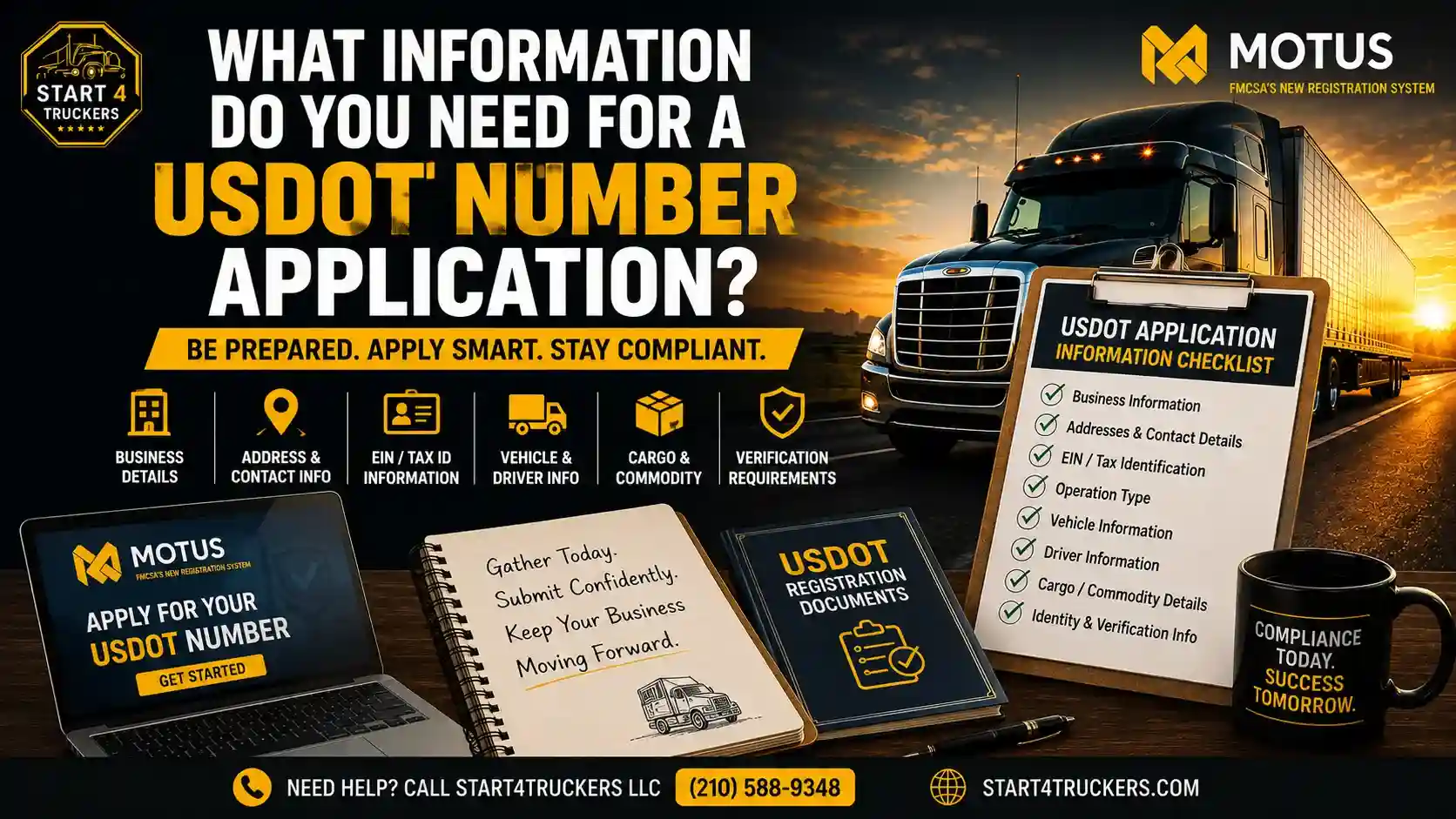
Before you open FMCSA’s Motus system and start your application, it helps to know exactly what you’ll be asked for. Most delays happen not because the application itself is hard, but because someone starts it without the right information on hand and has to stop halfway through to go dig it up.
Generally, you’ll want your legal business information, business and mailing address, contact information, tax identification details, carrier operation information, vehicle information, driver information, cargo information, and the identity verification details Motus requires, all gathered before you start. Having this ready ahead of time makes the process faster and helps you avoid the kind of avoidable errors that slow an application down.
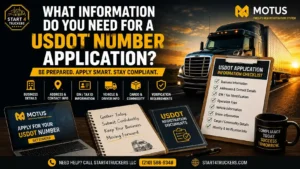
USDOT Application Requirements: What Information Do You Need?
Here’s a quick overview of what you’re generally asked to provide, and why each piece matters.
| Information | Why You Need It |
| Legal business name | Identifies your company to FMCSA |
| DBA or trade name | Identifies your operating name, if different |
| Business address | Establishes your principal place of business |
| Mailing address | Used if different from your business address |
| Contact information | Lets FMCSA reach you |
| Tax identification information | Confirms your business identity |
| Operation type | Determines how your carrier operation is classified |
| Vehicle information | Describes your commercial vehicles |
| Driver information | Describes your drivers |
| Cargo information | Identifies what you transport |
| Identity and business verification | Required as part of Motus access and registration |
In short: gather your business, carrier, vehicle, driver, cargo, and contact information before you start the application. If you’d rather talk this through with someone first, call Start4Truckers LLC at (210) 588-9348.
Before You Start Your USDOT Application: 10 Things to Have Ready
1. Your Legal Business Name
This should be the exact legal name tied to your business, whether that’s your LLC, corporation, or your own name as a sole proprietor. Consistency matters here. Your legal name and your DBA, or “doing business as” name, are two different fields, so don’t mix them up.
2. Your DBA or Trade Name
If you operate under a name different from your legal business name, have that trade name ready too. Not every business has one, so this only applies if it’s relevant to you.
3. Your Principal Business Address
This is your company’s actual physical location, not a PO box. Have your full street address, city, state, and ZIP code ready and accurate.
4. Your Mailing Address
If you receive mail somewhere different from your principal business address, have that mailing address ready as well.
5. Your Business Phone and Email
Have your business phone number, a working email address, and the contact information for whoever’s responsible for the registration on hand.
6. Your EIN or Tax Identification Information
Have your business’s tax identification information ready. Depending on your specific business structure and circumstances, this may look a little different from one applicant to the next, so don’t assume your situation matches someone else’s exactly.
7. Your Carrier Operation Details
Know how you’ll classify your operation before you start: interstate or intrastate, for-hire or private, property or passenger, and whether hazardous materials are involved.
8. Your Vehicle Information
Have your vehicle count, vehicle type, and weight information ready, along with basic details about your commercial motor vehicles.
9. Your Driver Information
Know how many drivers you’re registering and how they’re classified, including whether they hold a CDL.
10. Your Cargo or Commodity Information
Know what you’ll actually be hauling: general freight, household goods, hazardous materials, or something more specialized.
What Business Information Is Required for a USDOT Application?
Legal Business Name and DBA Name
Your legal business name identifies your company as it’s officially registered. Your DBA, if you have one, is your operating name.
Business Entity Type
Whether you’re set up as an LLC, corporation, sole proprietorship, or partnership affects how your business information is entered.
EIN or Tax Identification Number
Have your applicable tax identification information ready, matching your official business records.
Principal Place of Business and Mailing Address
Your principal business address and your mailing address, if different, should both be accurate and ready to enter.
Business Phone and Email
Have working contact details ready so FMCSA can reach you if needed.
Responsible Company Official
Have clear information ready about who’s authorized to manage your company’s registration. Under Motus, this person is generally referred to as the Company Official, and their information needs to line up consistently across your accounts.
What Carrier Information Do You Need for USDOT Registration?
Interstate vs. Intrastate Operation
Whether you operate across state lines or stay entirely within one state affects your registration category. If you’re only intrastate, our guide on USDOT number requirements for intrastate carriers covers that specifically.
Type of Carrier Operation
You’ll generally classify your operation type as part of the application. Not every applicant fits every category, so don’t assume yours is the same as another carrier’s.
Property vs. Passenger Operations
Whether you’re hauling freight or transporting passengers changes how your operation is classified.
For-Hire vs. Private Carrier
Whether you’re hauling for other companies or exclusively for your own business also affects your classification.
Hazardous Materials Operations
If your operation involves hazardous materials, this can affect your registration requirements, separate from your standard vehicle and cargo information.
What Vehicle Information Do You Need for a USDOT Application?
Number of Commercial Vehicles
Have an accurate count of your commercial motor vehicles ready.
Vehicle Type and Weight
Know your vehicle types (truck tractors, straight trucks, and so on) and applicable weight information, including your gross vehicle weight rating where relevant.
Do You Need to Own the Truck Before Applying?
This depends on your specific situation and shouldn’t be assumed one way or the other. If you’re unsure how this applies to you, it’s worth confirming before you start.
Do You Need Your VINs Before Applying?
Vehicle identification information can be relevant to your registration, though exact requirements can vary depending on your registration path. Don’t assume every VIN detail is required at every step.
What Driver Information Is Needed for a USDOT Application?
Number of Drivers
Have a count of your drivers ready, including yourself if you drive for the company.
CDL and Non-CDL Drivers, Owner-Operators, and Company Drivers
Know how your drivers are classified. This is generally operational information for your registration, separate from detailed driver qualification records, which are part of a broader ongoing compliance process rather than the initial application itself.
Do You Need Every Driver’s Full Information Before Applying?
Generally, no. The application typically asks for driver count and operational classification information, not full individual driver files. Those individual records matter for your ongoing compliance, including things like your drug and alcohol program and Clearinghouse registration, but that’s a separate step from the initial application.
What Cargo Information Do You Need for USDOT Registration?
General Freight, Household Goods, and Hazardous Materials
Know what commodities you’ll be hauling. Your cargo classification, whether it’s general freight, household goods, hazardous materials, or something more specialized, is part of your registration.
Why Your Cargo Type Matters
Your operation and the commodities you transport can affect your registration category and potentially other regulatory requirements down the line, so it’s worth having this figured out ahead of time rather than guessing during the application.
What Documents Do You Need for a USDOT Number Application?
It helps to separate the information you’ll need to provide from documents or identification you may need for verification. These aren’t always the same thing, and exact requirements can vary depending on your circumstances and registration path.
Business Formation Information
This might include your Articles of Organization, Articles of Incorporation, or partnership details, depending on your business structure.
Tax Identification Information
Have your applicable tax ID information match your official business records.
Government-Issued Identification
As part of Motus’s identity verification process, you’ll generally need a valid government-issued photo ID.
Business Address Information
Have documentation or records confirming your business address, in case anything needs to match up during verification.
Other Supporting Information
Exact document requirements can depend on your specific registration process and circumstances, so it’s worth confirming what applies to your situation rather than assuming a generic list covers everything.
USDOT Application Requirements in Motus: What Has Changed in 2026?
What Is Motus?
Motus is FMCSA’s modernized USDOT Registration System, which launched in 2026 and replaced the older Unified Registration System along with several other legacy platforms. It’s now the primary system carriers use to apply for a new USDOT number, apply for operating authority, and manage their registration going forward.
What Information Should You Prepare Before Opening Motus?
Have your business information, contact details, carrier operation classification, vehicle information, driver information, cargo information, and identity verification materials ready before you log in, so you’re not stopping partway through to track something down.
Do You Need a Login.gov Account?
Yes. Motus uses Login.gov for account access, and new applicants generally need to complete identity verification through that process, which includes a government-issued ID and a device with a camera, like a smartphone or tablet. Our detailed Login.gov and Motus setup guide walks through this process step by step.
Why Does Motus Require Identity Verification?
This is a security measure meant to confirm that the person registering a carrier account is who they say they are, which helps FMCSA reduce fraud and unauthorized account access.
What Is a Motus Company Account?
Your Motus company account is where you manage your company’s information, control who has access, handle registrations, and submit filings going forward. If you’re unclear on who should be listed as your company’s point of contact, our guide on what a Motus company official is explains that role in more detail.
How Motus Differs From the Older Registration Process
Motus consolidates what used to be spread across multiple separate systems into one dashboard, with a stronger identity verification step built in from the start. If you’re ready to walk through the actual application, our guide on how to apply for a new USDOT number in Motus covers the process directly.
Running into account setup issues already? Call (210) 588-9348 and we can help you sort it out.
Do You Need a USDOT Number Before You Apply?
Who Generally Needs a USDOT Number?
Generally, a USDOT number is required for certain interstate commercial vehicle operations, particularly those involving vehicles at or above certain weight thresholds, along with certain passenger operations and specified hazardous materials operations.
What If You Only Operate Intrastate?
State requirements can differ from federal ones, so intrastate-only operations may still have their own registration requirements depending on your state. Don’t assume federal rules are the whole picture.
Do All Trucking Companies Need a USDOT Number?
No. Not every trucking business is required to register federally. Whether you need one depends on your specific operation, vehicles, and how you use them.
Do You Need a USDOT Number and Operating Authority?
That depends on your operation too. A USDOT number and operating authority, like an MC number, serve different purposes and aren’t automatically the same requirement. Our guide on DOT number vs. MC number breaks down that distinction clearly.
USDOT Application Checklist: What to Gather Before You Apply
Business Information
- Legal business name
- DBA or trade name, if applicable
- Business entity type
- Principal business address
- Mailing address, if different
- Business phone number
- Email address
- Tax identification information
Carrier Information
- Interstate or intrastate operation
- Carrier type
- Property or passenger operation
- For-hire or private operation
- Hazardous materials information, if applicable
Vehicle Information
- Number of vehicles
- Vehicle types
- Weight information
- Commercial vehicle details
Driver Information
- Number of drivers
- Driver classifications
- CDL information, where applicable
Cargo Information
- Commodities transported
- General freight, household goods, or hazmat classification
Motus Access
- Login.gov account
- Identity verification materials
- Company information
- Authorized user information
Common USDOT Application Mistakes to Avoid
- Entering the wrong legal business name. This should match your official business records exactly.
- Using an incorrect business address. Mismatches here can create verification problems.
- Confusing a DBA with your legal business name. These are two separate fields for a reason.
- Choosing the wrong operation type. Take a minute to actually confirm your classification before selecting one.
- Providing incorrect vehicle information. Double-check your counts and vehicle details before submitting.
- Giving the wrong driver count. This should reflect your actual current operation.
- Selecting the wrong cargo type. Your commodities affect your classification, so don’t guess.
- Starting the application without required information. This is exactly what leads to stalled, half-finished applications.
- Ignoring Motus identity verification. Skipping or rushing this step can lock you out or delay your registration.
- Submitting without reviewing your information. A quick review before you hit submit catches most avoidable mistakes.
- Applying for a new USDOT number when you already have one. If your company previously had a USDOT number, you generally shouldn’t submit a new application. You’d claim your existing number in Motus instead. For common account issues around this, our guide on Motus registration errors is a good place to check first.
Can Missing Information Delay Your USDOT Application?
Incorrect Information Can Create Real Problems
Yes. Missing or inaccurate details are one of the most common reasons applications stall out or get flagged for review.
Address or Business Information Mismatches
If your address information doesn’t match your official records, this can trigger verification issues. Our guide on Motus address verification failed covers this exact problem if you’ve already run into it.
Identity Verification Issues
Problems during the Login.gov or Motus identity verification step, like a mismatched name or an outdated ID, can stop your application in its tracks.
Missing or Incorrect Registration Details
Gaps in your business, vehicle, driver, or cargo information can also slow things down, since incomplete applications generally can’t move forward smoothly.
When to Correct an Application
If you notice an error after submitting, address it as soon as possible rather than waiting, since incorrect information on file can create bigger headaches down the road.
USDOT Application vs. Operating Authority: What Information Is Different?
USDOT Number
Your USDOT number is generally a safety identifier tied to your company’s operation as a motor carrier.
Operating Authority
Operating authority, such as an MC, MX, or FF number, is a separate registration tied to certain for-hire interstate operations.
Do You Need Both?
It depends entirely on your specific operation. Some carriers need only a USDOT number, while others need both a USDOT number and operating authority.
Don’t Confuse USDOT Registration With MC Authority
These are commonly mixed up, but they’re not interchangeable. Our DOT number vs. MC number guide explains exactly how they differ and when each one applies to you.
USDOT Application Requirements for New Owner-Operators
If You’re Starting With One Truck
Focus first on your business, vehicle, and operation information, and make sure your Motus account setup is squared away before you begin.
If You’re Leasing a Truck
Have clear information ready about your lease arrangement, since this can affect how your vehicle information is entered.
If You Plan to Add More Trucks
Think ahead about how you’ll manage adding vehicles to your registration later, so your initial setup doesn’t create extra work down the line.
If You’re Hiring Drivers
Have an accurate driver count ready, and start thinking early about your broader compliance obligations, like drug and alcohol testing requirements, which are separate from the initial application itself.
If You’ll Haul Freight Across State Lines
Make sure your interstate operation classification is accurate from the start, since this affects your registration category.
What Should You Double-Check Before Submitting Your USDOT Application?
Before you hit submit, run through this quick quality check:
- Business name
- Address
- Contact information
- Tax ID information
- Operation classification
- Vehicle information
- Driver count
- Cargo information
- Identity verification
- Registration type
If you’re unsure whether you need only a USDOT number or additional operating authority as well, it’s worth verifying your specific registration requirements before submitting, rather than guessing and having to correct it later.
How Start4Truckers LLC Can Help With Your Trucking Registration
Getting all of this information organized before you even open Motus can save you a lot of back-and-forth. Start4Truckers LLC is a third-party agency, not FMCSA or a government office, that helps trucking entrepreneurs across the country get their registration and business setup handled the first time correctly.
We can help you prepare your USDOT registration, and if you need more than just a USDOT number, we can also help with MC registration, BOC-3 filing, LLC formation, and the rest of your compliance setup. We can’t guarantee FMCSA approval timelines or bypass the agency’s review process, but we can make sure your application goes in accurately and is complete the first time.
Need help preparing your USDOT application? Call Start4Truckers LLC at (210) 588-9348, and we’ll help you get everything organized before you start.
Final Checklist: Are You Ready to Apply for a USDOT Number?
Before you start, make sure you have:
- Business information, including your legal name, DBA, address, and contact details
- Tax identification information
- Carrier operation details
- Vehicle information
- Driver information
- Cargo information
- Motus and Login.gov access ready
- Identity verification materials on hand
- The correct registration type confirmed
If all of this is accurate and ready to go, you’re in a much better position to complete your USDOT registration in one sitting, instead of stopping halfway through to track down basic company or operation details.
Conclusion
Preparing for your USDOT application really comes down to gathering accurate business, carrier, vehicle, driver, and cargo information ahead of time, and making sure your Motus and Login.gov access is set up correctly before you start. Getting this right the first time saves you the headache of stalled applications and verification issues later.
If you’d rather have help getting everything organized, call Start4Truckers LLC at (210) 588-9348, and we’ll walk you through your specific registration needs.
Frequently Asked Questions
1. What information do I need to apply for a USDOT number?
Generally, your legal business information, address, contact details, tax identification information, carrier operation classification, vehicle and driver details, cargo information, and Motus identity verification materials.
2. What are the basic USDOT application requirements?
You’ll need accurate business, carrier, vehicle, driver, and cargo information, along with a Login.gov account and completed identity verification through Motus.
3. What documents do I need for a USDOT number?
This can include business formation documents, tax identification information, and a government-issued photo ID for identity verification, though exact requirements can vary by your specific situation.
4. Do I need an EIN to apply for a USDOT number?
Requirements depend on your specific business structure. Have your applicable tax identification information ready and matching your official records.
5. Do I need an LLC before getting a USDOT number?
Not necessarily. Your business entity type is part of what you’ll report, but the specific structure required depends on your own business decisions, not a universal rule.
6. What business information is required for USDOT registration?
Generally your legal business name, DBA if applicable, business entity type, address, mailing address, contact information, and tax identification information.
7. What vehicle information is needed for a USDOT application?
Generally your number of commercial vehicles, vehicle types, and applicable weight information.
8. What driver information is needed for USDOT registration?
Generally your driver count and classification, such as CDL versus non-CDL, rather than full individual driver files.
9. What cargo information do I need for a USDOT application?
Your commodity classification, such as general freight, household goods, or hazardous materials.
10. Do I need a USDOT number if I only operate intrastate?
It depends on your state’s specific rules. Federal requirements are not the only rules that may apply to intrastate-only operations.
11. Do I need both a USDOT number and an MC number?
It depends on your operation. Some carriers need only a USDOT number, while others also need operating authority like an MC number.
12. What information do I need to apply for a USDOT number in Motus?
The same core business, carrier, vehicle, driver, and cargo information, plus a Login.gov account and completed identity verification specific to Motus.
13. Do I need Login.gov for a USDOT application?
Yes. Motus uses Login.gov for account access and identity verification as part of the current registration process.
14. Can incorrect information delay my USDOT application?
Yes. Mismatched or inaccurate information is one of the most common causes of delays and verification issues.
15. Can I apply for a USDOT number if I already have one?
Generally, no. If your company already has or previously had a USDOT number, you should claim that existing number in Motus rather than submitting a new application.