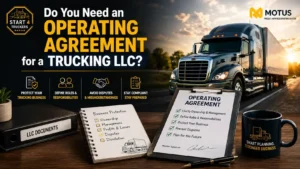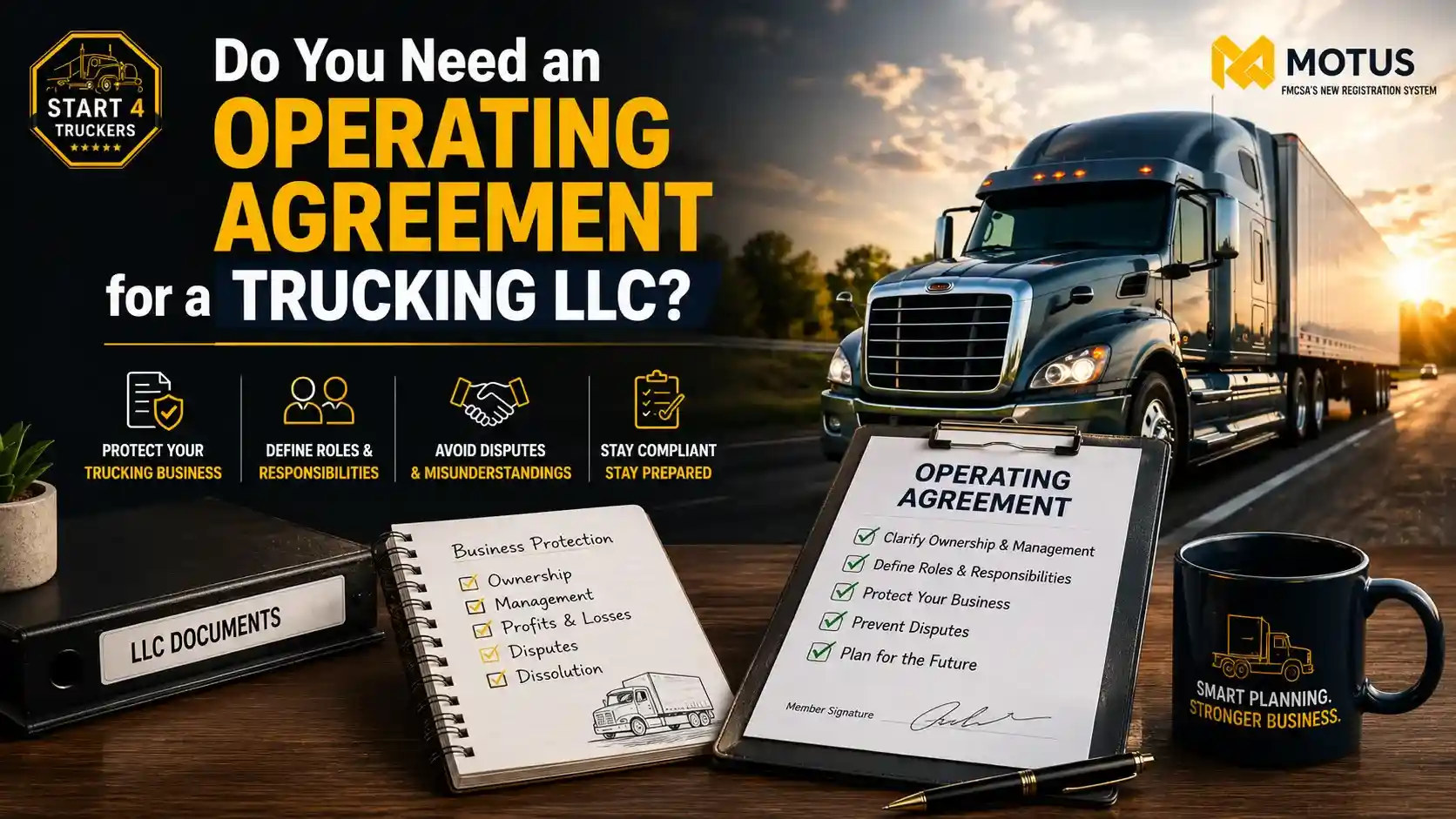
An operating agreement is an internal document that explains how your trucking LLC is owned and managed. Whether a written agreement is legally required depends on the state where your LLC is formed. Even when it isn’t mandatory, a written agreement is generally recommended because it clarifies ownership, management, financial rules, and what happens when the business changes.
You already formed your LLC, or you’re about to. Now you’re wondering if you actually need this extra document, or if it’s just more paperwork on top of everything else you’re handling for your trucking business. Let’s break it down.
What Is an Operating Agreement for a Trucking LLC?
An operating agreement is the internal rulebook for your LLC. It’s different from the paperwork you filed to create the business in the first place.
What Does an LLC Operating Agreement Do?
It generally sets the rules for:
- Ownership and who holds what percentage of the company
- Management and who makes day-to-day and major decisions
- Member responsibilities
- Capital contributions
- How profits and losses are divided
- Distributions
- Adding or removing members
- How disputes get handled
- Dissolving the company
Why Is This Important for a Trucking Business Specifically?
Generic LLC advice doesn’t always translate to trucking. Think through situations like these:
- One owner running a single tractor and wondering if this document even matters.
- Two owners who each brought a truck into the business and now share a small fleet.
- A spouse or family member added as a co-owner.
- Adding a second truck and needing to decide who signs for the loan.
- Hiring your first driver and deciding who has the authority to do that.
- Buying additional equipment on the company’s behalf.
- One member wanting to leave or sell their share.
An operating agreement gives you a place to answer these questions before they turn into a problem.
Is an Operating Agreement a Public Document?
Generally, no. It’s an internal document that isn’t filed with the state and isn’t part of the public record in most cases. You should keep it with your other core business records instead, similar to how you’d keep your Articles of Organization or LLC formation paperwork on file.
Do You Need an Operating Agreement for a Trucking LLC?
Is It Legally Required?
Whether a written operating agreement is legally required depends on the state where your LLC is formed and the applicable LLC law in that state. Some states require one. Others don’t. This is genuinely state-specific, so don’t assume your state’s rules match what you read in a general LLC article online.
What If Your State Doesn’t Require One?
“Not required” doesn’t mean “not useful.” Without a written agreement, your LLC generally falls back on your state’s default LLC rules, which:
- Weren’t written with your specific business in mind
- May not reflect how you and your co-owners actually intend to run things
- Can leave ownership and decision-making unclear if a dispute comes up later
- Can make it harder to bring in a new member cleanly
Should You Have One Even If It Isn’t Required?
Generally, yes. This is where the article can actually be useful instead of just repeating a legal definition. A written agreement gives your trucking business a clear, documented answer to “who owns what” and “who decides what,” instead of leaving it to assumptions or a state default rule you’ve probably never read.
Does a Single-Member Trucking LLC Need an Operating Agreement?
Is It Required?
Same answer as above: it depends on your state. Some states technically don’t require one for a single-member LLC.
Why Should a One-Owner Trucking Company Have One Anyway?
Even with just one owner, a written agreement can:
- Document your ownership clearly
- Establish your management structure on paper
- Record how the business is actually operated
- Help show separation between you personally and the LLC as its own entity
- Provide continuity if your circumstances change
- Make things easier if you decide to bring in a second member later
- Give you an organized business record if a lender, partner, or the IRS ever asks for one
What Should a Single-Member Trucking LLC Operating Agreement Include?
- LLC name and state of formation
- Business purpose
- Confirmation of the sole member and their ownership interest
- Capital contribution details
- Management authority
- How profits and losses are treated
- Distribution rules
- Banking arrangements
- Recordkeeping practices
- Tax treatment
- How the agreement can be amended
- Dissolution terms
- Successor or continuity provisions, in case something happens to you
If you’re still deciding on your business structure at all, our guide on LLC vs. sole proprietor for trucking is worth reading first, and our single-member trucking LLC EIN guide covers a related early-stage question.
Does a Multi-Member Trucking LLC Need an Operating Agreement?
Why Does This Matter More With Multiple Owners?
With two or more owners, there are simply more decisions that need a clear answer. Assumptions that seemed obvious when you started the business can turn into disagreements fast, especially once real money and equipment are involved.
How Should Ownership Percentages Be Defined?
Your agreement should spell out:
- Whether ownership is split evenly (50/50, for example) or unevenly
- How capital contributions factor into ownership percentages
- What happens if one member contributes more later, such as buying a new truck for the company
How Should Profits and Losses Be Divided?
Don’t leave this to assumption. State clearly how profits and losses are allocated between members, whether that matches ownership percentages exactly or follows a different agreed formula.
Who Makes Decisions for the Trucking LLC?
Your agreement should define whether the LLC is:
- Member-managed, where the owners themselves run day-to-day operations
- Manager-managed, where a designated manager (who may or may not be an owner) handles operations
It should also separate routine decisions from major ones, and set clear voting thresholds for anything significant, like buying a truck, taking on debt, or signing a major contract.
What Happens If Trucking LLC Partners Disagree?
This is exactly the kind of situation a good operating agreement plans for ahead of time, including:
- A dispute-resolution process
- What happens in a voting deadlock
- Buyout provisions if one partner wants out
- Mediation or arbitration, where appropriate, instead of going straight to court
What Should a Trucking LLC Operating Agreement Include?
Here’s a practical checklist covering the core sections most trucking LLC operating agreements should address:
- LLC name and business information
- Ownership and membership interests
- Member contributions
- Management structure
- Voting rights and decision-making
- Profits, losses, and distributions
- Business expenses and company funds
- Member responsibilities
- Rules for adding new members
- Rules for removing or replacing a member
- Ownership transfer rules
- Buyout and buy-sell provisions
- What happens if a member dies or becomes incapacitated
- Dispute resolution
- Dissolution of the LLC
- How the agreement can be amended
- Recordkeeping and signature requirements
Here’s what makes this genuinely useful for a trucking business instead of generic: if two owners run a trucking company together, the agreement should clearly say who can buy equipment, sign major contracts, hire drivers, take on business debt, or make other significant calls on the company’s behalf. That specificity is what actually prevents disputes down the road.
What Are the Benefits of an Operating Agreement for a Trucking LLC?
- Clearly defines ownership, so there’s no confusion about who owns what.
- Establishes management rules, so everyone knows who’s responsible for what.
- Reduces owner disputes, because the hard questions are already answered on paper.
- Creates clear profit and loss rules, instead of leaving money questions to assumption.
- Helps with business continuity if an owner leaves, retires, or passes away.
- Documents how the LLC actually operates, which matters for lenders, partners, and your own records.
- Helps keep business and personal affairs separate, which supports good entity governance.
One important note: an operating agreement alone doesn’t automatically guarantee liability protection for your personal assets. What it can do is help document that your LLC is being operated as its own separate entity, which is part of good overall governance. Real protection depends on your state’s law and how you actually run the business day to day.
What Happens If a Trucking LLC Doesn’t Have an Operating Agreement?
- Your state’s default LLC rules apply instead, whether or not they fit your business.
- Ownership and management can be less clear, especially with more than one owner.
- Disputes between members can become harder to resolve without an agreed process.
- Profit distribution can be unclear, particularly with uneven contributions.
- Adding or removing owners can get complicated without a defined process.
- Business continuity is less clearly defined if something happens to an owner.
To be clear, not having an operating agreement doesn’t automatically make your LLC invalid. It just means you’re relying on your state’s general default rules instead of rules built around your specific business.
Operating Agreement vs. Articles of Organization
These two documents are easy to confuse, but they serve very different purposes.
| Feature | Operating Agreement | Articles of Organization |
| Purpose | Internal LLC rules | Creates and forms the LLC |
| Filed with the state | Generally no | Yes |
| Public record | Generally no | Generally yes |
| Ownership rules | Yes | Usually limited |
| Management rules | Yes | Basic formation information only |
| Profit distribution | Can address in detail | Generally not detailed |
| Member responsibilities | Yes | Generally not detailed |
| Internal governance | Yes | No |
Operating Agreement vs. Other Trucking Business Documents
It’s easy to mix these up when you’re juggling multiple filings at once, so here’s how each one fits.
Operating Agreement vs. EIN
Your EIN identifies your business for federal tax purposes. It doesn’t replace or explain how your LLC is governed.
Operating Agreement vs. USDOT Number
Your USDOT number is a federal identifier used for qualifying motor carriers, tied to safety and compliance. It has nothing to do with your LLC’s internal ownership or management structure. See our comparison of DOT number vs. MC number for more on this specific piece.
Operating Agreement vs. MC Number
Your MC number relates to your operating authority for certain interstate for-hire carriers. An operating agreement doesn’t provide operating authority in any way.
Operating Agreement vs. BOC-3
BOC-3 is a completely separate process-agent designation filing. Learn more in our guide on what a BOC-3 filing is.
Operating Agreement vs. Registered Agent
Your registered agent handles service-of-process responsibilities for your LLC. Your operating agreement governs internal matters between you and your co-owners. They’re not interchangeable.
Is an Operating Agreement Required to Get Trucking Authority?
Is It Required for a USDOT Number?
No. An operating agreement is not itself part of the federal USDOT registration process.
Is It Required for an MC Number?
No. Operating authority and your operating agreement are handled separately.
Can You Start a Trucking Company Without One?
Technically, in many states, yes, though it’s generally not recommended. LLC formation, your state’s requirements, your trucking registrations, and your operating agreement are all separate pieces of your setup, and having one doesn’t automatically mean you’re fully compliant on the others. If you’re just getting started, our guide on how to start a trucking company walks through the full picture.
How to Create an Operating Agreement for a Trucking LLC
- Check your state’s LLC requirements. Rules vary, so confirm what applies to your specific state.
- Identify the LLC members. Single-member or multi-member changes what needs to be addressed.
- Define ownership percentages. Especially important with more than one owner.
- Decide how the LLC will be managed. Member-managed or manager-managed.
- Define financial rules. Cover contributions, profits, losses, distributions, and business expenses.
- Add rules for major trucking business decisions, such as buying trucks, leasing equipment, taking on business debt, hiring drivers, selling equipment, signing major contracts, or adding another owner.
- Add exit, buyout, and dissolution rules.
- Have all members review and sign it.
- Keep it with your business records, not buried in an email inbox somewhere.
- Update it whenever the business changes.
Can You Write Your Own Trucking LLC Operating Agreement?
Can an Owner-Operator Create One Without a Lawyer?
For a straightforward, single-member LLC with simple ownership and management, many owner-operators handle this on their own, often starting from a solid template and adjusting it for their specific business.
When a Template May Be Enough
- A simple single-member LLC
- Straightforward, uncomplicated ownership
- A simple management structure with no major complications
When You Should Consider Legal Help
- Multiple owners
- Unequal ownership arrangements
- Complex buyout provisions
- Outside investors involved
- Significant company assets
- A complicated management structure
- Unusual state-specific requirements
Does an Operating Agreement Need to Be Notarized?
Usually not as a blanket requirement, but this can depend on your state and the specifics of your agreement, so it’s worth double-checking rather than assuming.
Do All LLC Members Need to Sign It?
Generally, yes. Every member should sign to confirm they agree to the terms.
Should You Keep a Signed Copy?
Yes. Keep a signed copy with your core business records, alongside your formation documents and other important paperwork.
Should You Update It After Major Business Changes?
Yes, absolutely. An outdated agreement that no longer reflects your actual ownership or operations isn’t much better than having none at all.
When Should You Update a Trucking LLC Operating Agreement?
Review or update your agreement when you’re:
- Adding another truck to the fleet
- Adding a new member
- Removing a member
- Changing ownership percentages
- Changing your management structure
- Buying another business
- Changing how profits are distributed
- Taking on significant business debt
- Changing your overall business structure
- Bringing on a new partner
- Changing your operating model in a meaningful way
Common Trucking LLC Operating Agreement Mistakes
- Using a generic template without checking state requirements. What works in one state may not fit another.
- Not listing ownership clearly. Vague ownership language causes real problems later.
- Not defining who can make major decisions. This is one of the most common sources of disputes.
- Ignoring profit and loss rules. Money disagreements are some of the hardest to resolve after the fact.
- Forgetting buyout rules. You need a plan before someone actually wants out.
- Not addressing what happens if a member leaves. Don’t leave this to a conversation you’ll have to have during a disagreement.
- Mixing personal and business finances. This undermines the whole point of having a separate entity.
- Never updating the agreement. A stale agreement doesn’t reflect your actual business anymore.
- Assuming the agreement replaces FMCSA compliance. It doesn’t. Your operating agreement and your federal trucking compliance are completely separate.
- Assuming an operating agreement alone guarantees liability protection. It supports good governance, but it isn’t a standalone shield.
Do You Need One? Quick Decision Guide
| Your Situation | Recommendation |
| Single-member trucking LLC | Generally recommended |
| Multi-member trucking LLC | Strongly recommended |
| Two owner-operators running one company | Strongly recommended |
| Family-owned trucking LLC | Recommended |
| LLC planning to add members later | Recommended |
| LLC with multiple trucks | Recommended |
| LLC with complex ownership | Strongly recommended |
| Your state requires one | Required |
State requirements can change over time. Always check your state’s current LLC rules, or speak with a qualified attorney about your specific situation, before relying on a generic template.
How Start4Truckers LLC Can Help With Your Trucking Business Setup
If all of this feels like one more thing on an already long list, that’s exactly where we come in. Start4Truckers LLC is a third-party agency, not a law firm or a government office, that helps trucking entrepreneurs across the country handle business formation and compliance from the ground up.
We can help you with your LLC formation, your EIN registration, your USDOT registration, your MC number, your BOC-3 filing, and your ongoing FMCSA compliance, so you’re not piecing your setup together on your own.
Setting up a trucking LLC and not sure which registrations and compliance steps you actually need? Call Start4Truckers LLC at (210) 588-9348, and we’ll help you work through the setup process step by step.
Frequently Asked Questions
1. Do you need an operating agreement for a trucking LLC?
Not always legally required, but generally recommended even in states where it isn’t mandatory, since it clarifies ownership, management, and financial rules for your business.
2. Is an operating agreement required for a trucking LLC?
It depends on the state where your LLC is formed. Some states require one, others don’t, so check your specific state’s LLC law.
3. Does a single-member trucking LLC need an operating agreement?
Usually not legally required, but still a good idea, since it documents ownership and can help separate you personally from the LLC as its own entity.
4. Does a multi-member trucking LLC need an operating agreement?
Strongly recommended, since it defines ownership percentages, decision-making authority, and profit-sharing rules between multiple owners.
5. What happens if a trucking LLC doesn’t have an operating agreement?
Your state’s default LLC rules generally apply instead, which can leave ownership, management, and dispute resolution less clearly defined for your specific business.
6. What should a trucking LLC operating agreement include?
Generally, ownership details, management structure, financial and profit-sharing rules, member responsibilities, buyout provisions, and dissolution terms, among other core sections.
7. Is an operating agreement the same as Articles of Organization?
No. Articles of Organization create the LLC and are filed with the state. The operating agreement is an internal document explaining how the LLC operates.
8. Does an operating agreement need to be filed with the state?
Generally no. It’s typically kept as an internal business record rather than filed publicly.
9. Does an operating agreement need to be notarized?
Usually not as a blanket rule, but this can depend on your state, so it’s worth verifying your specific requirements.
10. Can I write my own trucking LLC operating agreement?
Often, yes, for simple single-member LLCs. More complex ownership situations may benefit from legal help.
11. Do all LLC members need to sign the operating agreement?
Generally, yes. Every member should sign to confirm agreement to the terms.
12. Does an operating agreement protect my trucking business?
It supports good governance and documentation of your LLC as a separate entity, but it isn’t a standalone liability shield on its own.
13. Is an operating agreement required to get an MC number or USDOT number?
No. These are separate federal registration and authority processes, unrelated to your internal operating agreement.
14. Can I change my trucking LLC operating agreement later?
Yes. Most agreements include an amendment process for updating terms as your business changes.
15. How often should a trucking LLC operating agreement be updated?
Whenever there’s a meaningful change, such as adding a truck, adding or removing a member, or changing ownership percentages or management structure.