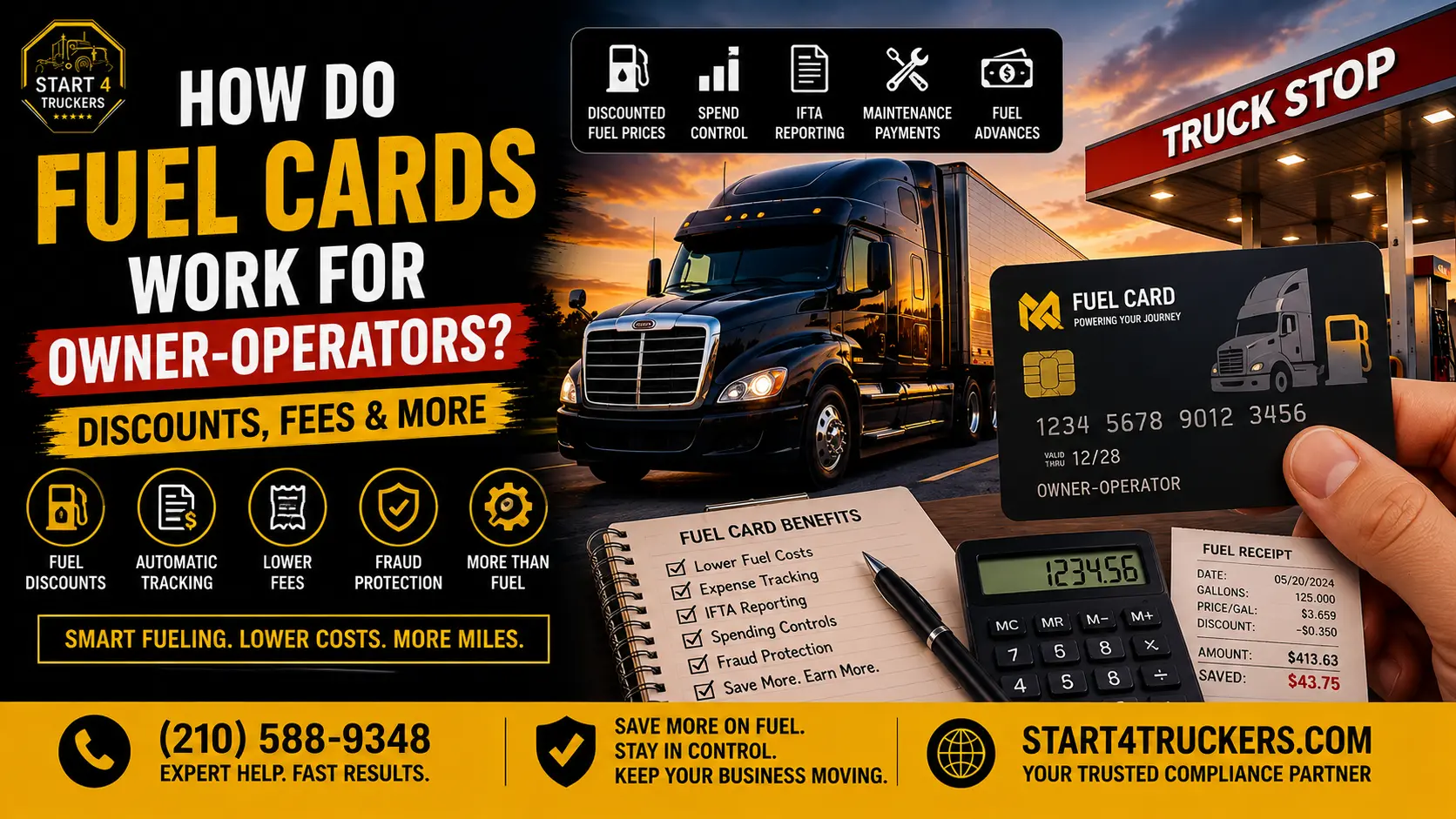
A fuel card for owner-operators works like a prepaid or credit-based payment card built specifically for buying diesel and truck-related expenses. It gives drivers discounted per-gallon pricing at partner truck stops, tracks fuel purchases automatically for IFTA reporting, and often includes tools like fuel advances, maintenance payments, and spending controls. Most fuel cards charge either a monthly fee, a per-transaction fee, or both, so the real savings depend on your fuel network, your mileage, and how the card’s fee structure stacks up against the discount it offers.
Fuel is one of the biggest recurring costs an owner-operator faces, often eating up a huge share of gross revenue. A good fuel card can meaningfully cut that cost every single week. A bad one can quietly eat your savings in fees you never noticed. This guide breaks down exactly how fuel cards work, what discounts and fees actually look like, and how to pick the right one for your operation.
What Is a Fuel Card for Owner-Operators?
A fuel card is a payment card designed specifically for purchasing diesel and other trucking-related expenses at partner locations, offering discounted pricing, purchase tracking, and spending controls that a regular debit or credit card doesn’t provide.
Unlike a standard credit card, a fuel card is built around a network of truck stops and fuel providers. The card issuer negotiates bulk pricing with these locations, then passes some of that discount along to drivers who use the card. Many fuel cards also work at maintenance shops, scale locations, and truck washes, not just fuel pumps.
How Do Fuel Cards Actually Work?
A fuel card connects to an account funded either through a credit line, a linked bank account, or your factoring or dispatch company, and it applies negotiated discounts automatically at the pump when used at a partner location.
Step 1: You Apply for a Card
Applications typically ask for your MC or USDOT number, business information, and sometimes a credit check, depending on the card issuer.
Step 2: The Card Gets Linked to a Funding Source
Depending on the provider, your card may draw from a prepaid balance, a revolving credit line, or funds loaded through a factoring company or trucking company back-office service.
Step 3: You Fuel Up at a Partner Location
Swiping the card at a network fuel stop applies the negotiated discount automatically, without you needing to do anything extra at the pump.
Step 4: Transactions Are Tracked Automatically
Every purchase is logged with location, gallons, price per gallon, date, and time, which becomes valuable data for expense tracking and fuel tax reporting.
Step 5: You Pay the Card Back
Depending on the card type, you either pay off a credit balance on a set schedule, or the amount is automatically deducted from a linked account or your factoring proceeds.
How Fuel Card Discounts Work
Fuel card discounts come from the card issuer’s negotiated bulk pricing agreements with specific truck stop chains, meaning the discount amount varies by location, fuel network size, and sometimes your monthly fuel volume.
Network-Based Discounts
Most fuel card savings come from discounts at specific partner chains. A card tied to a large national network, like major truck stop brands, tends to offer more consistent savings across more locations than a card with a smaller footprint.
Volume-Based Discounts
Some cards offer tiered discounts, meaning the more fuel you purchase through the card each month, the deeper the discount becomes. This can matter a lot for higher-mileage owner-operators.
Regional vs National Networks
A regional network might offer a steeper discount within its coverage area but leave you paying full price outside it. A national network trades some discount depth for broader, more consistent coverage across your routes.
Common Fuel Card Fees to Watch For
Fuel cards commonly charge monthly account fees, per-transaction fees, ATM or cash advance fees, inactivity fees, and sometimes a paper statement or card replacement fee, all of which can eat into your actual fuel savings.
- Monthly Account Fees – A flat fee charged regardless of how much you use the card
- Per-Transaction Fees – A small charge applied every time you swipe the card
- Cash Advance Fees – Charged when you pull cash against your fuel card balance
- Inactivity Fees – Applied if the card sits unused for a certain period
- Card Replacement Fees – Charged if you need a new physical card issued
- Out-of-Network Fees – Charged when you fuel at a location outside the card’s partner network
Before signing up, it’s worth calculating your expected monthly fuel spend, multiplying it by the advertised discount, and then subtracting every fee you can identify. That’s the number that actually tells you whether a card is worth it.
Not sure how to compare fuel card offers against your actual mileage and routes? Call Start4Truckers LLC at (210) 588-9348 and we’ll help you run the numbers.
Fuel Card Payment Terms and Limits
Fuel cards typically come with either a prepaid balance you load yourself, a revolving credit line with a set spending limit, or a linked account funded through your factoring or dispatch company, each with different repayment timing.
Prepaid Fuel Cards
You load funds onto the card before use, similar to a gift card. There’s no credit risk for the issuer, which sometimes makes these easier to qualify for.
Credit-Based Fuel Cards
These extend a line of credit that you pay back on a billing cycle, similar to a standard credit card, but often with lower interest rates or better terms specific to fuel purchases.
Factoring-Linked Fuel Cards
Some factoring companies offer fuel cards tied directly to your factored invoices, allowing fuel purchases to be paid from expected receivables before the invoice is even fully processed.
Spending Limits
Most cards allow you to set daily or per-transaction spending limits, which can help control costs across a fleet or simply create guardrails for your own spending.
Fuel Cards and IFTA Reporting
Fuel cards automatically track the gallons purchased and the state where each purchase occurred, which significantly simplifies quarterly IFTA reporting compared to manually saving paper receipts.
Since IFTA requires carriers to report fuel purchased and miles driven by state, having a digital, itemized record from your fuel card removes a huge amount of manual work. Many fuel card providers offer downloadable reports formatted specifically to support IFTA filing, which can save hours every quarter compared to reconstructing purchases from a shoebox of receipts.
Fuel Advances and Cash Access
Many fuel cards offer cash advance features that let drivers access a portion of their available balance or credit line for non-fuel expenses on the road, though these advances usually carry their own separate fee.
This can be useful for emergency repairs, lumper fees, or other on-the-road expenses that come up unexpectedly. That said, cash advances are usually one of the more expensive features on a fuel card, so they’re best treated as a backup option rather than a routine spending method.
Fraud Protection and Card Security
Most fuel cards include fraud monitoring, transaction alerts, and the ability to set spending controls by location, purchase type, or dollar amount, which helps prevent unauthorized use and catch suspicious activity quickly.
Because fuel theft and card skimming are real risks at truck stops, look for a card that offers real-time transaction alerts sent to your phone, the ability to lock the card instantly if it’s lost, and purchase restrictions that block non-fuel categories if you don’t need them.
Types of Fuel Cards for Owner-Operators
Owner-operators typically choose between single-network fuel cards tied to one truck stop brand, multi-network cards that work across several major chains, and fleet cards offered through factoring or dispatch services that bundle fuel discounts with other back-office tools.
Single-Network Cards
Offer the deepest discounts but only within one truck stop chain’s locations.
Multi-Network Cards
Provide broader coverage across several major chains, trading some discount depth for flexibility on your actual routes.
Factoring or Back-Office Bundled Cards
Often included as part of a broader back-office or factoring service, combining fuel discounts with invoice funding, expense tracking, and sometimes compliance support in one package. Our back-office compliance services and freight factoring services can work together with a fuel card setup like this.
Fuel Card vs Business Credit Card
A fuel card offers negotiated per-gallon discounts and built-in IFTA-friendly reporting that a general business credit card doesn’t provide, while a business credit card offers broader spending flexibility but no fuel-specific savings.
| Feature | Fuel Card | Business Credit Card |
| Fuel discounts | Yes, network-based | No |
| IFTA-ready reporting | Often included | Not typically |
| Spending flexibility | Limited to fuel/maintenance | Broad |
| Cash advance | Available, often costly | Available, often costly |
| Credit check required | Sometimes | Usually |
For most owner-operators, a dedicated fuel card paired with a separate business account tends to work better than trying to use one general-purpose card for everything.
How to Choose the Right Fuel Card
Choose a fuel card by comparing network coverage against your actual routes, calculating real savings after fees, checking IFTA reporting features, and confirming the payment terms match your cash flow situation.
- Check Network Coverage Against Your Routes – A card is only as good as the stops it covers on your actual lanes
- Calculate Real Net Savings – Discount minus fees is the number that matters, not the advertised discount alone
- Confirm IFTA Reporting Support – Look for downloadable, state-itemized fuel reports
- Review Payment Terms – Match the card type to your cash flow, whether that’s prepaid, credit, or factoring-linked
- Look at Fraud Protection Features – Real-time alerts and instant lock capability matter
- Ask About Additional Perks – Some cards include maintenance discounts, scale fees, or roadside assistance
Common Fuel Card Mistakes Owner-Operators Make
Common mistakes include choosing a card based on the advertised discount alone without checking fees, picking a network that doesn’t match actual routes, ignoring cash advance fees, and failing to use the card’s reporting tools for IFTA filing.
- Focusing only on the advertised discount without calculating fees
- Choosing a network that doesn’t cover your actual lanes
- Relying heavily on cash advances without understanding the cost
- Not downloading fuel reports each quarter for IFTA purposes
- Letting a card sit inactive and triggering inactivity fees
- Not comparing more than one card option before committing
How Start4Truckers LLC Can Help
Setting up the right fuel card is just one piece of running an efficient trucking business. Start4Truckers LLC helps owner-operators get set up with trucking fuel card services, alongside quarterly IFTA filing support, freight factoring services, and full trucking company setup support.
If you’re still working through the basics of getting your operation off the ground, our guides on how to start a trucking company and how to become an owner-operator truck driver are good starting points.
Call Start4Truckers LLC at (210) 588-9348 or explore our plans and pricing to find the right fuel card and back-office setup for your business.
Final Thoughts
A fuel card can meaningfully lower one of your highest recurring costs as an owner-operator, but only if you actually understand how the discounts and fees interact. Network coverage, transaction fees, and monthly charges all shape whether a card’s advertised savings translate into real money in your pocket at the end of the month. Pairing the right fuel card with good IFTA reporting habits and clear spending controls turns it from just another piece of plastic into a genuine cost-saving tool for your business.
Start4Truckers LLC can help you set up a fuel card that actually fits your routes and cash flow. Call (210) 588-9348 or reach out through our contact page to get started.
Frequently Asked Questions
1. How do fuel cards work for owner-operators?
A fuel card links to a funding source, whether prepaid, credit-based, or factoring-linked, and applies negotiated discounts automatically when used at partner truck stops, while tracking every purchase for expense and tax reporting purposes.
2. Do fuel cards actually save owner-operators money?
They can, but the real savings depend on the card’s discount depth, its fee structure, and whether the partner network actually covers the routes you drive. Calculating net savings after fees is the only way to know for sure.
3. What fees do fuel cards typically charge?
Common fees include monthly account fees, per-transaction fees, cash advance fees, inactivity fees, card replacement fees, and out-of-network fees.
4. Can a fuel card help with IFTA reporting?
Yes. Most fuel cards automatically track gallons purchased and the state of purchase, and many offer downloadable, IFTA-ready reports that simplify quarterly filing significantly.
5. What is the difference between a prepaid and credit-based fuel card?
A prepaid card requires you to load funds before use, similar to a gift card, while a credit-based card extends a line of credit that you repay on a billing cycle.
6. Do fuel cards offer cash advances?
Many do, allowing access to funds for non-fuel expenses like repairs or lumper fees, though cash advances typically carry their own separate, often higher, fee.
7. Are fuel cards only good for buying diesel?
No. Many fuel cards also work at maintenance shops, scale locations, and truck washes, not just fuel pumps.
8. How do I know if a fuel card’s network covers my routes?
Check the card provider’s list of partner locations against the states and lanes you regularly drive before signing up, since a discount only helps if you can actually use it.
9. Do I need good credit to get a fuel card?
It depends on the card type. Prepaid fuel cards typically don’t require a credit check, while credit-based cards often do.
10. Can factoring companies provide fuel cards?
Yes. Many factoring companies offer fuel cards linked directly to your factored invoices, allowing fuel purchases to draw against expected receivables.
11. What should I look for in fuel card fraud protection?
Look for real-time transaction alerts, the ability to instantly lock a lost or stolen card, and spending controls that restrict purchases by location, category, or dollar amount.
12. Is a fuel card better than a regular business credit card for fuel purchases?
For fuel specifically, yes, since fuel cards offer negotiated discounts and IFTA-friendly reporting that a general business credit card doesn’t provide.
13. Can I use a fuel card at any truck stop?
Only at locations within the card’s partner network, unless the card includes out-of-network purchase options, which usually come with reduced or no discount.
14. What happens if I don’t use my fuel card for a while?
Some fuel cards charge an inactivity fee if the account goes unused for a set period, so it’s worth checking a card’s terms before letting it sit dormant.
15. Can Start4Truckers LLC help me set up a fuel card?
Yes. Start4Truckers LLC helps owner-operators set up fuel cards that match their routes and cash flow needs, alongside broader back-office, factoring, and IFTA compliance support.