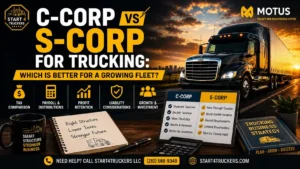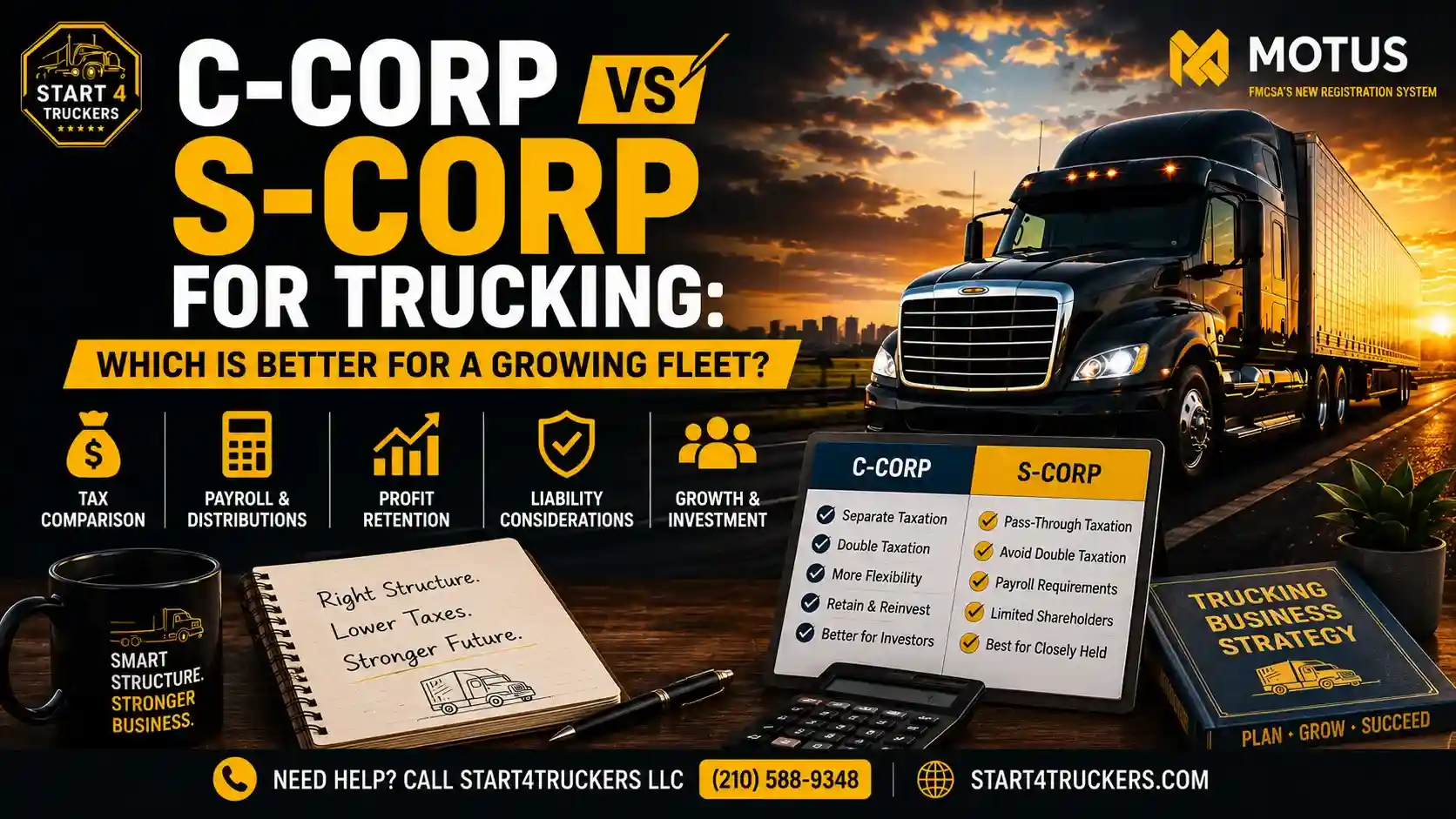
There’s no single “best” structure that fits every trucking company. An S-Corp can work well for a qualifying, owner-operated trucking business that wants pass-through taxation. A C-Corp can become more attractive once a company wants to retain profits, bring in certain investors, or build out a larger corporate structure.
The real question to ask yourself is this: are you mostly taking profits out of the business, or are you planning to keep and reinvest a good chunk of them to grow the fleet? That single question drives most of the decision.
Quick note before we dig in: tax rules can vary based on your state and your specific situation. This article is general educational information, not individualized tax advice. Talk to a qualified tax professional before changing your entity or tax election. If you’d rather talk through your setup with our team first, call Start4Truckers LLC at (210) 588-9348.
C-Corp vs S-Corp for Trucking: What’s the Difference?
What Is a C-Corp?
A C-Corporation is a corporation taxed as its own separate entity. The company pays corporate income tax on its profits, generally reported on Form 1120. If the corporation later distributes those profits to shareholders as dividends, shareholders can owe tax on that income too.
What Is an S-Corp?
An S-Corporation is a tax election, not a separate type of legal entity. A qualifying corporation, or an LLC that elects to be taxed as a corporation, can elect S-Corp status so that income, losses, deductions, and credits generally pass through to shareholders instead of being taxed at the corporate level. S-Corps generally file Form 1120-S, and shareholders receive a Schedule K-1 showing their share of the company’s income.
S-Corp Is a Tax Election, Not a Different Type of Company
This trips up a lot of trucking business owners, so it’s worth spelling out clearly:
- A corporation that qualifies can elect S-Corp status.
- Certain LLCs can also elect to be taxed as a corporation, and then potentially make an S-Corp election on top of that.
- “C-Corp vs S-Corp” is really a comparison of federal tax treatment, not two completely different kinds of companies.
Legal structure and federal tax election are two separate decisions, and mixing them up is one of the most common mistakes trucking business owners make.
C-Corp vs S-Corp for a Trucking Company: Quick Comparison
| Factor | C-Corp | S-Corp |
| Federal tax treatment | Corporate taxation | Pass-through |
| Double taxation | Possible | Generally avoided at the federal level |
| Owner compensation | Salary and dividends | Salary and distributions |
| Profit retention | Flexible | Requires additional planning |
| Shareholders | Generally more flexible | Eligibility restrictions apply |
| Stock classes | More flexibility | Generally one class |
| Outside investment | Often more flexible | More restrictive |
| Tax return | Form 1120 | Form 1120-S |
| Election required | Not applicable | Yes, via Form 2553 |
| Best potential fit | Growth, reinvestment, and investment-oriented businesses | Qualifying, closely held businesses |
So which one is actually better? It depends entirely on your goals. If you plan to distribute most of your profit to yourself each year, S-Corp tax treatment is often worth considering. If you plan to retain a significant amount of profit inside the company to fund growth, a C-Corp can start to make more sense.
How C-Corp and S-Corp Taxes Work for Trucking Companies
How C-Corp Taxation Works
Here’s the basic flow: your trucking company earns profit, the corporation pays applicable corporate tax on that profit, and whatever’s left over can either stay in the company or potentially be distributed to shareholders. If it’s distributed as a taxable dividend, the shareholder may owe tax on that income as well.
Why C-Corps Can Face Double Taxation
This happens because of two separate layers: corporate-level tax on the company’s profit, and potentially shareholder-level tax on dividends paid out of that profit.
Does that automatically make a C-Corp a bad choice? No. Whether double taxation is worth it depends heavily on what the company actually plans to do with its profits.
How S-Corp Pass-Through Taxation Works
Here’s the general flow for an S-Corp: your trucking company earns income, that income generally passes through to the shareholders, and each shareholder reports their share on their personal tax return, whether or not the money was actually distributed to them.
How Owner Salary and Distributions Work in an S-Corp
Owners who actively work in the business are generally required to pay themselves reasonable compensation, meaning a fair wage for the work they do, subject to normal payroll taxes. Additional profit can be paid out as a distribution, which is often treated differently than wages.
One important correction here: S-Corp distributions are not automatically tax-free. Owners still generally report their share of the company’s income on their personal return, whether it was distributed or not.
Payroll Taxes in a Trucking S-Corp
Owner-employees generally need proper payroll set up, including withholding, Social Security, and Medicare, along with the related employer filing responsibilities. This is one area where trucking companies commonly run into trouble, especially if payroll wasn’t set up correctly from the start.
Not sure whether your current setup is handling this correctly? Call (210) 588-9348 and our team can help point you in the right direction.
When Does an S-Corp Make Sense for a Trucking Company?
An S-Corp May Fit a Profitable Owner-Operator
This structure tends to fit well when:
- The owner actively operates the business
- The company has consistent, meaningful profits
- The owner wants pass-through tax treatment
- The company doesn’t need a complex outside investment structure
- Ownership fits within the S-Corp eligibility rules
S-Corp for a Small or Growing Trucking Fleet
This can also work well for a small, owner-managed fleet that’s hiring a few drivers and growing steadily. That said, don’t assume a specific truck count automatically determines whether S-Corp status makes sense. The number of trucks you own isn’t the actual tax test. Your income, ownership, and how you use your profits matter far more.
S-Corp Reasonable Compensation
The IRS expects owner-employees to pay themselves a reasonable salary for the work they actually perform, rather than taking most or all company income as distributions to avoid payroll taxes. This is one of the areas the IRS scrutinizes most closely with S-Corps.
S-Corp Ownership Restrictions
To qualify, an S-Corp generally must:
- Have no more than 100 shareholders (spouses and certain family members can be treated as one shareholder for this test)
- Have only eligible shareholders, generally individuals, certain trusts, and estates
- Have only one class of stock
- Be a domestic entity
If you’re already running as a trucking LLC and want to explore this path, our existing guide on S-Corp election for trucking LLCs walks through the election process in more detail.
When Does a C-Corp Make Sense for a Growing Trucking Fleet?
When Fleet Growth Requires Significant Reinvestment
Picture this: the company earns substantial profit, the owner doesn’t need to pull all of it out personally, and instead the company retains that money to buy trucks, invest in equipment, hire more drivers, or fund technology and expansion. This is exactly the scenario where a C-Corp structure starts to earn a real look.
When You Want to Retain Business Profits
Retained earnings can become working capital for fleet expansion, equipment purchases, and general reinvestment, without needing to distribute all of that money to owners first.
When You Want Outside Investors
C-Corp structures tend to offer more flexibility for certain types of outside investment arrangements, partly because of the flexibility around multiple stock classes and a less restrictive shareholder structure.
When You Plan to Build a Larger Corporate Business
If you’re picturing multiple shareholders, a more complex management structure, outside capital, or significant long-term expansion, a C-Corp framework tends to accommodate that better than an S-Corp’s restrictions allow.
Is C-Corp Double Taxation Ever Worth It?
It can be, depending on your goals. The potential cost of paying tax at both the corporate and shareholder level needs to be weighed against the benefits of retaining capital inside the company, investment flexibility, and your long-term growth strategy. There’s no universal right answer here. It comes down to your specific numbers and plans.
C-Corp vs S-Corp for Fleet Expansion
Buying More Trucks
How your business structure interacts with retained profits, financing, and cash flow can genuinely affect how comfortably you can fund new equipment purchases as your fleet grows.
Hiring More Drivers
Payroll, employee administration, and employment tax obligations apply regardless of your entity’s tax structure, but how profits flow through the business can affect how you plan for those growing costs.
Reinvesting Trucking Profits
The real question isn’t simply “which structure has the lowest tax rate.” It’s “how is my company actually going to use its profits?” A business that reinvests heavily has very different needs than one where the owner takes most of the profit home each year.
Expanding Into a Larger Fleet
The bigger your long-term ownership and investment plans, the more this decision matters. A company planning to stay small and owner-managed has very different needs than one planning to bring in partners or investors down the road.
C-Corp vs S-Corp: Ownership and Investment Differences
Shareholder Rules
C-Corps generally allow more flexibility with shareholder count and type. S-Corps have specific eligibility restrictions that limit who can own shares.
Number and Type of Shareholders
S-Corps are capped at 100 shareholders, with certain family members treated as one shareholder for that count. Shareholders also generally need to be individuals, certain trusts, or estates, not other corporations or partnerships.
One Class of Stock vs. Multiple Classes
S-Corps are generally limited to one class of stock. C-Corps can issue multiple classes, which is part of what makes them more flexible for certain investment structures.
Bringing in Outside Investors
A growing trucking company looking for outside investment may find a C-Corp structure fits its financing plans better, simply because of the added flexibility around stock and ownership.
Family-Owned Trucking Fleet vs. Investor-Funded Fleet
A family-owned fleet with straightforward ownership often fits comfortably within S-Corp rules. A company actively seeking outside investors or planning a more complex ownership structure may find a C-Corp fits better.
C-Corp vs S-Corp: Which Has Better Tax Benefits for Trucking?
There’s no simple “S-Corp always wins on taxes” answer here, so let’s break it into a framework instead.
S-Corp Potential Tax Advantages
- Pass-through taxation, generally avoiding a separate corporate-level tax
- A structure that separates owner wages from distributions
- Potential payroll tax planning considerations, depending on your situation
C-Corp Potential Advantages
- Flexibility to retain profits inside the company
- A structure built for reinvestment
- More flexibility for outside investment and a more complex corporate structure
Why Your Profit Level Alone Doesn’t Determine the Answer
Your actual answer depends on a mix of factors: your owner compensation, how much you distribute versus retain, state taxes, deductions, other income sources, business expenses, and your investment plans. Two trucking companies with the same revenue can land on completely different answers here.
C-Corp vs S-Corp for Trucking: Which Is Better for You?
Choose an S-Corp When…
- You have a qualifying, closely held business.
- You expect to distribute most of the profit to yourself.
- You want pass-through taxation.
- You don’t need a complex investor structure.
- Your ownership fits within S-Corp eligibility rules.
Consider a C-Corp When…
- You’re planning significant expansion.
- You expect to retain a substantial amount of profit.
- You want more flexibility for outside investors.
- You expect a more complex ownership structure down the road.
- You’re building toward long-term corporate growth.
When an LLC May Still Be the Better Starting Point
Don’t feel like you have to jump straight to choosing between C-Corp and S-Corp. An LLC offers real flexibility as a legal structure, and it can be taxed under different federal classifications, including a possible S-Corp election later once your business is ready for it. If you’re still deciding on your foundational structure, our guide on LLC vs. sole proprietor for trucking is a good place to start.
Still not sure where your company fits? Call (210) 588-9348 and we can help you think through the decision.
Can You Change From an S-Corp to a C-Corp?
Can an S-Corp Revoke Its S Election?
Generally, yes, an S-Corp can revoke its election, though this involves specific IRS filing requirements and timing considerations.
What Happens When a Corporation Changes Tax Status?
Changing tax status can involve IRS filing requirements, specific timing rules, potential tax consequences, and possible state-level effects. This isn’t something to do casually. Get professional advice before making the switch.
Why You Should Plan the Change Before Your Fleet Gets Much Larger
Status changes are much easier to manage when your company is smaller and simpler. The bigger and more complex your trucking business gets, the more moving parts a structure change involves.
How to Elect S-Corp Status for a Trucking Company
Confirm S-Corp Eligibility
Check your shareholder count, shareholder types, stock structure, and entity status against the IRS requirements before filing anything.
File Form 2553
This is the form that makes the actual S-Corp election with the IRS.
Understand the Election Deadline
The IRS generally requires Form 2553 to be filed no later than 2 months and 15 days after the start of the tax year you want the election to apply to, subject to certain late-election relief rules if you miss it.
Wait for IRS Acceptance
Filing the form and getting IRS acceptance are two different steps. Don’t assume you’re operating as an S-Corp until the IRS confirms it.
Set Up Payroll and Accounting Properly
Once approved, you’ll need proper payroll, clean bookkeeping, separated business finances, and accurate records for distributions. This is where a lot of new S-Corps run into trouble if they’re not prepared for it.
Our full walkthrough on S-Corp election for trucking LLCs covers this process step by step if you want more detail.
C-Corp vs S-Corp for Trucking: Real-World Examples
These are simplified examples for illustration only, not tax advice for your specific situation.
Example 1: One-Truck Owner-Operator
A single owner-operator with steady profit and no plans for outside investors is often a straightforward candidate for S-Corp consideration, assuming the numbers make sense.
Example 2: Five-Truck Family-Owned Fleet
A family-owned fleet with a handful of trucks, steady payroll, and profits mostly going back to the family often fits comfortably within S-Corp eligibility.
Example 3: 20-Truck Fleet Reinvesting Profits
A larger fleet that’s reinvesting most of its profit into new trucks, equipment, and drivers might start to see real value in a C-Corp structure built around retained earnings.
Example 4: Trucking Company Seeking Outside Investment
A company actively courting outside investors often needs the ownership and stock flexibility that a C-Corp structure provides.
Example 5: Fleet Owner Taking Most Profits Personally
An owner who wants to pull most of the company’s profit out each year for personal use is generally in a very different position than a business focused on reinvestment, and that difference should shape the structure decision.
C-Corp vs S-Corp for Trucking: Pros and Cons
C-Corp Pros
- Flexible ownership structure
- Potentially more attractive for outside investment
- Flexible stock structure
- Ability to retain corporate profits for growth
- Suitable for certain long-term growth strategies
C-Corp Cons
- Potential double taxation
- More complex tax considerations overall
- Corporate compliance requirements
- Possible state-level tax complications
S-Corp Pros
- Pass-through taxation
- Generally avoids federal corporate-level income tax
- Can work well for qualifying, closely held businesses
- Potential payroll tax planning benefits
S-Corp Cons
- Shareholder eligibility restrictions
- The one-class-of-stock rule
- Reasonable compensation requirements
- More administrative complexity than a basic, disregarded LLC in many cases
C-Corp vs S-Corp vs LLC for Trucking Companies
LLC
An LLC is a flexible legal entity structure. By default, a single-member LLC is generally taxed like a sole proprietorship, and a multi-member LLC is generally taxed like a partnership, unless it elects a different tax treatment.
LLC Taxed as an S-Corp
An eligible LLC can elect to be taxed as an S-Corp, combining LLC-level legal flexibility with S-Corp pass-through tax treatment, assuming it meets the eligibility rules.
C-Corp
A separate corporate structure with its own tax return, subject to potential double taxation, but more flexible for ownership and investment.
Which One Is Best for a New Owner-Operator?
Many new owner-operators start with a simple LLC, since it’s flexible and straightforward, then consider an S-Corp election once profits are consistent enough to make sense of the additional payroll and administrative requirements. Our guide on how to start a trucking company covers this early-stage decision in more detail.
Which One Is Better for a Growing Fleet?
As your fleet, revenue, and reinvestment needs grow, the S-Corp vs C-Corp question becomes more relevant, and the right answer depends on how you plan to use your profits going forward. Remember: legal structure and tax election are two separate decisions, and understanding that distinction is genuinely the key to getting this right.
Common Mistakes Trucking Companies Make When Choosing a Tax Structure
- Choosing an S-Corp just because someone said it saves taxes. It doesn’t automatically save money for every business.
- Assuming C-Corp double taxation always makes it a bad choice. It depends entirely on your goals.
- Ignoring state taxes. Federal tax treatment and state tax treatment aren’t the same thing, and they can differ significantly.
- Ignoring owner compensation rules. This is one of the most commonly audited areas of S-Corp compliance.
- Mixing business and personal money. This undermines good entity governance regardless of your tax structure.
- Changing structure without planning for the tax consequences. A structure change isn’t as simple as flipping a switch.
- Choosing based only on the number of trucks you own. Fleet size alone isn’t the actual tax test.
- Ignoring long-term fleet growth plans. The right structure today might not be the right structure in three years.
How Start4Truckers LLC Can Help With Your Trucking Business Setup
Choosing the right business structure is just one part of setting up a compliant, well-organized trucking business. Start4Truckers LLC is a third-party agency, not a CPA firm or tax attorney, that helps trucking entrepreneurs across the country handle business setup and compliance from the ground up.
We help with trucking LLC formation, EIN registration, and the rest of your trucking company’s federal and state compliance needs, so you can focus on running your business instead of chasing paperwork. For the tax election itself, we strongly recommend working with a qualified tax professional to confirm what’s right for your specific numbers.
Setting up your trucking business and want help figuring out the right structure to start with? Call Start4Truckers LLC at (210) 588-9348, and we’ll walk you through the setup process.
Final Verdict: C-Corp or S-Corp for Your Trucking Fleet?
S-Corp May Be the Better Fit If…
You run a profitable, closely held trucking company, you plan to distribute most of your profit, and your ownership fits comfortably within S-Corp rules.
C-Corp May Be Worth Considering If…
You plan significant reinvestment, expect to retain substantial profits, or want more flexibility to bring in outside investors as your fleet grows.
The Right Choice Depends on Your Growth Plan
Don’t choose a tax structure just because another trucking company uses it. Base your decision on how your company earns, distributes, retains, and reinvests its profits, and where you actually want your fleet to be in the next several years.
If you want help getting your trucking business set up properly from the start, call Start4Truckers LLC at (210) 588-9348, or explore our trucking LLC formation services to see how we can help.
Frequently Asked Questions
1. Is an S-Corp or C-Corp better for a trucking company?
Neither is automatically better. An S-Corp often fits a profitable, closely held business that wants pass-through taxation, while a C-Corp can fit better for companies planning significant reinvestment or outside investment.
2. Can a trucking company be an S-Corp?
Yes, as long as the company or LLC meets the IRS eligibility requirements and properly elects S-Corp status using Form 2553.
3. Can a trucking company be a C-Corp?
Yes. A trucking business can operate as a C-Corp, which is generally the default tax treatment for a standard corporation unless it elects S-Corp status.
4. What is the biggest tax difference between an S-Corp and C-Corp?
C-Corps face potential double taxation at the corporate and shareholder level, while S-Corps generally use pass-through taxation, avoiding a separate federal corporate-level tax.
5. Do C-Corps pay double taxes?
Potentially, yes. The corporation pays tax on its profit, and shareholders can owe additional tax if that profit is later distributed as a taxable dividend.
6. Does an S-Corp avoid double taxation?
Generally, yes, at the federal level. Income typically passes through to shareholders once, rather than being taxed at both the corporate and shareholder level.
7. When should a trucking company consider a C-Corp?
Generally when the company plans to retain significant profits for reinvestment, wants more flexibility for outside investors, or is building toward a larger, more complex corporate structure.
8. When does an S-Corp make sense for a trucking company?
Often for a profitable, owner-operated or closely held trucking business that wants pass-through taxation and doesn’t need a complex investment structure.
9. Can an S-Corp own multiple trucks?
Yes. There’s no limit on the number of trucks an S-Corp can own tied to its tax status. That’s a business decision, not a tax eligibility rule.
10. Can an S-Corp have multiple owners?
Yes, up to 100 shareholders, with certain family members treated as one shareholder, and all shareholders meeting the eligibility requirements.
11. Can a trucking company switch from an S-Corp to a C-Corp?
Yes, generally by revoking the S-Corp election, though this involves specific IRS filing requirements and should be planned carefully with a tax professional.
12. Is a C-Corp better for a growing trucking fleet?
It can be, particularly when a company plans to retain substantial profits or seek outside investment, but it isn’t automatically better for every growing fleet.
13. Is an S-Corp better for an owner-operator?
Often, yes, for a profitable owner-operator who plans to distribute most of the profit personally and doesn’t need a complex ownership structure.
14. Can a trucking LLC elect S-Corp taxation?
Yes, an eligible LLC can elect to be taxed as an S-Corp by filing Form 2553, while still keeping its underlying LLC legal structure.
15. Should I choose a C-Corp or S-Corp based on how many trucks I own?
No. Fleet size alone doesn’t determine which structure fits best. Your profit level, how you use those profits, and your ownership and growth plans matter far more.