Starting a trucking company but not sure which MC authority to choose? FMCSA offers different operating authority types depending on what you transport, and picking the wrong one can cause registration problems, insurance headaches, and compliance delays.
This guide breaks down Property vs HHG vs Passenger Authority so you can register the right way the first time. Start4Truckers LLC helps trucking companies understand these requirements and choose the correct authority before they ever submit an MC number application.
What Is FMCSA Operating Authority?
FMCSA operating authority is federal permission that allows a for-hire carrier to transport regulated freight or passengers across state lines. It comes in different types depending on what you haul, and it is separate from your USDOT Number.
The Federal Motor Carrier Safety Administration (FMCSA) requires operating authority so it can track who is legally allowed to move freight or people for compensation between states. Without the right authority, a carrier cannot legally operate in interstate commerce.
USDOT Number vs MC Number: What Is the Difference?
A USDOT Number identifies your business and tracks your safety records with FMCSA. An MC Number represents your actual operating authority, the legal permission to haul regulated freight or passengers across state lines for compensation.
Many new carriers assume these two numbers mean the same thing. They don’t. For a full breakdown, see our guide on DOT Number vs MC Number.
What Are the Different Types of MC Authority?
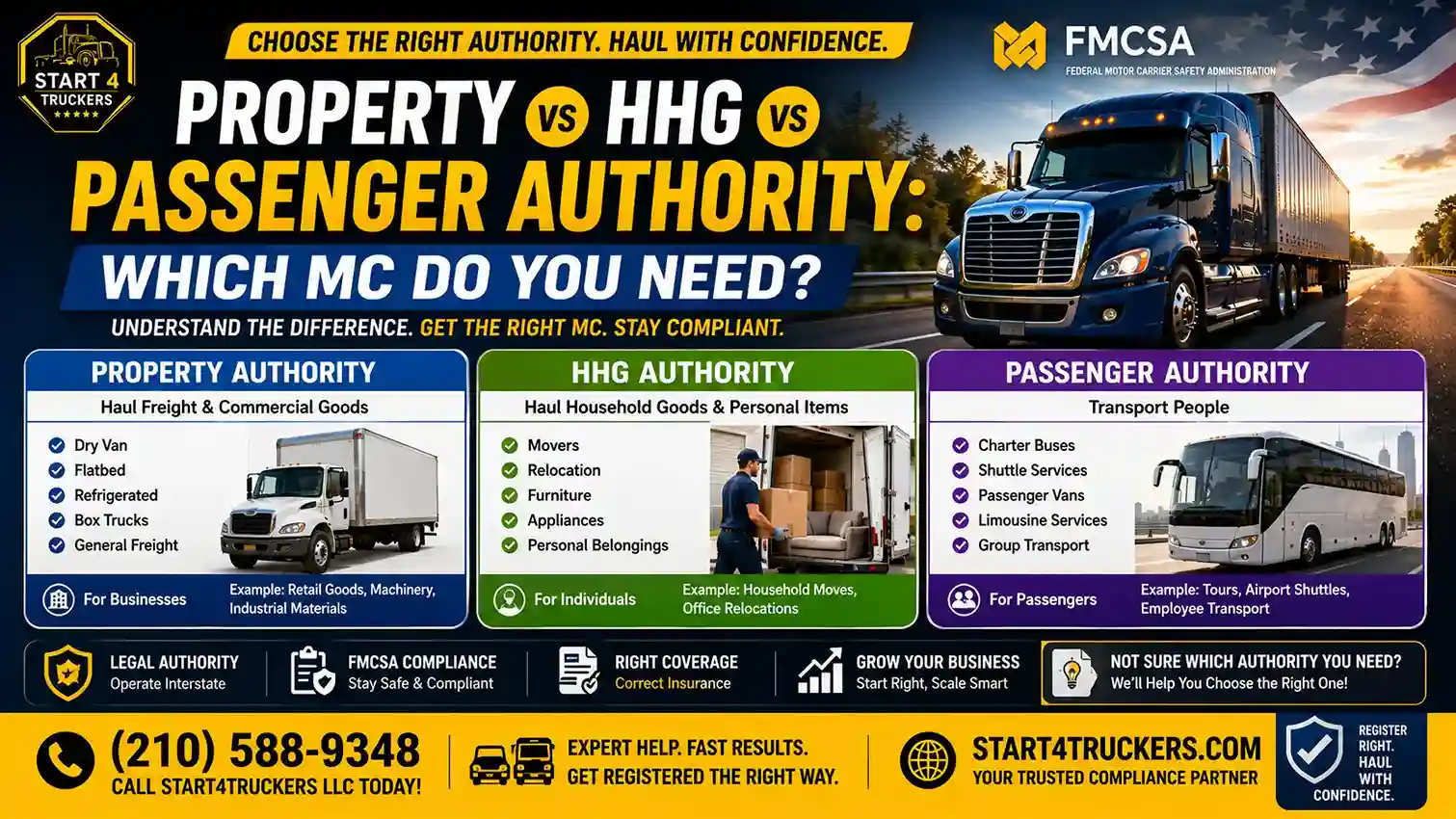
There are three main types of FMCSA operating authority: Property Carrier Authority, Household Goods (HHG) Authority, and Passenger Carrier Authority. Each one covers a different type of cargo or transportation service.
| Authority Type | What You Transport | Examples |
| Property Carrier | Freight and goods | Dry van, flatbed, box trucks |
| HHG Carrier | Personal household items | Movers, relocation companies |
| Passenger Carrier | People | Buses, shuttles, passenger vans |
1. Property Carrier Authority
Property authority covers general freight and commercial goods moved for businesses. This is the most common authority type for standard trucking companies.
2. Household Goods (HHG) Authority
HHG authority covers personal belongings moved during a household or office relocation. It falls under stricter FMCSA consumer protection rules than standard freight.
3. Passenger Carrier Authority
Passenger authority covers businesses that transport people instead of cargo, such as charter buses, shuttles, and vans.
Property Carrier Authority Explained
Property Carrier Authority is required for companies that transport commercial freight and goods across state lines for compensation. It applies to dry van, flatbed, refrigerated, and box truck operations.
Who Needs Property Carrier Authority?
- Freight carriers hauling for businesses
- Owner-operators running interstate loads
- Dry van carriers
- Flatbed operators
- Refrigerated freight carriers
- Box truck businesses
Examples of Freight Transport Covered Under Property Authority
Property authority covers general commodities, machinery, retail products, industrial materials, and other commercial goods being transported from one business to another.
Property Carrier Authority Requirements
To operate under property authority, you generally need:
- A USDOT Number
- An approved MC Number application
- Proof of insurance filing
- A completed BOC-3 filing
- An up-to-date MCS-150 form
If you’re still working through the basics of registration, our guide on how to get trucking authority walks through the full process.
Property authority is by far the most common authority type on the road today. Most dry van, flatbed, and refrigerated carriers hauling general commodities between states operate under this classification, along with box truck businesses handling last-mile or regional freight for other companies. If your trucks move goods that belong to a business rather than a private individual’s household, property authority is almost always the correct choice.
Not sure if property authority fits your business? Call Start4Truckers LLC at (210) 588-9348 and we’ll help you confirm.
Household Goods (HHG) Authority Explained
Household Goods Authority is required for companies that transport personal belongings, like furniture and appliances, during a move. It falls under additional FMCSA consumer protection rules that don’t apply to standard freight carriers.
Who Needs a Household Goods Authority?
- Residential moving companies
- Office relocation companies
- Furniture transportation businesses
- Full-service moving providers
What Are Considered Household Goods?
Household goods generally include furniture, appliances, personal belongings, and other household items being moved from one home or office to another.
Household Goods Authority vs Property Authority
The key difference comes down to who owns the cargo. Property carriers transport commercial freight owned by businesses. HHG carriers transport personal possessions belonging to individual customers, which is why FMCSA applies stricter consumer protection standards to movers.
This distinction matters because FMCSA holds household goods movers to a higher standard than typical freight carriers. Movers often deal directly with individual consumers who may not be familiar with trucking regulations, so FMCSA requires additional disclosures, estimates, and paperwork designed to protect customers during a move. A moving company that mistakenly registers as a property carrier can find itself out of compliance the moment it starts handling residential relocations.
Passenger Carrier Authority Explained
Passenger Carrier Authority is required for companies that transport people, rather than freight, across state lines for compensation. This includes charter buses, shuttles, vans, and similar passenger transportation services.
Who Needs Passenger Carrier Authority?
- Charter bus companies
- Airport shuttle services
- Passenger van operators
- Limousine services
- Group and tour transportation providers
Examples of Passenger Transportation Operations
Passenger authority covers tourism transportation, employee shuttle services, airport transportation, and private passenger services operating across state lines.
Because passenger carriers are responsible for the safety of the people riding in their vehicles, FMCSA applies its own set of insurance and safety standards that differ from freight-based authority types. A charter bus company, for example, faces different liability coverage requirements than a flatbed carrier hauling steel, even though both may operate interstate. Understanding this distinction early helps you budget correctly for insurance before you ever apply.
Property vs HHG vs Passenger Authority Comparison
Property authority covers freight for businesses, HHG authority covers personal belongings during moves, and passenger authority covers people. Each type carries different insurance requirements and serves different customers.
| Feature | Property Authority | HHG Authority | Passenger Authority |
| Transport Type | Freight | Household Items | People |
| Common Businesses | Trucking companies | Movers | Shuttle/bus operators |
| Main Customers | Businesses | Individuals | Passengers |
| Insurance Needs | Cargo/public liability | HHG coverage | Passenger liability |
| Examples | Dry van, flatbed | Furniture movers | Charter bus |
How Do I Know Which MC Authority I Need?
Your authority type depends entirely on what you transport. Freight and commercial goods need property authority, personal belongings during a move need HHG authority, and human passengers need passenger authority.
Choose Property Authority If You:
- Haul freight for businesses
- Transport commercial goods
- Operate trucks for hire across state lines
Choose HHG Authority If You:
- Move household belongings
- Provide relocation services
- Handle personal customer property
Choose Passenger Authority If You:
- Transport people instead of cargo
- Operate buses, shuttles, or passenger vans
Do All Trucking Companies Need Operating Authority?
No. Not every carrier needs MC authority. Private carriers hauling their own goods generally don’t need it, while for-hire carriers transporting regulated freight or passengers across state lines usually do.
A private carrier, such as a company that only moves its own inventory between its own warehouses, typically does not need operating authority the same way a for-hire carrier does. For-hire carriers, on the other hand, are in the business of transporting freight or passengers that belong to someone else, in exchange for payment, which is exactly the activity FMCSA authority is designed to regulate.
The type of authority you need also depends on whether you operate in interstate or intrastate commerce. If you’re unsure which category applies to you, our guide on USDOT Number Requirements for Intrastate Carriers can help clarify.
Common Mistakes When Selecting FMCSA Authority Type
The most common mistakes include choosing property authority for a moving business, selecting the wrong passenger authority, ignoring insurance requirements, and submitting incorrect FMCSA registration information.
Choosing Property Authority for Moving Services
Movers need HHG authority, not property authority. Choosing the wrong one can cause your application to be rejected or your business to operate out of compliance.
Selecting Passenger Authority Incorrectly
Passenger businesses sometimes register under the wrong authority type, which can create insurance gaps if an incident occurs.
Ignoring Insurance Requirements
Each authority type carries different required insurance coverage. Skipping this step can delay your approval or leave you underinsured.
Incorrect FMCSA Registration Information
Simple errors in your MCS-150 or MC Number application can slow down approval or trigger compliance reviews later.
Can You Change Your FMCSA Authority Type Later?
Yes. You can update your FMCSA authority type if your business changes what it transports, but this usually requires updating your registration, your insurance filing, and possibly your MCS-150 information.
If your business grows from hauling freight into offering moving services, or adds passenger transportation, you’ll need to file the appropriate updates with FMCSA to reflect your new authority type. Skipping this step can create compliance gaps even if your original registration was correct.
How to Apply for FMCSA Operating Authority
To apply for FMCSA operating authority, you determine your carrier type, register for your USDOT and MC Number, complete your MCS-150 filing, submit proof of insurance, file your BOC-3, and wait for FMCSA approval.
Step 1: Determine Your Carrier Type
Decide whether you’re a property, HHG, or passenger carrier based on what you plan to transport.
Step 2: Register USDOT and MC Number
Apply for your USDOT Number and MC Number through FMCSA’s registration system.
Step 3: Complete MCS-150 Filing
Your MCS-150 form provides FMCSA with your basic business and safety information.
Step 4: Submit Insurance Filing
Insurance requirements vary by authority type, so make sure your filing matches the coverage required for property, HHG, or passenger operations.
Step 5: Complete BOC-3 Filing
A BOC-3 filing designates process agents in each state where you operate.
Step 6: Wait for FMCSA Approval
Once everything is submitted, FMCSA reviews your application before granting active operating authority.
Ready to get your authority set up correctly? Call Start4Truckers LLC at (210) 588-9348 today.
FMCSA Authority Requirements Checklist
- ✔ USDOT Number
- ✔ MC Number
- ✔ BOC-3 Filing
- ✔ Insurance Filing
- ✔ MCS-150 Update
- ✔ Operating Authority Approval
- ✔ Safety Compliance Requirements
How Start4Truckers LLC Helps You Choose the Right Authority
Picking the correct MC authority type is one of the most important decisions when starting a trucking company. Start4Truckers LLC helps new and existing carriers with:
- FMCSA registration assistance
- MC authority registration
- USDOT setup
- BOC-3 filing
- Ongoing compliance support
Start4Truckers LLC helps new and existing carriers complete FMCSA registration correctly and avoid authority selection mistakes. Explore our trucking company setup services or compare our plans and pricing to find the right fit for your business.
Final Thoughts
Choosing the correct authority comes down to one simple question: what are you transporting? Property carriers handle freight, HHG carriers handle personal belongings, and passenger carriers transport people.
Choosing the right FMCSA authority type is the first step toward operating legally. Start4Truckers LLC helps trucking companies register correctly, complete required filings, and stay compliant with FMCSA regulations. Call us at (210) 588-9348 or visit our contact page to get started today.
Frequently Asked Questions
1. What are the three main types of FMCSA operating authority?
The three main types are Property Carrier Authority, Household Goods Authority, and Passenger Carrier Authority. Each one applies to a different type of cargo or transportation service under FMCSA regulations.
2. What is the difference between property carrier and household goods authority?
Property carriers transport commercial freight owned by businesses, while household goods carriers transport personal belongings owned by individual customers during a move. HHG authority also comes with stricter consumer protection rules.
3. What type of MC authority do I need for my trucking company?
It depends on what you transport. Freight and commercial goods require property authority, personal belongings during a move require HHG authority, and passengers require passenger authority.
4. Do I need property carrier authority to haul freight?
Yes, if you’re operating as a for-hire carrier transporting regulated commercial freight across state lines, you generally need property carrier authority.
5. What is household goods authority with FMCSA?
Household goods authority is FMCSA’s classification for companies that move personal belongings, like furniture and appliances, for individual customers rather than commercial freight for businesses.
6. Do moving companies need HHG authority?
Yes. Moving companies transporting household belongings across state lines need household goods authority, not standard property authority.
7. Who needs passenger carrier authority?
Businesses that transport people for compensation across state lines, such as charter buses, shuttle services, and passenger van operators, need passenger carrier authority.
8. Does a USDOT number replace MC authority?
No. A USDOT Number identifies your business for safety tracking, while MC authority grants legal permission to operate as a for-hire carrier. Most interstate for-hire carriers need both.
9. Can a trucking company have multiple types of authority?
Yes. A business can hold more than one type of FMCSA operating authority if it transports different types of cargo or passengers as part of its operations.
10. How do I apply for FMCSA operating authority?
You determine your carrier type, register your USDOT and MC Number, complete your MCS-150 filing, submit proof of insurance, file your BOC-3, and wait for FMCSA review and approval.
11. How long does it take to get MC authority approved?
Approval times vary depending on application accuracy and FMCSA processing volume. Errors or missing information, like an incomplete insurance filing, can add delays.
12. What documents are required for MC authority?
You typically need your USDOT registration, MC Number application, insurance filing, BOC-3 filing, and MCS-150 form to complete the process.
13. How much insurance is required for each authority type?
Insurance requirements vary by authority type and cargo classification. Property, HHG, and passenger carriers each have different minimum coverage requirements set by FMCSA.
14. Can I change my FMCSA authority type later?
Yes. If your business starts transporting a different type of cargo or passengers, you can update your FMCSA registration and insurance filing to reflect the new authority type.
15. What happens if I choose the wrong authority type?
Choosing the wrong authority type can lead to application delays, insurance coverage gaps, and compliance issues if your actual operations don’t match your registered authority.