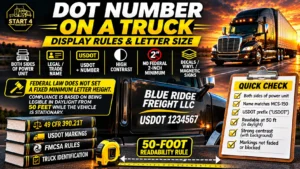
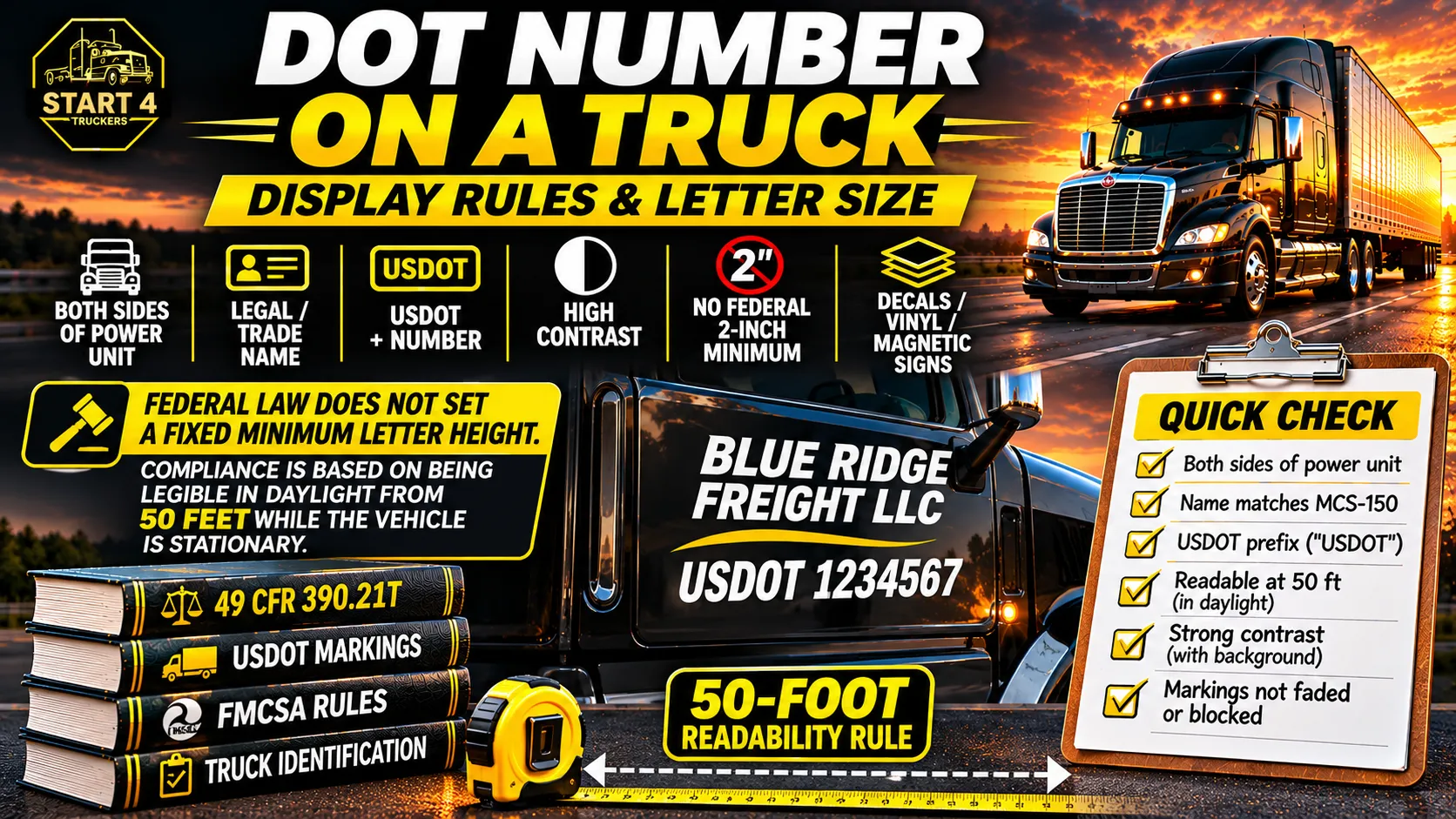
If your truck is a commercial motor vehicle (CMV) used in interstate commerce, the DOT number on your truck has to follow 49 CFR 390.21T. Show your legal name or a single trade name, plus “USDOT” and your number, on both sides of the power unit. The letters must contrast with the background and be readable from 50 feet in daylight.
DOT Number on Truck: Quick Answer
Under federal truck marking rules, a covered commercial motor vehicle must display the operating carrier’s legal name or registered trade name and its identification number preceded by “USDOT.” The markings must appear on both sides of the power unit, contrast with the background, and be readable from 50 feet away in daylight while the vehicle is stationary.
Federal law does not specify a minimum 2-inch letter height. Two-inch lettering is a common practical choice, but compliance depends on actual readability. State requirements may differ.
What are the DOT number display requirements for trucks?
The federal DOT number display requirements are short. They cover what the marking says, where it goes and how readable it is. They don’t set a font, a color or a letter height.
Many people search for 49 CFR 390.21. That section is suspended, so the rule in force is 49 CFR 390.21T. The wording is nearly identical, and most DOT number on truck requirements come straight from it.
| Requirement | What the federal rule says |
| Required information | Legal name or single trade name from your MCS-150, plus your number preceded by USDOT |
| Placement | Both sides of the self-propelled CMV (the power unit) |
| Size | No set letter height |
| Contrast | Letters must contrast sharply with the background |
| Readability | Legible in daylight from 50 feet while the truck is parked |
| Upkeep | Must stay legible. Faded or peeling markings don’t count. |
| Material | Paint or a removable device, if it meets the same rules |
Those are the core DOT number requirements for trucks, and the USDOT lettering requirements too. Logos and phone numbers are optional if they don’t conflict.
How big do DOT numbers have to be on a truck?
Federal law gives no size. The only test is that the marking must be readable from 50 feet in daylight while the truck is parked.
So there are no official DOT number size requirements in inches, no required DOT number font size, no set DOT number lettering size and no DOT number height requirement. The right DOT number on truck size is whatever passes the 50-foot test.
Is there a federal 2-inch letter size requirement?
No. Plenty of decal sellers and sign shops state a 2-inch minimum as if it were federal law. It isn’t. The federal rule sets the 50-foot standard and nothing more.
Two-inch lettering often works, but it can fail when the font is thin, the color blends in or the marking sits low behind a fuel tank. Many shops use 2 to 3 inches on pickups and 3 inches or more on box trucks and tractors. Treat that as a starting point for your US DOT number size, not a guarantee.
States are different. US DOT number size requirements can vary for intrastate trucks. In Illinois, for example, Commerce Commission rules have intrastate for-hire carriers display an ILL.C.C. number, and J.J. Keller reports the letters must be at least 2 inches high and half an inch wide. That’s a state rule, not a federal one.
How to check the 50-foot visibility rule
You can test your truck in five minutes:
- Park the truck in daylight.
- Measure 50 feet from the side of the truck.
- Read the company name and the full USDOT number out loud.
- Check digits that look alike, like 3 and 8, or 1 and 7.
- Repeat on the other side.
If you have to squint, make the letters bigger or bolder, or change the color. Have someone else read it too, since you already know your number.
Where to put DOT number on truck sides
Where to put a DOT number on a truck is the first question most new carriers ask, and how to display DOT number on truck sides comes second. The federal rule only says both sides of the power unit. It doesn’t name a panel. Good DOT number placement on truck sides, and a sensible DOT number location, both come down to one thing: an officer has to read it from the road or the shoulder.
DOT number on truck door and other body panels
The DOT number on a truck door is the most common setup. Doors are flat, at eye level and rarely blocked. Other visible side panels on the power unit also work, including a sleeper or the body of a box truck. Markings on a separate trailer don’t replace the markings on the power unit.
Avoid spots that toolboxes, ladders or fuel tanks can cover.
Does the USDOT number have to appear on both sides?
Yes. Display DOT number on truck sides, both of them. Your USDOT number on truck markings has to appear on both sides of the self-propelled vehicle, and a trailer doesn’t count.
DOT number on pickup truck, box truck and semi-truck
A DOT number on vehicle sides is only required for covered CMVs, not every personal truck. In interstate commerce, a vehicle is a CMV if any of these is true:
- It has a gross vehicle weight rating, gross combination weight rating, gross vehicle weight, or gross combination weight of 10,001 pounds or more, whichever is greater.
- It’s built or used to carry 9 to 15 passengers for pay, or 16 or more passengers.
- It carries hazardous materials that need placards.
You need a DOT number on a pickup truck when the pickup is used for business and meets one of those tests. A hotshot pickup pulling a heavy trailer is a common example. A personal-use pickup doesn’t need one. The same rules apply to a DOT number on box truck and semi-truck doors. If you’re unsure whether DOT numbers on trucks like yours are required, see interstate vs. intrastate trucking authority.
What information must be displayed with your USDOT number?
Legal company name or registered trade name
Your truck must show the legal name or a single trade name exactly as it appears on your MCS-150. If your business name has changed, update company information with FMCSA before you order new lettering. A mismatch between the truck and FMCSA records is an easy citation. If your MCS-150 is out of date, see how to update your MCS-150 in Motus.
Is an MC number required on the truck?
No. FMCSA says there’s no marking requirement for the MC number, though you can add it as extra information. If you’re unclear on how the two numbers work, compare DOT number vs. MC number.
When is “operated by” required?
You need “operated by” when another person’s name also appears on the truck. This often happens when an owner-operator’s business name is on a truck leased to a carrier. The operating carrier’s name and USDOT number must follow the words “operated by.”
- Smith Trucking LLC
- Operated by: Blue Ridge Freight LLC
- USDOT 1234567
Blue Ridge Freight LLC is the operating carrier, so the USDOT number shown must belong to that carrier.
Can you use DOT number decals, vinyl stickers or magnetic signs?
Yes. Federal rules allow paint or a removable device. That covers vinyl letters, DOT number stickers for trucks and magnetic signs, as long as the marking meets the same readability rules and stays in good shape.
There are no separate USDOT number decal requirements. The same DOT number lettering requirements apply whether you paint or use vinyl, so your DOT number decal size still has to pass the 50-foot test. What matters is visibility and durability, not the material. A magnetic sign that slides, fades or falls off isn’t compliant once it does, and you should check your state’s rules before relying on one.
DOT number requirements for interstate vs. intrastate trucks
The federal marking rule is the baseline for interstate carriers. Intrastate carriers follow their own state’s rules. Many states adopt the federal rule, but some add their own number formats, size rules or exemptions, so check with your state DOT before ordering decals. Our guide to USDOT requirements for intrastate carriers is a good starting point.
DOT number markings on leased or rented trucks
For qualifying rentals of 30 calendar days or less, the truck can display the rental company’s name and USDOT number. The rental agreement must contain the information required by 49 CFR 390.21T(e), including the renting carrier’s details and a law-enforcement cooperation statement, and it must stay in the vehicle for the whole rental.
Common DOT number display mistakes
- Wrong number: an old, inactive or mistyped number
- Missing “USDOT”: the number appears without the letters in front
- Mismatched company name: the truck shows a name that isn’t on the MCS-150
- Poor contrast: gray on silver, or dark blue on black
- One side only: the marking is on the driver side only
- Faded or blocked markings: it was readable once, or a toolbox now covers it
What happens if your truck doesn’t display the DOT number correctly?
An officer can cite a marking violation during a roadside inspection. It goes on the inspection report, which is part of your carrier’s safety record. Penalty amounts vary by case and by state, so fix problems as soon as you spot them.
A wrong or missing number can also stop inspection results from linking to your company, and brokers may question a truck that doesn’t match FMCSA records.
Need a USDOT number before marking your truck?
Before operating a covered commercial truck, confirm your USDOT registration is active and that you have any operating authority you need. Then make sure your markings match your FMCSA records. Just starting? Learn how to get a DOT number first, and plan for the FMCSA new entrant requirements that come next.
Start4Truckers.com is a private filing service, not FMCSA. We handle USDOT number registration and offer DOT compliance assistance, so your truck markings match your records from day one. Call (210) 588-9348.
Frequently asked questions
How big do DOT numbers have to be on a truck?
Federal law doesn’t set a size. The marking must be readable from 50 feet in daylight while the truck is parked. Many carriers use letters 2 to 3 inches tall.
Do DOT numbers have to be 2 inches tall?
No. There’s no federal 2-inch minimum. Two inches is a common guideline, but your marking only complies if it passes the 50-foot test. Some states may have their own size rules.
Where should the DOT number be placed on a truck?
On both sides of the power unit, where it can be read from 50 feet. Doors are the most common spot, but other side panels work if nothing blocks them.
Does the USDOT number have to be on both sides?
Yes. Federal rules require the marking on both sides of the self-propelled CMV.
Can DOT numbers be displayed on a truck door?
Yes. The door is the most popular location because it’s flat, visible and easy to read. It’s not required, though, and any side panel can work.
Does a truck need to display its MC number?
Not under federal rules. Only the company name and USDOT number are required. You can add the MC number as extra information.
Can I use magnetic DOT number signs?
Yes, federal rules allow removable devices. The sign must stay readable from 50 feet and stay in place. If it falls off or fades, the truck is out of compliance.
Do pickup trucks and box trucks need DOT numbers?
They do if they’re CMVs used in interstate business, such as a vehicle rated at 10,001 pounds or more. Personal-use pickups don’t need one.
Does the company name have to match FMCSA records?
Yes. It must be the legal name or a single trade name listed on your MCS-150. Update your FMCSA records before you change the name on your truck.