Blog

Your blog category

What Is the IFTA Fuel Tax Agreement Guide for Truckers
Blog

What Is the IFTA Fuel Tax Agreement? Guide for Truckers

If you drive a commercial truck across state lines, fuel taxes are part of your life. Every state has its own fuel tax rate. Without a system to manage all of them, you’d need to file taxes in every single state you drove through. That would be a nightmare. That’s exactly why the IFTA Fuel Tax Agreement exists. In this blog post, you will know everything about IFTA, what it is, who needs it, how to file, and how to stay compliant. Whether you’re an owner-operator just starting or managing a small fleet, this is your complete reference. What Is the International Fuel Tax Agreement (IFTA)? The IFTA Fuel Tax Agreement, short for International Fuel Tax Agreement, is a cooperative program between 48 U.S. states and 10 Canadian provinces. It simplifies fuel tax reporting for commercial carriers operating across multiple jurisdictions. Here’s the simple version: instead of filing separate fuel tax returns in every state you drive through, you file just one return with your base state. Your base state then handles distributing the tax money to every other state you operate in. One license. One return. One filing. Done. The International Fuel Tax Agreement is managed at the state level, with oversight by organizations such as the Federal Motor Carrier Safety Administration (FMCSA) and coordination through the IFTA, Inc. governing body. Without IFTA, interstate trucking tax rules would require carriers to stop at every state border, purchase trip permits, and file separate reports, costing time, money, and sanity. If you’re just starting your trucking business, understanding IFTA is step one. Check out this full guide on how to start a trucking company before anything else. Why Fuel Tax Compliance Matters in the United States Fuel taxes fund the roads you drive on. Every state collects them to maintain highways, bridges, and infrastructure. The IFTA Fuel Tax Agreement makes sure every state gets its fair share based on how many miles you drove there, not just where you bought fuel. Without motor carrier compliance, carriers face: Heavy financial penalties License suspension IFTA audit risk Out-of-service orders Commercial trucking regulations in the U.S. are strict. Staying compliant isn’t optional; it’s the foundation of a legally operating business. Don’t leave your compliance to chance. Whether you’re filing for the first time or trying to fix past mistakes, getting professional help early saves you money, time, and stress. Explore our Trucking Compliance Services and let our team handle the details so you can focus on the road. IFTA Member Jurisdictions The IFTA Fuel Tax Agreement covers almost all of North America. Here’s a breakdown: U.S. Member States (48 total notable ones include): Texas California Florida New York Illinois Georgia, Ohio, Pennsylvania, and all remaining 48 contiguous states Canadian Member Provinces (10 total, including): Ontario Quebec British Columbia Alberta And six additional provinces Non-IFTA Jurisdictions: Alaska Hawaii The District of Columbia Mexico If you’re operating in Florida specifically, here’s a helpful resource: how to get a DOT number in Florida, your first step before getting IFTA licensed there. Who Needs to Comply With the IFTA Fuel Tax Agreement? Not every truck driver needs IFTA. Here’s exactly who does. You need IFTA if your vehicle meets ALL of these: Has two axles and a gross vehicle weight (GVW) over 26,000 lbs, OR Has three or more axles regardless of weight, OR Is used in combination with a total weight exceeding 26,000 lbs AND the vehicle travels across at least two IFTA member jurisdictions. Who is exempt from IFTA: Recreational vehicles (RVs) used for personal travel Farm vehicles operating within a set radius Intrastate-only trucks that never cross state lines Government-owned vehicles What about owner-operators? Yes, if you operate your own truck across state lines and meet the vehicle requirements, IFTA applies to you. Read more about the owner-operator vs company driver differences and what compliance looks like for each. Do hotshot truckers need IFTA? It depends on the truck-and-trailer weight combination. If the combined GVW exceeds 26,000 lbs and you cross state lines, yes, IFTA is required. How the IFTA System Works: Step by Step Understanding the IFTA process removes all the confusion. Here’s how the full system flows: Step 1: Register with your base jurisdiction Apply for an IFTA license in the state where your truck is registered and your records are kept. This is your “base jurisdiction.” Step 2: Receive your IFTA license and decals  Once approved, you’ll receive one IFTA license (keep a copy in the cab) and two annual decals, one for each side of the cab. Step 3: Track miles and fuel by jurisdiction  Every trip counts. Record total miles driven in each state and all fuel purchased — including state, gallons, and location. Step 4: File your quarterly fuel tax return  Four times a year, submit your IFTA quarterly tax return to your base state. Report all miles and fuel by jurisdiction. Step 5: Pay or receive a refund  Your base state calculates what you owe each jurisdiction based on your fuel consumption reporting. If you bought more fuel than you consumed in a state, you may get a credit or refund. Following these five steps consistently keeps your IFTA fuel tax filing accurate, on time, and completely audit-proof. The cleaner your process, the smoother every quarterly filing becomes quarter after quarter, year after year. Need help setting it all up from scratch? Our Trucking Company Setup Services cover everything from IFTA licensing to full compliance management, so you never miss a step. IFTA Licensing Process Explained To get your IFTA license, you’ll need: A valid USDOT number looks like yours, up with the US DOT number lookup tool Your MC authority (if applicable), learn more at the DOT number vs. the MC number EIN (Employer Identification Number): Get yours through EIN Registration Services Vehicle information (VIN, GVW, axle count) Your base state registration details Most states process IFTA applications within 2–4 weeks. Some offer expedited processing online. Want it handled for you? The IFTA License and Decals
How to Renew Your MC Authority Step-by-Step Guide
Blog

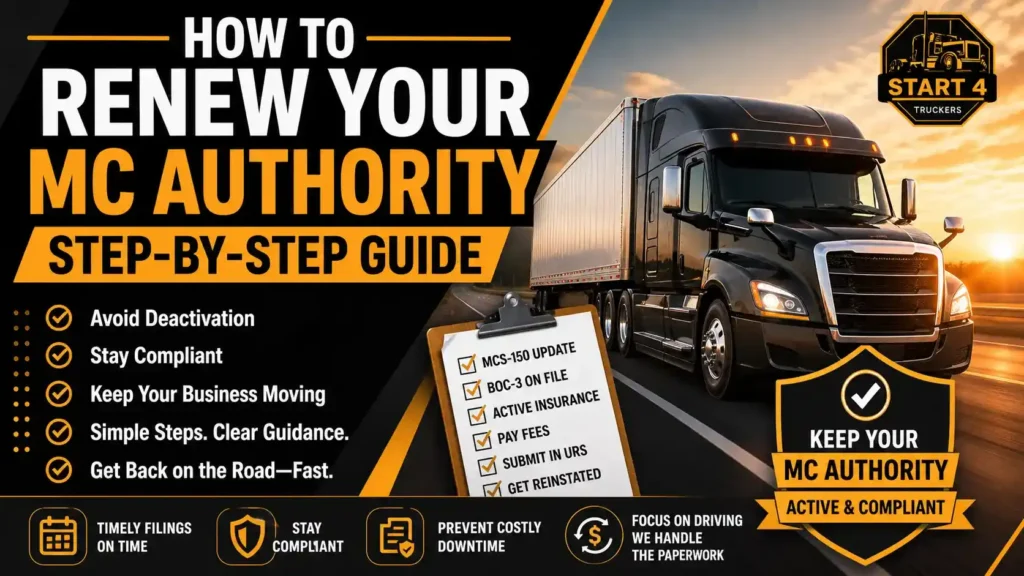
How to Renew Your MC Authority: Step-by-Step Guide

Losing your MC authority can shut down your trucking business overnight. One missed filing. One lapsed insurance policy. One overdue update. That’s all it takes. If you’re trying to renew your MC authority or worried your authority might get deactivated soon, this guide walks you through every single step. Simple language. Clear instructions. No confusion. Whether you’re a first-time carrier or a seasoned owner-operator, this is the only guide you need. Let’s get into it. What Is MC Authority Renewal? MC authority (Motor Carrier Authority) is the federal permission that allows you to haul freight across state lines for hire. It’s issued by the FMCSA (Federal Motor Carrier Safety Administration) and tied to your MC number. When your authority is active, you can legally operate as an interstate carrier. When it’s not, you can’t. MC authority renewal means restoring or maintaining that active status through the Unified Registration System (URS). It’s not always a simple annual renewal like a driver’s license. Sometimes it’s a reinstatement. Sometimes it’s a compliance update. Knowing the difference saves you time and money. If you’re just getting started or need a full breakdown of registrations, the USDOT and MC Authority Registration Services page is a solid place to begin. Do You Actually Need to Renew MC Authority? Here’s something that confuses a lot of carriers: MC authority is not automatically renewed every year. It’s technically a one-time grant, but it can be deactivated due to non-compliance. When that happens, you need to go through a reinstatement process, which feels a lot like renewal but has different steps. Here’s a quick comparison: Situation What You Need Authority is active, never lapses MCS-150 biennial update only Authority was deactivated Full reinstatement + filings Insurance lapsed and was restored Refile BMC-91 or BMC-32 BOC-3 was missing Refile process agent form The MCS-150 update is required every two years based on your USDOT number’s last two digits. Missing it is one of the top reasons the FMCSA authority gets deactivated. Want to understand the difference between your DOT and MC numbers? Read this: DOT Number vs MC Number: What’s the Difference? Signs Your MC Authority Needs Renewal Don’t wait for a shutdown notice. Watch for these warning signs: Your MC number status shows “Revoked” or “Inactive” in the URS portal Your insurance provider sends a cancellation notice to FMCSA You missed your MCS-150 filing deadline You receive a compliance enforcement letter from FMCSA Your BOC-3 process agent filing has expired or is missing The FMCSA website shows your carrier operating status as inactive You can check your status anytime using the US DOT Number Lookup tool. Check it regularly, not just when something feels wrong. Why FMCSA Deactivates MC Authority The FMCSA doesn’t deactivate authority randomly. There are clear triggers: Insurance cancellation: If your BMC-91 or BMC-32 filing lapses, FMCSA revokes authority automatically Late or missed MCS-150 update: Required every 24 months; skipping it causes deactivation Missing BOC-3: Every carrier needs a registered process agent on file Unpaid FMCSA fees: Outstanding fees can freeze your registration Safety violations: Serious safety compliance failures can lead to suspension Outdated or incorrect compliance documents: Wrong addresses, wrong ownership info, stale filings The good news? Most of these are fixable. The sooner you act, the faster you’re back on the road. Start4Truckers LLC specializes in fixing suspended MC authority fast. Their compliance team handles the paperwork so you don’t lose operating days. Step-by-Step Guide: How to Renew Your MC Authority Step 1: Check Your MC Number Status in URS Go to the FMCSA’s Unified Registration System (URS) portal and look up your MC number. Your status will show as one of these: Active: you’re good Inactive: Deactivated, needs reinstatement Revoked: Serious violation; full reinstatement required Pending: Application in process Know your status before doing anything else. This determines your exact path forward. Step 2: Update Your MCS-150 Before Renewal The MCS-150 is your motor carrier identification form. It must be updated every two years based on your USDOT number. If it’s overdue, update it first. Trying to renew without a current MCS-150 will cause delays or rejections. Filing it is straightforward on the FMCSA website. Or you can use the MCS-150 Filing Registration Form to have it handled professionally. Step 3: File or Refile Your BOC-3 (Process Agent Requirement) Every motor carrier operating interstate must have a BOC-3 process agent on file. This designates a legal representative in each state you operate in. If your BOC-3 is missing or expired, your authority won’t be restored. Need it filed now? The BOC-3 Filing Service gets it done quickly. Step 4: Ensure Insurance Filings Are Active This is the most common reason the MC authority gets revoked. You must have active filings on record with FMCSA: BMC-91: Primary liability insurance BMC-32: Cargo insurance (if applicable) Your insurance provider files these directly with FMCSA. If coverage lapses even for a day, FMCSA can deactivate your authority immediately. Call your insurer. Confirm the filings are current. Get written confirmation. Step 5: Pay FMCSA Reinstatement or Renewal Fees Some reinstatements require fees. Here’s a general breakdown: Fee Type Estimated Cost FMCSA reinstatement fee $80–$300+ depending on violation BOC-3 filing $30–$75 (varies by provider) Insurance filings Varies by carrier Compliance service (optional) Contact Start4Truckers LLC Pay promptly. Unpaid fees will stall your renewal. Step 6: Submit Renewal Through the FMCSA URS Portal Once all filings are current and fees are paid, submit your renewal or reinstatement application through the official FMCSA URS portal. If you want someone else to handle the full submission, the MC Authority Registration Form lets you do exactly that. Step 7: Wait for FMCSA Review and Activation After submission, FMCSA reviews your application. Standard processing time is 4–6 weeks for a new authority. Reinstatements can be faster, sometimes 10–20 business days, if all documents are complete. Delays happen when: Insurance filings aren’t confirmed BOC-3 is still pending There are errors in your application Monitor your status regularly during this period. How Long Does MC

What Is BOC-3 Filing and Why It’s Required for Trucks
Blog

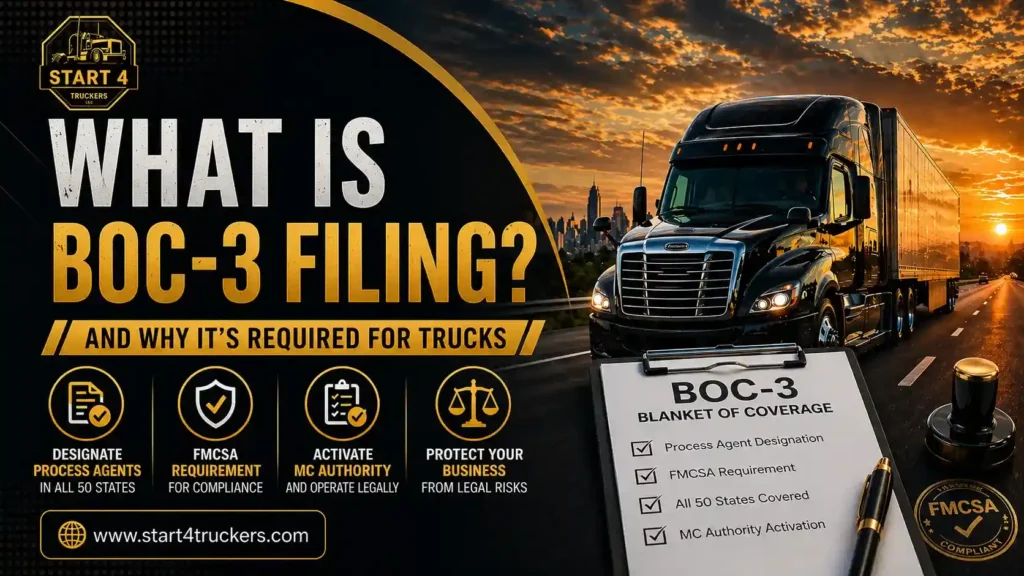
What Is BOC-3 Filing and Why It’s Required for Trucks

Starting a trucking business comes with a lot of paperwork. One of the most important forms you’ll hear about is the BOC-3 filing. But what is BOC-3 filing, exactly? And why does the FMCSA require it? Simply put, a BOC-3 is a federal form that assigns a process agent to represent your trucking company in every U.S. state. Without it, your MC authority will never activate and you can’t legally haul freight across state lines. Whether you’re a new carrier, a freight broker, or an owner-operator, this guide will walk you through everything you need to know. At Start4Truckers LLC, we help trucking businesses file their BOC-3 fast and get their authority activated without the confusion. Let’s break it all down. What Is BOC-3 Filing? BOC-3 stands for Blanket of Coverage. It’s an official FMCSA form used to designate process agents across all 50 states. A process agent is a person or company authorized to receive legal documents on your behalf in each state. This includes court papers, lawsuits, and official government notices. The designation of process agents is a legal requirement under federal transportation regulations. The FMCSA wants every carrier to have a local point of contact in every state so that if something legal happens, there’s always someone who can be reached. Think of it this way: if your trucking company is registered in Texas but you haul freight to New York, the FMCSA needs to know who receives legal papers in New York on your behalf. That’s what your process agent does. What Does a BOC-3 Form Include? The form includes: Your company’s legal name and address Your USDOT number and MC number A complete list of all 50 states The name and contact of your designated process agent in each state Certification by an authorized blanket agent Most trucking companies use a blanket agent one company that covers all states under a single filing. This is faster, cheaper, and easier than hiring individual agents for each state. Why BOC-3 Filing Is Required for Trucks The FMCSA requires this filing because interstate trucking operations cross multiple state lines. Each state has its own legal system. If a lawsuit is filed against your company in a state where you don’t have a local representative, the legal process breaks down. That’s why FMCSA compliance requirements include having a process agent in every state you operate in or may operate in. Here’s the key point: you cannot activate your MC authority without a BOC-3 on file. It’s one of the final steps in the MC authority registration process. This requirement applies nationwide. It doesn’t matter if you’re in Florida, California, or anywhere in between all motor carriers operating in interstate commerce must file a BOC-3. Who Needs to File a BOC-3? Motor Carriers If you’re applying for operating authority for trucking, you need a BOC-3. This includes: New carriers applying for an MC number Interstate carriers hauling goods across state lines Anyone going through trucking company setup If you’re just getting started, check out this full guide on how to start a trucking company before diving into filings. Freight Brokers and Freight Forwarders Freight brokers and freight forwarders also need a BOC-3. However, unlike carriers, they are allowed to file the form themselves without using a blanket agent as long as they have someone who qualifies in each state. That said, most brokers still prefer using a professional service to avoid errors. Owner-Operators If you’re an independent owner-operator with your own MC authority, you must file a BOC-3. If you’re leased to a carrier and operating under their authority, you typically don’t need one. Not sure which setup is right for you? Read our comparison on owner-operator vs company driver and how to become an owner-operator truck driver. What Does a BOC-3 Process Agent Do? A BOC-3 process agent plays a quiet but critical role in your trucking business. Here’s what they do: Receive legal notices sent to your company in their state Accept court documents if your company is involved in a lawsuit Handle FMCSA correspondence when needed Protect your business during any legal action by ensuring proper service of process You don’t interact with your process agent day-to-day. But if something legal happens, they step in immediately. This is why service of process is so important under federal transportation regulations. Without a valid agent on file, a court could claim your company was never properly served creating major legal problems. BOC-3 Filing Requirements Here are the core FMCSA compliance requirements for the BOC-3: Requirement Details Who must file Motor carriers, brokers, freight forwarders Who can file Authorized blanket agents only (for carriers) When to file Before MC authority activates Coverage All 50 U.S. states Filing frequency One-time (not annual) Must be kept at Principal place of business The form must be submitted by an authorized blanket agent for motor carriers. This is a company or individual approved by the FMCSA to handle these filings on your behalf. You can learn more about your DOT number vs MC number requirements to understand how BOC-3 fits into the bigger picture. How To File BOC-3: Step-by-Step Guide Filing a BOC-3 is straightforward when you follow the right steps. Step 1: Choose an FMCSA-Authorized Process Agent Look for a company with a nationwide network of process agents in all 50 states. Make sure they are authorized to file with the FMCSA through the Unified Registration System. Ready to skip the search? File your BOC-3 with a trusted authorized agent and get your coverage set up fast all 50 states, no hassle.  Step 2: Provide Your Company Information You’ll need to share: Legal business name Principal business address USDOT number MC number (if already issued) Type of operation (carrier, broker, forwarder) If you don’t have a DOT number yet, here’s how to get a DOT number in Florida as an example. You can also use the US DOT number lookup to verify your current registration status. Step 3: Agent Files BOC-3 With

Owner Operator vs Company Driver Which one Is Better
Blog

Owner Operator vs Company Driver Which one Is Better

Choosing between being an owner-operator or a company driver is one of the biggest decisions in a trucking career. Both paths offer real opportunities, but they come with very different lifestyles, income levels, and responsibilities. Some drivers want freedom of choice and high earning potential. Others prefer job stability and a steady paycheck without the stress of running a business. Understanding the difference can save you years of frustration and thousands of dollars.  In this blog post, you will know everything in simple, honest terms so you can pick the right path for your goals. Owner Operator vs Company Driver at a Glance Feature Owner Operator Company Driver Average Annual Income $150,000–$250,000 gross $55,000–$80,000 Net Profit (After Expenses) $50,000–$100,000+ $55,000–$80,000 (stable) Startup Costs $10,000–$30,000+ $0 Risk Level High Low Truck Ownership Yes (yours or leased) No (company’s) Schedule Flexibility High Low Home Time Variable More predictable Benefits (Health, 401k) Self-funded Employer-provided Maintenance Responsibility Driver pays Company pays This table tells a clear story: Owner operators earn more but carry higher financial risk and operational costs, while company drivers enjoy job stability, employer-paid maintenance, and predictable home time. Not sure where to start? Explore our Plans & Pricing and find the right setup for your trucking goals. What Is an Owner Operator? An owner-operator is a truck driver who owns or leases their own semi-truck and runs it as a business. Instead of working for a company, they work for themselves. They find their own freight, manage their own operational costs, and handle everything from equipment ownership to taxes. Think of it like owning a pizza delivery car instead of driving for someone else’s restaurant. You keep more of the money, but you also pay for the gas, repairs, and insurance yourself. Owner operators deal with: Trucking authority (MC number from FMCSA) Owner operator insurance (cargo, liability, physical damage) Fuel expenses and maintenance cost Relationships with freight brokers and shippers ELD (Electronic Logging Device) compliance under DOT regulations Many start through lease-purchase programs, which let drivers lease a truck with the option to own it, though these come with their own risks and fine print worth reading carefully. Thinking about becoming an owner-operator? Our Trucking Company Setup Services handle the hard parts authority, DOT number, and compliance so you can focus on the road.  How Owner Operators Actually Work Getting started as an owner-operator takes planning. Here’s a simple step-by-step picture: Get your CDL (Commercial Driver’s License): The foundation of any trucking career Register your business: Here’s a helpful comparison of LLC or sole proprietor  Get your USDOT number: Required by the FMCSA for interstate hauling Apply for your MC authority: Understand the difference between DOT and MC numbers Get insurance: Non-negotiable before hauling a single load Find freight: Through load boards like DAT or Truckstop, direct carrier contracts, or freight brokers Contract obligations and workload flexibility look completely different once you’re running your own truck. You choose when you work and what loads you take but you also eat what you kill. If you want to set yourself up for success from day one, check out our Plans & Pricing and pick the package that fits your goals. How Much Do Owner Operators Make? Let’s talk real numbers. According to the FMCSA and industry data, owner operators gross between $150,000 and $250,000 per year. But gross income is not take-home pay. Typical Annual Expenses for an Owner Operator: Expense Estimated Annual Cost Fuel Cost $50,000–$70,000 Truck Loan Payments $20,000–$30,000 Insurance Rates $10,000–$18,000 Maintenance Cost $15,000–$25,000 Operating Expenses (permits, tolls, ELD, etc.) $5,000–$10,000 Total Expenses $100,000–$153,000 So on $200,000 gross, a well-managed owner operator might net $60,000–$100,000 after expenses. That’s solid, but it requires discipline and smart decision-making. The good news? Owner operators enjoy significant tax deductions for fuel, repairs, depreciation, and even part of your phone bill can reduce your taxable income. The IRS self-employment tax guide is worth bookmarking. Owner Operator Pros Full independence you’re your own boss Load selection skip loads that don’t pay well High earning potential no income ceiling Tax deductions on business expenses Schedule flexibility work when you want Ability to grow into a fleet and hire other drivers One real example: Mike, an OTR driver from Texas, spent 5 years as a company driver, saved money, bought his own truck, and now nets $85,000/year while working 3 weeks on, 1 week off. He chooses his own loads and refuses cheap freight. That’s the upside of business ownership done right. Owner Operator Cons Let’s be honest, it’s not all freedom and big checks. Very high startup cost, easily $15,000–$30,000 out of pocket Financial risk, slow freight weeks still mean truck payments Business management stress, invoicing, IFTA taxes, compliance Maintenance responsibility for a blown engine can cost $20,000+ Unstable freight rate markets shift, sometimes badly Compliance with FMCSA rules requires ongoing attention Authority setup, compliance requirements, and paperwork aren’t for everyone. Many drivers burn out in year one because they weren’t ready for the business side. What Is a Company Driver? A company driver is a professional CDL holder who drives a truck owned by their employer. The company handles the truck, the fuel card, the insurance, and most of the paperwork. The driver just shows up, picks up the load, and delivers it. It’s the most common entry point into OTR trucking and local trucking jobs. For millions of drivers, it’s also a long-term career choice, not just a stepping stone. How Company Drivers Work A typical day for a company driver looks like this: The dispatcher assigns a load (the driver has limited say) Pre-trip inspection on the company’s truck Haul the load, log hours via ELD Return or pick up the next load per dispatch Weekly paycheck, no invoicing, no broker calls There’s a certain peace in this structure. The driver lifestyle differences between company and owner-operator life are massive. Company drivers trade income ceiling for job stability, and many are totally fine with that trade. How Much Do Company Drivers Make?

DOT Number vs MC Number
Blog

DOT Number vs MC Number: Key Differences Explained

If you’re starting a trucking business, two terms will appear almost immediately: DOT Number vs MC Number. Many new carriers assume they mean the same thing, but they don’t. These are two separate federal requirements with different purposes, and confusing them can lead to fines, delays, or even having your truck placed out of service. Whether you’re a first-time owner-operator, a hotshot hauler, or building a full trucking fleet, understanding which number you need is the first step toward staying legal and compliant.  This blog post explains everything in clear, simple language so you can move forward with confidence. What Is a DOT Number? (USDOT Explained) A USDOT number is a unique identifier assigned by the Federal Motor Carrier Safety Administration to commercial motor vehicle operators. It was created to help the government monitor carrier safety records, run compliance reviews, and track accident histories. Every time your truck goes through a roadside inspection, the officer pulls up your DOT number to check your safety profile in the Safety Measurement System (SMS). It’s basically your trucking business’s fingerprint in the federal system. Who Needs a DOT Number? Not every driver needs one, but the list is longer than most people think. You need a DOT number if you operate a commercial motor vehicle (CMV) that: Weighs over 10,001 lbs (gross vehicle weight rating) Transports 16 or more passengers (including the driver) for compensation Transports 9 or more passengers in interstate commerce for hire Carries hazardous materials that require placarding Crosses state lines in any commercial capacity Even if you only drive locally, many states, such as Florida, Texas, and California, require a DOT number for intrastate operations. If you’re figuring out how to get a DOT number in Florida, state-specific rules matter a lot. Also, if you’re a new entrant carrier, you’ll automatically enter the New Entrant Safety Assurance Program, which means you’re under extra safety monitoring for your first 12–18 months. This is another reason getting your DOT right from day one is so important. What DOT Numbers Are Used For Your DOT number works behind the scenes in more ways than one: Roadside inspections: Officers verify your safety standing instantly Safety audits: FMCSA uses them to schedule compliance reviews Carrier identification: Shippers and brokers verify you through it Public safety record tracking: Anyone can look up your record using a US DOT number lookup Crash and violation history: All recorded under your DOT number How to Apply for a DOT Number (Step-by-Step) Applying is easier than most people think. Here’s what you do: Go to the FMCSA Unified Registration System (URS) at safer.fmcsa.dot.gov Create an account and start a new application Enter your business legal name, EIN, and business structure Select your operation type (carrier, broker, freight forwarder, etc.) Describe your commercial vehicle operations Submit your DOT number, which is assigned almost instantly Common mistakes to avoid: entering the wrong business name, selecting the wrong operation type, or skipping the intrastate/interstate question. How Long Does It Take and How Much Does It Cost Cost: Completely free Time: Assigned almost instantly through the URS portal Activation: Your DOT number becomes active right away, but you still need to complete your MCS-150 biennial update every two years to keep it active What Is an MC Number? (Motor Carrier Authority Explained) An MC number stands for Motor Carrier number. It’s your operating authority the official permission from the FMCSA to carry freight or passengers across state lines for compensation. Without it, you’re legally not allowed to haul for-hire loads in interstate trucking. Think of it this way: your DOT number tells the government who you are. Your MC number tells them what you’re allowed to do. Who Needs an MC Number? You need an MC number if you are: A for-hire carrier moving freight across state lines A freight broker arranging loads for others A carrier hauling regulated commodities like electronics, furniture, or clothing A passenger carrier operating across state lines for hire You do NOT need an MC number if you: Only haul your own goods (private carrier) Transport exempt commodities like unprocessed agricultural products Operate strictly within one state (intrastate only) What MC Numbers Are Used For Your MC number does several important things: Grants you legal operating authority in interstate commerce Ties to your insurance filings with the FMCSA Links to your BOC-3 (blanket of coverage) process agent filing Allows shippers and brokers to verify your authority status Tracks your licensing and registration under federal regulations How to Apply for an MC Number (Step-by-Step) Getting your MC number takes more steps than a DOT number: Log into the FMCSA Unified Registration System (URS) Apply for operating authority (select the right type carrier, broker, etc.) Pay the $300 filing fee File your BOC-3 (designates process agents in each state) Submit proof of insurance meeting FMCSA minimums: $750,000 for general freight $1,000,000+ for hazardous materials Wait through the 20–25 business-day protest period FMCSA approves your authority, and you become active Every step here matters, and one missing document can delay your activation by weeks. Want it done right the first time? Let Start4Truckers LLC handle your MC authority from application to activation, we manage the entire process so you can focus on driving.  Cost and Activation Time Cost: $300 per authority type (more if applying for multiple) Processing time: 20–25 business days after all documents are submitted Insurance must be on file before your authority activates During the protest period, other carriers can challenge your application. This is rare, but it does happen DOT Number vs MC Number: Side-by-Side Comparison This is where most blogs fall short. Let’s go deep. Requirement DOT Number MC Number Who issues it FMCSA FMCSA Primary purpose Safety compliance & tracking Legal operating authority Who needs it Most CMV operators Interstate for-hire carriers Cost Free $300 per authority type Applies to intrastate Yes (many states) No Applies to interstate Yes Yes (for-hire only) Insurance required No Yes BOC-3 filing needed No Yes Protest period No Yes

How to Become an Owner-Operator Truck Driver
Blog

How to Become an Owner-Operator Truck Driver: The Complete Step-by-Step Guide

Every year, thousands of company drivers make the same decision: stop building someone else’s business and start building their own. Becoming an owner-operator truck driver is one of the most direct paths to financial independence in American trucking, but it is not a simple step. It is a full business launch, and it demands that you treat it like one. In this blog, we will guide you through every stage from earning your CDL to getting your DOT number, forming your LLC, securing commercial truck insurance, and pulling your first load under your own trucking authority. No fluff. No skipped steps. What Is an Owner Operator, Exactly? An owner-operator is a truck driver who owns or leases their own commercial motor vehicle and operates as an independent business. You are not an employee. You are a motor carrier. That distinction matters legally, financially, and operationally. As an owner operator, you decide what freight you haul, what lanes you run, and what rates you accept. You are also responsible for every compliance regulation, expense, and tax filing that comes with running a trucking business. The upside is real: owner operators who run efficiently can earn significantly more per mile than company drivers. The accountability is just as real. There are two ways to operate as an owner-operator: Leased to a carrier: You haul under a larger motor carrier’s authority. The carrier provides some insurance coverage and often gives you freight. You have less paperwork but also less freedom. Under your own authority: You apply for your own USDOT number and operating authority through the Federal Motor Carrier Safety Administration (FMCSA). You find your own loads, carry your own insurance, and answer to no carrier. More responsibility, more control. Most new owner operators start leased to a carrier and move to their own authority once they have cash reserves and experience. This guide covers the full path to your own authority because that is where most people want to end up. Step 1: Get Your CDL (If You Don’t Have One Already) You cannot operate a commercial motor vehicle without a Commercial Driver’s License (CDL). This is the foundation. Without it, nothing else in this guide applies. Requirements to get a CDL: Be at least 21 years old to drive interstate commerce (across state lines) Be at least 18 years old for intrastate operations (within your home state only) Hold a valid standard driver’s license Pass a DOT physical examination Pass a drug test through the FMCSA Drug and Alcohol Clearinghouse Pass the CDL written knowledge tests and skills exam A Class A CDL is what most owner operators need. It lets you operate any combination of vehicles with a gross combined weight rating (GVWR) over 26,001 pounds, where the towed unit exceeds 10,000 pounds, the standard setup for long-haul and regional freight. CDL training programs at community colleges and commercial driving schools typically run four to eight weeks for full-time courses. Costs vary but generally fall between $3,000 and $10,000. Some carriers offer sponsored CDL training in exchange for a contract period as a company driver, which can reduce or eliminate upfront costs. Step 2: Gain Real Road Experience Before Going Independent Getting your CDL is the license to learn, not the license to run your own business. Most successful owner operators spend one to three years driving for a company before going independent. That time is not wasted. It is an investment. Working as a company driver teaches you: How freight movement works across the country How to manage hours of service and stay compliant with ELD requirements How to read load boards, communicate with brokers, and negotiate rates How to handle breakdowns, weather, and the unexpected without losing freight or a customer What routes are profitable, and which ones eat your margins There is also a practical financial reason to wait. Insurance companies look at CDL experience when setting your premiums. Many carriers will not write a policy for owner operators with less than two years of experience, and those that do charge significantly higher rates. New authority owner operators routinely pay $14,000 to $22,000 per year for primary liability and cargo insurance alone. Rates drop as your experience record grows. Run at least one year as a company driver before seriously planning your launch. Two years is better. Step 3: Write a Business Plan and Know Your Numbers Most guides skip this step. It is not optional. It is the difference between owner operators who survive their first year and those who do not. Before you spend a dollar on filings or equipment, you need to know: Your startup costs LLC formation: $50–$800 (varies by state) FMCSA operating authority (MC number) filing fee: $300 BOC-3 process agent filing: $30–$50 Commercial truck insurance: $14,000–$22,000 per year IRP registration: Around $1,500 per year IFTA permits: Cost varies by state Equipment costs: Used truck (3–7 years old): $80,000–$150,000 Your operating costs Fuel is your largest variable expense, often consuming 25 to 35 percent of gross revenue. Add maintenance, truck payment, insurance, permits, and living expenses. Experienced owner operators often say you need at least $15,000 to $20,000 in working capital reserves before your first load. Your break-even rate per mile Know what you need to earn per loaded mile just to cover your costs. If you don’t know this number, you will take loads that lose money without realizing it until it is too late. Not sure how to structure your business before you even apply? Explore how to start a trucking company, which lays out the full foundation. Step 4: Form Your Business Entity (LLC Recommended) Before you file anything with the FMCSA, form your business entity. Most owner operators choose a Limited Liability Company (LLC) because it separates your personal assets from your business liabilities. If your truck is involved in an accident and a lawsuit follows, an LLC means your house, savings, and personal property have legal protection that a sole proprietorship does not provide. How to

How to Get a DOT Number in Florida
Blog

How to Get a DOT Number in Florida: Step-by-Step Guide

Starting a trucking business in Florida is exciting, but before your wheels hit the road, you must get your USDOT number. Whether you’re operating within Florida or crossing state lines, this number is required to run legally. Without it, you risk fines, delays, or even shutdowns that can stop your business before it begins.  The Federal Motor Carrier Safety Administration (FMCSA) issues this number to track safety and compliance for commercial carriers. It’s a critical step every new trucker must complete to operate smoothly. Florida also has additional rules enforced by the Florida Department of Highway Safety and Motor Vehicles, even for intrastate carriers.  In this blog post, you will know everything about Florida DOT number requirements, from who needs one to how to apply, what it costs, and how to stay compliant. Let’s get into it. What Is a DOT Number? A DOT number, officially called a USDOT number, is a unique identification number issued by the FMCSA. Think of it like a Social Security number for your trucking business. It lets the government track your safety records, inspections, crash reports, and audit history. Once you’re registered, your USDOT number stays connected to your company forever. Every time your truck gets inspected at a weigh station, or every time you’re part of an accident investigation, that number tells regulators who you are and how safely you’ve been operating. Here’s what your DOT number is linked to: Safety audit history: Your roadside inspection results Compliance reviews: Whether your fleet meets federal safety standards Crash records: Reported accidents tied to your operation Insurance filings: Proof that you’re properly covered For Florida carriers, this number is required for both interstate commerce (crossing state lines) and many types of intrastate operations (staying entirely within Florida). Who Needs a DOT Number in Florida? Not every truck on the road needs a DOT number, but more businesses qualify than you might think. Florida follows both FMCSA federal rules and its own state-level requirements. Here’s a breakdown: Florida Intrastate DOT Number Requirements Even if you never leave Florida, you may still need a Florida intrastate DOT number. Under Florida law, you’re required to register if your commercial operation fits any of these categories: Vehicles with a Gross Vehicle Weight Rating (GVWR) of 10,001 lbs or more Commercial vehicles transporting property for business purposes Passenger carriers with 8 or more passengers for compensation, or 15+ passengers without compensation Vehicles transporting hazardous materials that require placards under federal law Real example: If you run a box truck inside Florida for a local delivery company and your vehicle weighs over 10,001 lbs, you need a DOT number even if you never cross the Florida state line. Florida Interstate DOT Requirements If your logistics operations cross state lines, say, hauling freight from Miami to Atlanta, you’re in interstate commerce territory. The FMCSA Unified Registration System (URS) requires all interstate motor carriers to have a USDOT number, no exceptions. Real example: A flatbed company based in Tampa that picks up cargo in Orlando and delivers to Alabama must register under FMCSA’s interstate rules and obtain a USDOT number before their very first trip. Do You Need an MC Number Too? (DOT vs MC Number Explained) This is one of the most common questions from new Florida truckers. The short answer: a DOT number and an MC number are not the same thing, and some carriers need both. Feature DOT Number MC Number Issued by FMCSA FMCSA Purpose Safety & identity tracking Operating authority for hire Who needs it Most commercial carriers For-hire interstate carriers Cost Free ~$300 filing fee Required for intrastate? Often yes (FL-specific) No Required for interstate for-hire? Yes Yes If you’re hauling freight for other people across state lines and getting paid for it, you need a motor carrier authority, which is your MC number. If you’re an owner-operator running your own goods intrastate, you likely only need the DOT number. Check out our USDOT & MC registration services to get expert guidance on which one applies to you. Documents & Information You Need Before Applying Before you sit down to fill out the online application, gather the following. Having everything ready saves time and reduces errors. Business legal name and contact information EIN (Employer Identification Number) or SSN if you’re a sole proprietor Business structure: LLC, sole proprietor, corporation, etc. Vehicle details, including GVWR and the number of trucks Type of operation: interstate or intrastate Cargo type: general freight, hazardous materials, passengers, etc. Principal place of business address Insurance information (required for activation) Not sure whether to set up an LLC or go as a sole proprietor? Read our complete guide on LLC vs sole proprietor for trucking before you apply your business structure directly affects your registration. How to Get a DOT Number in Florida (Step-by-Step Process) Here’s exactly how to get your USDOT number in Florida. Follow these steps to avoid delays or rejections. Step 1: Determine Whether Your Business Qualifies Ask yourself: Does my vehicle weigh over 10,001 lbs? Do I transport goods or people commercially? Do I cross state lines? If you answered yes to any of these, you very likely need a DOT number. And yes, owner-operators need a DOT number in Florida if they operate a qualifying vehicle. You can also apply even if you don’t own a truck yet. The DOT number is assigned to your business entity, not the vehicle itself. Step 2: Register Online via the FMCSA URS Portal Head to the FMCSA Unified Registration System portal at fmcsa.dot.gov. Create an account using your business email and name. You’ll select your entity type (LLC, corporation, sole proprietor) and enter your EIN or SSN. This is the official federal portal. Be careful of third-party sites that charge fees just to submit the application. The basic USDOT number Florida application is completely free. Step 3: Complete the MCS-150 Form The MCS-150 form filing is the Motor Carrier Identification Report. It collects key information about your operation: Operation classification: Are you an intrastate

LLC vs Sole Proprietor for Trucking Why LLC Always Wins
Blog

LLC vs Sole Proprietor for Trucking: Why LLC Always Wins

Starting a trucking business is exciting, but one wrong decision at the beginning can cost you far more than you expect. Many new truckers jump into work without thinking about their business structure, and that mistake can lead to serious financial risk later. When it comes to LLC vs sole proprietor trucking, the difference isn’t just paperwork. It affects your liability, taxes, and how well your business can grow over time. In this blog post, you’ll learn the key differences in simple terms so you can choose the right structure and protect your future on the road. LLC vs Sole Proprietor Trucking  LLC vs sole proprietor trucking: An LLC is better for most truckers because it protects personal assets, reduces liability risk, and offers tax flexibility. A sole proprietorship is easier to start, but it exposes you to full personal risk. What Is a Sole Proprietor in Trucking? A sole proprietor trucking business is the most basic setup. When you drive under your own name with no formal business registered, you are automatically a sole proprietor. You don’t need to fill out forms. You don’t need to pay registration fees. You just start working. Sounds easy, right? It is at first. But here’s the problem: the law sees you and your business as the same person. That means if your truck causes an accident, someone sues your business, or you owe money to a freight broker, they can come after your personal bank account, your home, your car, everything. Many new drivers start here because it feels simple. But simple doesn’t always mean safe. What Is an LLC for Truckers? An LLC (Limited Liability Company) for owner-operator trucking is a real, registered business. You form it through your state, and it creates a legal wall between you and your business. Think of it like this: If your trucking business is an LLC and something goes wrong, the lawsuit stays inside the business. Your personal savings, your house, and your family’s money stay protected. This is called personal asset protection in trucking, and it’s the #1 reason most experienced drivers choose an LLC. LLC vs Sole Proprietor Trucking: Full Comparison Table Factor LLC Sole Proprietor Liability Protection Strong personal assets protected None, you’re fully exposed Taxes Flexible can choose S-Corp status Simple, but full self-employment tax Setup Cost $50–$800 (state fees) $0 Setup Difficulty Moderate Very easy Broker Credibility Higher looks more professional Lower trust Growth Potential Excellent, easy to scale Limited EIN Required Yes Optional (can use SSN) Business Bank Account Recommended/required Optional DOT/MC Registration Works with both Works with both As you can see, the LLC wins in almost every category that actually matters when you’re building a real trucking career. Key Differences Truckers Must Know Liability Protection for Truckers This is the big one. In trucking, accidents happen. It’s not always your fault, but when someone’s injured or property is damaged, lawyers go after whoever has money. Real example: In 2022, a solo owner-operator in Ohio was sued for $1.2 million after a rear-end accident. He was a sole proprietor. He lost his home, his truck, and had to file for bankruptcy. If he had an LLC, his personal home would have been safe. An LLC creates what lawyers call a “corporate veil,” a legal barrier that stops lawsuits from bleeding into your personal life. This is the #1 reason to form an LLC for owner-operator trucking. Tax Differences: LLC vs Sole Proprietor Trucking Both structures require you to pay self-employment tax in trucking, which is about 15.3% on top of your income tax. But an LLC gives you an option a sole proprietor doesn’t: electing S-Corp status. With S-Corp status, you pay yourself a reasonable salary and take the rest as a distribution. You pay self-employment tax only on the salary portion, not the full amount. This can save a trucking LLC owner thousands of dollars every year. For example: If you earn $100,000 net as a sole proprietor, you pay self-employment tax on all $100,000. As an LLC with an S-Corp election, you pay yourself a $60,000 salary + a $40,000 distribution. You only pay self-employment tax on $60,000, saving roughly $6,000+ annually. That’s real money back in your pocket. Note: Talk to a licensed CPA before making tax elections. Every situation is different. Startup Cost and Setup Sole proprietor: $0. Just start working. LLC: $50–$500, depending on your state, plus a little paperwork. Some states, like Kentucky, charge as low as $40. Others, such as Massachusetts, charge $500. One-time cost for a lifetime of protection? That’s a no-brainer. Credibility with Brokers and Freight Companies Here’s something new truckers don’t always think about: broker trust. When you call a freight broker and say “ABC Trucking LLC,” it sounds professional. When you say “just me, John Smith,” brokers sometimes hesitate. They worry about reliability and long-term relationships. An LLC signals that you’re serious about your trucking business. It helps you win better freight contracts and build stronger relationships with shippers who prefer to work with registered business entities. Pros and Cons of LLC for Truckers Pros: Strong liability protection for truckers Potential tax savings with S-Corp election More credibility with brokers and lenders Easier to open a business bank account Better foundation for business growth Separates personal and business finances Cons: Small upfront registration cost Annual state fees in some states Slightly more paperwork (operating agreement, EIN, etc.) Need to keep business and personal finances separate Pros and Cons of Sole Proprietorship in Trucking Pros: Zero cost to start Simple setup, no paperwork Easy tax filing (Schedule C) Cons: Zero personal asset protection your biggest risk Full self-employment tax on all income Lower credibility with brokers Harder to get business loans or credit Can’t easily bring in partners or investors Why Most Truckers Choose an LLC Ask any experienced owner-operator who’s been in the business for 5+ years, and most will tell you the same thing: they wish they’d formed an LLC from day one. Here’s

How to Start a Trucking Company in the USA Complete Step-by-Step Guide
Blog

How to Start a Trucking Company in the USA: Complete Step-by-Step Guide

Most trucking companies fail not because of trucks, but because they start without understanding the system. The trucking industry moves America. Around 70% of all freight in the United States is transported by trucks, according to the American Trucking Associations. With over $940 billion in annual revenue, trucking is one of the biggest and most in-demand industries today. If you are searching for how to start a trucking company in the USA, you are entering a market with strong growth and long-term opportunity. However, starting a trucking business in the USA is not just about buying a truck. You need proper DOT registration, an MC authority from the FMCSA, licenses, permits, insurance, and a clear business plan. Startup costs can range from $10,000 to $100,000+, depending on your setup.  In this blog post, we will explain each step in simple terms so you can start your trucking business with confidence. What Is a Trucking Company? A trucking company is a business that transports goods from one place to another using commercial trucks. It sounds simple, but there are actually several types and picking the right one matters a lot when you’re just starting. Types of trucking businesses include: You also need to decide early on whether you want to run as an owner-operator (just you and your truck, doing everything yourself) or build a fleet business where you hire drivers and manage multiple trucks. Both have pros and cons, which we’ll cover later in this guide. Trucking Company Startup Requirements in the USA Before you can legally move a single load, there are some must-have requirements you need to check off. Here’s a quick checklist so you know what’s coming: Startup Requirements Checklist Requirement Description Commercial Driver’s License (CDL) Required if you plan to drive the truck yourself Business Registration Register as LLC, Corporation, or Sole Proprietorship EIN (IRS) Tax ID number issued by the Internal Revenue Service USDOT Number Issued by the Department of Transportation for tracking safety MC Number (Motor Carrier Authority) Required to haul freight across state lines Unified Carrier Registration (UCR) Annual registration for interstate carriers BOC-3 Filing Designates a legal process agent in each state Operating Authority Permission to operate as a trucking company Trucking Insurance Includes liability, cargo, and physical damage coverage IRP Registration Required for operating across multiple states IFTA Account Used for reporting and paying fuel taxes HVUT (Form 2290) Tax for vehicles over 55,000 lbs Step-by-Step Guide How to Start a Trucking Company in the USA Step 1 – Choose Your Business Structure The first decision you’ll make is how to legally structure your business. This affects your taxes, your personal liability, and how your company grows over time. Here’s a simple comparison: Business Structure Liability Protection Tax Filing Best For Sole Proprietor None (personal assets at risk) Personal tax return Very small, low-risk operations LLC Strong (personal assets protected) Pass-through or corporate Most new trucking businesses Corporation (S or C Corp) Strong Corporate tax return Larger fleets, investors Most trucking startups go with an LLC because it protects your personal assets (like your home and savings) if something goes wrong, and it’s simpler to manage than a corporation. Check out the trucking company LLC formation options to understand exactly what’s involved. Step 2 – Register Your Trucking Business Once you’ve picked your structure, it’s time to make it official. This step usually takes 2–5 business days. Step 3 – Get Your DOT Number and MC Authority This is one of the most important steps. Without these, you can’t legally haul freight across state lines. You can get help with USDOT and MC authority registration to make sure everything is filed the first time correctly. Step 4 – Get Required Trucking Insurance No insurance = no business. The FMCSA requires proof of insurance before activating your operating authority. Here’s what you’ll typically need: Get quotes from multiple commercial truck insurance providers to compare rates. Insurance is typically one of the highest ongoing costs in the trucking business. Step 5 – Purchase or Lease Your Equipment You need a truck. Now comes the big question: buy or lease? Factor Buying Leasing Upfront Cost High ($15,000–$150,000+) Low (little to no down payment) Monthly Payment None (if paid off) Fixed monthly payment Ownership You own the asset The leasing company owns it Maintenance Your responsibility Sometimes included Flexibility Less flexible More flexible Best for Experienced operators with capital New operators with limited cash For brand-new owner-operators, leasing is often the smarter move to keep startup costs down. As you grow, you can buy your own trucks. Step 6 – Hire Drivers or Operate Solo If you’re driving yourself, make sure your CDL (Commercial Driver’s License) is current and matches the type of vehicle you’re operating (Class A CDL for most semi-trucks). If you’re hiring drivers: Starting solo as an owner-operator keeps things simple while you learn the business. Many successful fleet owners started with just one truck. Step 7 – Start Finding Loads Now that you’re set up, you need freight to haul. Here’s how new trucking companies find loads: Cost to Start a Trucking Company in the USA Let’s talk real numbers. Here’s a trucking startup cost breakdown so you know what to expect: Expense Category Estimated Cost Truck Purchase (used) $15,000 – $80,000 Truck Lease (monthly) $800 – $2,500/month Trailer (if needed) $5,000 – $40,000 Primary Liability Insurance $8,000 – $18,000/year Cargo Insurance $1,000 – $3,000/year FMCSA MC Authority Filing $300 BOC-3 Filing $30 – $50 UCR Registration $59 – $500+ (based on fleet size) IFTA/IRP Registration $100 – $500 Business Formation (LLC) $50 – $500 (varies by state) EIN Registration Free DOT Number Free Fuel (first month) $2,000 – $6,000 Drug Testing Program Setup $200 – $500 Load Board Subscription $35 – $150/month Miscellaneous (repairs, tolls) $1,000 – $3,000 TOTAL ESTIMATED STARTUP $10,000 – $100,000+ Starting with one truck on a lease-to-own or leasing model significantly cuts upfront costs. Many owner-operators launch for under $15,000 if they already have a

US DOT Number Lookup The Complete 2026 Guide to Finding, Searching, and Verifying Any Carrier
Blog

US DOT Number Lookup: The Complete 2026 Guide to Finding, Searching, and Verifying Any Carrier

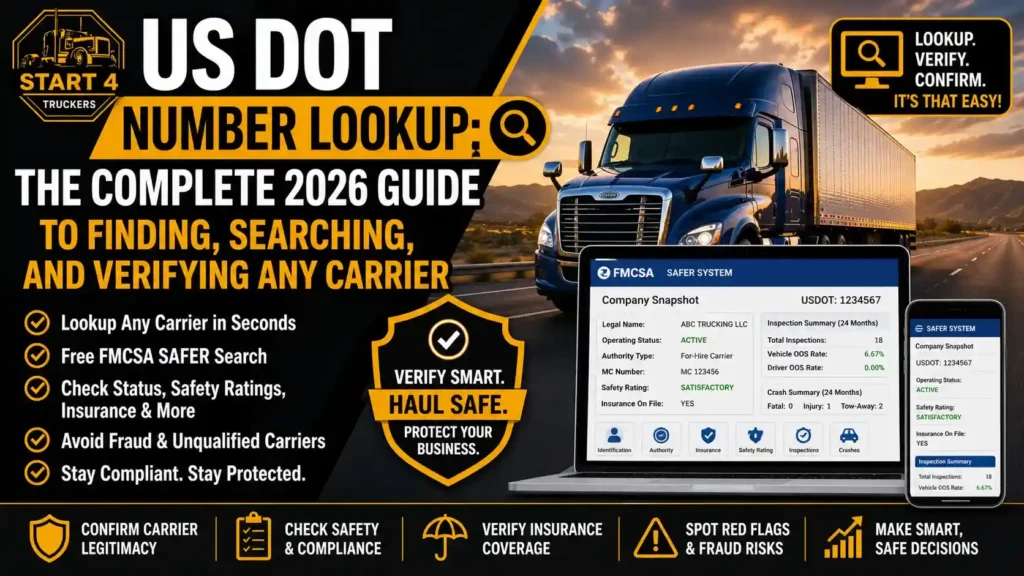
Whether you are a carrier who needs to verify your own DOT status before a roadside inspection, a freight broker running due diligence on a new partner, or a consumer checking if a moving company is legitimate you need a US DOT number lookup. The process takes less than two minutes and costs nothing. But most people stop at finding the number. They do not know what the results actually mean, what to do when something looks wrong, or how to use that information to protect their business. This guide covers everything from scratch. You will learn how to run the search, how to read every field in the results, what red flags to watch for, how to handle an inactive or out-of-service status, and what tools go beyond the free FMCSA lookup when you need more. What Is a USDOT Number? A USDOT number also written as a USDOT number or just DOT number is a unique identification number assigned by the Federal Motor Carrier Safety Administration (FMCSA) to commercial motor carriers operating in the United States. It functions as your company’s official fingerprint in the federal transportation system. The FMCSA uses it to track everything connected to your operation: safety inspection results, roadside violation history, crash data, compliance review outcomes, insurance filings, and operating authority status. Every time your truck is inspected or your company is audited, that data is recorded against your USDOT number and becomes part of your permanent public record. Who Is Required to Have a USDOT Number? Federal law requires a USDOT number if your business operates any of the following: Beyond federal law, 38 states also require USDOT numbers for intrastate commercial vehicle operations. This means even if your trucks never leave your home state, you may still need one. States with notable intrastate requirements include California, Texas, Florida, New York, and Illinois if you operate in any of these states with commercial vehicles, always confirm your state-level requirements with the relevant state DOT. What Is the Difference Between a DOT Number and a USDOT Number? They are exactly the same thing. “USDOT number” simply adds the “US” prefix to clarify it is the American federal identifier, distinguishing it from state-issued carrier numbers. The trucking industry uses both terms interchangeably. If someone tells you that you need a DOT number or a USDOT number, they mean the exact same document. Why Would You Run a US DOT Number Lookup? There are three distinct groups of people who search for DOT number lookups, each with a different need: 1. Carriers and Owner-Operators Checking Their Own Status If you operate commercial vehicles, your DOT number status directly affects your ability to legally run loads. Common reasons carriers look up their own number include: Running a self-lookup is fast compliance hygiene. Carriers who monitor their own record catch problems before they become enforcement actions. 2. Freight Brokers and Shippers Vetting Carriers Before a broker dispatches a load with a carrier, especially a new one verifying their DOT number is standard due diligence and, in many brokerage operations, a non-negotiable policy. The lookup confirms: Carrier fraud and double-brokering have become significant problems in the trucking industry. A DOT number lookup is the first line of defense, and we cover fraud warning signs in detail in a later section. 3. Consumers Verifying a Moving Company or Transport Provider If you are hiring a moving company, a car transport service, or any business that uses commercial vehicles to move your property, checking their USDOT number tells you whether they are legitimately registered, properly insured, and in good standing with federal safety standards. It also reveals any history of accidents or safety violations information that moving companies do not advertise on their own websites. The Free Tool: FMCSA SAFER System The official source for US DOT number lookups is the FMCSA SAFER System Safety and Fitness Electronic Records System. It is the federal government’s public-facing carrier database and it is completely free to use. Access it at: safer.fmcsa.dot.gov  The SAFER system gives you access to the Company Snapshot, a comprehensive record for every registered carrier that includes identification data, operating status, safety ratings, inspection history, crash data, and insurance information. There is no account required, no fee, and no login needed for a standard Company Snapshot lookup. How to Do a US DOT Number Lookup Step by Step Follow these steps to run a complete free USDOT number search using the FMCSA SAFER system: Step 1: Open your browser and go to safer.fmcsa.dot.gov This is the official FMCSA SAFER website. Bookmark it and you will use it regularly if you operate in the trucking or logistics industry. Step 2: Locate the “Company Snapshot” link On the SAFER homepage, find and click “Company Snapshot” in the FMCSA Searches section. This is the primary lookup tool for carrier information. Step 3: Choose your search method The Company Snapshot offers three search options: Step 4: Enter your search term and click Search Type in the USDOT number, MC number, or company name and hit the search button. Results load within seconds. Step 5: Review the Company Snapshot results page The results page contains multiple data sections. Each one tells you something different about the carrier. The next section walks through exactly what every field means. On Mobile: The SAFER website works on mobile browsers. Navigate to safer.fmcsa.dot.gov on your phone, tap Company Snapshot, and the same search options appear. The results display in a condensed format scroll down to see all sections including insurance and crash data, which appear below the fold on smaller screens. What Does a US DOT Number Lookup Show You? (Full Field Guide) This is where most articles stop at a surface-level summary. Below is a complete explanation of every section in the Company Snapshot and what each piece of data actually means for your decision-making. Company Identification Section Displays the carrier’s legal name, DBA name, physical address, mailing address, and phone number. How to use it: Always

Scroll to Top