Many trucking companies start as Household Goods carriers and later decide to haul general commodities, dry van freight, equipment, or other property loads instead. The transition from Household Goods to General Freight requires updating your FMCSA Operating Authority, reviewing your insurance filings, and confirming your carrier information is accurate.
This guide walks through the complete process, requirements, and compliance steps involved. Start4Truckers LLC helps carriers manage exactly this kind of authority change without unnecessary delays.
How Do You Change Household Goods to General Freight?
To change from Household Goods to General Freight, a carrier must update its FMCSA Operating Authority information, modify its type of operation, review insurance requirements, and ensure all registration details are accurate. Depending on your existing authority structure, updates may be completed through FMCSA systems like MOTUS, along with any required filings and compliance updates.
What Does Changing from Household Goods to General Freight Mean?
Changing from Household Goods to General Freight means updating your FMCSA operating authority type and cargo classification, not creating a new company. Your business entity and, usually, your USDOT Number stay the same throughout the process.
You Are Changing Your FMCSA Authority Type, Not Your Company
This distinction matters more than most carriers realize. Your LLC or corporation remains the same legal entity. Your USDOT Number usually stays the same as well, since it identifies your business, not your cargo type. Whether your MC Number changes depends on how your existing authority was structured. If you’re still working out the basics of authority types, our guide on Property vs HHG vs Passenger Authority is a good starting point.
Why Do Trucking Companies Switch from Household Goods to General Freight?
Carriers typically make this switch to access more freight opportunities, work with a wider range of brokers and shippers, haul different equipment types like dry van or flatbed, and generally increase business flexibility beyond residential moving services.
Access More Freight Opportunities
General Freight authority opens the door to a much broader range of loads compared to residential household moves alone.
Work With Brokers and Shippers Outside the Moving Industry
Freight brokers and shippers outside the household goods space typically look for carriers registered specifically under General Freight authority.
Haul Dry Van, Reefer, Flatbed, and General Commodities
This change allows carriers to diversify into equipment types and freight categories entirely separate from household moving.
Expand Beyond Residential Moving Services
Some carriers find that residential moves alone limit their growth potential compared to general commercial freight hauling.
Increase Business Flexibility
Holding General Freight authority gives carriers more flexibility to pursue whichever freight opportunities make the most sense for their business at any given time.
Household Goods Authority vs General Freight Authority
Household Goods authority covers personal belongings moved for individual customers, while General Freight authority covers general commodities and commercial cargo. The two carry different broker relationships, cargo types, and insurance considerations.
| Category | Household Goods Authority | General Freight Authority |
| Main Operation | Moving personal property | Transporting general commodities |
| Common Carriers | Moving companies | Freight carriers |
| Freight Type | Household items | General cargo/property |
| Broker Opportunities | Limited | Wider opportunities |
| Insurance Needs | Specific requirements | General freight requirements |
For a deeper breakdown of authority types overall, see our guide on Property vs HHG vs Passenger Authority.
Can You Change Household Goods Authority to General Freight?
Yes. Carriers can update their operation type from Household Goods to General Freight. The exact requirements depend on your current FMCSA authority structure, and some changes require updated filings before the new authority becomes active.
This isn’t an uncommon request. Plenty of carriers start in household moving and later expand or pivot into general freight as their business evolves. The key is following the correct compliance steps rather than simply starting to haul different freight without updating your FMCSA records first.
Not sure what your current authority actually allows? Call Start4Truckers LLC at (210) 588-9348 and we’ll help you review it.
Requirements to Change Household Goods to General Freight
You’ll generally need an active USDOT Number, an active MC Number and operating authority, updated FMCSA registration information, correct business details, an updated insurance filing, a valid BOC-3 filing, and overall compliance with FMCSA requirements.
Active USDOT Number
Your USDOT Number needs to be active and in good standing before pursuing any authority change.
Active MC Number and Operating Authority
Your existing MC Number and operating authority status should be current and accurate as the starting point for this change.
Updated FMCSA Registration Information
Your FMCSA registration should reflect accurate, up-to-date business information before submitting any authority change request.
Correct Business Information
Double-check that your business name, address, and other core details match across all FMCSA records.
Updated Insurance Filing
General Freight operations may carry different insurance considerations than Household Goods authority, so this should be reviewed carefully.
Valid BOC-3 Filing
Your BOC-3 filing needs to remain current throughout this process, since it’s tied to your overall operating authority status.
Compliance With FMCSA Requirements
Beyond the paperwork itself, staying in general compliance with FMCSA rules supports a smoother authority change process.
How to Change Household Goods to General Freight (Step-by-Step Process)
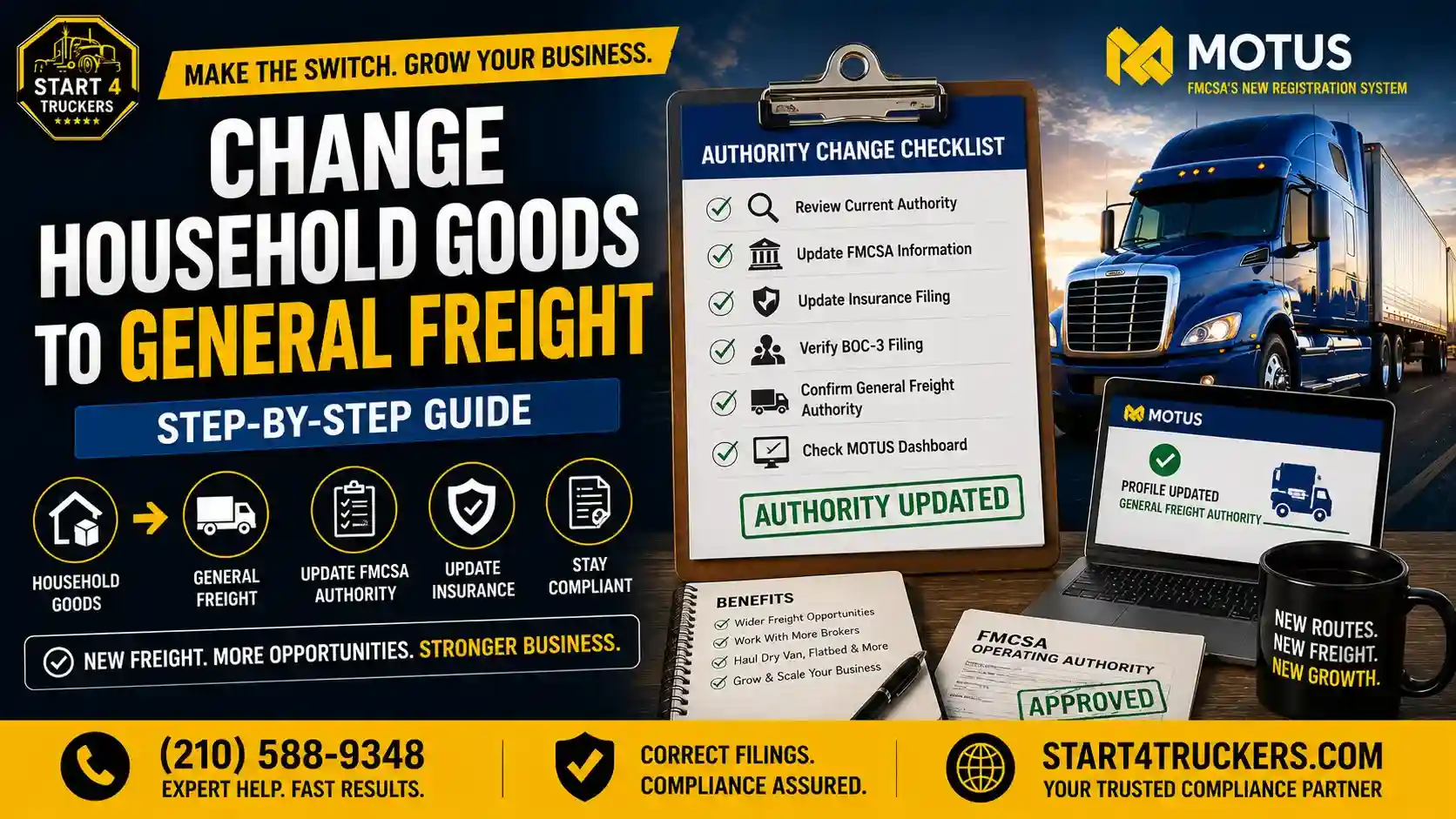
The process involves reviewing your current authority, determining the specific change needed, updating your FMCSA registration information, reviewing insurance requirements, verifying your BOC-3 filing, and confirming your updated authority status once the change is processed.
Step 1: Review Your Current FMCSA Authority
Start by reviewing your USDOT record, current MC authority type, carrier profile, and operating status to understand exactly what you’re working with.
Step 2: Determine the Correct Authority Change Needed
Decide whether you’re removing your Household Goods designation entirely, adding General Freight or property operations alongside it, or updating your carrier classification in some other way.
Step 3: Update Your FMCSA Registration Information
Submit the necessary registration updates reflecting your new operation type. This is typically handled through FMCSA’s registration systems, including the MOTUS Portal. If you haven’t linked your account yet, our guide on how to link FMCSA Portal to MOTUS can help.
Step 4: Update Insurance Requirements
Review your liability insurance, cargo insurance considerations, and any BMC-91 filing details with your insurance provider to make sure your coverage matches your new operation type.
Step 5: Verify BOC-3 Filing
Confirm your process agent designation is still active and correctly tied to your authority. If you’re unsure whether you can handle this filing yourself, our guide on can you file your own BOC-3 explains the requirements.
Step 6: Confirm Your Updated Authority Status
After your change is submitted, check the SAFER System, FMCSA Database, and your MOTUS profile to confirm your authority now reflects General Freight operations correctly.
Want help managing this change from start to finish? Call Start4Truckers LLC at (210) 588-9348 today.
Do You Need a New MC Number to Change from Household Goods to General Freight?
Many carriers do not need a brand-new MC Number to make this change. Whether a new MC Number is required depends on how your existing authority is structured, so it’s worth reviewing your current authority before assuming you need to reapply from scratch.
In many cases, updating your existing authority type is sufficient, since your USDOT Number and MC Number identify your business rather than your specific cargo classification. That said, some situations do call for additional applications or filings, which is why reviewing your current authority carefully before making changes is so important. Our guide on DOT Number vs MC Number can help clarify what each number actually represents.
Can a Household Goods Carrier Haul General Freight?
Not legally, without first updating your FMCSA authority. Operating outside your registered authority type, even temporarily, can create compliance issues, regardless of how minor the freight difference might seem.
Authority type and actual cargo hauled need to match. A carrier registered only for Household Goods that starts hauling general commodities before updating their FMCSA records is operating outside their authorized scope. Updating your records first, rather than assuming your existing authority already covers the new freight type, protects your business from unnecessary compliance risk.
How Does MOTUS Affect Household Goods to General Freight Changes?
MOTUS is where much of this authority update process now takes place, including updating carrier information, linking your FMCSA profile, and checking your registration status after submitting changes.
Updating Carrier Information in MOTUS
Your business and operational details are updated directly through your MOTUS carrier profile as part of this process.
Linking Your FMCSA Profile
If your FMCSA Portal account isn’t yet linked to MOTUS, this needs to happen before you can manage authority changes through the platform. Our guide on how to link FMCSA Portal to MOTUS walks through this process.
Checking Registration Status
After submitting your changes, monitor your MOTUS dashboard to confirm your updated authority status reflects correctly.
Handling MOTUS Registration Issues
If you run into registration errors along the way, our guide on MOTUS registration errors covers common problems and fixes.
Documents Needed for Household Goods to General Freight Change
You’ll generally need your USDOT Number information, MC authority details, MCSA-1 application information, an updated MCS-150, insurance filing documents, BOC-3 filing information, and current business registration documents.
- USDOT Number Information – Confirms your identified business
- MC Authority Details – Confirms your existing operating authority
- MCSA-1 Information – Your original or updated application details
- MCS-150 Update – Reflects your current business and fleet information; see our MCS-150 filing guide if you need a refresher
- Insurance Filing Documents – Confirms coverage matching your new operation type
- BOC-3 Filing Information – Confirms your process agent designation is current
- Business Registration Documents – Confirms your legal business details match FMCSA records
How Long Does It Take to Change FMCSA Authority Type?
Processing time depends on FMCSA’s current review workload, whether your insurance updates are submitted correctly and on time, and how quickly any MOTUS-related processing steps move. Incorrect or incomplete information is the most common cause of unnecessary delays.
Carriers who submit complete, accurate information upfront generally see a smoother, faster process than those who leave gaps that require follow-up correspondence with FMCSA.
How Much Does It Cost to Change from Household Goods to General Freight?
Costs can include FMCSA filing fees, potential insurance premium changes, compliance service costs if you use a third-party provider, and any BOC-3-related fees tied to maintaining your process agent designation. Exact amounts vary and should be confirmed directly with FMCSA and your insurance provider.
FMCSA Filing Fees
Specific filing fees can apply depending on the exact nature of your authority change, so confirm current amounts directly with FMCSA.
Insurance Changes
Switching operation types can affect your insurance premiums, since coverage requirements may differ between Household Goods and General Freight operations.
Compliance Service Costs
If you use a compliance service to manage this transition, costs will vary depending on the provider and scope of support.
BOC-3 Related Costs
Maintaining your process agent designation may involve its own separate cost, depending on your provider.
Common Mistakes When Changing Household Goods to General Freight
Common mistakes include hauling new freight types before the authority update is complete, failing to update insurance, forgetting BOC-3 requirements, using the wrong cargo classification, and not confirming FMCSA records after submitting the change.
Operating Before Authority Update Is Complete
Some carriers assume they can start hauling general freight the moment they submit a change request, without waiting for confirmation that the update actually processed.
Not Updating Insurance
Continuing to operate under outdated insurance coverage that doesn’t match your new authority type creates real risk if a claim ever needs to be filed.
Forgetting BOC-3 Requirements
Overlooking your process agent designation during a broader authority change can leave your account in an inactive state.
Using Incorrect Cargo Classification
Selecting the wrong classification during your update can create confusion or delays in FMCSA’s review process.
Not Checking FMCSA Records After Submission
Skipping the final confirmation step means you might not notice if something didn’t update correctly until much later.
What Happens After Changing to General Freight Authority?
Once your authority change is complete, your carrier profile reflects General Freight operations, opening up new freight opportunities and broker relationships, while your compliance responsibilities continue under your updated authority type.
Updated Carrier Profile
Your FMCSA and SAFER records will reflect your new General Freight classification going forward.
New Freight Opportunities
With updated authority, you can begin pursuing general commodity freight, dry van, flatbed, and other loads previously outside your registered scope.
Broker Verification
Brokers and shippers verifying your authority will now see your updated classification, which can open doors that were previously closed under Household Goods-only authority.
Compliance Responsibilities
Your ongoing compliance obligations continue under your new authority type, including maintaining accurate MCS-150 updates, insurance filings, and BOC-3 status.
How Start4Truckers LLC Can Help With FMCSA Authority Changes
Changing your FMCSA authority type involves more moving parts than most carriers expect, from registration updates to insurance coordination to BOC-3 verification. Start4Truckers LLC helps trucking companies manage FMCSA authority changes correctly and avoid compliance delays when switching operations, including:
- FMCSA authority updates
- MOTUS registration assistance
- MC authority changes
- USDOT registration support
- BOC-3 filing
- Insurance filing assistance
- Ongoing DOT compliance services
Explore our trucking company setup services or compare our plans and pricing to find the right support for your transition.
Call Start4Truckers LLC today at (210) 588-9348 or visit our contact page to get your authority change handled correctly.
Conclusion
Changing from Household Goods to General Freight is an authority update, not a brand-new company formation. Your business entity and typically your USDOT Number stay the same, while your FMCSA operating authority, insurance filings, and registration details need to be reviewed and updated to reflect your new operation type.
Taking the time to review your current authority, update every required filing, and confirm your new status before hauling different freight protects your business from unnecessary compliance risk. Start4Truckers LLC can guide you through each step of this transition. Call us at (210) 588-9348 or reach out through our contact page to get started.
Frequently Asked Questions
1. How do I change Household Goods to General Freight?
You review your current FMCSA authority, determine the specific change needed, update your registration information through FMCSA and MOTUS, review your insurance filing, verify your BOC-3 status, and confirm your updated authority once processed.
2. Can I change my Household Goods authority to General Freight?
Yes. Carriers can update their operation type from Household Goods to General Freight, though the exact requirements depend on your current authority structure and filings.
3. Do I need a new MC Number to switch to General Freight?
Not always. Many carriers can update their existing authority without needing a brand-new MC Number, though this depends on how your current authority is structured.
4. What is the difference between Household Goods and General Freight authority?
Household Goods authority covers personal belongings moved for individual customers, while General Freight authority covers general commodities and commercial cargo, with different broker relationships and insurance considerations.
5. Can a moving company become a general freight carrier?
Yes. Many moving companies expand or pivot into general freight by updating their FMCSA operating authority and meeting the relevant insurance and compliance requirements.
6. How do I update my FMCSA operating authority type?
You submit updated registration information reflecting your new operation type, typically through FMCSA’s systems including the MOTUS Portal, along with any required insurance and BOC-3 updates.
7. Can I change my authority type through MOTUS?
Yes, much of this process is now managed through MOTUS, including updating your carrier profile and checking your registration status after changes are submitted.
8. What documents are required to change authority type?
You’ll generally need your USDOT Number information, MC authority details, MCSA-1 information, an updated MCS-150, insurance filing documents, BOC-3 filing information, and business registration documents.
9. Do I need new insurance after switching to General Freight?
Possibly. General Freight operations may carry different insurance considerations than Household Goods authority, so it’s worth reviewing your coverage with your provider before completing the switch.
10. Does my BOC-3 need to be updated after changing authority?
Your BOC-3 filing should remain active and correctly tied to your operating authority throughout this process, so it’s worth confirming this hasn’t lapsed during the transition.
11. How long does an FMCSA authority change take?
Processing time varies based on FMCSA’s review workload, the accuracy of your submitted information, and how quickly related insurance or MOTUS updates are completed.
12. How much does it cost to change FMCSA authority?
Costs can include FMCSA filing fees, potential insurance premium adjustments, and any third-party compliance service fees. Exact amounts should be confirmed directly with FMCSA and your insurance provider.
13. Can I haul general freight with Household Goods authority?
No, not without first updating your FMCSA authority. Operating outside your registered authority type can create compliance issues, even if the change feels minor.
14. Does changing authority affect my USDOT Number?
Generally, no. Your USDOT Number identifies your business rather than your cargo type, so it typically remains the same throughout an authority change.
15. Who can help me change my FMCSA authority from Household Goods to General Freight?
Start4Truckers LLC helps trucking companies manage this exact type of FMCSA authority change, including registration updates, insurance coordination, and BOC-3 verification, to keep the transition compliant and on schedule.