Many moving companies reach a point where household moves are not enough. The work slows down after summer, and brokers keep posting steady freight loads you can’t take. If you only hold Household Goods (HHG) authority, you can’t legally haul those loads yet. You first need to change household goods to general freight, or add general freight authority next to the one you have.
This guide explains what general freight means, how it differs from household goods, and how to make the change with FMCSA in Motus. It also covers insurance, fees and the mistakes that slow carriers down.
How to Change Household Goods to General Freight: Quick Answer
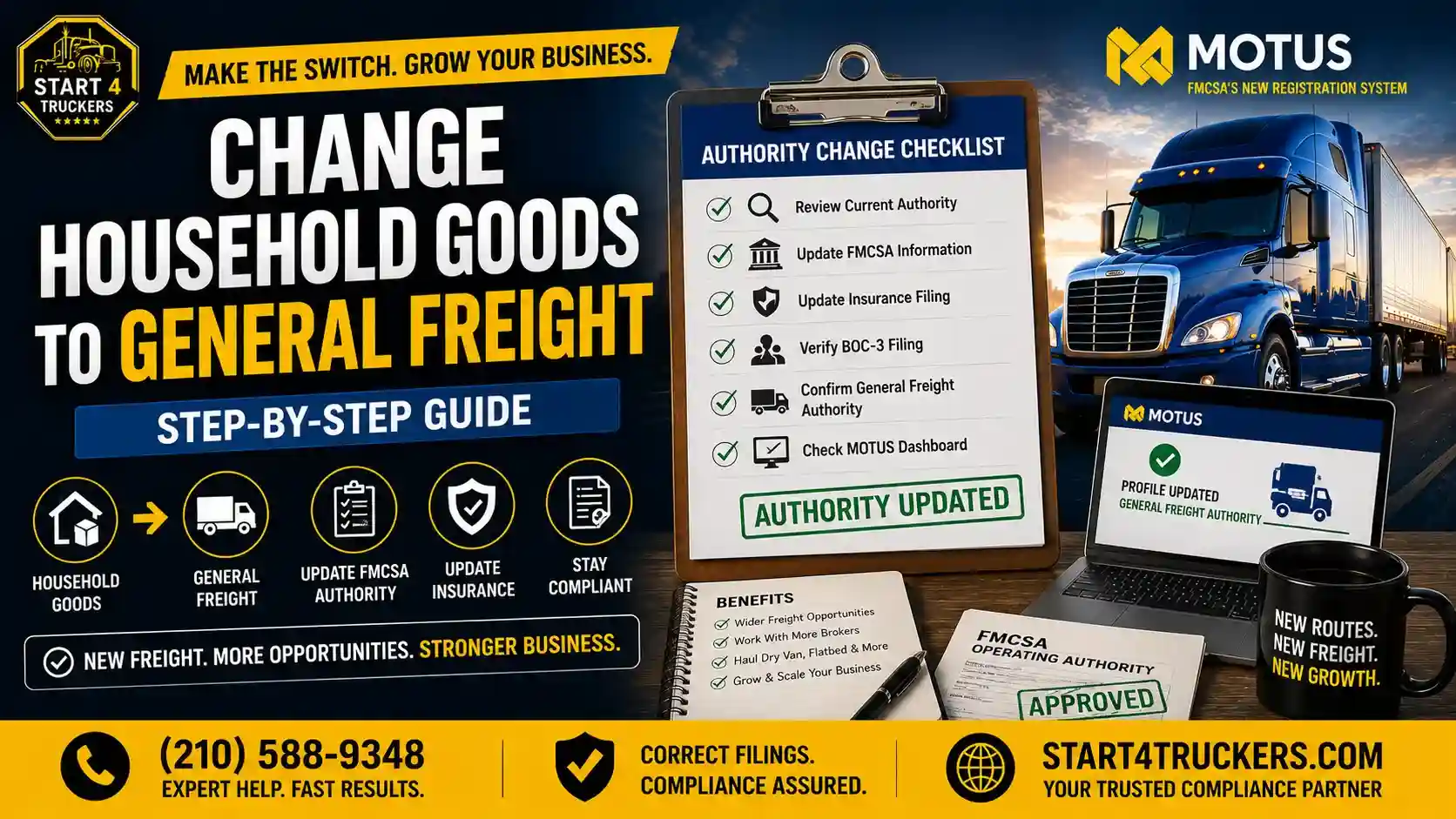
Here’s how to change household goods to general freight,
- Apply for Motor Carrier of Property (except Household Goods) authority in Motus.
- Pay the $300 FMCSA fee for the new authority type.
- Have your insurer file liability coverage for the new authority.
- Make sure a BOC-3 is on file for it.
- Update your cargo classification on the MCS-150.
- Wait until the new authority shows as active before you start general freight hauling.
If the same legal business continues operating, its existing USDOT number and EIN remain unchanged. However, the newly granted general freight authority in Motus will receive its own distinct docket (MC) number.
General Freight Meaning: What Is General Freight?
General freight refers to everyday commercial cargo, such as retail goods, packaged products, and industrial supplies, that travels in standard trailers like dry vans or flatbeds. It specifically excludes cargo that requires special equipment, temperature control, permits, or hazardous materials handling.
So what does general freight mean for your company? It means shipping for businesses. You pick up from a shipper, such as a factory, warehouse or store, and deliver to another business. That’s very different from moving a family’s belongings.
What Is Considered General Freight?
What is considered general freight is easiest to explain by what’s left out. Hazardous materials, refrigerated loads, oversize loads and household goods all have their own rules. Most other goods count.
Common general freight examples include:
- Palletized retail products and consumer goods
- Packaged food that doesn’t need a reefer
- Building supplies, like lumber or drywall
- Machine parts and industrial supplies
- Furniture and appliances delivered from a store or factory
- Paper, plastic and other packaged materials
The furniture point surprises a lot of movers. FMCSA says that delivering furniture or appliances from a factory or store to a customer’s home is not a household goods move.
What Is General Freight Trucking?
General freight trucking is the part of the industry that moves these everyday goods by truck, across town or across the country. The general freight trucking meaning covers both truckload, where one shipper fills the trailer, and less-than-truckload, where several shippers share it.
A general freight trucking company usually gets loads from brokers, load boards or direct shipper contracts. As a general freight hauler, you’d book loads by the mile or by the trip instead of by the move. General freight transport also runs all year, while household moves peak in summer. That’s why many movers find that trucking general freight keeps their trucks busy in the slow months.
Household Goods Authority vs General Freight Authority
FMCSA treats these as two separate authority types, and each has its own rules. This table compares household goods authority vs general freight authority.
| Features | Household Goods authority | General freight authority |
| Official FMCSA name | Motor Carrier of Household Goods | Motor Carrier of Property (except Household Goods) |
| Who you serve | People moving their own belongings | Shippers, brokers and other businesses |
| Liability insurance | Required | Required |
| Cargo insurance filed with FMCSA | Required: $5,000 per vehicle, $10,000 per occurrence | Not required by FMCSA |
| Extra consumer rules | Estimates, inventories, arbitration program (49 CFR Part 375) | None of the mover rules |
| FMCSA fee | $300 | $300 |
The FMCSA name for general freight authority is motor carrier of property except household goods. On forms and in Motus, the last three words appear in parentheses. For a closer look at every authority type, including passenger authority, read how property, household goods and passenger authority compare.
What Is Considered Household Goods in Trucking?
Under 49 CFR 375.103, household goods generally include personal items and property used, or meant to be used, in a home. FMCSA also considers the transportation arrangement and the services provided by the carrier.
So, what is household goods in trucking? A common example is a moving company transporting a family’s belongings from one home to another. A couch moved between homes is household goods, while the same couch shipped from a factory to a retail store is general freight.
Common household goods examples include:
- Furniture, beds and mattresses from a home
- Boxes of clothing, dishes and kitchen items
- Appliances and electronics a family already uses
- Books, decor and other personal belongings
The key difference is not just the type of item being transported. Who arranges the shipment, where the goods are coming from and going to, and the services the carrier provides can also affect whether the transportation falls under FMCSA’s household goods moving rules.
Can You Change Household Goods to General Freight?
Yes. FMCSA lets carriers change authority type when their business changes. Its own FAQ uses the example of switching from household goods carrier to motor carrier.
But you can’t make the switch just by editing your profile. HHG authority covers household goods only. Hauling general freight with HHG authority alone means you’re operating without the right authority. That can lead to fines, an out-of-service order and insurance claims that don’t get paid.
You also have a choice to make:
- Add general freight and keep HHG. This works if you still want to do moves. You’ll hold both authorities and keep both sets of insurance filings.
- Switch fully. If you’re done with moves, add general freight authority, then ask FMCSA to voluntarily revoke your HHG authority. That way your records show what you actually do.
Authority Type vs Cargo Classification
These two get mixed up all the time, and the mix-up causes a lot of delays.
- Operating authority type is what you’re allowed to haul for hire across state lines. Changing it takes a new authority application and a fee.
- Cargo classification is the list of cargo boxes checked on your MCS-150. It describes what you carry, such as General Freight or Household Goods.
An FMCSA cargo classification change is a free MCS-150 update. You should check General Freight when you switch. But that update alone doesn’t give you the right to haul general freight for hire. You still need the authority.
How to Change Household Goods to General Freight in Motus
Motus replaced FMCSA’s older registration tools in May 2026, so the change now starts there. To change operating authority type, FMCSA requires a new application for the authority you want. Here’s the process.
Step 1: Check Your Current Records
Log in to Motus and review your company account. Confirm your USDOT number, current HHG docket number, legal name and address. If anything is out of date, fix it first, because old details are a common reason applications stall. If you can’t get into your company account, start by learning how to link the FMCSA Portal to Motus.
Step 2: Apply for General Freight Authority
In Motus, start the applicable additional operating authority application and select Motor Carrier of Property (Except Household Goods). Review the authority options shown for your business before submitting. Answer each question carefully and pay the fee by card. FMCSA doesn’t refund authority fees, so choosing the wrong type costs you $300.
Step 3: Set Up Insurance for the New Authority
Ask your insurance agent to file proof of liability coverage (Form BMC-91 or BMC-91X) for the new authority. Your insurer sends it to FMCSA, not you. The new authority won’t go active without it. The insurance section below explains what to ask for.
Step 4: File the BOC-3
Your BOC-3 names a process agent in each state who can accept legal papers for your company. FMCSA needs it on file before your authority goes active. Make sure your process agent files it for the new authority, not just your old HHG record. Here’s more on what a BOC-3 filing is.
Step 5: Update Your MCS-150
Review your cargo classifications in Motus and add General Freight to reflect your new operations. Keep Household Goods listed if you still plan to transport personal belongings. Also, verify that your active vehicle and driver counts remain accurate.
Step 6: Confirm the Change Before You Haul
Don’t take a general freight load until Motus shows the new authority as active. Check the status in your company account, then look your company up in Motus public search. Brokers will check it too.
If you’d rather not file it yourself, Start4Truckers.com can handle MC number registration for the new authority type.
Do You Need a New MC Number?
Your USDOT number stays the same. It’s your company’s safety ID, and changing authority type doesn’t change it.
Your docket number works differently. FMCSA says Motus gives every newly granted authority its own docket number. So your general freight authority will get a separate MC number, and your HHG docket keeps the number it already has. If you’re not sure how the two numbers fit together, read about the difference between a DOT number and an MC number.
General Freight Insurance
General freight insurance works differently from mover insurance, so call your agent before you apply.
- Liability: For non-hazardous freight in trucks with a weight rating (GVWR) of 10,001 pounds or more, FMCSA requires at least $750,000 in liability coverage.
- Cargo: FMCSA requires HHG carriers to file cargo insurance. It doesn’t require cargo coverage for a general freight carrier.
- What brokers want: Most brokers and shippers still ask for cargo coverage, often $100,000 or more, and many want $1 million in liability. Without it, you’ll get fewer loads.
Your premium may change too. A general freight carrier usually drives more miles and hauls different cargo than a mover. Tell your agent exactly what you’ll haul and where, so the policy matches the work.
How Much It Costs and How Long It Takes
Cost: FMCSA charges $300 for each new authority type. If your HHG application is still pending and you picked the wrong type, FMCSA says you can change it at no extra fee. The MCS-150 update is free. Your other costs are insurance premiums, the BOC-3 filing and any filing service fees.
Time: Online applications in Motus move much faster than paper forms, which take at least eight business days just for the initial review. Once submitted, your authority goes active after the mandatory protest period ends and your insurance and BOC-3 filings are on record. Plan for a few weeks for the full process.
Common Mistakes When Switching
- Hauling before the authority is active. One load can bring fines and a claim your insurer won’t pay.
- Only changing the cargo box. Checking General Freight on the MCS-150 doesn’t give you authority.
- Forgetting the insurance filing. No liability filing means no active authority.
- Picking the wrong authority type. FMCSA won’t refund the fee.
- Leaving HHG active by mistake. If you’re done with moves, close out the HHG authority on purpose. Don’t just let its cargo filing lapse.
Need Help Switching to General Freight?
Start4Truckers.com is a private filing service, not FMCSA. We can file your new authority in Motus, coordinate the BOC-3 and update your MCS-150 so all your records match. That way you can start hauling general freight without guessing at the steps. Call (210) 588-9348.
Frequently Asked Questions
What does general freight mean in trucking?
General freight is everyday cargo that doesn’t need special equipment, permits or handling, like palletized goods, building supplies and packaged products. It’s shipped between businesses, not moved for a household.
What is considered household goods under FMCSA rules?
Under 49 CFR 375.103, household goods are personal items and property used, or meant to be used, in a home. Furniture delivered from a store or factory to a home doesn’t count.
Can I change from Household Goods to General Freight?
Yes. You apply for Motor Carrier of Property (except Household Goods) authority in Motus, pay the $300 fee, and get your insurance and BOC-3 filed for it. You can keep or drop your HHG authority.
Can I haul general freight with the Household Goods authority?
No. HHG authority covers household goods only. You need active property authority before you haul general freight for hire across state lines.
Do I need a new MC number to change authority type?
Your USDOT number stays the same. But Motus gives each newly granted authority its own docket number, so your general freight authority will have a separate MC number.
Can I change my cargo classification in Motus?
Yes. You change it through an MCS-150 update in your Motus company account, and it’s free. It updates your records but doesn’t add operating authority.
How much does it cost to change FMCSA operating authority?
FMCSA charges $300 for each new authority type once your earlier application has been granted. If that application is still pending, FMCSA allows the change at no extra fee.
Do I need different insurance for general freight?
Federal liability insurance requirements depend on vehicle weight and cargo. For non-hazardous for-hire property carriers, the minimum is generally $750,000 for vehicles weighing 10,001 pounds or more and $300,000 for lighter vehicles with a GVWR of 10,000 pounds or less. While FMCSA does not require general property carriers to file cargo insurance, most brokers and shippers will require it before giving you loads.
How long does it take to change from Household Goods to General Freight?
Online applications in Motus move much faster than paper forms, which take at least eight business days just for the initial review. Once submitted, your authority goes active after the mandatory protest period ends and your insurance and BOC-3 filings are on record. Plan for a few weeks for the full process.