Not sure if your truck actually needs an IFTA license? It comes down to one specific legal definition: the IFTA Qualified Motor Vehicle. Get this classification wrong, and you risk fuel tax penalties, decal violations, and headaches at the weigh station that are easy to avoid once you understand the rule.
This guide breaks down exactly what qualifies, what doesn’t, and how to keep your fleet compliant. Start4Truckers LLC helps carriers get their IFTA classification and registration right the first time.
What Is an IFTA Qualified Motor Vehicle?
An IFTA Qualified Motor Vehicle is a vehicle used to transport people or property that meets one of three criteria: it has two axles and a gross vehicle weight or registered gross vehicle weight over 26,000 pounds, it has three or more axles regardless of weight, or it operates in a combination whose total weight exceeds 26,000 pounds. Recreational vehicles used purely for personal pleasure are excluded, even if they meet the weight threshold.
What Is IFTA?
IFTA, the International Fuel Tax Agreement, is a fuel tax collection agreement among the 48 contiguous U.S. states and 10 Canadian provinces. It simplifies fuel tax reporting for carriers operating qualified motor vehicles across more than one member jurisdiction.
Instead of filing separate fuel tax reports in every state you drive through, IFTA lets you file one quarterly report through your base jurisdiction, which then distributes the appropriate tax amounts to each state or province where you traveled. Our guide on what IFTA is and how it works covers the full agreement in more detail.
What Is a Qualified Motor Vehicle Under IFTA?
Under the IFTA Articles of Agreement, a qualified motor vehicle is any vehicle used, designed, or maintained to transport people or property that meets specific weight or axle criteria, regardless of whether it’s a single unit or part of a combination.
The official IFTA definition, confirmed across multiple state revenue and transportation agencies, breaks the qualification down into three separate paths. A vehicle only needs to meet one of them to be considered “qualified.”
The Three Qualification Criteria
A motor vehicle is IFTA qualified if it:
- Has two axles and a gross vehicle weight (GVW) or registered GVW exceeding 26,000 pounds (11,797 kilograms), or
- Has three or more axles, regardless of weight, or
- Operates in combination with a trailer, where the combined weight exceeds 26,000 pounds (11,797 kilograms)
This means axle count alone can trigger qualification, even for a lighter vehicle, if it has three or more axles.
IFTA Weight and Axle Thresholds Explained
The key number to remember for IFTA is 26,000 pounds. Two-axle vehicles need to exceed this weight to qualify, while three-or-more-axle vehicles qualify regardless of weight.
| Vehicle Configuration | Weight Threshold | Qualifies for IFTA? |
| Two axles | Exceeds 26,000 lbs GVW or registered GVW | Yes |
| Two axles | 26,000 lbs or under | No |
| Three or more axles | Any weight | Yes |
| Power unit + trailer combination | Combined weight exceeds 26,000 lbs | Yes |
| Power unit + trailer combination | Combined weight 26,000 lbs or under | No |
Keep in mind that GVW refers to the actual gross vehicle weight, while registered GVW refers to the weight your vehicle is registered for, and either one can trigger qualification if it exceeds the threshold.
Vehicles That Typically Qualify Under IFTA
Common vehicles that qualify under IFTA include tractor-trailers, heavy straight trucks, dump trucks, and any combination vehicle whose total weight crosses the 26,000-pound threshold.
Vehicles that generally meet IFTA’s qualified motor vehicle definition include:
- Tractor-trailer combinations used for interstate freight
- Heavy straight trucks with a GVW over 26,000 pounds
- Dump trucks and construction vehicles above the weight threshold
- Buses used commercially, when they meet the weight or axle criteria
- Any three-axle-or-more commercial vehicle, regardless of weight
If you’re still working through the basics of getting your trucking company registered, our guide on how to start a trucking company walks through the full setup process, including where IFTA fits in.
Vehicles That Are Exempt From IFTA
Recreational vehicles used exclusively for personal pleasure are excluded from IFTA’s qualified motor vehicle definition, even if they meet the weight or axle threshold. Vehicles operating only within one state also fall outside IFTA’s interstate-focused requirement.
The Recreational Vehicle Exemption
IFTA specifically excludes recreational vehicles from qualification. This typically includes motor homes, pickup trucks with attached campers, and buses used exclusively for personal pleasure. To qualify for this exemption, the vehicle cannot be used in connection with any business activity.
Intrastate-Only Operations
If your vehicle never crosses state lines, it doesn’t need an IFTA license, even if it otherwise meets the weight or axle threshold. However, many states require a separate intrastate fuel tax permit for vehicles that meet the same structural criteria but only operate locally.
Qualified Motor Vehicle vs Commercial Motor Vehicle (CMV)
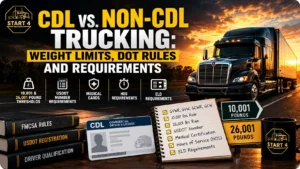
An IFTA Qualified Motor Vehicle and a Commercial Motor Vehicle (CMV) are related but separate classifications with different weight thresholds. CMV status under FMCSA generally starts at 10,001 pounds, while IFTA qualification for two-axle vehicles starts above 26,000 pounds.
This distinction trips up a lot of new carriers. Just because your truck is a commercial motor vehicle under FMCSA rules doesn’t automatically mean it’s an IFTA-qualified motor vehicle.
| Feature | Commercial Motor Vehicle (CMV) | IFTA Qualified Motor Vehicle |
| Governing Body | FMCSA | IFTA Member Jurisdictions |
| Typical Weight Threshold | 10,001 lbs GVWR/GCWR | Over 26,000 lbs (two axles) |
| Axle Rule | Not axle-based | 3+ axles qualify regardless of weight |
| Purpose | Safety regulation | Fuel tax reporting |
| Applies To | Interstate and some intrastate operations | Interstate operations in IFTA jurisdictions |
For more on how CMV status affects registration requirements, see our guide on USDOT Number Requirements for Intrastate Carriers.
Do You Need IFTA If You Only Drive Intrastate?
No. IFTA specifically applies to qualified motor vehicles operated in two or more member jurisdictions. If your vehicle never leaves your home state, you generally don’t need an IFTA license, though your state may still require a separate intrastate fuel tax permit.
The core trigger for IFTA isn’t just your vehicle’s weight or axle count; it’s interstate travel. A qualifying vehicle that only operates within one state’s borders falls outside IFTA’s scope entirely, even though it still meets the physical qualification criteria.
Not sure whether your operation counts as interstate for IFTA purposes? Call Start4Truckers LLC at (210) 588-9348, and we’ll help you sort it out.
Combination Vehicles and IFTA Qualification
When a power unit is paired with a trailer, IFTA looks at the combined weight of the whole unit, not just the tractor alone. If that combined weight exceeds 26,000 pounds, the combination qualifies, even if the power unit alone would not.
This is an important nuance for smaller trucks pulling heavier trailers. A two-axle truck that seems too light to qualify on its own can still trigger IFTA qualification once you factor in the trailer’s weight.
How to Know If Your Vehicle Qualifies: Decision Checklist
Walk through these questions to determine if your vehicle needs an IFTA license.
- Does your vehicle operate in two or more IFTA member jurisdictions? If no, IFTA doesn’t apply, though a state intrastate fuel permit may still be required.
- Does your vehicle have two axles? If yes, check whether its GVW or registered GVW exceeds 26,000 pounds.
- Does your vehicle have three or more axles? If yes, it qualifies regardless of weight.
- Is your vehicle operated in combination with a trailer? If yes, check whether the combined weight exceeds 26,000 pounds.
- Is the vehicle used exclusively for personal, non-business recreational purposes? If yes, it’s excluded from qualification even if it meets the weight or axle criteria.
Result: If you answered yes to interstate travel and yes to any of the weight or axle criteria, and the vehicle isn’t a personal recreational vehicle, it’s an IFTA Qualified Motor Vehicle.
IFTA License and Decal Requirements
Carriers operating qualified motor vehicles across IFTA jurisdictions need an IFTA license and a set of decals for each qualifying vehicle, issued annually by their base jurisdiction, with renewals generally due by December 31.
Your IFTA license and original documentation should stay with your carrier records, while the physical decals are affixed to each qualifying vehicle. Copies of your license are also typically required to be kept in each vehicle for roadside verification. If you’re setting up your fuel tax account for the first time, our guide on trucking IFTA account setup and our overview of quarterly IFTA filing can help you get everything in place.
IFTA vs UCR vs USDOT: Comparing Weight Thresholds
IFTA, UCR, and USDOT registration all use different criteria to determine which vehicles and businesses they apply to, which is exactly why a single truck can be required to register under one program but not another.
| Program | Purpose | Typical Trigger |
| USDOT Number | Safety identification | CMV weight/use thresholds, generally 10,001+ lbs |
| UCR Registration | Annual fee based on fleet size | Any interstate carrier, broker, or forwarder |
| IFTA | Fuel tax reporting | Qualified motor vehicle in 2+ jurisdictions, generally 26,001+ lbs (two axles) or 3+ axles |
Understanding how these programs differ helps you avoid assuming one registration automatically covers the others. Our guides on UCR Registration Deadlines by Year and USDOT Number Requirements for Intrastate Carriers break down those specific requirements in more detail.
Common Mistakes Carriers Make Classifying Vehicles
The most common mistakes include assuming CMV status automatically means IFTA qualification, forgetting to count trailer weight in combinations, misapplying the recreational vehicle exemption, and ignoring the three-or-more-axle rule.
Assuming CMV Status Equals IFTA Qualification
Since these two classifications use different weight thresholds, a vehicle can be a commercial motor vehicle under FMCSA rules without automatically being an IFTA qualified motor vehicle.
Forgetting to Count Trailer Weight
Carriers sometimes only look at the tractor’s weight, missing that the combined weight with a trailer can push a lighter truck into qualified status.
Misapplying the Recreational Vehicle Exemption
Some carriers assume any personal-use-style vehicle is automatically exempt, without confirming that it’s genuinely used exclusively for personal pleasure and not connected to any business activity.
Ignoring the Three-or-More-Axle Rule
A common oversight is assuming weight is the only factor that matters. A lighter vehicle with three or more axles still qualifies under IFTA, regardless of how much it weighs.
Consequences of Misclassifying a Vehicle
Misclassifying a vehicle, whether by under- or over-reporting its IFTA status, can lead to fuel tax penalties, license revocation, reinstatement fees, and complications during roadside inspections or audits.
Operating a qualified vehicle without the required IFTA license and decals can result in citations at weigh stations and back taxes owed once the error is caught. On the other hand, mistakenly registering a vehicle that doesn’t actually qualify can create unnecessary paperwork and reporting obligations. Getting the classification right the first time saves both money and administrative headaches down the road.
Want a second set of eyes on your fleet’s IFTA classification? Call Start4Truckers LLC at (210) 588-9348 today.
How Start4Truckers LLC Helps With IFTA Compliance
Classifying vehicles correctly and staying current on fuel tax filings is easier with the right support behind you. Start4Truckers LLC helps trucking companies with:
- IFTA account setup
- IFTA registration
- Quarterly IFTA filing
- USDOT and MC authority registration
- UCR registration
- Ongoing FMCSA and fuel tax compliance support
Explore our trucking company setup services or compare our plans and pricing to find the right fit for your fleet.
Call Start4Truckers LLC today at (210) 588-9348 or reach out through our contact page to get your IFTA classification and filings handled correctly.
Final Thoughts
Knowing whether your vehicle counts as an IFTA Qualified Motor Vehicle comes down to three simple checks: weight, axle count, and combination weight, layered on top of the basic requirement that you’re operating across two or more member jurisdictions. Getting this classification right protects you from fuel tax penalties and keeps your fleet moving without unnecessary roadside complications.
Start4Truckers LLC helps carriers classify their vehicles correctly and stay current on every IFTA filing requirement. Call us at (210) 588-9348 or visit our contact page to get your fleet compliant today.
Frequently Asked Questions
1. What is an IFTA Qualified Motor Vehicle?
An IFTA Qualified Motor Vehicle is a vehicle used to transport people or property that either has two axles and a GVW over 26,000 pounds, has three or more axles regardless of weight, or operates in a combination exceeding 26,000 pounds combined weight.
2. What weight makes a vehicle IFTA qualified?
For two-axle vehicles, the gross vehicle weight or registered gross vehicle weight must exceed 26,000 pounds (11,797 kilograms) to qualify under IFTA.
3. Does a vehicle with three axles always qualify for IFTA?
Yes. Under IFTA’s definition, any vehicle with three or more axles qualifies regardless of its actual weight.
4. Are recreational vehicles exempt from IFTA?
Yes. Recreational vehicles used exclusively for personal pleasure, such as motor homes and campers, are excluded from IFTA’s qualified motor vehicle definition, even if they meet the weight threshold.
5. Do I need IFTA if I only drive within one state?
No. IFTA applies specifically to vehicles operating in two or more member jurisdictions. Intrastate-only operations generally don’t need an IFTA license, though a separate state fuel tax permit may still apply.
6. Is a commercial motor vehicle (CMV) the same as an IFTA qualified motor vehicle?
No. CMV status under FMCSA typically starts at a lower weight threshold, generally 10,001 pounds, while IFTA qualification for two-axle vehicles requires exceeding 26,000 pounds. A vehicle can be a CMV without being IFTA qualified.
7. Does trailer weight count toward IFTA qualification?
Yes. When a power unit operates in combination with a trailer, IFTA looks at the combined weight of the whole unit. If that combined weight exceeds 26,000 pounds, the combination qualifies.
8. What happens if I misclassify my vehicle under IFTA?
Misclassification can lead to fuel tax penalties, license revocation, reinstatement fees, and complications during roadside inspections or audits, depending on whether the vehicle was under- or over-reported.
9. Do I need a separate IFTA decal for each qualified vehicle?
Yes. Each qualified motor vehicle typically needs its own set of IFTA decals, issued alongside your carrier’s IFTA license from your base jurisdiction.
10. How often does an IFTA license need to be renewed?
IFTA licenses are generally renewed annually, with most renewals due by December 31 each year, though specific deadlines can vary slightly by jurisdiction.
11. Can a two-axle truck avoid IFTA qualification?
Yes, if its gross vehicle weight or registered gross vehicle weight is 26,000 pounds or under, and it’s not operated in a combination exceeding that threshold, a two-axle truck may fall outside IFTA’s qualified motor vehicle definition.
12. Does IFTA apply to buses?
Buses can qualify under IFTA if they meet the weight or axle criteria and are used commercially rather than exclusively for personal recreational use.
13. What is the difference between GVW and registered GVW for IFTA purposes?
GVW refers to the vehicle’s actual gross weight, while registered GVW refers to the weight it’s registered for. Either measurement exceeding 26,000 pounds can trigger IFTA qualification.
14. Do I need IFTA for a vehicle used only for personal towing?
If the vehicle is used exclusively for personal, non-business purposes, such as towing a personal camper, it likely falls under the recreational vehicle exemption and doesn’t require IFTA registration.
15. Can Start4Truckers LLC help me determine if my fleet qualifies for IFTA?
Yes. Start4Truckers LLC helps carriers review their fleet’s weight, axle configuration, and operating patterns to determine IFTA qualification, then handles account setup and ongoing quarterly filings.