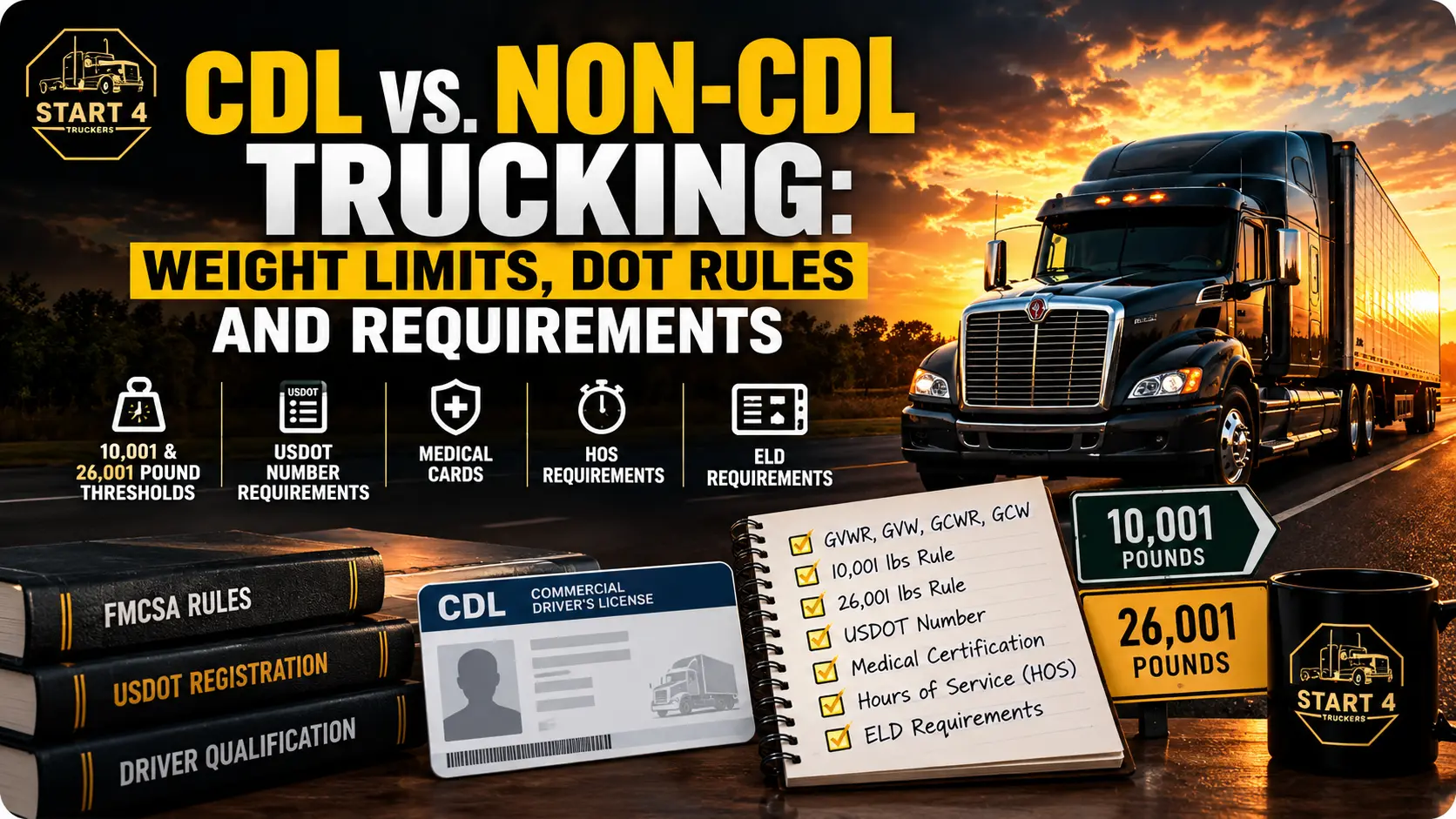
One of the most common trucking misconceptions is that drivers without a Commercial Driver’s License are exempt from Department of Transportation regulations.
A CDL and DOT compliance are not the same thing.
You may be able to drive a commercial vehicle without a CDL, but your business can still be subject to Federal Motor Carrier Safety Administration requirements. Depending on the vehicle, cargo, and type of operation, those requirements may include a USDOT number, medical certification, driver qualification records, Hours of Service compliance, and vehicle markings.
The two weight thresholds that cause the most confusion are:
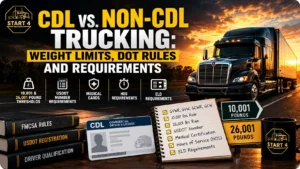
- 10,001 pounds: The general federal threshold at which many vehicles used in interstate commerce become regulated commercial motor vehicles.
- 26,001 pounds: The general threshold at which a Class A or Class B CDL may be required, depending on the vehicle configuration and trailer weight.
Here is how the rules generally work.
What Is the Difference Between CDL and Non-CDL Trucking?
CDL rules determine whether a driver needs a commercial driving credential to operate a particular vehicle.
DOT and FMCSA rules determine whether the driver and motor carrier must comply with federal safety, registration, and operating requirements.
That means a truck can be:
- Light enough to operate without a Class A or Class B CDL; and
- Heavy enough to qualify as a federally regulated commercial motor vehicle.
A vehicle rated between 10,001 and 26,000 pounds is the clearest example. The driver may not need a Class A or B CDL based on weight alone, but federal commercial vehicle requirements can still apply when the vehicle is used in interstate commerce.
GVWR, GVW, GCWR and GCW Explained
Before determining whether you need a CDL or USDOT number, you need to understand four weight measurements.
Gross Vehicle Weight Rating
GVWR is the maximum loaded weight a manufacturer assigns to a single vehicle. It normally appears on the vehicle’s certification label.
Gross Vehicle Weight
GVW is the vehicle’s actual operating weight, including the vehicle, driver, fuel, equipment, and cargo.
Gross Combination Weight Rating
GCWR is the applicable rated weight of a combination, such as a truck and trailer.
Under the federal definition, determining GCWR may involve the value displayed by the power-unit manufacturer or the combined ratings and weights of the power unit and towed units.
Gross Combination Weight
GCW is the actual combined weight of the truck, trailer, cargo, occupants, and equipment.
Federal classifications may consider the applicable rating or actual weight, whichever is greater. Operators should check vehicle labels, trailer ratings, manufacturer-designated GCWR, and actual operating weights.
CDL and Non-CDL Weight Thresholds
The following table provides a general overview. Passenger transportation, hazardous materials, state licensing rules, and certain specialized operations can produce different requirements.
| Vehicle or combination | General license requirement | Typical federal requirements for interstate operations |
| Vehicle or combination weighing 10,000 pounds or less | Appropriate non-CDL state license | Generally outside the federal weight-based CMV threshold, but passenger capacity, hazardous materials, and state rules may still trigger requirements |
| Vehicle or combination from 10,001 to 26,000 pounds | A Class A or B CDL is generally not required based on weight alone | A USDOT number and federal safety compliance are generally required for qualifying interstate CMV operations |
| Single vehicle weighing 26,001 pounds or more | Class B CDL generally required | USDOT registration and applicable federal safety requirements generally apply |
| Combination weighing 26,001 pounds or more with a towed unit over 10,000 pounds | Class A CDL generally required | USDOT registration and applicable federal safety requirements generally apply |
| Vehicle carrying placardable hazardous materials | Appropriate CDL and endorsement may be required regardless of weight | Hazardous-material registration, safety and testing requirements may apply |
| Vehicle designed to carry 16 or more people, including the driver | Class C, B or A CDL may be required depending on the vehicle | Passenger-carrier registration and safety requirements may apply |
These are federal standards. States can apply additional licensing, registration, and intrastate commercial vehicle rules.
The 10,001-Pound Rule for Non-CDL Vehicles
A vehicle or combination used in interstate commerce generally falls within the federal commercial motor vehicle definition when its applicable GVWR, GVW, GCWR, or GCW is 10,001 pounds or more.
This can include:
- Box trucks
- Cargo vans
- Straight trucks
- Hotshot pickups and trailers
- Landscaping trucks
- Construction vehicles
- Delivery trucks
- Certain towing and service vehicles
The driver may not need a Class A or B CDL, but the motor carrier and driver can still have several compliance responsibilities.
Do Non-CDL Trucks Need a USDOT Number?
A USDOT number is generally required when a company operates a qualifying commercial vehicle in interstate commerce.
The weight-based requirement generally applies when the vehicle has a GVWR, GVW, GCWR, or GCW of 10,001 pounds or more, whichever applicable value is greater.
A USDOT number may also be required regardless of this weight threshold when the vehicle:
- Transports certain numbers of passengers;
- Carries placardable quantities of hazardous materials; or
- Falls under applicable state-level USDOT registration rules.
Interstate commerce does not always mean that the truck physically crosses a state line. An intrastate trip may still be part of interstate commerce when the cargo originates outside the state or is continuing to a destination outside the state.
Some states also require USDOT numbers for qualifying intrastate commercial vehicles.
Learn more about USDOT registration services.
Does a Non-CDL Carrier Need an MC Number?
A USDOT number and MC operating authority serve different purposes.
The USDOT number identifies a motor carrier for safety monitoring and compliance. MC operating authority permits certain types of compensated interstate transportation.
An MC number is generally required when a business transports federally regulated commodities owned by someone else for compensation in interstate commerce.
However, carriers do not need operating authority. Common exceptions can include:
- Private carriers transporting their own property;
- For-hire carriers exclusively transporting exempt commodities; and
- Operations conducted exclusively within certain federally designated commercial zones.
The correct registration depends on what you transport, who owns the cargo, whether you receive compensation, and where you transport it.
Learn more about MC operating authority registration.
Do Non-CDL Drivers Need a DOT Medical Card?
A non-CDL driver generally needs to meet federal medical qualification requirements when operating a commercial motor vehicle weighing 10,001 pounds or more in interstate commerce, unless a specific exception applies.
The examination must be performed by a medical examiner listed on the National Registry of Certified Medical Examiners.
The driver should confirm:
- Whether the operation is interstate or intrastate;
- Whether federal or state medical requirements apply;
- When the medical certification expires; and
- Whether the carrier has retained the required documentation.
State medical requirements may also apply to intrastate non-CDL operations.
Driver Qualification Files for Non-CDL Drivers
Carriers often assume that Driver Qualification files are required only for CDL drivers. That is not correct.
A carrier generally must maintain a Driver Qualification file for each driver subject to the qualification requirements in 49 CFR Part 391. Depending on the operation and driver, the file may include:
- A completed driver employment application;
- Motor vehicle records;
- Annual driving-record review documentation;
- Medical qualification documentation;
- A road test certificate or an accepted equivalent; and
- Other records required by the applicable regulations.
CDL and non-CDL files are not always identical. CDL drivers can have additional licensing, Clearinghouse, and drug-and-alcohol compliance requirements.
Hours of Service Rules for Non-CDL Drivers
Non-CDL commercial drivers can still be subject to federal Hours of Service rules.
For property-carrying operations, these rules can include:
- An 11-hour driving limit following the required off-duty period;
- A 14-hour driving window;
- A 30-minute break requirement when applicable; and
- A 60- or 70-hour limit over seven or eight consecutive days.
A qualifying driver may use the short-haul exception when all applicable conditions are met, including time, reporting location, and air-mile requirements.
Using the short-haul exception does not mean that Hours of Service rules disappear. It changes how you may maintain qualifying time records.
Do Non-CDL Drivers Need an ELD?
A non-CDL driver is not automatically exempt from the Electronic Logging Device rule.
If the driver is required to prepare records of duty status, an ELD may be required unless a specific exception applies.
Examples of potential ELD exceptions include:
- Qualifying short-haul drivers who use time records;
- Drivers who use paper logs no more than the permitted number of days within 30 days;
- Certain driveaway-towaway operations; and
- Vehicles using qualifying pre-2000 engines.
The carrier should determine ELD applicability based on actual operation rather than assuming a non-CDL license creates an exemption.
Drug and Alcohol Testing for CDL and Non-CDL Drivers
Federal DOT drug-and-alcohol testing rules generally apply to drivers who are required to hold a CDL or Commercial Learner’s Permit and who operate covered commercial motor vehicles.
A driver who is not required to hold a CDL is generally outside FMCSA’s Part 382 testing program. However, employers may maintain their own lawful testing policies, and other federal or state requirements may apply.
Placardable hazardous-material transportation should not be treated as a simple non-CDL exception. It may require a Class C CDL with the appropriate endorsement, even when the vehicle is below the usual Class A or B weight threshold.
Entry-Level Driver Training Requirements
Entry-Level Driver Training requirements generally apply to drivers seeking:
- An initial Class A or Class B CDL;
- An upgrade from a Class B to a Class A CDL; or
- Certain passenger, school bus, or hazardous-material endorsements.
A driver operating a vehicle that does not require a CDL is generally not subject to federal ELDT requirements for that non-CDL operation.
The Pickup-and-Trailer Weight Trap
Hotshot and pickup-and-trailer operators need to calculate the entire combination carefully.
Consider this example:
- Pickup truck rating: 14,000 pounds
- Gooseneck trailer rating: 14,000 pounds
- Combined rating: 28,000 pounds
Because the combination exceeds 26,000 pounds and the towed unit exceeds 10,000 pounds, this configuration would generally fall within Class A CDL territory.
It may still require a Class A CDL even when the trailer is empty, or the combination’s scale weight is temporarily below 26,001 pounds. The applicable ratings and actual weights must be reviewed under the federal definitions.
If the power unit has a 14,000-pound rating and the trailer has a 12,000-pound rating, their combined rating would be 26,000 pounds. That calculation alone would remain below the 26,001-pound Class A threshold.
However, operators should still check:
- The manufacturer-designated GCWR;
- Actual vehicle and combination weights;
- Trailer GVWR and actual weight;
- Cargo and passenger classifications; and
- State-specific licensing requirements.
Other Rules That Can Apply to Non-CDL Commercial Vehicles
Depending on the operation, non-CDL carriers may also need to comply with requirements involving:
- Commercial vehicle inspections, repair and maintenance;
- Annual vehicle inspections;
- USDOT number and legal-name markings;
- Accident registers;
- Cargo securement;
- Insurance or financial responsibility;
- UCR registration;
- BOC-3 process-agent designation;
- State permits and registrations; and
- New-entrant safety requirements.
Operating below the CDL weight threshold should never be treated as a complete exemption from commercial transportation rules.
Get the Correct Registrations Before You Begin Operating
Every carrier has a different setup. Requirements can change based on vehicle weight, trailer configuration, cargo, business model, and operating territory.
Start4Truckers.com helps trucking businesses complete their:
- USDOT registration;
- MC operating authority application;
- BOC-3 filing;
- UCR registration; and
- Related carrier setup filings.
Our team reviews your operating details and assists with the filings relevant to your business.
Start your USDOT registration or call the Start4Truckers.com team at (210) 588-9348.
Frequently Asked Questions
What is the weight limit for non-CDL trucking?
For weight-based CDL classification, a vehicle or combination can generally remain below the Class A or Class B threshold when its applicable rating and actual weight do not reach 26,001 pounds. Passenger capacity, hazardous materials, vehicle configuration, and state law can still require a CDL.
Can I operate a 26,000-pound truck without a CDL?
Generally, a vehicle at 26,000 pounds remains below the federal 26,001-pound Class A or Class B threshold. You must still check the vehicle’s GVWR, GVW, GCWR, and GCW, along with its passenger capacity, cargo, and applicable state rules.
Do I need a DOT medical card for a non-CDL box truck?
Generally, yes, when the vehicle qualifies as a commercial motor vehicle weighing 10,001 pounds or more and is operated in interstate commerce, unless a specific exception applies. Intrastate medical card requirements vary by state.
Does a non-CDL truck need a USDOT number?
A USDOT number is generally required for a qualifying commercial vehicle weighing 10,001 pounds or more when it operates in interstate commerce. Passenger capacity, hazardous-material transportation, and state rules can also trigger registration requirements.
Does a non-CDL carrier need an MC number?
An MC number may be required when the carrier transports federally regulated property owned by others for compensation in interstate commerce. Private carriers, exempt-commodity carriers, and certain commercial-zone operations may not require interstate operating authority.
Do non-CDL drivers have to maintain logbooks?
They may need to maintain Hours of Service records when operating a qualifying commercial motor vehicle. Drivers who meet a short-haul exception may use qualifying time records instead of standard records of duty status.
Do non-CDL drivers need an ELD?
An ELD may be required when a non-CDL driver must prepare records of duty status and no ELD exception applies. Whether the driver needs an ELD depends on the operation—not simply on whether the driver holds a CDL.
Do non-CDL commercial trucks have to stop at weigh stations?
Weigh-station rules vary by state and may depend on vehicle type, registered weight, GVWR, cargo, and posted instructions. A non-CDL vehicle is not automatically exempt. Drivers should follow posted signs and confirm the rules in every state where they operate.
Can a non-CDL driver or truck be placed out of service?
Yes. An enforcement officer can place a driver or vehicle out of service when a violation meets the applicable out-of-service criteria. Examples can include serious Hours of Service violations, driver-qualification issues, unsafe vehicle conditions, or hazardous-material violations.