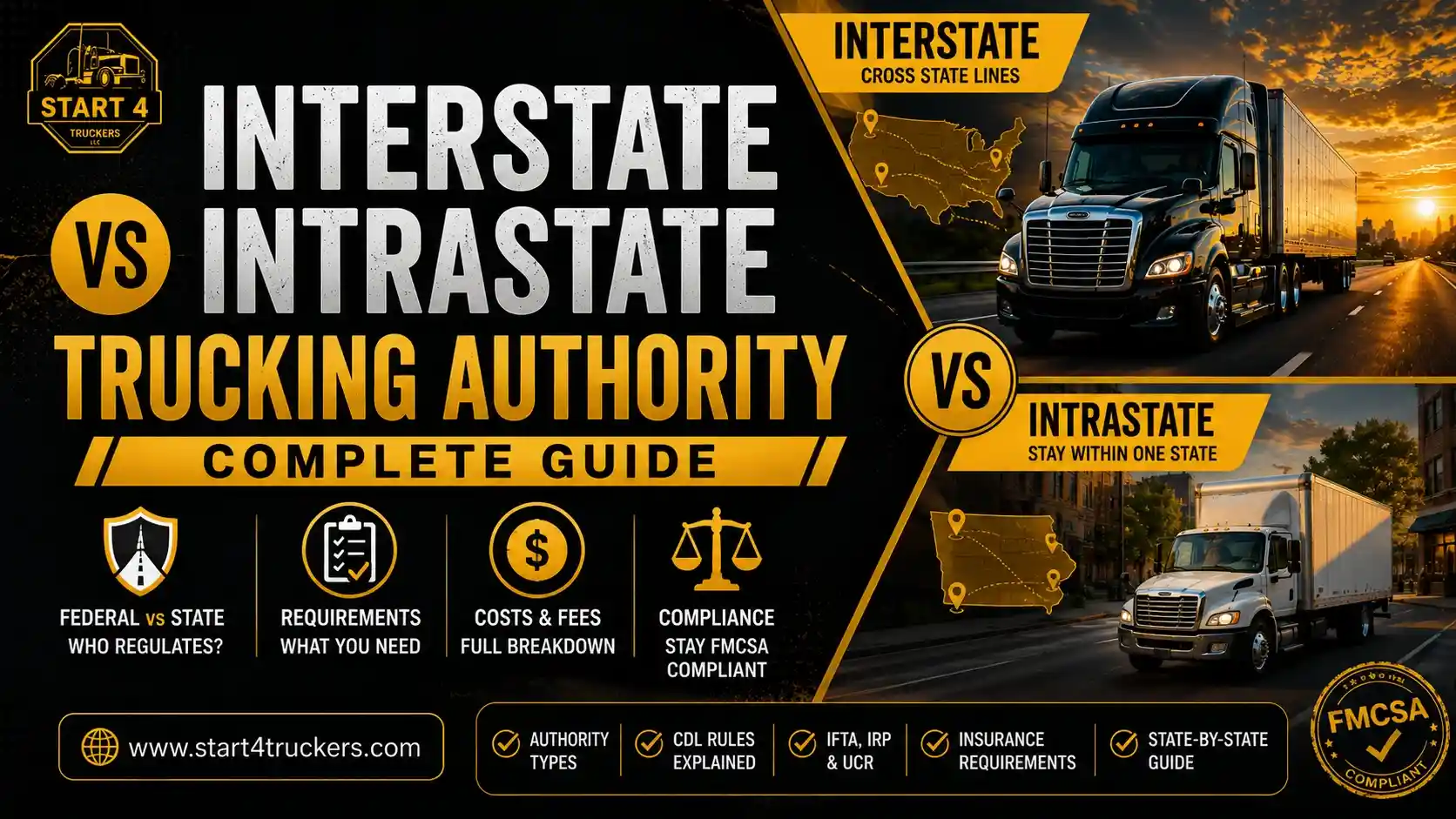
If you’re starting a trucking business, one of the first things you must understand is the difference between interstate and intrastate trucking authority. Many new carriers get confused about which one they need, and choosing the wrong authority can lead to fines, delays, surprise audits, or even getting shut down by the FMCSA.
In this guide, you’ll learn exactly what each authority means, who needs it, how they work, the costs involved, and the steps to stay fully compliant from day one.
What Is Interstate vs Intrastate Trucking? (Simple FMCSA Definition)
Interstate Trucking
Interstate trucking means hauling freight that crosses state lines. It’s regulated by the Federal Motor Carrier Safety Administration (FMCSA) and the U.S. Department of Transportation (USDOT).
But here’s what surprises many new carriers: even if your truck never leaves your home state, your load can still be considered interstate commerce. How? If the freight originated from or is destined for another state, it falls under federal rules.
Examples of interstate loads:
- Hauling goods from Texas to Tennessee
- Picking up Amazon freight in Ohio destined for Pennsylvania
- Transporting auto parts from a Michigan plant to dealers nationwide
If this is your business model, you’ll need to register your USDOT number and obtain MC authority before your first load.
Intrastate Trucking
Intrastate trucking means your truck AND your freight both stay within one state. You pick up in Dallas and deliver in Houston; that’s intrastate.
Intrastate carriers are regulated by state DOT offices, not FMCSA. Requirements vary by state. Some states require a state DOT number. Others use their own permit systems entirely.
Common intrastate operations:
- Local delivery services
- Dump trucks and concrete mixers
- Regional food distribution
- Construction equipment haulers
Key Differences Between Interstate and Intrastate Trucking
Here’s a clear comparison to help you understand the major differences at a glance:
| Category | Interstate | Intrastate |
| Regulator | FMCSA (Federal) | State DOT |
| CDL Age Requirement | 21+ | 18+ (in most states) |
| DOT Number | Required (USDOT) | Required in some states |
| MC Number | Required (for-hire) | Not required |
| UCR Registration | Required | Not required |
| IFTA | Required | Required only if crossing state lines |
| IRP Plates | Required | Only if operating in multiple states |
| ELD Mandate | Applies | Varies by state |
| Insurance Minimum | $750K–$1M+ | Varies by state |
| BOC-3 Filing | Required | Not required |
Interstate trucking requires federal authority from FMCSA. Intrastate trucking follows state rules, which are usually simpler and cheaper but still require compliance.
Interstate vs Intrastate CDL Requirements
Interstate CDL Requirements
To drive commercially across state lines, you must meet all federal CDL standards:
- Age: 21 years or older
- DOT physical exam: Required every 2 years
- Medical certificate: Must be kept current
- Drug and alcohol testing: Pre-employment + random testing required
- ELD compliance: Electronic logging device required for most CMVs
- Endorsements: Hazmat (H), Tanker (N), Doubles/Triples (T), Passenger (P)
All of this falls under FMCSA Parts 383 and 391. Learn more at the FMCSA website.
Intrastate CDL Requirements
Intrastate CDL rules differ by state, but common differences include:
- Age: Many states allow drivers as young as 18 for intrastate operations
- Medical card: Some states have looser medical standards than federal rules
- Hours of service: Some states allow different driving hours
- ELD rules: Not all states require ELDs for intrastate-only drivers
Always check your state DOT website for the exact intrastate CDL rules. For example, California trucking requirements differ greatly from Texas or Florida.
Operating Authority Requirements for Interstate Trucking (Full FMCSA Checklist)
This is where most new carriers get overwhelmed. Here’s exactly what you need to operate legally as an interstate for-hire carrier:
FMCSA Interstate Authority Checklist:
- USDOT Number: Required for all interstate CMVs
- MC Number: Required for for-hire interstate carriers
- BOC-3 Filing: Process agent designation in every state
- Insurance (BMC-91X): Liability filing with FMCSA
- UCR Registration: Annual unified carrier registration
- IFTA Account: Fuel tax reporting for multi-state operations
- IRP Apportioned Plates: Required for trucks over 26,000 lbs
- Tax id (Employer ID Number): Required by IRS for business operations
- FMCSA Clearinghouse: Drug and alcohol violation registry
- ELD Device: Installed and registered
Each of these steps takes time. Start4Truckers LLC handles all of these filings: DOT, MC, BOC-3, UCR, IFTA. So you don’t miss a step. Learn about full trucking compliance support to get started the right way.
Intrastate Authority Requirements (State-Level Permits & Rules)
Intrastate Authority Checklist:
- State DOT number (if required by your state)
- State intrastate operating permit
- State-required insurance coverage
- IFTA/IRP only if operating across state lines at any point
- State-specific CDL and medical requirements
States like California, New York, and Texas have their own intrastate authority systems with separate fees and paperwork. Don’t assume no federal authority means no compliance; state rules can be just as strict.
State-by-State Intrastate Requirements (Key Examples)
| State | Intrastate DOT Required? | State Permit Required? | Notes |
| Texas | Yes | Yes (TxDOT) | Strict weight and oversize permit rules |
| California | Yes | Yes (CARB + CA DMV) | Emission standards apply |
| Florida | Yes | Yes | Florida carriers must file separately |
| New York | Yes | Yes (NYSDOT) | Strict axle weight laws |
| Pennsylvania | Yes | Yes | Pennsylvania carriers need PUC authority |
| Indiana | Yes | Limited | Indiana carriers follow INDOT rules |
| Georgia | Yes | Yes | Georgia carriers need a state motor carrier permit |
| Illinois | Yes | Yes | Illinois carriers need ICC authority for for-hire |
| North Carolina | Yes | Yes | NC carriers must register with NCUC |
| Ohio | Yes | Limited | Simpler permit structure |
IFTA, IRP, and UCR Requirements: Who Needs What?
IFTA (International Fuel Tax Agreement)
IFTA tracks fuel taxes across states. If your truck travels into two or more states, you need an IFTA account. Learn more about IFTA fuel tax and how it works. Need to register? Use our IFTA registration service.
Who needs it: Interstate carriers with vehicles over 26,000 lbs or 3+ axles. Who is exempt: Intrastate-only carriers (if they truly never cross state lines)
IRP (International Registration Plan)
IRP gives you apportioned license plates that are valid in all member jurisdictions. Required for CMVs over 26,000 lbs operating in two or more states.
UCR (Unified Carrier Registration)
UCR is a federal registration required for all interstate motor carriers. Fees are based on fleet size. Penalties for non-compliance include fines and possible shutdown at weigh stations. Register with our UCR registration service.
Insurance Requirements: Interstate vs Intrastate Trucking
Interstate FMCSA Insurance Minimums
| Freight Type | Minimum Liability |
| General freight (for-hire) | $750,000 |
| Hazardous materials | $1,000,000–$5,000,000 |
| Passenger carriers | $1,500,000+ |
| Non-hazmat (under 10,001 lbs) | $300,000 |
All filings go through Form BMC-91X submitted directly to FMCSA.
Intrastate Insurance Rules
Insurance minimums vary by state. Most states require between $300,000–$1,000,000 in liability coverage for for-hire intrastate carriers. Shippers and brokers often require $1M liability + $100,000 cargo regardless of your authority type.
Cost of Interstate vs Intrastate Authority (Full Breakdown)
Interstate Authority Startup Costs
| Item | Estimated Cost |
| USDOT Number | Free |
| MC Number Filing | ~$300 |
| BOC-3 Filing | ~$35–$75 |
| UCR Registration | $76–$4,000+ (fleet size) |
| Insurance (annual) | $8,000–$16,000+ |
| IFTA Account Setup | Varies by state |
| IRP Plates | $1,500–$3,000+ |
| ELD Device | $200–$800 |
| Total Estimate | $10,000–$20,000+ first year |
Intrastate Authority Startup Costs
| Item | Estimated Cost |
| State DOT Permit | $100–$500 |
| State Insurance | $5,000–$12,000 |
| State Plates | $500–$1,500 |
| Total Estimate | $5,600–$14,000 first year |
Intrastate is cheaper to start, but interstate opens the door to far more freight and revenue. Ready to take that next step? Explore our USDOT and MC authority registration services and get your interstate authority set up the right way.
Penalties for Operating Without Proper Authority
This is a section most trucking websites skip, but it’s critical.
Operating without the correct authority can result in:
- FMCSA fines: Up to $16,000 per violation for operating without MC authority
- Out-of-service orders: Your truck gets parked immediately at inspection
- Insurance cancellation: One gap and your policy may be voided
- UCR violations: Fines of $100–$5,000 per occurrence
- IFTA/IRP enforcement: Back taxes, penalties, and interest charges
- State DOT enforcement: Separate state fines on top of federal penalties
The bottom line: one roadside inspection can shut down your entire operation if your authority isn’t in order. Don’t risk it. Review our ongoing DOT compliance service to stay protected year-round.
Which One Makes More Money: Interstate or Intrastate?
Rate Per Mile Comparison
| Truck Type | Interstate (avg/mile) | Intrastate (avg/mile) |
| Dry Van | $2.50–$3.50 | $1.75–$2.50 |
| Reefer | $2.75–$4.00 | $2.00–$3.00 |
| Flatbed | $3.00–$4.50 | $2.25–$3.25 |
| Hazmat | $4.00–$6.00+ | $3.00–$4.50 |
| Box Truck | $1.50–$2.50 | $1.25–$2.00 |
Interstate pays more per mile. But intrastate can still be highly profitable for local delivery businesses with high volume and short turnaround. The right choice depends on your truck type, region, and business model.
Pros and Cons: Interstate vs Intrastate Trucking
| Factor | Interstate | Intrastate |
| Earning Potential | Higher | Moderate |
| Startup Cost | Higher | Lower |
| Regulatory Burden | Heavy (FMCSA) | Lighter (State) |
| Freight Availability | Nationwide | Regional only |
| Home Time | Less | More |
| Compliance Complexity | High | Medium |
| Scalability | Excellent | Moderate |
Real-World Examples of Interstate vs Intrastate Loads
Interstate Examples:
- A refrigerated truck hauls produce from California to Illinois, crossing 3 state lines
- A flatbed carrier picks up steel in Pennsylvania and delivers to a Georgia plant
- A dry van driver picks up Amazon freight in Indiana destined for New York
- A hazmat carrier transports chemicals from Texas to Missouri
Intrastate Examples:
- A dump truck hauls gravel between two construction sites in the same county
- A local delivery service moves retail goods between warehouses within Florida
- A box truck delivers restaurant supplies across North Carolina cities
- A concrete mixer services multiple job sites all within Arkansas
Complete Step-by-Step Guide to Getting Interstate Authority
Here’s the exact process, with realistic timelines from the official DOT guide:
- Apply for USDOT Number: Online at FMCSA portal (same day). Need help? Use our USDOT registration service to get it filed correctly the first time.
- Apply for MC Authority: $300 filing fee, processed in 20–25 business days
- File BOC-3: Designate process agents in all states (1–3 days)
- Submit Insurance Filings (BMC-91X): Your insurer files this directly to FMCSA
- Register for UCR: Annual, based on fleet size
- Set Up IFTA Account: Apply through your base state
- Register IRP Plates: Through your state DMV
- Join FMCSA Drug & Alcohol Clearinghouse: Mandatory for all CMV operators
- Install ELD Device: Must be FMCSA-certified; use our ELD setup service
- Authority Activation & Monitoring: After 10 days of MC approval with no protests, you’re active
Understanding the difference between a DOT number and MC number is a key first step every new carrier should take.
Final Thoughts
Choosing between interstate vs intrastate trucking authority is one of the most important decisions you’ll make as a motor carrier. The wrong choice or a missed filing can cost you thousands in fines and lost operating days.
Whether you’re just learning how to start a trucking company or you’re ready to scale up, getting your operating authority, insurance filings, and compliance setup done correctly matters more than speed.
Start4Truckers LLC handles every step: USDOT registration, MC authority, BOC-3, UCR, IFTA, IRP, and more. Their team handles the paperwork while you focus on building your business.
Ready to get legal and start hauling? Visit Start4Truckers LLC today and let their compliance experts set up your authority the right way fast, affordable, and stress-free.
Frequently Asked Questions
1. What is the main difference between interstate and intrastate trucking?
Interstate trucking crosses state lines and is regulated by FMCSA. Intrastate trucking stays within one state and is regulated by state DOT offices.
2. Do I need a separate authority for intrastate trucking?
Yes, in most states you need a state-issued operating permit even if you don’t need federal MC authority.
3. Can I run both intrastate and interstate loads?
Yes. Many carriers hold both federal MC authority and their state’s intrastate authority to maximize freight opportunities.
4. How do I know if my freight is considered interstate?
If your freight originates in or is destined for another state, even if the truck stays in one state, it’s legally considered interstate commerce.
5. What insurance is required for interstate trucking?
Minimum $750,000 liability for most general freight carriers. Hazmat loads require up to $5,000,000.
6. What is the minimum insurance for intrastate carriers?
It varies by state, typically between $300,000–$1,000,000. Always check your state DOT website.
7. Does intrastate trucking require a DOT number?
Yes, in most states. Check your specific state’s requirements.
8. Do I need an MC number for intrastate operations?
No. MC numbers are only required for interstate for-hire carriers.
9. Do I need UCR if I only haul intrastate?
No. UCR is only required for interstate carriers.
10. How long does it take to get interstate authority approved?
Typically 20–25 business days after submission to FMCSA, plus a 10-day protest period.
11. What happens if I operate without authority?
Fines up to $16,000 per violation, out-of-service orders, and potential license revocation.
12. Who regulates intrastate trucking?
Your state’s Department of Transportation (DOT) office, not FMCSA.
13. What is the age requirement for interstate vs intrastate CDL?
Interstate requires age 21+. Many states allow intrastate CDL at age 18.
14. Do interstate carriers always need IFTA?
Yes, if the vehicle exceeds 26,000 lbs, has 3+ axles, and operates in multiple states.
15. Is intrastate authority cheaper than interstate?
Yes. Intrastate startup costs are significantly lower since you skip FMCSA fees, UCR, BOC-3, and IFTA/IRP requirements.