
FMCSA REGISTERED PROCESS AGENT
IRS Form 2290 Filing Service for Owner Operators and Fleets
Get Your Stamped Schedule 1 Back in 1 to 2 Business Days. File Your HVUT Right the First Time.
.All 50 States · Filed Within Minutes · No Hidden Fees · FMCSA Compliant
50 States Covered
1–2 Day Schedule
5,000+ Carriers Helped
$0 Hidden Fees
IRS E-File
What Is IRS Form 2290 and Who Has to File It?
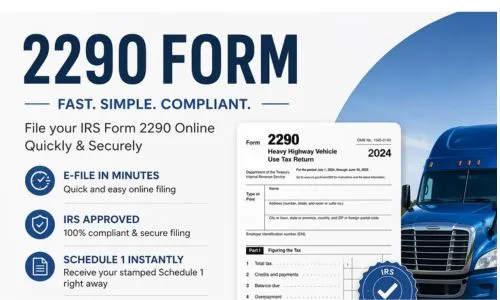
If your commercial truck weighs over 55,000 pounds gross and runs on public highways, the IRS requires you to pay the Heavy Vehicle Use Tax. Form 2290 is how you report and pay that tax. The stamped Schedule 1 you receive back is your proof of payment — and without it, you cannot register your truck at the DMV or renew your apportioned plates through IRP.
Start 4 Truckers prepares your return, submits it through an IRS-authorized e-file provider, and delivers your stamped Schedule 1 digitally in 1 to 2 business days so your registration renewals stay on track.
The HVUT tax year runs from July 1 through June 30. For trucks already on the road at the start of the period, the filing deadline is August 31. For a truck placed into service mid-year, the deadline falls at the end of the month after the first use month. A truck you start driving in September must be filed by October 31.
Who Must File IRS Form 2290?
Any person or business operating a taxable motor vehicle on public highways during the tax year owes this filing. Three groups deal with it every year.
Owner Operators
You run one truck over 55,000 lbs and haul freight for hire. Form 2290 applies to you every year. There is no minimum mileage that removes the requirement. File, pay the HVUT, and get your stamped Schedule 1 back to keep every registration current.
Fleet Owners
Every qualifying truck in your fleet needs its own entry on the 2290 return, each identified by VIN. A fleet of eight trucks means eight VIN entries. Miss one and that vehicle cannot renew its registration. We build multi-vehicle 2290 returns cleanly for fleets of any size.
New Truck Owners Mid-Year
Bought a truck in October? You have until November 30 to file the 2290 for that vehicle. The IRS calculates the HVUT on a pro-rated basis from the first use month. We file for new vehicles quickly so your registration stays on schedule from day one.
How Start 4 Truckers Files Your 2290 and Delivers Your Schedule 1
You do not need to navigate the IRS e-file portal. You do not need to figure out which gross taxable weight category your truck falls into. Give us the basics and we handle the return from preparation through submission.
You Give Us the Basics
Your Tax id, VIN numbers, gross taxable weight, and first use month. If your business does not yet have an Tax id, we file that first through our Tax id registration service and then move straight to your 2290.
We Prepare the Return
Our team builds the complete Form 2290, verifies every VIN against IRS format requirements, and confirms weight categories before anything is submitted. One wrong digit in a VIN causes a rejection that delays your Schedule 1 by days.
IRS E-File Submission
We submit electronically through an IRS-authorized e-file provider. No mailing, no waiting on manual processing. The IRS accepts and timestamps the return the same business day in most cases
Stamped Schedule 1 Delivered
Once the IRS accepts the return, you receive your stamped Schedule 1 digitally. Take it to the DMV for vehicle registration renewal. Use it for your IRP apportioned plate renewal. Your truck is clear to operate
What the IRS Does When You Miss the Form 2290 Deadline
The IRS penalty for a late Form 2290 is 4.5 percent of the total HVUT owed per month, charged for up to five months. On top of that, monthly interest accumulates on the unpaid tax. A $550 bill left unfiled for four months grows past $660 before the IRS sends a notice. The bigger problem is not the penalty itself — it is what the missing Schedule 1 does to your registrations.
Registration Blocked
Without a current stamped Schedule 1, your state DMV will not process your commercial vehicle registration renewal. Your truck cannot legally operate on public highways until the filing is complete and paid.
IRP Plates Held
The IRP office will not issue or renew your apportioned cab card without proof of HVUT payment. If you haul across state lines, your cab card goes invalid. Every mile you run on an expired cab card is an out-of-service risk at any weigh station.
Cascading Compliance Problem
A missed 2290 stalls every renewal that depends on the stamped Schedule 1. One missed filing creates a backlog across your DOT compliance documents that takes time and money to unwind. We catch late filers and get them current the same day they call.
How IRS Form 2290 Connects to Your Other Trucking Registrations
The stamped Schedule 1 from your 2290 filing connects directly to several other registrations that keep your truck legal and operating. Understanding the full sequence helps you avoid gaps.
IRS Form 2290 / HVUT
Annual tax return for trucks over 55,000 lbs. Produces the stamped Schedule 1 required for all renewals below.
State DMV Registration
Annual commercial vehicle registration at your base state. Requires a current stamped Schedule 1 for any truck over 55,000 lbs.
IRP Apportioned Plates
International Registration Plan cab card for multi-state haulers. Cannot be issued or renewed without a current Schedule 1.
USDOT Number (FMCSA)
Federal carrier identification. FMCSA safety audits review your 2290 compliance history as part of your overall operating authority record.
Your USDOT Number Application Now Goes Through FMCSA Motus
Motus is the FMCSA's new registration platform that replaced the old Unified Registration System starting May 14, 2026. If you are applying for a USDOT number today, your application goes through Motus, not the legacy portal. The process itself has not changed. You still apply, verify your business information, and receive your USDOT number the same way. What changed is the platform you do it through. Motus adds identity verification through IDEMIA as part of the process, so having your business details accurate and ready before you start prevents delays. Start 4 Truckers files your USDOT registration through Motus correctly from the first submission.
Six Reasons Truckers Trust Start 4 Truckers for Their 2290 Filing
We work only with trucking businesses. Every client we handle is an owner operator, a small fleet, or a motor carrier getting set up for the first time. That means we understand exactly where the stamped Schedule 1 goes downstream and we file accurately the first time.
IRS Authorized E-File
We submit through an IRS-authorized e-file provider. Your return goes directly to the IRS electronically. You get your stamped Schedule 1 back fast, not after waiting on mail processing.
VIN Verification Before Submission
One incorrect digit in a VIN causes the IRS to reject the entry. We verify every VIN before we submit. Rejected entries delay your Schedule 1 and push back your DMV and IRP renewals.
Multi-Vehicle Fleet Filings
Fleet owners with two, ten, or thirty trucks need every vehicle filed correctly. We build the complete 2290 return with all VINs, weights, and use dates and submit it as one coordinated filing.
Full Startup Sequence Support
Filing a 2290 is one step in a longer process. We handle LLC formation, Tax id registration, USDOT registration, MC authority, BOC-3 filing, and UCR Registration all in sequence so nothing falls through the gaps.
Flat-Rate Pricing, No Surprises
The IRS tax amount is quoted separately from our service fee. Both are disclosed before you pay anything. No bundled pricing, no hidden compliance charges added after the fact.
Live Support When You Need It
Call (210) 588-9348 or email info@start4truckers.com. Real people answer. If you have a question about your return, your Schedule 1, or what comes next with your IRP renewal, we walk you through it.
Frequently asked questions
Starting a trucking business is not just about knowing how to drive. It is about building a legal, compliant operation that brokers will load, banks will fund, and the FMCSA will not shut down.
The standard deadline is August 31 for trucks already on the road at the start of the July 1 tax year. For a truck placed into service after July 1, the deadline is the last day of the month following the first use month. A truck first driven in September must have its 2290 filed by October 31. Start 4 Truckers files the same day you submit your information so you never have to watch the calendar.
The stamped Schedule 1 is the document the IRS sends back after accepting your Form 2290. It proves you paid the HVUT for a specific vehicle and tax year. State DMVs require it for commercial vehicle registration renewals. IRP offices require it for apportioned plate renewals. A truck without a current stamped Schedule 1 cannot complete either process.
The IRS HVUT ranges from about $100 to a maximum of $550 per vehicle per year based on gross taxable weight. Our service fee for preparation and e-file submission is separate and disclosed upfront before you pay anything. Visit start4truckers.com/plans-and-pricing or call (210) 588-9348 for current rates.
No. The IRS requires an Employer Identification Number to process Form 2290 and will not accept a Social Security Number in its place. If your trucking business does not yet have an Tax id, we file that first through our Tax id registration service and then file your 2290 immediately after. Both can be completed in the same week.
Yes. If your truck is expected to travel 5,000 miles or fewer in the tax year — 7,500 for agricultural vehicles — it qualifies as a suspended vehicle and you owe no HVUT. But the IRS still requires you to file Form 2290 to declare the suspension. Skipping the filing entirely is a violation even when no tax is owed.
If you sell or transfer a vehicle after paying the HVUT and the truck continues operating under the same tax year, you may be eligible for a tax credit on a future 2290 return. We help fleet owners and owner operators calculate and claim the credit correctly so it applies to next year’s filing.
The IRS will reject that vehicle entry and your Schedule 1 will not include that truck. The registration renewal for that specific vehicle stalls until you refile with the corrected VIN. We verify every VIN before submission to prevent this. If a rejection happens for any reason, we refile at no additional charge.
Yes. When you purchase a used truck and put it into service, a new 2290 filing is required for that vehicle under your EIN for the current tax year. The previous owner’s filing does not transfer to you. The deadline is the last day of the month after your first use month. We file new vehicle additions quickly so you are not left waiting on registration.
Testimonials
“Filed my 2290 on a Monday, had my stamped Schedule 1 by Wednesday. My IRP renewal went through that same week without any problems. These guys know the trucking compliance process end to end.”
— Carlos M., Owner Operator — Texas
“I missed my deadline last year and paid an IRS penalty. This year I called Start 4 Truckers in July and they had my 2290 filed before August 31. No late fees, no stress, and my Schedule 1 was in my hands fast.”
— Denise W., Fleet Owner — Florida
File Your 2290 Today. Get Your Stamped Schedule 1 Fast.
We prepare the return, submit it to the IRS, and deliver your Schedule 1 so your truck stays registered and legal.
All 50 States · IRS Authorized E-File · 1 to 2 Business Days · Flat-Rate Pricing