If you have seen a USDOT number followed by a letter, such as 1234567B, you’ve run into one of the most visible changes in FMCSA’s new registration system. These USDOT number suffixes in Motus are easy to misread, and a lot of online content has them wrong. Some of it says MC numbers are gone. Some say suffixes must go on your trucks. Some say every existing carrier now has one.
This guide sticks to what FMCSA has published, and it flags where the agency’s own wording draws a line.
What are USDOT number suffixes in Motus?
Motus is FMCSA’s USDOT Registration System. Suffixes help identify the entity type and or the registrations FMCSA has granted, and they are displayed in Motus for reference.
In simple terms, the USDOT number still identifies the company. The letters after it tell you which registrations that company holds, that is carrier authority, broker authority, freight forwarder authority and so on.
This sits inside a larger change. FMCSA says it will keep identifying all regulated entities by a USDOT number as the unique identifier. The suffix adds detail to that number. It does not replace it.
The Official Suffix Codes
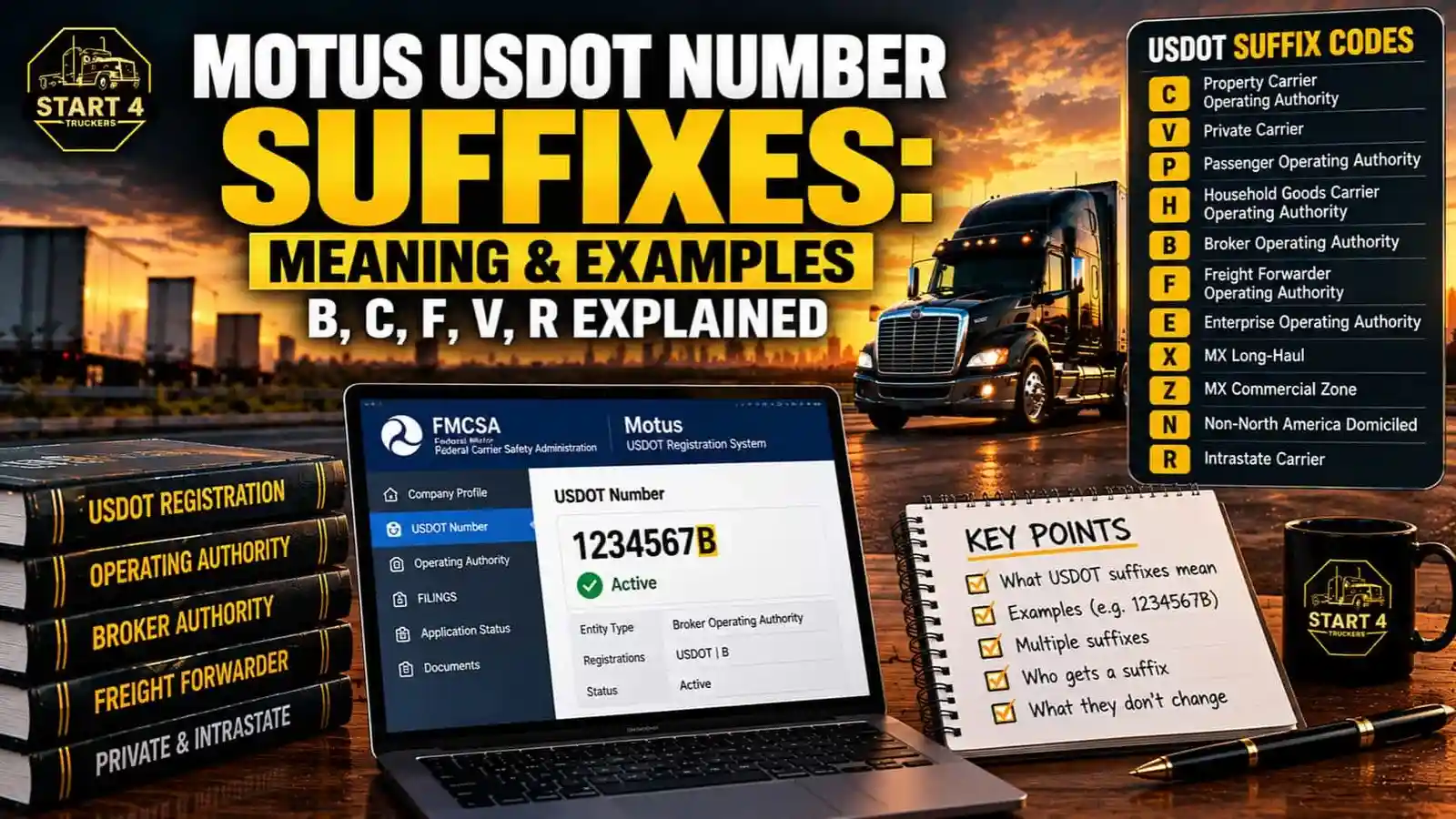
FMCSA lists the following suffixes:
| Suffix | Registration type |
| C | Property Carrier Operating Authority |
| V | Private Carrier |
| P | Passenger Operating Authority |
| H | Household Goods Carrier Operating Authority |
| B | Broker Operating Authority |
| F | Freight Forwarder Operating Authority |
| E | Enterprise Operating Authority |
| X | MX Long-Haul |
| Z | MX Commercial Zone |
| N | Non-North America Domiciled |
| R | Intrastate Carrier |
Cargo Tank, Intermodal Equipment Provider, and Hazardous Materials entities do not have their own suffixes.
Who actually sees a suffix?
This is where many guides go wrong. FMCSA’s Motus fact sheet separates two groups. Companies registering for the first time in Motus see suffixes next to their USDOT number in their company account. Registrants with existing USDOT numbers do not.
If you have held a USDOT number for years, your number has not changed and Motus has not added a letter to it. Existing USDOT and docket numbers do not change. So a suffixed number tells you something else too: the company probably registered in Motus rather than before it.
Can one USDOT number have multiple suffixes?
Yes. FMCSA says a registrant may have multiple suffixes after its USDOT number to identify the specific registrations it holds, and an entity with multiple operating authorities will have more than one suffix.
FMCSA’s published examples, using a placeholder number:
- 1234567C: a property carrier
- 1234567CH: a property carrier that also holds household goods authority
- 1234567CF: a property carrier that also holds freight forwarder authority
- 1234567B: a broker
These four are the examples in FMCSA’s own material. Other combinations follow the same logic: each authority the company holds adds its letter. We haven’t seen FMCSA publish a rule for letter order, so don’t treat the order as meaningful.
What does the B suffix mean on a USDOT number?
B stands for Broker Operating Authority. A number such as 1234567B tells you the registrant holds broker authority.
This is the suffix people search for most, because it reaches shippers and carriers who check who they’re dealing with. When you see a B:
- The company is registered as a property broker.
- If the same number also shows C or F, the company holds those authorities too.
- The suffix tells you what type of registration exists. It doesn’t tell you the company’s status, insurance, or safety record. For that, check the company’s record in Motus.
Why doesn’t a broker’s USDOT number just use an MC number?
There are so many people searching “broker B suffix instead of MC number.” The phrasing assumes the suffix replaced the MC number. As of now, it hasn’t, and this is the claim most worth correcting.
Here is the actual position:
- FMCSA has proposed no longer assigning MC numbers, but the change is under consideration, would go through a Notice of Proposed Rulemaking, and does not take effect with the first release of the new registration system.
- In the April 29, 2026 Federal Register notice, FMCSA said the Phase II release of Motus would not include the elimination of MC/FF numbers, safety registration, or changes to the Form BOC-3 filing process.
- FMCSA’s own “what’s coming” page says these proposed changes remain under consideration and will be open for public comment in a Notice of Proposed Rulemaking.
So a new broker can still receive a docket number. What has changed is how it’s issued: Motus assigns a unique docket number to each newly granted authority. The docket prefixes MC, MX and FF stay in use.
Older articles say MC numbers ended on October 1, 2025. That date was discussed in industry circles, but FMCSA never set it as a cutoff, and there’s no official date for eliminating MC numbers. If an article gives you a firm end date for MC numbers, treat it as out of date.
USDOT suffix vs. MC number: what’s the difference?
They answer different questions.
- USDOT number (with suffix): who the company is, and which types of registration it holds.
- MC, MX or FF docket number: a specific operating authority and the proceedings tied to it.
FMCSA’s own explanation helps here. MC numbers were never a statutory or regulatory requirement, and FMCSA historically used them to track proceedings for a single operating authority registration, not to identify a particular person or company. The USDOT number is the statutory identifier.
If FMCSA ever stops issuing the MC numbers then the existing ones would not simply be converted. FMCSA says that if it stops issuing MC numbers, then the existing ones will not be replaced by USDOT numbers.
Do suffixes go on trucks?
No. Suffixes are not a vehicle marking requirement. Your power units keep their current USDOT marking and you don’t need new decals. FMCSA repeats this in its fact sheet and its prep materials.
Where suffixes do matter: documents and correspondence
Here the Federal Register notice carries a detail most blogs skip. FMCSA says suffixes are not required for marking commercial motor vehicles, but are required by statute for identification on documents for business transactions involving freight forwarders, brokers, or motor carriers (for-hire non-exempt carriers).
The same notice adds that the suffixes are only visible in the system for ease of use at this time and will not change in formal Agency correspondence such as letters, notices and orders.
Read together, these two statements point to a practical question that FMCSA hasn’t fully answered in the sources we reviewed: how a company should show its suffix on contracts, rate confirmations and similar documents. If you issue or sign transaction documents, confirm the current expectation with FMCSA or your compliance adviser before changing templates.
How suffixes fit with the other Motus changes
Suffixes are one of several changes announced together.
Randomized numbers. To help prevent fraud, Motus randomizes newly issued USDOT numbers and operating authority docket numbers. Randomization applies to new numbers only.
One docket per new authority. Each newly granted authority gets its own docket number and its own history, even if you requested several in one application. Authorities that already share a docket number keep sharing it.
Clearer statuses. Status names are unchanged, but Motus adds reasons for pending applications. Examples include “Pending – FMCSA Review,” “Pending – Process Agent (Form BOC-3) Filings,” and “Pending – Financial Responsibility Filings.”
Identity and business verification. New applicants must pass identity proofing, and the Federal Register notice says FMCSA expects to verify roughly 800,000 existing registrants when they first access the system.
Timeline. FMCSA moved registration functions to Motus after a short blackout like URS and the registration options in the FMCSA Portal sunset permanently on May 14, 2026, with legacy registration functions offline until May 18. Industry sources date the all-user launch to May 19.
Common myths about USDOT suffixes
- MC numbers are gone. Not as of FMCSA’s published position. They’re proposed for phase-out, not eliminated.
- Every USDOT number now has a letter. No. Existing registrants don’t see suffixes.
- I have to add the letter to my truck.No.
- A suffix proves a company is safe or authorized. No. It labels registration type only. Check status, insurance and BOC-3 filings in the company’s record.
FAQs
What are the new USDOT number suffixes in Motus?
Letter codes displayed after new USDOT numbers: C, V, P, H, B, F, E, X, Z, N and R. Each identifies an entity type or registration granted.
What does the letter B mean after a USDOT number?
Broker Operating Authority.
Does a B replace the MC number for brokers?
No. FMCSA has proposed ending MC numbers, but that isn’t part of the current Motus rollout, and new authorities still receive docket numbers.
Can a registrant have multiple suffixes?
Yes. FMCSA’s examples include 1234567CH and 1234567CF.
What do C, B, F, V and R mean?
C is Property Carrier, B is Broker, F is Freight Forwarder, V is Private Carrier, and R is Intrastate Carrier.
Do existing USDOT numbers receive suffixes?
No. Suffixes are for companies registering for the first time in Motus.
Do suffixes need to appear on trucks?
No. FMCSA states they aren’t a vehicle marking requirement.
Can one USDOT number show both carrier and broker suffixes?
Yes, when the company holds both authorities. Every authority held is displayed.
Do USDOT number suffixes affect MCS-150 biennial update deadlines?
No. USDOT number suffixes identify registration types in Motus. They do not determine when your MCS-150 biennial update is due. FMCSA uses the final two digits of your USDOT number to determine the required filing month and year.