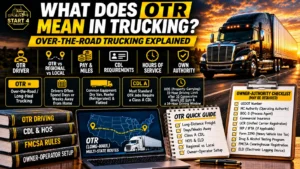
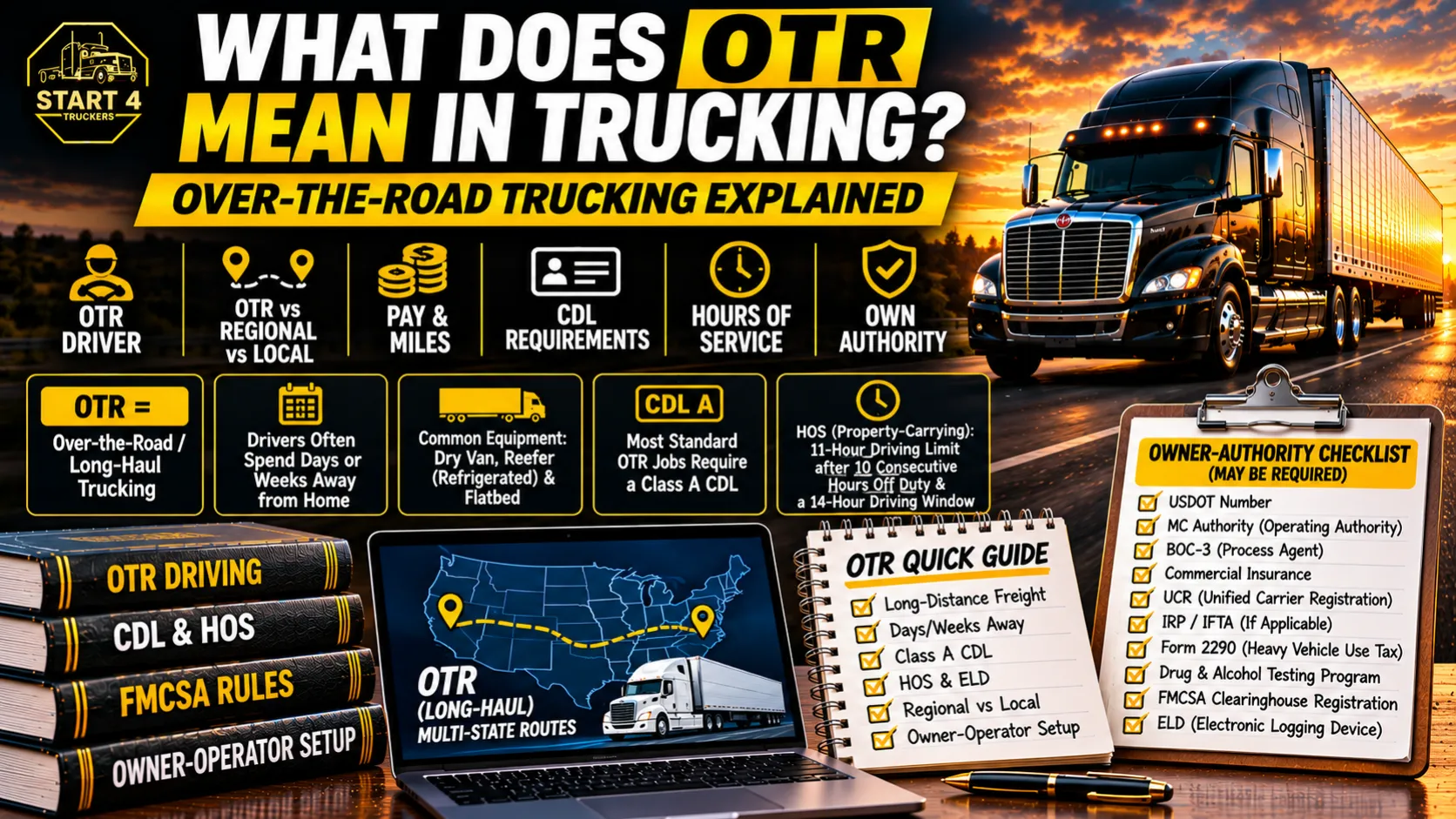
OTR stands for over-the-road. In trucking, it describes long-distance freight hauling, often across multiple states, with drivers spending days or weeks away from home. You’ll also hear it called long-haul trucking.
You’ll see the term in job ads, on load boards and in descriptions of freight lanes. This guide explains what OTR drivers do, how their pay works, which qualifications they need, and how the work compares with regional and local trucking. The business-registration section applies if you plan to operate your own truck.
What Does OTR Stand for in Trucking?
OTR is short for over-the-road. Carriers use it for long-distance work across a wide area, rather than routes centered on one city or a smaller region. It is an industry term, and there is no universal federal mileage cutoff. Ask how a carrier defines its OTR division when comparing jobs.
OTR and interstate commerce also describe different things. Regional or local work can fall under interstate rules, including some trips where the truck stays inside one state. See FMCSA’s interstate and intrastate definitions for the federal classification.
What Is an OTR Driver?
An OTR driver, or over-the-road truck driver, hauls freight on long-distance routes. Many drive tractor-trailers and sleep in the truck’s sleeper cab between shifts. They may work solo or share a truck with a team partner.
Company drivers use their employer’s equipment. Owner-operators own or finance a truck and either operate under their own authority or lease onto another carrier. Those arrangements change who handles dispatch, operating expenses and business filings.
What Does an OTR Truck Driver Do?
A typical OTR truck driver job description includes driving, equipment checks and the paperwork needed to move each load. Common duties include:
- Driving a tractor-trailer, usually pulling a dry van, a reefer (refrigerated trailer) or a flatbed
- Picking up freight from shippers and delivering it on long-distance lanes, often across state lines
- Doing pre-trip and post-trip inspections and reporting any defects
- Planning fuel stops, rest breaks and truck parking around hours-of-service (HOS) limits
- Keeping paperwork in order, such as bills of lading, electronic logging device (ELD) logs and fuel receipts
- Living out of a sleeper cab for most of the trip
A week might start with a pickup in Georgia, a delivery in Texas two days later, then a reload heading to Illinois. Dispatch lines up the next load. For an owner-operator, that usually means finding freight through a freight broker or load board. The goal is a good backhaul so the truck does not run empty for long. Empty miles are called deadhead, and they cost money.
Many carriers run OTR drivers on a schedule such as two to three weeks out followed by a few days at home. This varies by company, so always ask for the home-time policy in writing.
Team driving is common in OTR. Two drivers share one truck. One drives while the other rests in the sleeper berth, so the truck keeps moving while each driver stays within their own HOS limits.
A company driver’s dispatcher generally arranges freight. An owner-operator with independent authority may book loads directly, use a broker or work with a dispatch service. A leased-on operator’s arrangement depends on the carrier agreement.
OTR vs. Regional vs. Local Trucking
The main differences come down to distance, home time and how you get paid.
| Comparison | OTR | Regional | Local |
| Operating area | Long-distance lanes across a wide area | A defined region, often several neighboring states | A city, metro area or nearby delivery territory |
| Common home-time pattern | Often 1 to 3 weeks away | Often home weekly or on weekends | Often home daily |
| Common pay method | Cents per mile, percentage, salary or other carrier plan | Cents per mile, hourly, percentage or salary | Often hourly, salary or route-based pay |
| Typical work | Long-haul freight, including truckload and some linehaul work | Regional truckload, linehaul or dedicated assignments | Local pickup and delivery, distribution and other short routes |
| Equipment | Often a sleeper tractor | Sleeper or day cab, depending on route | Often a day cab or straight truck |
| Stops and handling | Often fewer stops on full-truckload lanes | Varies with the account and freight | May involve more stops and freight handling |
These are common industry patterns, not legal categories. Each carrier defines its own divisions.
When comparing regional vs. OTR trucking, ask about the actual schedule and average paid miles. OTR may provide more miles, while regional work may make home time easier to predict. Neither arrangement guarantees higher earnings.
Local trucking often gets drivers home daily, but the work may involve more stops, city traffic and physical handling. Confirm the shift and unloading duties before accepting a job.
Regional routes can cross state lines. Dedicated work can also be OTR: “dedicated” describes an assigned customer or account, while OTR describes the long-distance operating pattern. Schneider’s OTR lifestyle guide gives examples of solo, team and dedicated opportunities.
OTR vs. LTL: OTR describes distance. LTL (less-than-truckload) describes load size: several smaller shipments from different customers share one trailer. Some LTL linehaul drivers cover long distances, but much LTL work is local pickup and delivery.
How Much Do OTR Truck Drivers Make?
The U.S. Bureau of Labor Statistics reports a median annual wage of $58,640 for heavy and tractor-trailer truck drivers (May 2025). This figure covers the occupation as a whole, not OTR drivers alone.
For a cents-per-mile (CPM) job, multiply paid miles by the agreed rate to estimate mileage pay. As an illustrative calculation, 2,500 paid miles at $0.60 per mile produces $1,500 gross before taxes and deductions. That is a calculation example, not a typical weekly-pay promise.
OTR company drivers are often paid by the mile. The rate depends on the carrier, experience, freight and how paid miles are calculated. Tanker, hazmat or flatbed positions may pay differently from dry van work. Compare current offers using average weekly gross pay and the work required to earn it.
These terms affect what you earn:
- Paid miles vs. actual miles. Some carriers pay household-goods or short-route miles, which can be lower than the miles you actually drive.
- Detention pay. Extra compensation for qualifying delays at a shipper or receiver. The free waiting period and payment amount depend on the carrier, broker, or shipper agreement. Ask when detention pay starts and what documentation is required.
- Stop pay and layover pay. Extra pay for added stops or a forced day without a load.
- Per diem. Some carriers offer per diem programs for nights away from home. Ask a tax professional how this affects you.
- Sign-on bonuses. Read the payout schedule. Many pay out over months, not upfront.
When you compare job offers, ask for average weekly paid miles over the last few months, not the best week a driver ever had.
For owner-operators, compensation may be based on a percentage of load revenue, a per-mile rate, or an agreed amount per load. From that revenue, you cover fuel, insurance, maintenance, the truck payment, permits and fuel taxes. Know your cost per mile before you accept a load.
OTR CDL Requirements
There is no separate “OTR CDL.” The vehicle and work determine the license class and endorsements. Most standard tractor-trailer OTR jobs require a Class A CDL. A different vehicle may have different licensing requirements.
- Class A CDL. Under FMCSA’s license classifications, Class A generally applies when the combination’s gross combination weight rating or actual gross combination weight, whichever is greater, is at least 26,001 pounds, and the towed unit’s weight rating or actual gross weight, whichever is greater, exceeds 10,000 pounds.
- Minimum age. Standard interstate CMV driving generally requires drivers to be at least 21. Many states issue CDLs at 18 for intrastate work. OTR job applicants should check both the legal requirements and the carrier’s hiring policy.
- Entry-Level Driver Training (ELDT). Covered first-time Class A applicants and Class B-to-A upgrades must complete required ELDT before the skills test. First-time hazardous-materials endorsement applicants need the required training before the knowledge test. Find eligible providers through FMCSA’s Training Provider Registry.
- DOT medical certificate. Most non-excepted interstate CMV drivers must pass a DOT physical with a medical examiner listed on FMCSA’s National Registry. A medical examiner’s certificate may be valid for up to 24 months, but the examiner can issue a shorter certificate when follow-up monitoring is needed.
- Drug and alcohol testing. CDL drivers operating CMVs covered by federal testing rules are subject to pre-employment drug testing and random drug and alcohol testing. Employers must receive a negative pre-employment drug test result before allowing a driver to perform safety-sensitive duties. They must also conduct the required Clearinghouse query before hiring a driver for those duties and query current drivers at least annually.
- English proficiency. Federal rules require interstate CMV drivers to read and speak English well enough to communicate with the general public, understand highway traffic signs and signals, respond to official questions, and make entries on reports and records. FMCSA’s 2026 English-proficiency enforcement guidance explains the roadside assessment and applicable exceptions.
- Endorsements (when required for the freight or vehicle). H is for hazardous materials and requires a TSA security threat assessment. N is for tank vehicles. T is for doubles and triples. X combines the tank vehicle and hazardous materials endorsements. These endorsements may qualify drivers for additional types of work.
How to Become an OTR Truck Driver
- Confirm you are at least 21 and can pass a DOT physical.
- Get a commercial learner’s permit (CLP) from your state.
- Complete ELDT with a registered training provider.
- Pass the CDL skills test and get your Class A CDL.
- Apply to carriers that hire new drivers. Many start new drivers on OTR runs.
- Obtain any required endorsements before accepting work that needs them.
If you are still deciding between license types, see our guide to CDL vs. non-CDL trucking.
Hours of Service Rules for OTR Drivers
FMCSA’s hours-of-service rules shape every OTR trip. For property-carrying drivers:
- 11-hour driving limit: up to 11 hours of driving after 10 consecutive hours off duty.
- 14-hour window: under the standard rule, no driving beyond the 14th consecutive hour after coming on duty following 10 consecutive hours off duty. Ordinary off-duty breaks do not extend this window. Qualifying sleeper-berth splits and adverse-driving-condition exceptions are addressed below.
- 30-minute break: required after 8 cumulative hours of driving without at least a 30-minute interruption. Any consecutive 30-minute period of non-driving time can satisfy the break, including off-duty time, sleeper-berth time, or on-duty time when not driving.
- 60/70-hour limit: no driving after 60 on-duty hours in 7 days or 70 hours in 8 days.
- 34-hour restart: 34 or more consecutive hours off duty resets the 60/70-hour clock.
- Sleeper berth split: Drivers may split their required 10 hours off duty into two qualifying periods. One period must be at least 7 consecutive hours in the sleeper berth, and the other must be at least 2 consecutive hours off duty or in the sleeper berth. The two periods must total at least 10 hours. When properly paired under the rule, neither period counts against the 14-hour driving window.
- Adverse driving conditions: Drivers may extend the 11-hour driving limit and the 14-hour driving window by up to 2 hours when qualifying adverse driving conditions were not known, or could not reasonably have been known, before the driver began the trip.
The short-haul exception is separate from the industry’s OTR label. Eligible property-carrying drivers may use it when they stay within a 150-air-mile radius of their normal work-reporting location, return there, and are released from work within 14 hours, while meeting the other applicable conditions. It provides relief from specified logging requirements; it does not define where OTR begins.
Drivers outside that exception must follow the applicable record-of-duty-status rules. Most drivers required to keep those records need an electronic logging device (ELD), unless another exemption applies.
Detention, traffic and the search for truck parking can use up the available driving window. Plan parking before reaching your limit, rather than counting on finding an open space at the last stop.
Running OTR With Your Own Truck
Owning the truck gives you two main options: lease onto an authorized carrier or operate under your own authority. With a lease-on arrangement, confirm who handles registration, insurance, plates, fuel-tax reporting and other obligations. The written agreement matters.
If you plan to haul regulated freight for hire in interstate commerce under your own authority, review these requirements:
- USDOT number: identifies your company with FMCSA.
- MC operating authority: Generally required for for-hire interstate carriers transporting federally regulated property for compensation. Private carriers and for-hire carriers transporting exclusively exempt commodities generally do not need this authority. FMCSA charges a $300 application fee for each authority type requested.
- BOC-3 filing: names a process agent in each state.
- Insurance: your insurer submits the required liability filing to FMCSA. For non-hazardous for-hire property carriers using vehicles with a GVWR of 10,001 pounds or more, the federal liability minimum is generally $750,000. Cargo, vehicle and operation can change the applicable requirements. Brokers and shippers may require higher liability limits and cargo coverage.
- UCR registration: an annual registration for interstate carriers.
- IRP apportioned plates and IFTA: for qualifying trucks that run in more than one state.
- Form 2290: the filing for Heavy Vehicle Use Tax on highway motor vehicles with a taxable gross weight of 55,000 pounds or more, subject to applicable exemptions and tax-suspension rules.
- Drug and alcohol program and Clearinghouse registration.
- ELD: required for most drivers who must keep logs.
New interstate property carriers generally undergo a safety audit within their first 12 months of operations, as part of an 18-month new-entrant monitoring period. Keep driver, maintenance and operating records from the start. FMCSA’s New Entrant Safety Assurance Program explains the process.
FMCSA moved registration tasks to Motus in 2026. Follow the current account and identity-verification instructions when applying or updating records.
A company driver generally works under the employer’s carrier registrations. Taking an OTR driving job does not, by itself, mean you need to open a trucking business or apply for your own MC authority.
Start4Truckers.com helps businesses with USDOT, MC authority, BOC-3, UCR and related filings. If you plan to operate independently, ask us which filings apply to your operation. We are a private filing service, not a government agency. Government fees are separate from service fees, and you can file directly with the relevant agencies.
Is OTR Trucking Worth It? Pros and Cons
Pros:
- Potential for more paid miles, depending on dispatch, freight and available hours
- Entry-level opportunities with carriers that provide new-driver training
- A wide choice of freight and lanes for owner-operators
- Fewer daily stops than local delivery work
Cons:
- Long stretches away from family
- Loneliness, especially in the first few months
- Irregular sleep when loads run at night
- Hard-to-find truck parking and long detention waits
- Health strain from long hours of sitting and truck-stop food
- Your week depends heavily on a good dispatcher relationship
OTR may suit you if you enjoy long-distance driving and can manage extended time away from home. Some drivers use it to build experience before moving to regional or local work; others prefer it as a long-term job. The carrier’s schedule, equipment and pay plan will affect that decision as much as the route label.
Questions to Ask Before Accepting an OTR Job
Ask the recruiter about the specific account or division you would join. Company-wide averages may not describe that job.
- How many days or weeks will I be out, and how is home time scheduled?
- What are the average weekly paid miles for this position, and are any earnings guaranteed?
- Are miles calculated using practical routes, household-goods mileage or another method?
- When does detention or layover pay start, and what records do I need to qualify?
- Will I load, unload, tarp or handle freight, and is that work paid separately?
- If I leave, do I owe training costs or have to repay a bonus?
Get the pay terms and any repayment agreement in writing. Compare the likely weekly earnings with the hours, expenses and time away involved.
Frequently Asked Questions
What does OTR mean in trucking?
OTR means over-the-road. It refers to long-haul trucking, where drivers haul freight long distances, usually across several states, and stay away from home for days or weeks.
Is OTR the same as long-haul trucking?
Yes. Most carriers use the two terms the same way.
How long are OTR drivers on the road?
It depends on the carrier. Many OTR schedules run two to three weeks out, followed by a few days at home. Team and dedicated OTR runs can follow different schedules.
What is the difference between OTR and regional trucking?
OTR covers long routes nationwide with less frequent home time. Regional trucking stays within a set group of states and usually gets drivers home weekly.
How many hours can an OTR driver drive in a day?
Under the standard property-carrier rule, up to 11 hours of driving after 10 consecutive hours off duty, within a 14-hour driving window. Weekly limits and applicable break requirements still apply. Qualifying sleeper-berth splits and adverse-driving conditions can affect the calculation.
Do you need a special CDL to drive OTR?
No separate OTR license exists. Standard tractor-trailer jobs generally require a Class A CDL. The vehicle determines the license class, and the work determines required endorsements. Drivers generally must be at least 21 for interstate CMV work and meet applicable medical requirements. Endorsements are mandatory when the freight or equipment requires them.
How much do OTR drivers make per mile?
There is no single OTR mileage rate. Compare current offers by carrier, experience, freight and the method used to calculate paid miles. For illustration, $0.60 per mile multiplied by 2,500 paid miles equals $1,500 in gross mileage pay, before other pay, taxes and deductions.
What are OTR routes?
OTR routes are long-distance lanes, such as Southeast-to-Midwest or coast-to-coast freight. Some assignments change from load to load. Others are dedicated to a customer or account and may follow a more consistent pattern.
Can I run OTR with my own truck?
Yes. You can lease onto an authorized carrier or operate independently. If you haul regulated freight for hire in interstate commerce under your own authority, you generally need USDOT registration, MC authority, BOC-3, required insurance filings and UCR. IRP, IFTA and other filings depend on the vehicle and operation. Private carriers and carriers hauling exclusively exempt commodities may not need MC authority.