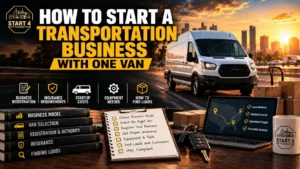
Every year, thousands of company drivers make the same decision: stop building someone else’s business and start building their own. Becoming an owner-operator truck driver is one of the most direct paths to financial independence in American trucking, but it is not a simple step. It is a full business launch, and it demands that you treat it like one.
In this blog, we will guide you through every stage from earning your CDL to getting your DOT number, forming your LLC, securing commercial truck insurance, and pulling your first load under your own trucking authority. No fluff. No skipped steps.
What Is an Owner Operator, Exactly?
An owner-operator is a truck driver who owns or leases their own commercial motor vehicle and operates as an independent business. You are not an employee. You are a motor carrier. That distinction matters legally, financially, and operationally.
As an owner operator, you decide what freight you haul, what lanes you run, and what rates you accept. You are also responsible for every compliance regulation, expense, and tax filing that comes with running a trucking business. The upside is real: owner operators who run efficiently can earn significantly more per mile than company drivers. The accountability is just as real.
There are two ways to operate as an owner-operator:
- Leased to a carrier: You haul under a larger motor carrier’s authority. The carrier provides some insurance coverage and often gives you freight. You have less paperwork but also less freedom.
- Under your own authority: You apply for your own USDOT number and operating authority through the Federal Motor Carrier Safety Administration (FMCSA). You find your own loads, carry your own insurance, and answer to no carrier. More responsibility, more control.
Most new owner operators start leased to a carrier and move to their own authority once they have cash reserves and experience. This guide covers the full path to your own authority because that is where most people want to end up.
Step 1: Get Your CDL (If You Don’t Have One Already)
You cannot operate a commercial motor vehicle without a Commercial Driver’s License (CDL). This is the foundation. Without it, nothing else in this guide applies.
Requirements to get a CDL:
- Be at least 21 years old to drive interstate commerce (across state lines)
- Be at least 18 years old for intrastate operations (within your home state only)
- Hold a valid standard driver’s license
- Pass a DOT physical examination
- Pass a drug test through the FMCSA Drug and Alcohol Clearinghouse
- Pass the CDL written knowledge tests and skills exam
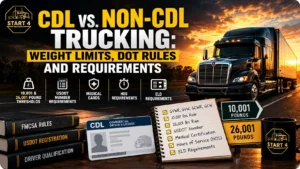
A Class A CDL is what most owner operators need. It lets you operate any combination of vehicles with a gross combined weight rating (GVWR) over 26,001 pounds, where the towed unit exceeds 10,000 pounds, the standard setup for long-haul and regional freight.
CDL training programs at community colleges and commercial driving schools typically run four to eight weeks for full-time courses. Costs vary but generally fall between $3,000 and $10,000. Some carriers offer sponsored CDL training in exchange for a contract period as a company driver, which can reduce or eliminate upfront costs.
Step 2: Gain Real Road Experience Before Going Independent
Getting your CDL is the license to learn, not the license to run your own business. Most successful owner operators spend one to three years driving for a company before going independent. That time is not wasted. It is an investment.
Working as a company driver teaches you:
- How freight movement works across the country
- How to manage hours of service and stay compliant with ELD requirements
- How to read load boards, communicate with brokers, and negotiate rates
- How to handle breakdowns, weather, and the unexpected without losing freight or a customer
- What routes are profitable, and which ones eat your margins
There is also a practical financial reason to wait. Insurance companies look at CDL experience when setting your premiums. Many carriers will not write a policy for owner operators with less than two years of experience, and those that do charge significantly higher rates. New authority owner operators routinely pay $14,000 to $22,000 per year for primary liability and cargo insurance alone. Rates drop as your experience record grows.
Run at least one year as a company driver before seriously planning your launch. Two years is better.
Step 3: Write a Business Plan and Know Your Numbers
Most guides skip this step. It is not optional. It is the difference between owner operators who survive their first year and those who do not.
Before you spend a dollar on filings or equipment, you need to know:
Your startup costs
- LLC formation: $50–$800 (varies by state)
- FMCSA operating authority (MC number) filing fee: $300
- BOC-3 process agent filing: $30–$50
- Commercial truck insurance: $14,000–$22,000 per year
- IRP registration: Around $1,500 per year
- IFTA permits: Cost varies by state
- Equipment costs: Used truck (3–7 years old): $80,000–$150,000
Your operating costs
Fuel is your largest variable expense, often consuming 25 to 35 percent of gross revenue. Add maintenance, truck payment, insurance, permits, and living expenses. Experienced owner operators often say you need at least $15,000 to $20,000 in working capital reserves before your first load.
Your break-even rate per mile
Know what you need to earn per loaded mile just to cover your costs. If you don’t know this number, you will take loads that lose money without realizing it until it is too late.
Step 4: Form Your Business Entity (LLC Recommended)
Before you file anything with the FMCSA, form your business entity. Most owner operators choose a Limited Liability Company (LLC) because it separates your personal assets from your business liabilities. If your truck is involved in an accident and a lawsuit follows, an LLC means your house, savings, and personal property have legal protection that a sole proprietorship does not provide.
How to form an LLC for your trucking business:
- Choose a business name, make sure it is not already registered in your state
- File Articles of Organization with your state’s Secretary of State office
- Pay the filing fee (Florida is $125, Texas is $300, Wyoming is $100)
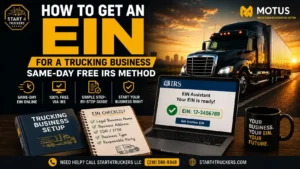
- Obtain an Employer Identification Number (Tax id) from the IRS for free and fast at IRS.gov
- Open a dedicated business bank account never mix personal and business funds
The Tax id is required for your FMCSA filings, your bank account, and your tax filings. Get it before you do anything else with the government.
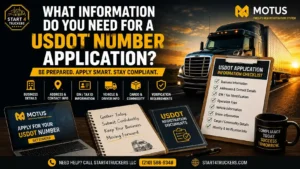
Step 5: Apply for Your USDOT Number
- Your USDOT number is your federal ID with the Department of Transportation.
- Required for operating commercial vehicles across state lines or hauling regulated commodities.
- Apply through the FMCSA Unified Registration System (URS) at fmcsa.dot.gov.
- You’ll need your business name, Tax id, address, operation type, and vehicle details.
- Registration is free.
- Your DOT number tracks your safety record, inspections, crashes, CSA score, and overall compliance, so keep it clean.
If you only haul for one shipper under a private carrier arrangement, you may only need a USDOT number. If you are hauling for-hire freight across state lines, you also need operating authority. You can learn more about the full USDOT and MC authority registration process through our dedicated service page.
Step 6: Apply for Operating Authority (MC Number)
To haul for-hire freight interstate as an owner operator, you need operating authority from the FMCSA what most people call the MC number. This is what legally allows you to pick up loads from brokers and shippers.
- The application fee is $300 per authority type.
- After you apply, a 10-business-day protest period allows existing carriers to object.
- Once cleared, your operating authority is granted.
- Granted authority is not active yet.
- To activate it, you must complete BOC-3, insurance filing, and UCR registration before hauling your first load.
Processing timeline: Plan for 21 to 25 days from application to active authority under normal conditions. Errors in your application, missing insurance filings, or incomplete information extend that timeline significantly. The FMCSA registration guide outlines every requirement in detail.
Step 7: File Your BOC-3 Process Agent Designation
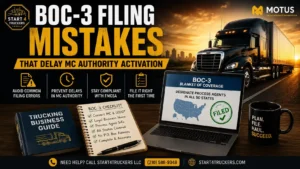
The BOC-3 is a federal filing that designates a process agent in every state where you operate. A process agent is someone who can accept legal documents on your behalf in that state. The FMCSA requires this filing before your operating authority becomes active.
You cannot file a BOC-3 yourself as an individual. It must be submitted by a registered process agent company that maintains agents in all 50 states. The cost is typically $30 to $50.
This is a fast filing, but it must be submitted before the FMCSA activates your authority. Missing this step is one of the most common reasons new carrier registration gets delayed.
Step 8: Get Commercial Truck Insurance
Commercial truck insurance is not just a legal requirement, it is your business protection. The FMCSA will not activate your operating authority until proof of insurance is on file, and that insurance must meet minimum federal coverage requirements.
Federal minimum coverage for for-hire carriers:
- Primary liability: $750,000 for general freight; $1,000,000 for certain commodities
- Motor truck cargo insurance: Required to haul most commercial freight
Those are minimums. Most freight brokers require $1,000,000 in primary liability as a condition of doing business with you.
What to expect on cost:
| Driver Profile | Estimated Annual Premium |
| 2+ years CDL, clean record | $14,000 – $17,000 |
| 1–2 years of CDL experience | $17,000 – $22,000 |
| Under 1 year of CDL experience | $22,000+ (if insurable) |
| Hauling hazardous materials | Add $3,000 – $8,000+ |
Factors affecting your rate include CDL experience, driving record, operating radius, cargo type, the state you operate in most, and your truck’s age and value. Shop multiple insurers and work with a broker who specializes in trucking insurance. Do not accept the first quote you receive.
Step 9: Register for UCR, IFTA, and IRP
Three additional trucking permits and registrations are required before you can legally haul interstate freight:
UCR: Annual interstate carrier registration required for all interstate carriers. Register at UCRregistration.com. For professional assistance with your trucking setup, contact Start4Truckers LLC.
IFTA: Required if you run in 2+ states; provides your fuel tax license/decals and requires quarterly fuel tax reports.
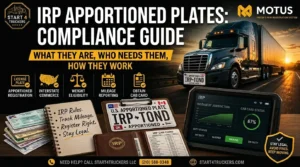
IRP: Apportioned plate that covers all member states; fees depend on mileage (often around $1,500/yr).
Do not wait until the last minute. Some states take one to two weeks to process IRP and IFTA applications.
Step 10: Join a Drug and Alcohol Testing Consortium
Federal regulations require owner operators who operate under their own authority to be enrolled in an FMCSA-compliant drug and alcohol testing consortium. This is not optional.
The FMCSA Drug and Alcohol Clearinghouse, established in 2020, is a federal database that records drug and alcohol program violations for CDL holders. Every owner-operator must be registered in the Clearinghouse and enrolled in a random testing program through a consortium or third-party administrator (C/TPA).
What consortium enrollment covers:
- Pre-employment drug testing
- Random testing throughout the year
- Post-accident testing
- Return-to-duty testing when applicable
Enrollment costs are generally $100 to $200 per year for a qualified random testing program. Setting this up correctly from day one keeps you protected, compliant, and road-ready.
Not sure how to get enrolled or what program fits your operation? Contact Start4Truckers LLC today and we’ll walk you through every compliance requirement so you never miss a step.
Step 11: Get an ELD and Prepare Your Truck for Compliance
The ELD mandate requires most commercial motor vehicle operators to use an electronic logging device to track hours of service. If your truck was manufactured after model year 1999 and is required to keep records of duty status, you need an ELD.
ELD options range from $200 to $600 for the device plus monthly subscription fees of $30 to $80. Always choose an ELD registered on the FMCSA’s list of certified ELD providers.
Beyond the ELD, your truck must pass a DOT inspection before you start hauling. A truck that fails a roadside inspection in your first week can result in out-of-service orders and damage to your CSA score before you’ve established a safety record.
Step 12: Find Freight and Build Your Book of Business
With your authority active, insurance filed, and truck ready, you are officially in business. Now you need freight.
- Use load boards like DAT and Truckstop to find spot freight and connect with brokers.
- Work with freight brokers early on, build relationships with those who pay fast, and treat carriers well.
- Aim to grow direct shipper connections over time for better rates and consistent loads.
- Use freight factoring if needed to maintain cash flow, since most brokers pay in 30–45 days.
How Long Does It Take to Become an Owner-Operator?
If you already have a CDL, the full compliance setup usually takes 4–8 weeks from forming your LLC to activating your authority, with insurance and the FMCSA protest period being the longest steps. If you’re starting from zero, expect 6–12 months total CDL training, driving experience, and then compliance.
Your timeline largely depends on how organized you are; missing documents or filing mistakes can add weeks, which is why many owner-operators use professional filing services to avoid delays.
What Does It Cost to Become an Owner Operator?
Here is a realistic breakdown of startup costs before your first load:
| Item | Estimated Cost |
| LLC Formation (state filing fee) | $100 – $500 |
| Tax id (IRS) | Free |
| USDOT Number | Free |
| FMCSA Operating Authority | $300 |
| BOC-3 Filing | $30 – $50 |
| UCR Registration (1 truck) | ~$176 |
| Commercial Truck Insurance (first year) | $14,000 – $22,000 |
| IRP Registration | ~$1,500 |
| IFTA Registration | $10 – $50 (varies by state) |
| ELD Device + First Month | $200 – $700 |
| Drug & Alcohol Consortium | $100 – $200 |
| Truck (used, 3–7 years old) | $80,000 – $150,000 |
| Working Capital Reserve | $15,000 – $20,000 |
The truck and insurance are by far the highest costs. Everything else is manageable if you plan. Check our Plans & Pricing page to see how we bundle all filing services into affordable, predictable packages.
Ready to Launch Your Trucking Business?
Becoming an owner-operator is a big move, but it puts you in control of your income, schedule, and future. The process may seem complex, but with the right steps, it’s completely achievable.
We take care of the entire compliance setup from LLC and Tax id to USDOT, authority, BOC-3, UCR, and IFTA so you can focus on getting on the road and making money. Check out our Plans & Pricing to get started with Start4Truckers LLC the right way.
Frequently Asked Questions
1. Do I need experience to become an owner-operator?
Most insurers require at least two years of CDL experience. Less experience means much higher premiums, so most drivers gain 2+ years before going independent.
2. Do I need an LLC to become an owner-operator?
You can operate as a sole proprietor, but an LLC is strongly recommended. It protects your personal assets from business liability.
3. How long does it take to get operating authority?
After applying, there’s a 10-business-day protest period. Your authority becomes active once BOC-3 and insurance filings are approved, usually 21–25 days total.
4. What is the difference between a USDOT number and operating authority?
A USDOT number tracks safety and compliance. Operating authority allows you to haul for-hire freight across state lines; most carriers need both.
5. Can I drive for Amazon, UPS, or major shippers as an owner-operator?
Big shippers require time in business and a clean safety record. Most new carriers haul brokered freight for 6–12 months first.
6. What happens if I haul freight before my authority is active?
It’s a federal violation and can void your insurance. Never haul until your authority, BOC-3, and insurance are fully active.
7. Can I apply for a DOT number without owning a truck?
Yes, your DOT number is assigned to your business, not a specific truck. But your authority won’t be operational until a vehicle is listed.
8. What is a CSA score, and why does it matter?
Your CSA score reflects inspections, violations, and crashes. A high score hurts your load opportunities and raises insurance costs.