If you drive a commercial truck across state lines, fuel taxes are part of your life. Every state has its own fuel tax rate. Without a system to manage all of them, you’d need to file taxes in every single state you drove through. That would be a nightmare.
That’s exactly why the IFTA Fuel Tax Agreement exists.
In this blog post, you will know everything about IFTA, what it is, who needs it, how to file, and how to stay compliant. Whether you’re an owner-operator just starting or managing a small fleet, this is your complete reference.
What Is the International Fuel Tax Agreement (IFTA)?
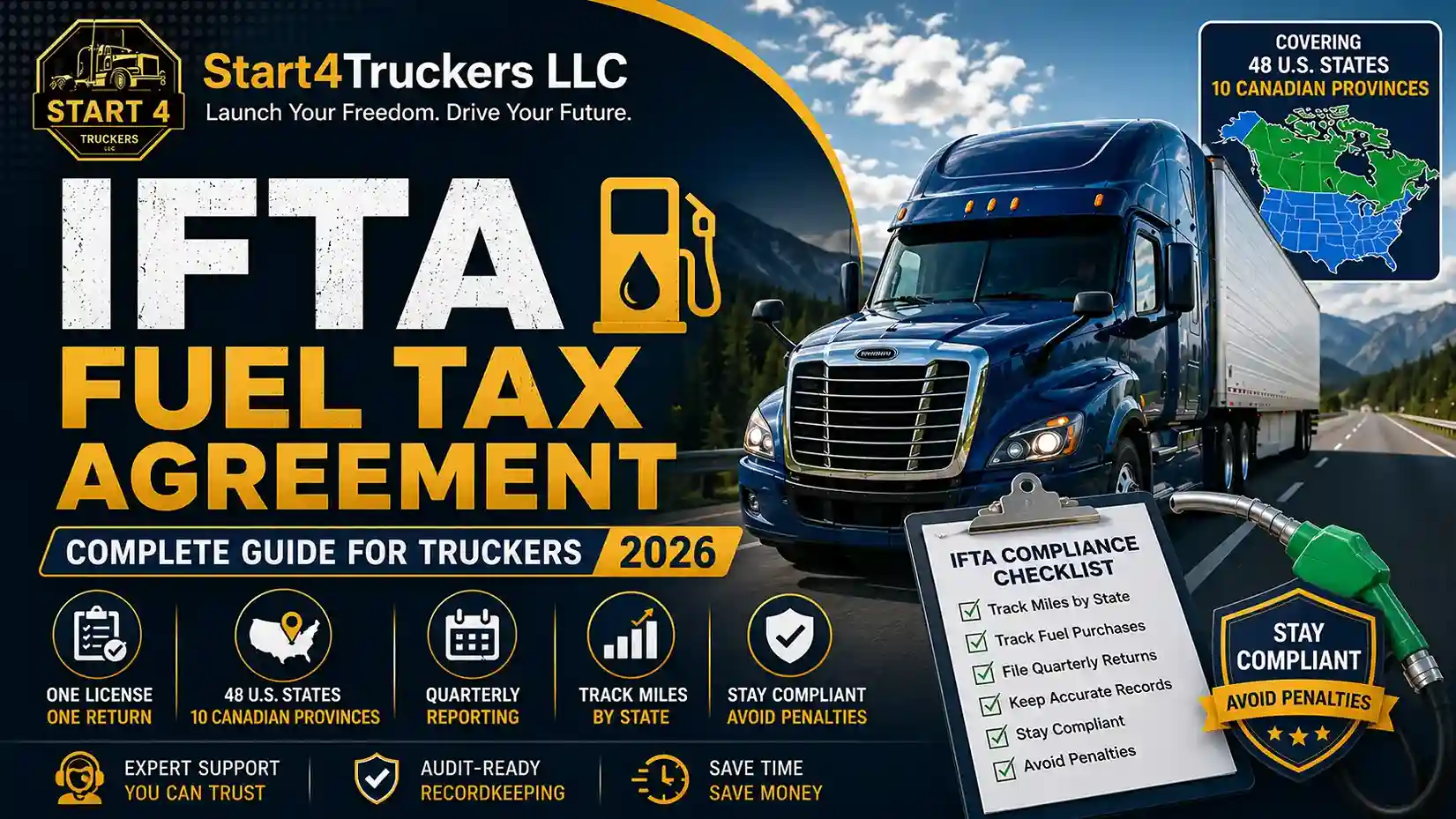
The IFTA Fuel Tax Agreement, short for International Fuel Tax Agreement, is a cooperative program between 48 U.S. states and 10 Canadian provinces. It simplifies fuel tax reporting for commercial carriers operating across multiple jurisdictions.
Here’s the simple version: instead of filing separate fuel tax returns in every state you drive through, you file just one return with your base state. Your base state then handles distributing the tax money to every other state you operate in.
One license. One return. One filing. Done.
The International Fuel Tax Agreement is managed at the state level, with oversight by organizations such as the Federal Motor Carrier Safety Administration (FMCSA) and coordination through the IFTA, Inc. governing body.
Without IFTA, interstate trucking tax rules would require carriers to stop at every state border, purchase trip permits, and file separate reports, costing time, money, and sanity.
If you’re just starting your trucking business, understanding IFTA is step one. Check out this full guide on how to start a trucking company before anything else.
Why Fuel Tax Compliance Matters in the United States
Fuel taxes fund the roads you drive on. Every state collects them to maintain highways, bridges, and infrastructure. The IFTA Fuel Tax Agreement makes sure every state gets its fair share based on how many miles you drove there, not just where you bought fuel.
Without motor carrier compliance, carriers face:
- Heavy financial penalties
- License suspension
- IFTA audit risk
- Out-of-service orders
Commercial trucking regulations in the U.S. are strict. Staying compliant isn’t optional; it’s the foundation of a legally operating business. Don’t leave your compliance to chance. Whether you’re filing for the first time or trying to fix past mistakes, getting professional help early saves you money, time, and stress. Explore our Trucking Compliance Services and let our team handle the details so you can focus on the road.
IFTA Member Jurisdictions
The IFTA Fuel Tax Agreement covers almost all of North America. Here’s a breakdown:
U.S. Member States (48 total notable ones include):
- Texas
- California
- Florida
- New York
- Illinois
- Georgia, Ohio, Pennsylvania, and all remaining 48 contiguous states
Canadian Member Provinces (10 total, including):
- Ontario
- Quebec
- British Columbia
- Alberta
- And six additional provinces
Non-IFTA Jurisdictions:
- Alaska
- Hawaii
- The District of Columbia
- Mexico
If you’re operating in Florida specifically, here’s a helpful resource: how to get a DOT number in Florida, your first step before getting IFTA licensed there.
Who Needs to Comply With the IFTA Fuel Tax Agreement?
Not every truck driver needs IFTA. Here’s exactly who does.
You need IFTA if your vehicle meets ALL of these:
- Has two axles and a gross vehicle weight (GVW) over 26,000 lbs, OR
- Has three or more axles regardless of weight, OR
- Is used in combination with a total weight exceeding 26,000 lbs
AND the vehicle travels across at least two IFTA member jurisdictions.
Who is exempt from IFTA:
- Recreational vehicles (RVs) used for personal travel
- Farm vehicles operating within a set radius
- Intrastate-only trucks that never cross state lines
- Government-owned vehicles
What about owner-operators? Yes, if you operate your own truck across state lines and meet the vehicle requirements, IFTA applies to you. Read more about the owner-operator vs company driver differences and what compliance looks like for each.
Do hotshot truckers need IFTA? It depends on the truck-and-trailer weight combination. If the combined GVW exceeds 26,000 lbs and you cross state lines, yes, IFTA is required.
How the IFTA System Works: Step by Step
Understanding the IFTA process removes all the confusion. Here’s how the full system flows:
Step 1: Register with your base jurisdiction
Apply for an IFTA license in the state where your truck is registered and your records are kept. This is your “base jurisdiction.”
Step 2: Receive your IFTA license and decals
Once approved, you’ll receive one IFTA license (keep a copy in the cab) and two annual decals, one for each side of the cab.
Step 3: Track miles and fuel by jurisdiction
Every trip counts. Record total miles driven in each state and all fuel purchased — including state, gallons, and location.
Step 4: File your quarterly fuel tax return
Four times a year, submit your IFTA quarterly tax return to your base state. Report all miles and fuel by jurisdiction.
Step 5: Pay or receive a refund
Your base state calculates what you owe each jurisdiction based on your fuel consumption reporting. If you bought more fuel than you consumed in a state, you may get a credit or refund.
Following these five steps consistently keeps your IFTA fuel tax filing accurate, on time, and completely audit-proof. The cleaner your process, the smoother every quarterly filing becomes quarter after quarter, year after year. Need help setting it all up from scratch? Our Trucking Company Setup Services cover everything from IFTA licensing to full compliance management, so you never miss a step.
IFTA Licensing Process Explained
To get your IFTA license, you’ll need:
- A valid USDOT number looks like yours, up with the US DOT number lookup tool
- Your MC authority (if applicable), learn more at the DOT number vs. the MC number
- Tax id (Employer Identification Number): Get yours through Tax id Registration Services
- Vehicle information (VIN, GVW, axle count)
- Your base state registration details
Most states process IFTA applications within 2–4 weeks. Some offer expedited processing online.
Want it handled for you? The IFTA License and Decals Registration Form lets Start4Truckers LLC take care of the full application on your behalf.
IFTA Decals: Placement, Renewal, and Penalties
Your IFTA decals must be:
- Displayed on both sides of the cab
- Visible and legible at all times
- Current for the active license year
Decals expire on December 31st every year. New decals must be in place by January 1st, though most states allow a grace period through February, with your renewal paperwork displayed.
Penalties for missing or invalid decals:
- Fines starting at $100 or more per violation
- Potential out-of-service order at weigh stations
- Additional scrutiny from Commercial Vehicle Safety Alliance inspectors
Renewing your decals annually is non-negotiable. Set a reminder every October to start the process early.
IFTA Quarterly Filing Requirements and Deadlines
The IFTA filing deadlines are fixed every year. Miss them, and you’ll face penalties.
| Quarter | Reporting Period | Filing Deadline |
| Q1 | January – March | April 30 |
| Q2 | April – June | July 31 |
| Q3 | July – September | October 31 |
| Q4 | October – December | January 31 |
Important rules:
- You must file even if you had zero miles in a quarter; this is called a “zero return.”
- Tax rates vary by jurisdiction and fuel type; diesel rates differ from gasoline rates.
- Filing late triggers a penalty of $50 or 10% of the net tax due, whichever is greater.
Most states allow online IFTA filing through their motor carrier portal. Check your base state’s DOT website for the direct link.
Need your MCS-150 updated, too? The MCS-150 Filing Registration handles that separately, but equally important requirement.
Recordkeeping Requirements for IFTA Compliance
The IFTA audit process is real. And the best way to survive one is solid recordkeeping.
You must keep the following for a minimum of 4 years:
- Trip sheets or GPS logs date, origin, destination, routes, odometer readings
- Fuel receipts date, location (state), gallons purchased, fuel type, vehicle ID
- Mileage records total miles and jurisdiction miles per trip
- Fleet records if operating multiple trucks, separate records per vehicle
Acceptable documentation formats:
- Paper trip logs
- Electronic logging device (ELD) exports
- GPS fleet tracking reports
- Fuel card statements (with state-level detail)
Organized records are your first line of defense against penalties. Sloppy records are one of the top audit triggers in the IFTA system.
How to Calculate IFTA Fuel Tax: Step-by-Step Example
Here’s a simplified example for one quarter:
Scenario: You drove 10,000 total miles — 6,000 in Texas, 4,000 in Louisiana. You purchased 1,000 gallons of diesel total.
Step 1: Calculate overall MPG 10,000 miles ÷ 1,000 gallons = 10 MPG
Step 2: Calculate fuel consumed per jurisdiction
- Texas: 6,000 miles ÷ 10 MPG = 600 gallons consumed
- Louisiana: 4,000 miles ÷ 10 MPG = 400 gallons consumed
Step 3: Calculate fuel purchased per jurisdiction. Say you bought 700 gallons in Texas and 300 in Louisiana.
Step 4: Calculate tax liability
- Texas: You consumed 600 but bought 700 → 100-gallon credit
- Louisiana: You consumed 400 but bought 300 → 100 gallons owed
Multiply by each state’s tax rate per jurisdiction to get the final dollar amount owed or credited.
This distance-based tax calculation is how IFTA ensures every state gets paid fairly based on actual road usage.
Understanding IFTA Audits: Causes, Process, and Prevention
What Triggers an IFTA Audit?
- Low MPG, unusual fuel efficiency numbers raise red flags
- Missing fuel receipts and gaps in documentation
- Inconsistent mileage reported miles don’t match GPS or ELD data
- Late or amended returns, repeated corrections signal problems
- Random selection, some audits are purely random
How the Audit Process Works
Your base state contacts you and requests records for a specific period, usually covering multiple quarters. An auditor reviews your trip logs, fuel receipts, and tax returns. Discrepancies result in back taxes, interest, and penalties.
How to Avoid IFTA Audit Problems
- Use an ELD system that automatically logs miles per state
- Keep every fuel receipt digital or paper
- File on time, every quarter
- Review your MPG before submitting. If it looks unusual, double-check
The Trucking Compliance Services at Start4Truckers LLC help carriers maintain audit-ready records year-round.
IFTA vs. IRP: What’s the Difference?
These two programs are often confused. Here’s a clear comparison:
| Feature | IFTA | IRP (International Registration Plan) |
| What it covers | Fuel taxes | Vehicle registration fees |
| What you get | IFTA license + decals | Apportioned license plate |
| Filing frequency | Quarterly | Annually |
| Based on | Miles driven per jurisdiction | Miles driven per jurisdiction |
| Who manages it | Base state | Base state |
Both IFTA and IRP are based on jurisdiction mileage, but they serve different purposes. IFTA handles apportioned fuel tax. IRP handles your registration plate fees across states.
Most interstate carriers need both. Learn about the full registration picture at USDOT and MC Authority Registration Services.
IFTA Requirements by State
IFTA in Texas
Texas carriers file through the Texas Department of Motor Vehicles. Online filing is available and strongly encouraged. Texas is a high-volume trucking state with active enforcement at weigh stations.
IFTA in California
California has some of the most detailed fuel consumption reporting requirements. ELD integration is practically expected for audit defense. File through the California Department of Tax and Fee Administration.
IFTA in Florida
Florida carriers register through the Florida Department of Highway Safety and Motor Vehicles. Online IFTA filing is available. If you’re new to Florida trucking, start by getting your DOT number in Florida.
IFTA in New York
New York requires IFTA registration AND a separate HUT (Highway Use Tax) permit. Don’t confuse the two; both are required for carriers operating in the state.
Common IFTA Mistakes Truckers Make
Avoid these errors. They cost money and trigger audits:
- Incorrect MPG: Unusually high or low MPG signals data errors
- Missing fuel receipts: Every gallon must be documented
- Wrong odometer entries: Start and end readings must match trip logs
- Reporting fuel in the wrong state: Location of purchase matters, not where you were headed
- Filing late: Even one day late triggers a minimum $50 penalty
- Forgetting zero returns: You must file even with no activity
- Not separating personal vs. business miles: All miles count unless properly excluded
Fixing these habits before filing saves you from expensive corrections and potential audits.
When You Do NOT Need IFTA
IFTA is not required if:
- Your vehicle weighs under 26,000 lbs and has only 2 axles
- You operate only within one state (intrastate only)
- You drive a recreational vehicle for personal use
- Your vehicle is government-owned and operated
- You’re a farmer operating within your designated radius
Still unsure about your structure and obligations? Read LLC vs Sole Proprietor for Trucking: Your business structure affects how compliance obligations are managed.
Temporary Fuel Trip Permits
If you’re operating a vehicle that doesn’t have IFTA registration and you need to cross into another IFTA jurisdiction, you’ll need a temporary fuel trip permit.
Key facts:
- Valid for a single trip or limited time period (usually 72 hours)
- Available through most state DOT portals or third-party permit services
- Costs vary by state, typically $15–$50 per permit
- Must be purchased before entering the jurisdiction
Trip permits are a short-term fix only. If you regularly operate interstate, get properly IFTA licensed.
Final IFTA Compliance Checklist
Before every filing deadline, run through this list:
- IFTA license is current and in the cab
- Decals are displayed on both sides of the cab
- All trip logs are complete (miles by state, odometer readings)
- All fuel receipts are saved and organized by state
- Quarterly return is calculated and reviewed for accuracy
- MPG falls within a reasonable range (check before filing)
- Return is submitted by the deadline
- Records are stored for at least 4 years
Also, keep your other compliance filings current, including your MC authority renewal, BOC-3 filing, and UCR registration.
Conclusion: Fuel Tax Made Simple
The IFTA Fuel Tax Agreement exists for one reason: to make life easier for truckers. One license. One quarterly filing. One system that handles all the complexity of multi-state fuel tax reporting for you.
But staying compliant means staying organized. Track your miles by state. Save every fuel receipt. File on time every quarter without fail. Keep your decals current. Store your records for four years. And if any part of the process feels overwhelming, don’t try to guess your way through it.
Start4Truckers LLC provides complete IFTA support from initial licensing and decal registration to quarterly filing and audit preparation. Their compliance team has helped hundreds of carriers across the United States stay fully compliant without the stress.
Ready to get compliant and stay that way? Get your IFTA license handled today and explore the full Trucking Company Setup Services available to keep your business running legally and profitably.
Frequently Asked Questions
1. What is the IFTA Fuel Tax Agreement and how does it work?
The IFTA Fuel Tax Agreement is a multi-state fuel tax program that lets interstate carriers file one quarterly return with their base state instead of filing separately in every state they operate in.
2. Who must register for IFTA?
Any carrier operating a qualified motor vehicle across two or more IFTA member jurisdictions. This includes owner-operators and fleets meeting the GVW or axle thresholds.
3. What states are included in the IFTA program?
All 48 contiguous U.S. states plus 10 Canadian provinces. Alaska, Hawaii, and Mexico are not part of IFTA.
4. What vehicles qualify for IFTA reporting?
Vehicles with two axles and GVW over 26,000 lbs, three or more axles of any weight, or combinations exceeding 26,000 lbs operating in multiple jurisdictions.
5. How do I calculate my IFTA fuel tax correctly?
Calculate total MPG, then determine fuel consumed per jurisdiction based on miles driven. Compare consumed gallons vs. purchased gallons per state to find tax owed or credits due.
6. What are the quarterly IFTA filing deadlines?
April 30, July 31, October 31, and January 31 for Q1 through Q4, respectively.
7. How much does an IFTA license cost?
Most states charge $10–$15 for the license plus a small fee per decal set. Costs vary slightly by base state.
8. How do I get IFTA decals for my truck?
Apply through your base state’s DOT portal or use the IFTA License and Decals Registration Form to have it handled professionally.
9. What happens if I file my IFTA return late?
A penalty of $50 or 10% of the net tax due, whichever is greater, is assessed. Interest may also be charged on unpaid balances.
10. What documents do I need for an IFTA audit?
Trip logs, fuel receipts, GPS records, odometer readings, and quarterly returns for the audit period. Records must cover the last 4 years.
11. How long should I keep IFTA records?
A minimum of 4 years from the filing date.
12. Do hotshot truckers need IFTA?
Yes, if the truck and trailer combination exceeds 26,000 lbs GVW and operates across state lines.
13. What is the difference between IFTA and IRP?
IFTA covers fuel tax reporting. IRP covers apportioned vehicle registration fees. Both are jurisdiction-based but serve different compliance purposes.
14. Can I file IFTA online through my state portal?
Yes, most IFTA member states offer online filing through their motor carrier or DOT portal. Check your base state’s website for access.
15. Does Start4Truckers LLC help with IFTA filing?
Yes, Start4Truckers LLC handles IFTA licensing, decal registration, and ongoing compliance support so you can focus on driving.